Translation alone is not market entry. Reaching Arabic-speaking audiences requires localising the message, text in images, video audio, and channel strategy for the intended audience and market. An Arabic market communications agency should help align these choices, not simply convert English copy into Arabic.
That distinction matters. MENA and the GCC are not single audiences, and a campaign that works in the United States or United Kingdom may carry a different meaning or weight across Arabic-speaking markets. Cultural fit shapes trust, while channel performance depends on local audience behaviour.
This guide explains how to localise content for Arabic-speaking audiences, assess communications channels, and structure market entry across MENA and the GCC. It also covers PR support, what to expect from a communications partner, and how to align messaging with market priorities. The aim is practical clarity: a strategy built around the audiences you intend to reach.
Key Takeaways
Localise the full message, including text in images and video audio; translation alone won’t establish cultural fit or protect brand trust.
Choose communications channels by audience and market, then refine the mix using performance metrics and audience feedback.
Build PR around a clear market position, credible executive messaging and communications that support your business objectives.
Use native Arabic expertise to assess cultural context, regional language choices, holidays and the intended meaning of visual cues.
Treat MENA and GCC entry as a market-specific strategy: align the narrative, audience priorities and route to market before scaling activity.
Table of Contents
Which marketing channels work best in the Middle East?
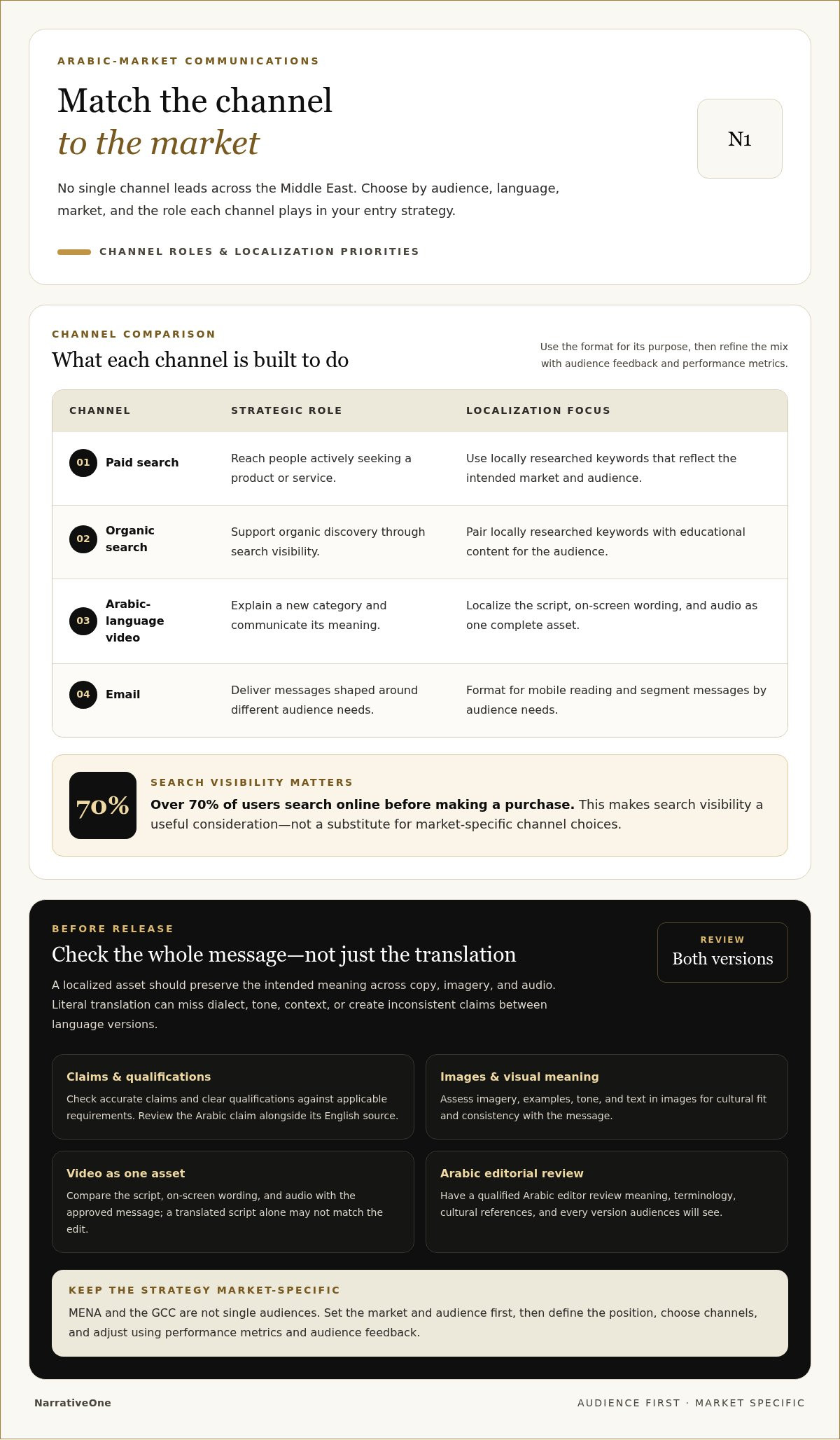
No single channel leads across the Middle East. Choose channels based on the audience, language, market, and role each plays in your entry strategy.
For example, search can capture active demand, while Arabic-language video can explain a new category. Match each format to its audience and purpose.
Cultural Localization and Brand Positioning
Cultural localisation shapes what a brand means, not just how its words read. Advertising that works in the United States or United Kingdom may not transfer directly to the region. Misalignment can undermine trust, so assess the message, imagery, examples, and tone before adapting each asset.
Start with the market and audience, then define the position you want to establish. A financial company entering the Gulf, for example, may need different proof points for institutional investors than for founders. An Arabic market communications agency should show how it connects audience insight to positioning and usable content, rather than treating translation as the whole assignment.
Compare agencies by reviewing relevant Arabic work, identifying who makes language decisions, and assessing how they maintain consistency between English and Arabic. In the United States, Arabic-language communications services are offered by bilingual communications consultancies, localisation specialists, and agencies serving international audiences. Look for demonstrated Arabic editorial capability and experience relevant to your communications needs.
Build a channel mix around the job each asset needs to do:
Use paid search to reach people actively seeking a product or service.
Use locally researched keywords and educational content to support organic discovery.
Make Arabic text in images and Arabic audio in videos, not English-only creative.
Format email for mobile reading and segment messages by audience needs.
Over 70% of users search online before making a purchase. That makes search visibility a useful consideration, but audience feedback and performance metrics should guide channel adjustments across markets.
Advertising Regulations and Translation Risks
U.S. advertising rules still apply when an advertisement is written in Arabic. Accurate claims, clear qualifications, and review of the final creative against applicable requirements remain essential. Review an Arabic product claim alongside its English source, including text in images and video narration.
Machine translation can miss dialect, tone, context, or the intended meaning of a phrase. Literal translation can also create inconsistent claims between Arabic and English versions. Have a qualified Arabic editor review meaning, terminology, cultural references, and every version audiences will see.
For video, review the script, on-screen wording, and audio as one communication asset. A translated script can still conflict with an image or spoken claim. Ask Arabic-language specialists to compare the complete edit with the approved message before release.
Qualifications should match the work: Arabic writing and editing, market-specific cultural judgment, and relevant communications or marketing experience. Ask the team to adapt a sample headline, image caption, and video line. Comparing the results reveals whether it can maintain the brand’s position across formats.
Public relations and marketing consultancy
Consultancy should connect market decisions to a communications plan. In the Middle East, public relations and reputation management are forecast to grow at a 5.93% CAGR through 2031.
As a specialized Arabic market communications agency, NarrativeOne can support technology companies, investment firms, startups, and businesses entering regional markets. Food exporters also need market-specific messaging when introducing products to buyers in MENA countries.
Core services should align audience, positioning, Arabic and English messaging, media relations, and channel priorities. For an investor announcement, that means defining the narrative, preparing executive messaging, and coordinating relevant press outreach.
A digital marketing consultation is most useful when the business brings a clear objective, target audience, and information about existing channels. Prepare the product description, priority countries, current messaging, and questions about Google search, social platforms, or email. This helps identify which strategies merit attention and what evidence could show progress.
For food export strategy, begin with the intended buyer and market. A producer entering a Gulf market, for example, should distinguish trade-facing communication from consumer-facing content. A consultation should clarify the product story, buyer information needs, language requirements, and materials needed to introduce the product. Communications planning is distinct from export logistics and product compliance.
A MENA market-entry consultation should turn a broad regional ambition into specific decisions. Identify the priority country, audience, business objective, and local narrative before selecting platforms. Saudi Arabia and the United Arab Emirates may require different positioning and media priorities. A regional label alone does not define the buyer or the story.
To assess the value of a consultancy conversation, use a short sequence:
State the business objective and the audience it depends on.
Identify the priority country and the decision-makers who matter.
Review existing English and Arabic messages for gaps or inconsistencies.
Agree which communications activity supports the objective and how progress will be evaluated.
The same framework applies to a free digital marketing consultation. "Free" describes the meeting, not its strategic value. A useful session should leave the business with clear decisions, not a generic list of channels.
Ask how the consultancy connects public relations with digital marketing, editorial messaging, and media priorities. Google can capture active search demand, while PR builds credibility through relevant narratives and coverage. The right mix depends on the objective, audience, and country, not a standard package.
An effective strategy rates channel choices with measurable outcomes. Public and institutional clients in the Middle East marketing and advertising agency market are forecast to grow at a 5.92% CAGR through 2031.
Audience analysis and digital channel selection
Arabic-speaking audiences span more than language alone. More than 450 million Arabic speakers live across 20 Arab countries, so market selection must precede channel selection.
Start by defining the decision-maker, business objective, and priority market. A campaign aimed at Gulf institutional investors needs different evidence and channels from one aimed at consumers in North Africa. The audience’s role, location, and information needs determine which messages can prompt a useful response.
Arabic-language work should account for variation in language. Modern Standard Arabic can support communication across borders, while colloquial forms may suit particular local audiences and contexts. No single dialect works for every campaign. Specify the intended country and audience, then align vocabulary, tone, and examples accordingly.
Which dialects and regional markets do Arabic communications agencies cover? Coverage varies by agency and assignment, but relevant markets include the Gulf and the wider Middle East and North Africa. Define the target country and audience first, then choose the Arabic register that fits them.
Market-specific analysis turns broad plans into decisions. Compare audience feedback and performance by country, platform, and campaign objective. If an educational post attracts engagement but few qualified enquiries, revise its next step or audience targeting. If a market responds to executive commentary, use that signal to shape future content.
Separate the Gulf from the wider Middle East in your reporting. Saudi Arabia accounted for 36.63% of Middle East marketing and advertising agency market revenue in 2025, while Qatar’s market is forecast to grow at a 5.83% CAGR through 2031. These figures describe agency-market activity, not campaign results. They help frame market context, but audience evidence should drive channel choices.
Use a simple analysis sequence before allocating effort:
Define the country, audience role, and intended action.
Review existing digital and social activity by market.
Compare engagement, enquiries, and audience feedback against the campaign objective.
Adjust the channel mix and Arabic content to observed trends.
Google is dominant in Middle Eastern search, and paid search can reach target audiences. Treat it as one channel in a country-specific plan, not a regional default. An Arabic market communications agency can support coordinated English and Arabic market-entry messaging when audience analysis shows the narrative needs adaptation.
continues beyond language and treats each market as a distinct audience. IMPRESS identifies the Arab market as comprising more than one audience. Among Arab countries, 5 are classified as high-income wealthy countries. Marketing channels can perform differently across Middle Eastern markets, so adapt strategies using performance metrics and audience feedback. Compare signals within each target market, then refine channel choices and messaging for the audiences most relevant to the campaign.
Native Arabic expertise and cultural factors
Arabic communication requires judgment beyond vocabulary. Cultural context can influence how advertising, visuals, and business messages are received.
Native Arabic Expertise
Native Arabic specialists assess meaning, tone, and audience fit across written and spoken content. Their review should cover headlines, product descriptions, executive statements, and video scripts. Ask who edits the work and how they assess regional language choices. A phrase suited to one audience may sound formal, unfamiliar, or unclear to another.
Cultural Research and Adaptation
Research should connect the target country, audience, and campaign purpose before copy is finalised. For a consumer campaign in the Gulf, assess whether its examples, imagery, and timing fit the intended audience. Cultural holidays can affect relevance, while audience feedback can reveal when a message misses its mark. Adapt the content based on those findings.
Arabic-speaking markets span 20 Arab countries, including markets across the Middle East and Africa. That range makes “Arabic audience” too broad to guide execution. Define the country, audience, and communication objective first. Then give language specialists a clear brief on dialect, tone, terminology, and the action each asset should support.
Visual review matters as much as copy review. Check people, settings, gestures, clothing, colours, and symbols in every advertisement. An image chosen for a United States campaign may carry different associations in a Gulf context. Review the complete creative, not just the Arabic caption, so the image and message communicate the same intent.
Emojis need the same scrutiny. Interpretations can vary across cultures, so assess whether an emoji supports the intended meaning in the relevant market. A celebratory symbol in a social post, for example, should reinforce the message rather than create ambiguity. Treat emojis as part of the copy, not as decoration added after approval.
Business culture guidance should prepare executives for the specific communication setting. Before a Gulf media interview, align the spokesperson on Arabic terminology, the order of key points, and how to explain the company’s role. For investor communications, establish consistent language for the organisation, its leadership, and its market position across English and Arabic materials.
Use a practical review sequence for every asset:
Set the target country, audience, and intended response.
Have an Arabic specialist review wording and cultural context.
Check visuals, audio, and text together across each channel.
Use audience feedback to refine future campaigns.
This process makes cultural awareness a repeatable control. It helps brands maintain consistent meaning across markets without assuming one Arabic version will suit every audience.
Arabic-market entry strategy for MENA and GCC
Regional entry needs a sequence, not a regional slogan. Treat each target country as a distinct operating decision, then connect its audience, message, and channels to a clear commercial objective.
Start by choosing a market where the company has a clear audience and a credible reason to enter. Saudi Arabia, for example, may be a priority for a technology firm seeking institutional relationships, while another business may need to begin in a different GCC market. Define the buyer, decision-makers, and desired engagement before planning campaigns. This keeps regional reach from becoming a substitute for market focus.
Next, build a country-specific narrative. Identify the problem the business solves, why its approach matters locally, and what evidence supports that position. A technology company should explain its relevance to local customers, partners, or investors rather than rely on a global description. Align English and Arabic materials so executives, media, and prospective partners encounter a consistent account.
Then connect communications to the route to market. Souq, now part of Amazon, and noon.com are eCommerce marketplaces identified for boosting online sales in the Middle East. Their relevance depends on the company’s sales model. A business seeking institutional relationships needs a different communications approach from a consumer brand selling through marketplaces.
Map the entry plan across the following decisions:
Set the target country, audience, and business objective.
Define the core narrative and evidence for that audience.
Select channels that support discovery, credibility, or direct engagement.
Review market insights and audience response before expanding activity.
Channel decisions should reflect the objective. Search can capture existing intent, media relations can establish credibility, and executive communications can explain complex offerings. A paid advertising agency may support advertising execution, but advertising alone cannot resolve unclear positioning or weak market relevance. Keep communications roles distinct and link each channel to a measurable business purpose.
For a GCC launch, prepare market-specific materials before outreach begins. These may include an Arabic company description, executive talking points, a concise product explanation, and consistent language for investors or partners. A single translated deck rarely answers every audience’s questions. Adapt proof points and detail to the people making each decision.
Let evidence guide expansion. Compare audience engagement, media response, qualified enquiries, and partner interest against the original objective. If Saudi Arabia generates relevant stakeholder conversations while another market produces broad but unqualified attention, refine priorities accordingly. Treat feedback as a planning input, not a decorative report.
For an entry plan built around coordinated English and Arabic messaging, develop your market-entry communications strategy.
NarrativeOne: Fund Positioning
NarrativeOne helps investment firms structure communications around a clear fund narrative and market position. Turn to this work when entering a market, preparing a fundraise, or aligning stakeholders around the firm’s investment thesis.
Fund Positioning establishes the core story, while LP Communications supports consistent updates to limited partners. Portfolio Announcements frame relevant company milestones, and Partner Thought Leadership gives investment leaders a platform to share sector perspectives. Each activity should reinforce the same institutional narrative while addressing distinct audiences.
For firms preparing English and Arabic market messaging, the strategic task is coherence: preserve the fund’s positioning while adapting language and context for the intended audience. Visit n1comms.com to discuss communications needs with NarrativeOne.
Build the Narrative Before the Next Market Move
Market entry requires leadership attention, capital, and reputation. Before expanding activity, decide what the organisation needs to be understood for, which stakeholders need that understanding, and how communications will reinforce the position over time. These decisions provide the operating logic for each announcement, investor update, and executive contribution.
An Arabic market communications agency can structure a narrative for a defined audience and strategic objective. For investment firms, NarrativeOne’s Fund Positioning, Portfolio Announcements, and LP Communications support distinct parts of that system. The work is most useful when stakeholders need a consistent account of the fund’s position and progress, rather than disconnected messages.
Set strategic priorities first. Then align the narrative, spokespeople, and communications activity with those priorities. This gives leadership a clearer basis for deciding what to say, when to say it, and which audiences matter most.
Contact NarrativeOne about Arabic markets to discuss the communications priorities behind your next move. A well-built narrative gives the strategy a stronger foundation.
Frequently Asked Questions
How should content be localised for Arabic-speaking markets?
Localise terminology, structure, and calls to action for the intended audience. Create an approved glossary for product names, investment terms, and executive titles, then apply it consistently across announcements, presentations, and web copy. For example, describe a fund’s investment thesis consistently in its press statement and investor presentation. Track versions and approvals so later edits do not introduce conflicting claims across English and Arabic materials.
What is an Arabic market communications agency?
An Arabic market communications agency helps organisations shape and deliver communications for Arabic-speaking audiences. Its work can include audience-specific messaging, media relations, executive communications, and bilingual materials. For an investment firm, the practical value is coordination: aligning the fund’s position, leadership voice, and announcements with defined stakeholder objectives. The agency’s remit should match the required communications work, rather than be assumed to cover every marketing function.
Which U.S. Arabic communications agencies specialize in media relations, public relations, and advertising?
NarrativeOne provides communications strategy and media relations for investment firms and technology founders, including targeted outreach to MENA and international business press. Its communications work is distinct from advertising placement. For a U.S.-based organisation seeking Arabic communications, define whether the mandate is earned media, public relations, or paid advertising before comparing options. That distinction clarifies the required expertise, deliverables, and measures of success without conflating separate disciplines.
How can a business measure the results of an Arabic-language communications campaign?
Set measures against the campaign objective before launch. For a media announcement, track relevant coverage, message accuracy, and engagement from priority stakeholders. For investor communications, monitor qualified follow-up conversations and consistency in limited partners’ questions. Use tagged campaign links and a consistent enquiry-source field to connect digital responses with communications activity. Review results by market and audience, then adjust the next cycle based on what advanced the objective.