Silence between quarterly reports is not neutral. When a material portfolio, performance, or firm development surfaces, LPs need context before the next scheduled report, not a stream of unfiltered updates. Effective between-quarter LP communication is timely when it matters, restrained when it doesn’t, and controlled before it reaches investors.
Formal reports remain essential, but they can’t address every development as it unfolds. The operational risk is that investment, finance, and relationship teams hold different pieces of the story, while unclear review and disclosure controls delay an update or undermine its accuracy. More communication isn’t the answer. Better judgment, clear ownership, and a reliable review process are.
This practical checklist shows how to distinguish material interim updates from routine reporting, define communication triggers, assign owners, and build review and follow-up into the process. The result is a disciplined approach that gives LPs useful context without adding noise or weakening trust.
Key Takeaways
Use materiality, investor relevance, timing, and communication obligations to decide whether a development warrants an interim update.
Structure each message around what happened, why it matters to the fund, verified facts, and the next step. Leave out unsupported interpretation and unnecessary detail.
Make between-quarter LP communication a controlled workflow: identify the trigger, assign one relationship owner, gather inputs, review, send, and document follow-up.
Coordinate scheduled reports with interim-event planning in an annual communications framework so investors receive a coherent account, not disconnected updates.
A 12-month narrative plan, executed weekly and reported monthly, can help investment firms keep communication disciplined between formal reporting cycles.
Table of Contents
Why Between-Quarter LP Communication Matters Beyond the Quarterly Report
What Should an Interim LP Update Say, and What Should It Leave Out?
The Between-Quarter LP Communication Checklist: Prepare, Review, Send, Follow Up
Make Between-Quarter LP Communication a Repeatable Fund Discipline
Why Between-Quarter LP Communication Matters Beyond the Quarterly Report
Quarterly reporting records performance and portfolio activity on a scheduled cycle, but material developments do not wait for that cycle. Between-quarter LP communication is contact outside formal reporting, used when an event changes the context investors need to understand the fund, its operations, or a decision before them. Its purpose is not to keep inboxes active. It is to close an information gap with disciplined, decision-useful context.
Interim updates have a distinct role. A quarterly report provides a structured account of a reporting period. A notice communicates a specific event or action, such as a capital call or distribution. An annual investor meeting creates a forum for broader discussion. An interim update addresses a development that matters now, without replacing those channels or repeating their content. Clear roles and responsibilities underpin the GP-LP relationship; Understanding Limited Partnerships provides a concise foundation for that structure.
A useful interim update is timely, factual, and relevant to an LP decision. Timely does not mean instant. It means sharing information when it is sufficiently verified and useful, rather than waiting for the next scheduled report by default.
What belongs between formal LP reports?
An interim message should add context, not repeat information already delivered. Consider a portfolio company development: explain what changed, why it matters to the fund, and whether LPs need to take or anticipate an action. Routine progress that does not change an investor’s understanding can remain in the normal reporting cycle.
Keep evidence separate from judgment. State verified facts as facts; label estimates and interpretation clearly, and identify open questions rather than filling gaps with assumptions. Before drafting, ask what the LP needs to know, what fund development makes it relevant, and what follow-up the manager is prepared to provide.
How interim communication supports investor confidence
Silence can leave LPs to interpret a meaningful development without the fund’s context. That uncertainty may create avoidable concern, especially when investors hear fragments elsewhere or see events that appear inconsistent with the fund’s stated strategy. A concise, factual update clarifies what the manager knows, what remains unresolved, and when further information will follow. It does not promise a result.
Predictable contact also demonstrates continuity. Connecting a development to the fund’s mandate and the investor relationship gives LPs a clearer basis for understanding its significance. That discipline belongs within the wider LP communications strategy, where interim messages and scheduled reporting reinforce one another rather than compete for attention. Trust is supported by consistency, accuracy, and follow-through.
Which Fund Developments Merit an Interim LP Update?
Not every internal change belongs in an investor’s inbox. The decision turns on whether a development changes an LP’s understanding of the fund, affects an investor action, or creates a communication obligation. Apply the same screen across portfolio companies, fund operations, leadership, strategy, and investor matters. Consistent triage helps avoid both silence on material events and noise around routine activity.
An event merits an update when it materially changes an LP’s understanding or next action. Keep the decision tied to investor relevance, not internal urgency or a desire to appear active. A portfolio company milestone may warrant context if it affects the fund’s outlook or the manager’s stated strategy. A routine internal meeting usually does not, unless it leads to a consequential decision or commitment.
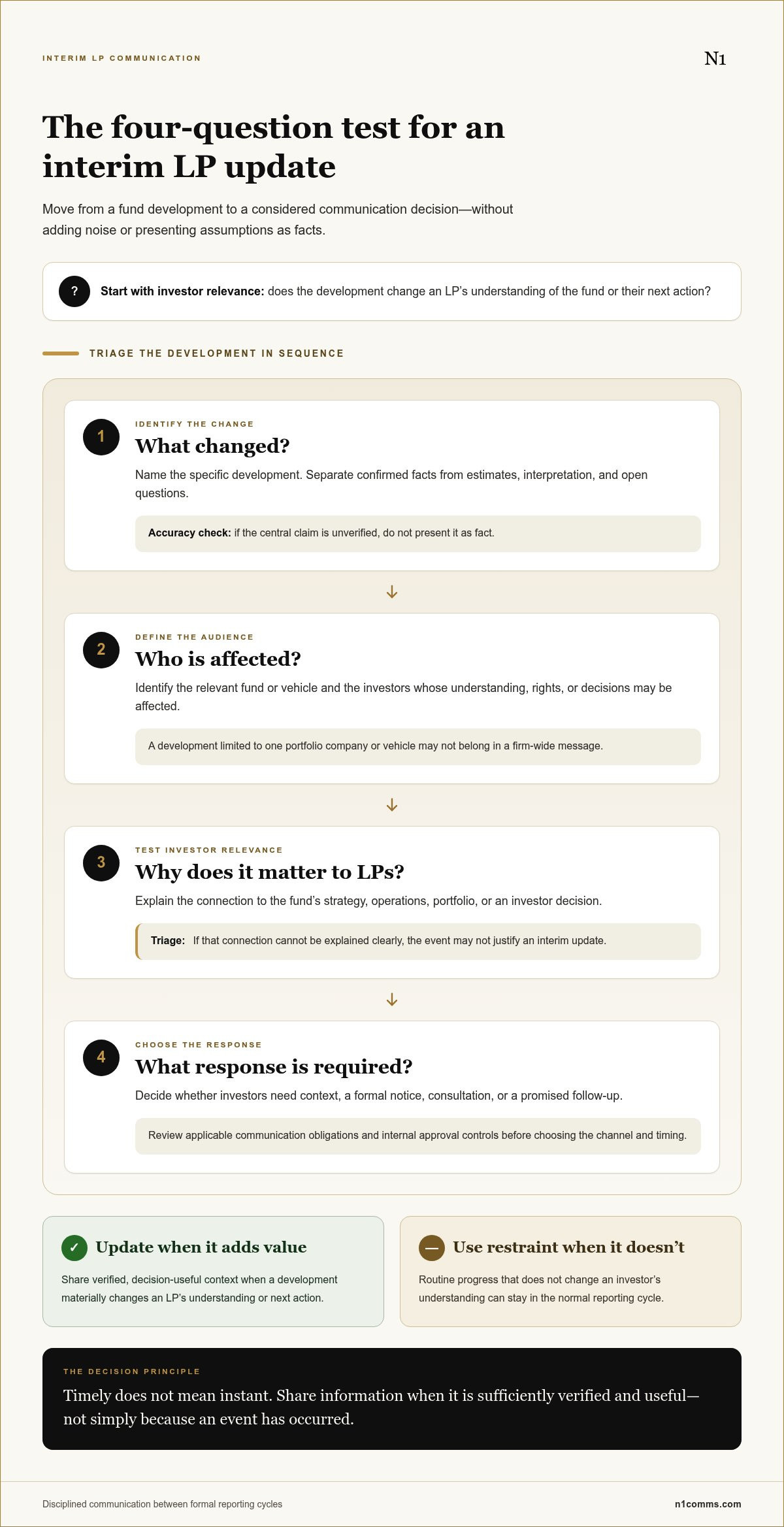
A four-question test for interim updates
Before drafting, answer these four questions in sequence. They establish whether there is a genuine trigger, who it affects, and what communication is appropriate.
What changed? Identify the specific development, then separate confirmed facts from estimates, interpretation, and open questions. If the central claim is unverified, do not present it as fact.
Who is affected? Identify the relevant fund or vehicle and the investors whose understanding, rights, or decisions may be affected. A development confined to one portfolio company or vehicle may not belong in a firm-wide message.
Why does it matter to LPs? State the connection to the fund’s strategy, operations, portfolio, or an investor decision. If that connection cannot be explained clearly, the event may not justify an interim update.
What response is required? Decide whether investors need context, a formal notice, consultation, or a promised follow-up. Review applicable communication obligations and internal approval controls before selecting the channel and timing.
This screen applies to more than portfolio news. Changes in fund operations, leadership, or strategy can affect investor expectations, while an upcoming investor action may require direct communication rather than a general update. The trigger is the consequence for the LP, not the category of event alone.
When restraint is the right communication decision
Restraint is not silence by default. It is the decision not to send a message that adds no verified context or investor value. Frequent notes about routine internal activity can obscure material developments and weaken the signal investors need. Don’t manufacture updates to fill the space between scheduled reports.
If facts remain under review, hold unresolved claims. Confirm what can be stated, complete the appropriate review, and avoid presenting a working assumption as a conclusion. When an issue matters but cannot yet be fully explained, communicate only what is verified and relevant, subject to the applicable controls. Set a clear next-update point, even if the update will confirm that review is ongoing.
A documented trigger test makes between-quarter LP communication more consistent across teams and vehicles. Firms building this discipline can align their process with LP communications support.
What Should an Interim LP Update Say, and What Should It Leave Out?
An interim update should reduce uncertainty, not transfer the manager’s working notes to investors. Build the message around four elements: the development, its relevance to the fund, the facts that support the account, and what happens next. Keep the message proportionate to the event. A routine milestone does not become exceptional because it arrives between reports.
Connect the development to the fund’s established thesis only where that helps LPs interpret the event. A brief explanation of relevance is enough; the update does not need to restate the fund’s wider narrative. In disciplined between-quarter LP communication, the message earns its place through precision, not length.
A concise structure for an interim LP message
Lead with what happened and why LPs are receiving the update now. Then distinguish confirmed information from its implications and anything still unresolved. Close with any action required, the accountable owner for follow-up, and the next communication point if appropriate. This structure helps investors distinguish the event itself from the manager’s assessment of it.
For example, if a portfolio company changes a planned launch date, state the confirmed change first. Explain the fund relevance only to the extent it is known, and identify any effects still being assessed. Don’t imply a financial or strategic consequence before the underlying facts support it.
Decision-useful contextLeave outThe specific development and when it occurred, if relevantBackground already provided in a recent reportIts clear connection to the fund, vehicle, or investor actionRoutine detail that does not change LP understandingVerified facts, with estimates clearly identified as estimatesUnsupported predictions or interpretations presented as factWhat the manager is doing next and when LPs will hear more, if knownReassurance that promises an outcome the manager cannot control
Use a practical test: can an LP identify what changed, why it matters, and what to expect next? If not, tighten the message or resolve the information gap before sending.
How to handle incomplete or sensitive information
Incomplete information requires clear boundaries, not confident speculation. Label estimates and open questions; don’t present them as established facts just to make the update sound complete. Explain what is known, what remains under review, and when further information is expected if a follow-up point can be set responsibly.
Before distribution, consider confidentiality, investor-specific rights, and the firm’s applicable review requirements. Share only information appropriate for the intended recipients, and keep the message within the approved disclosure scope. Compliance rules should be embedded before the compliance director reviews drafts. A controlled update supports accuracy and consistency without obscuring material context.
The Between-Quarter LP Communication Checklist: Prepare, Review, Send, Follow Up
A reliable process prevents an interim update from becoming a last-minute drafting exercise. Give one relationship owner accountability for the message, while finance, investment, legal, and compliance teams supply and review information within their remit. The owner coordinates the work; that does not mean one person must verify every underlying fact.
The workflow is trigger, verify, approve, deliver, and close the loop. Apply the sequence consistently, then adapt the message to the event and the fund’s procedures.
Identify the trigger. Record what happened, when it happened, and why it may matter to investors. Confirm that the event warrants an update rather than routine reporting. Assign one relationship owner to coordinate the process and maintain a clear record of decisions.
Verify the inputs. Gather relevant information from the teams that own it. Confirm the affected fund or vehicle, distinguish established facts from estimates, and resolve conflicting inputs before drafting. Mark unresolved items clearly; don’t let polished wording disguise gaps in the evidence.
Define the audience and purpose. Identify the intended recipients and what the update needs to do: provide context, support an investor action, deliver a notice, or establish follow-up. Check that the content and distribution align with the fund’s governing documents and applicable communication obligations.
Review and approve. Route the draft for factual, confidentiality, and compliance review under the fund’s process. Compliance rules are embedded before the compliance director reviews drafts. Confirm that the final version reflects approved information and has been cleared by the right internal decision-makers.
Deliver and close the loop. Send through the appropriate channel, then track delivery, investor questions, commitments, and any issue needing a further response. Assign each inquiry an accountable owner, coordinate an accurate answer, and retain the approved message and follow-up record under firm procedures.
Before sending: verify inputs, audience, and approvals
Use a final control check before distribution: does the message identify the correct development, vehicle, recipients, and purpose? Have the relevant inputs been verified? Have governing documents and applicable review requirements been considered? Record the owner and required approvals. If the recipient list or approval status is unclear, pause distribution until it is resolved.
After sending: manage questions and close the loop
Delivery is not completion. Log investor questions and any commitment made in the message, then route each item to an owner who can provide a verified response. If the answer depends on further review, say so clearly and set a responsible follow-up point. Preserve the approved version and related records according to firm procedures.
For investment firms formalising this operating discipline, strengthen your LP communications workflow with a clear ownership and review structure.
Make Between-Quarter LP Communication a Repeatable Fund Discipline
Interim updates work best as part of a communications system, not as isolated responses to events. Build an annual framework that places scheduled reporting alongside likely investor touchpoints and defines how material developments enter the review process. Clarify ownership, approval routes, audience considerations, and how follow-up is tracked. This creates operating discipline without turning every calendar entry into a reason to send a message.
A practical framework can map:
Scheduled reporting and investor meetings, with their established owners and review steps.
Potential interim triggers across portfolio companies, fund operations, leadership, strategy, and investor actions.
The responsible relationship owner and relevant information owners for each communication type.
Review gates, approved distribution channels, and follow-up records under firm procedures.
NarrativeOne develops a 12-month narrative plan, executed weekly and reported monthly. This cadence connects long-range positioning to active communications work, while leaving room to assess material events on their own merits. The plan provides a framework for consistency, not a reason to issue routine updates that do not add investor value.
Build continuity across the fund and portfolio
Interim messages should remain consistent with the fund’s established investment narrative, but each update must stay specific to its subject. A portfolio company development is not the same as fund-level performance or an investor matter. Keep those contexts distinct so an LP can see which entity or vehicle is involved, why the information matters, and what it does not imply. A consistent relationship owner and review workflow help maintain that separation.
NarrativeOne’s investment-firm model brings one senior strategist, one journalist network, and one compliance workflow together across the firm and portfolio companies. Shared infrastructure supports coordination; it does not erase the different facts, audiences, or disclosure considerations attached to each update.
Use bilingual, compliance-aware communications infrastructure
For investment firms communicating in English and Arabic, language discipline is part of message control. NarrativeOne’s Bilingual content is natively drafted in both languages to senior financial-journalist standards, rather than drafted in one language and translated after the fact. This supports consistent meaning across versions while respecting each audience.
Compliance rules are embedded before the compliance director reviews drafts. The sequence matters: build review into the workflow, then route the message through the firm’s approval process. NarrativeOne brings 17 years of operating experience inside MENA’s most recognised investment institutions. That context informs its approach, not a promise of a particular investor response or outcome.
Review the fund’s reporting calendar and interim-update process together. If ownership, review, or follow-up has no clear place in that system, make that gap the next operating priority. Repeatable between-quarter LP communication depends on infrastructure that holds through routine updates and material events alike.
Turn the Communication Framework Into Operating Practice
Test the framework against how your firm actually works. Map the investor calendar, identify who owns material updates, and confirm how information moves from investment and finance teams through review and follow-up. Gaps are easier to address before an event puts the process under pressure.
Strong between-quarter LP communication comes from consistent execution, not a single well-written update. NarrativeOne brings 17 years of operating experience inside MENA’s most recognised investment institutions, with one senior strategist, one journalist network, and one compliance workflow shared across the firm and portfolio companies. That structure supports coordination while keeping the fund’s judgment and approvals central.
Strengthen your fund’s LP communications with NarrativeOne’s communications approach. Put a clear operating discipline in place, and give every material update the governance it deserves.
Frequently Asked Questions
How often should a fund communicate with LPs between quarterly reports?
There’s no useful fixed quota for interim messages. In between-quarter LP communication, frequency should follow material developments and investor needs, not a target number of emails. If no event changes an LP’s understanding or requires action, keep the next contact on the established reporting calendar. If a material event arises, assess it promptly and communicate when verified information can be shared under the fund’s process.
Should a fund send an LP update when nothing material has changed?
Usually, no. An ad hoc “no news” message can add inbox volume without improving an investor’s understanding. Keep routine relationship contact on its planned schedule, where it has a clear purpose, and use interim messages for developments that change context or require attention. If investors are waiting on a specific answer, a brief status note may still be useful even when the underlying position has not changed.
What should an LP update say when information is still being verified?
Say only what can be established, and identify the point still under review. For example: “We’re confirming the effect of this operational change and will provide an update when that review is complete.” Don’t include an unverified estimate simply to make the message feel complete. If timing is known and appropriate to share, give a clear next communication point; otherwise, avoid promising a deadline the fund can’t support.
Do between-quarter LP updates replace quarterly reports or formal notices?
No. Interim updates supplement scheduled reporting; they don’t replace it. Quarterly reports provide the fund’s formal periodic account, while notices communicate specific matters through the channels and processes applicable to them. A short explanatory update should not be treated as a substitute for either. Keep the established reporting calendar intact, and assess separately whether a development requires a formal notice or another communication under the fund’s governing documents and procedures.
Can one interim update cover multiple funds, vehicles, or co-investments?
It can if the development is relevant to each audience and the message preserves distinctions between investments. Identify which fund, vehicle, or co-investment each fact concerns, and avoid presenting one vehicle’s position as another’s. Consider whether all intended recipients should receive the same information. If relevance, confidentiality, or investor-specific rights differ, prepare separate versions or distribute information to the appropriate recipient groups.
Who should own communication with LPs between quarterly reports?
Assign one relationship owner to coordinate the update from trigger through follow-up. That person maintains investor context, confirms the intended audience, gathers inputs, and tracks questions or commitments. They don’t need to generate or approve every fact alone. Investment, finance, and other relevant teams should validate information they own, while designated reviewers follow the firm’s approval process. Clear accountability prevents conflicting drafts and unanswered investor inquiries.
How should a fund communicate a sensitive development to LPs?
Use a controlled process and a message matched to the affected investors. Confirm the facts, determine what can appropriately be disclosed, and complete the relevant internal review before distribution. State known information plainly, avoid speculation, and explain what action the fund is taking or when it expects to provide further context, if that can be stated responsibly. Limit circulation to the intended audience and coordinate responses so investors receive consistent, accurate information.
Frequently Asked Questions
What belongs between formal LP reports?
An interim message should add context, not repeat information already delivered. Consider a portfolio company development: explain what changed, why it matters to the fund, and whether LPs need to take or anticipate an action. Routine progress that does not change an investor’s understanding can remain in the normal reporting cycle. Keep evidence separate from judgment. State verified facts as facts; label estimates and interpretation clearly, and identify open questions rather than filling gaps with assumptions. Before drafting, ask what the LP needs to know, what fund development makes it relevant, and what follow-up the manager is prepared to provide.
How often should a fund communicate with LPs between quarterly reports?
There’s no useful fixed quota for interim messages. In between-quarter LP communication, frequency should follow material developments and investor needs, not a target number of emails. If no event changes an LP’s understanding or requires action, keep the next contact on the established reporting calendar. If a material event arises, assess it promptly and communicate when verified information can be shared under the fund’s process.
Should a fund send an LP update when nothing material has changed?
Usually, no. An ad hoc “no news” message can add inbox volume without improving an investor’s understanding. Keep routine relationship contact on its planned schedule, where it has a clear purpose, and use interim messages for developments that change context or require attention. If investors are waiting on a specific answer, a brief status note may still be useful even when the underlying position has not changed.
What should an LP update say when information is still being verified?
Say only what can be established, and identify the point still under review. For example: “We’re confirming the effect of this operational change and will provide an update when that review is complete.” Don’t include an unverified estimate simply to make the message feel complete. If timing is known and appropriate to share, give a clear next communication point; otherwise, avoid promising a deadline the fund can’t support.
Do between-quarter LP updates replace quarterly reports or formal notices?
No. Interim updates supplement scheduled reporting; they don’t replace it. Quarterly reports provide the fund’s formal periodic account, while notices communicate specific matters through the channels and processes applicable to them. A short explanatory update should not be treated as a substitute for either. Keep the established reporting calendar intact, and assess separately whether a development requires a formal notice or another communication under the fund’s governing documents and procedures.
Can one interim update cover multiple funds, vehicles, or co-investments?
It can if the development is relevant to each audience and the message preserves distinctions between investments. Identify which fund, vehicle, or co-investment each fact concerns, and avoid presenting one vehicle’s position as another’s. Consider whether all intended recipients should receive the same information. If relevance, confidentiality, or investor-specific rights differ, prepare separate versions or distribute information to the appropriate recipient groups.
Who should own communication with LPs between quarterly reports?
Assign one relationship owner to coordinate the update from trigger through follow-up. That person maintains investor context, confirms the intended audience, gathers inputs, and tracks questions or commitments. They don’t need to generate or approve every fact alone. Investment, finance, and other relevant teams should validate information they own, while designated reviewers follow the firm’s approval process. Clear accountability prevents conflicting drafts and unanswered investor inquiries.
How should a fund communicate a sensitive development to LPs?
Use a controlled process and a message matched to the affected investors. Confirm the facts, determine what can appropriately be disclosed, and complete the relevant internal review before distribution. State known information plainly, avoid speculation, and explain what action the fund is taking or when it expects to provide further context, if that can be stated responsibly. Limit circulation to the intended audience and coordinate responses so investors receive consistent, accurate information.