
A deal announcement can earn attention, but it cannot establish authority on its own. Building market authority as a VC depends on what the market sees between transactions: a clear investment thesis, partners who explain it with substance, and communications that reinforce the same point of view over time.
Visibility often spikes around a fundraise or portfolio announcement, then recedes. Partner insight can remain episodic, while a firm’s thesis blurs into familiar market language. The problem is not necessarily a shortage of expertise. It is the absence of a disciplined system for turning expertise into a recognizable signal.
How can a VC firm build authority that lasts beyond a fundraise or deal announcement? This guide sets out a practical approach: sharpen the investment thesis, make partner expertise visible, and establish a communications rhythm that builds credibility across market touchpoints. It covers how to align firm messaging with portfolio announcements and create a consistent system that supports partners and portfolio companies. Authority is not a moment of visibility. It is the cumulative effect of a point of view, demonstrated consistently.
Key Takeaways
Distinguish earned authority from visibility, reputation, and short-lived attention by defining the market recognition your firm wants to build.
Make your thesis defensible by connecting investment evidence to clear sectors, stages, decision principles, and observed market change.
Building market authority as a VC requires more than press mentions. Assess whether your messages, evidence, audiences, and communications cadence reinforce one another.
Create a repeatable publishing process with clear themes, owners, review, and learning, while allowing partners to express distinct expertise.
Embed authority-building in firm infrastructure, not a one-off campaign, with sustained ownership, evidence, cadence, and governance.
Table of Contents
Build a VC Authority System Around a Defensible Investment Thesis
Build VC Market Authority as Firm Infrastructure, Not a Campaign
What Building Market Authority as a VC Actually Means
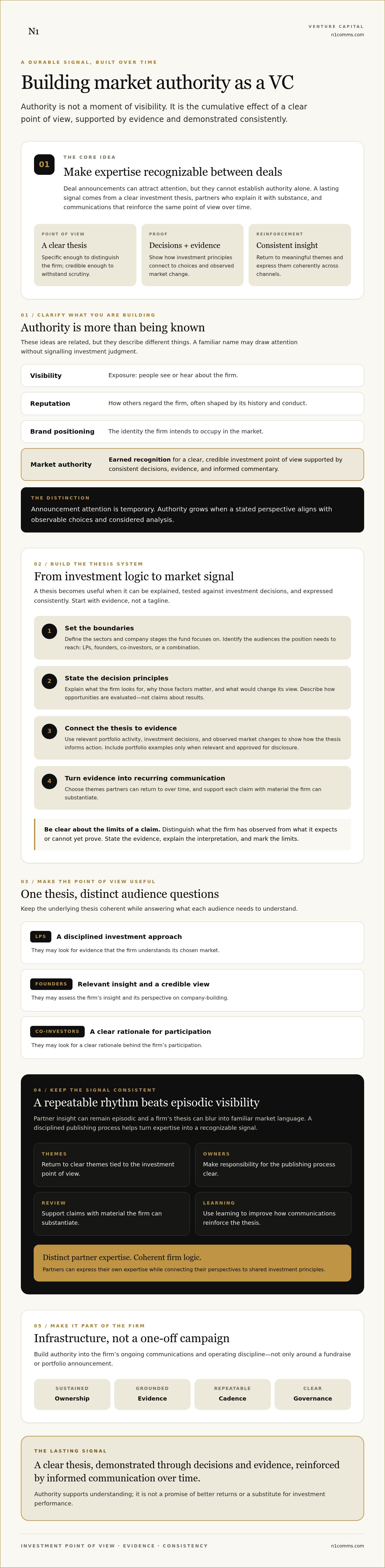
VC market authority is earned recognition that a firm has a clear, credible investment point of view and can support it with consistent decisions, evidence, and informed commentary. It is not simply being known. It is being trusted to explain a particular part of the market with judgment.
Venture capital (VC) involves investing in companies with the potential for growth, often at an early stage. A firm’s authority develops when its public perspective helps people understand its investment choices: why it backs certain companies, what it sees changing in a sector, and which principles guide its decisions. The point of view must be specific enough to distinguish the firm and credible enough to withstand scrutiny.
Related concepts are easy to confuse. Visibility is exposure. Reputation reflects how others regard the firm, often based on its history and conduct. Brand positioning is the identity the firm intends to occupy in the market. Announcement attention is temporary. Authority is earned over time, when a stated perspective aligns with observable choices and considered analysis.
How VC market authority differs from name recognition
A familiar name may attract attention without signalling investment judgment. A firm becomes recognizable for a specific perspective when its fund materials, partner commentary, and public evidence reinforce the same core thesis. Consistency does not require identical wording. It requires coherent logic across channels.
Different audiences test that logic in different ways. LPs may look for a disciplined investment approach and evidence that the firm understands its chosen market. Founders may assess whether the firm has relevant insight and a credible view of company-building. Co-investors may look for a clear rationale behind its participation. The underlying thesis should remain coherent while the communication answers each audience’s distinct questions.
Why authority matters between fundraises and deals
Transaction news shows what happened. A persistent point of view explains why it matters. Between announcements, partner expertise can connect developments in a sector to the firm’s wider investment thesis, giving audiences useful context without turning every observation into a promotion.
This is where building market authority as a VC becomes a long-term discipline. Partners contribute distinct experience, and the firm connects those perspectives to shared investment principles. The result is a clearer signal between deals and fundraises, not a promise of better returns or a substitute for investment performance. Authority supports understanding. Investment results remain the test of the strategy.
Build a VC Authority System Around a Defensible Investment Thesis
A thesis becomes useful to the market when it can be explained, tested against investment decisions, and expressed consistently. Building market authority as a VC starts with evidence, not a tagline. The National Venture Capital Association offers an industry perspective on venture capital. A firm’s task is to make its own investment logic equally clear and specific.
Build the system in sequence:
Set the boundaries. Define the sectors and company stages the fund focuses on, then identify the audiences the position needs to reach: LPs, founders, co-investors, or a combination.
State the decision principles. Explain what the firm looks for, why those factors matter, and what would change its view. Principles should describe how the fund evaluates opportunities, not make claims about results.
Connect the thesis to evidence. Use relevant portfolio activity, investment decisions, and observed market changes to show how the thesis informs action. Include portfolio examples only when they are relevant and approved for disclosure.
Turn evidence into recurring communication. Select themes partners can return to over time, and support each claim with material the firm can substantiate.
Authority depends on repeated, consistent evidence, not a single compelling claim. A defensible view can be bold, but it must distinguish what the firm has observed from what it expects or cannot yet prove. Broad predictions may attract attention, while unsupported certainty can weaken credibility. State the evidence, explain the interpretation, and mark the limits.
Translate the fund thesis into a clear market position
Positioning should answer three questions: who is the fund speaking to, where does it invest, and what does it believe about that market that its decisions can support? For a deeper framework on differentiation, see this guide to fund brand positioning strategy. The aim is not to claim ownership of an entire sector. It is to make the fund’s investment case distinct and credible.
Turn partner expertise into a coherent point of view
Map each partner’s expertise to a distinct part of the shared thesis. One partner may address a sector’s operating dynamics; another may explain how the fund assesses company stage or execution risk. Set recurring themes rather than chasing every news cycle. For the process behind shaping those themes, see how to build a fund narrative.
That sequence can become a working communications framework. Firms developing fund positioning and partner thought leadership can explore NarrativeOne’s investment-firm work as one example.
Why Press Mentions Alone Do Not Create VC Market Authority
A press mention records an event. Authority reflects a pattern. One portfolio announcement may generate a burst of coverage, but it does not establish what a firm believes, how it assesses a market, or whether its perspective is useful beyond that transaction.
Attention can be temporary; authority requires consistent evidence. Building market authority as a VC means connecting each public touchpoint to a defensible thesis, supporting it with relevant evidence, reaching the audiences that matter, and maintaining a deliberate cadence. A high volume of mentions cannot compensate for an unclear message or unsupported claims.
Distinguish a news spike from durable credibility
Compare an isolated announcement with repeated expert contributions that explain the same investment perspective from different angles. The test is not simply how many outlets carried a story. Ask whether the coverage reached relevant LPs, founders, and co-investors, and whether it gave them a clearer understanding of the firm’s judgment.
Evaluate communications across four dimensions:
Message: Does each contribution reinforce a coherent investment perspective?
Evidence: Can the firm substantiate its statements with approved, relevant material?
Audience: Does the communication reach people who need to understand the firm’s thesis?
Cadence: Does the firm show up between deal announcements, not only when news breaks?
Earned media measures can help track exposure, but they need context. Mention counts or estimated media value are indicators of activity, not proof of investment quality, influence, or trust. Interpret them alongside message relevance, audience fit, and the evidence behind the coverage.
Make compliance part of the authority framework
Communications can create reputational and compliance risk when review happens as a last-minute correction. Build review into the workflow instead. Define what can be disclosed, identify claims that need substantiation, and route drafts through the appropriate reviewer before publication. Applicable requirements depend on the firm, the communication, and the rules that apply. Verify them with the appropriate compliance reviewer rather than assuming one process fits every situation.
A disciplined process makes review operational: compliance rules are embedded in drafts before the compliance director reviews them. Partners should use precise, supportable language and distinguish observed facts from interpretation or forecast. A firm can communicate its expertise without implying guaranteed press coverage, investment returns, or fund performance.
The objective is not maximum exposure. It is a reliable signal, repeated with discipline and supported by evidence. Coverage should serve the thesis rather than stand in for it.
Create a Repeatable VC Communications Rhythm That Compounds
A thesis only compounds when the firm returns to it with discipline. That takes an operating rhythm: set the themes, assign owners, produce material, review it, then learn from how it lands. The aim is not to make every partner sound alike. It is to ensure each contribution strengthens a shared firm-level narrative.
Plan authority-building across the year
A 12-month narrative plan, executed weekly and reported monthly, can give a firm continuity while leaving room to respond to meaningful market developments. For early-stage firms building that foundation, see this guide to emerging VC fund communications.
Translate the annual plan into a working schedule. Assign each theme to a partner with relevant expertise, then connect it to a market development, fund milestone, or approved portfolio evidence. A partner focused on a particular sector can develop a recurring view of its changes; another can address the firm’s approach to evaluating companies. Their perspectives should differ in subject and voice while remaining consistent with the fund’s central thesis.
Include portfolio signals selectively. Confirm disclosure permissions before using company details, and frame each announcement so it supports the firm’s wider investment narrative without overstating what one investment demonstrates. For portfolio announcements, use the established sequence: T-14 → T-10 → T-5 → T-2 → Day 0 → +7. These defined points support preparation and follow-through without making every portfolio event carry the same message.
Measure credibility signals without confusing activity for impact
Track a small set of indicators against a clearly stated baseline. Review relevant Tier-1 mentions, consistency of the firm’s core messages, fit with intended audiences, and share of voice over time. Define each measure and retain its original context. A change in one indicator has meaning only when the comparison period and measurement basis are clear.
Relevance: Did coverage reach the LPs, founders, or co-investors the firm intended to inform?
Consistency: Did coverage and partner commentary accurately reflect the fund’s thesis?
Continuity: Did the firm maintain a presence between announcements and fundraise milestones?
These are communications indicators. They do not independently prove fundraising success, investment quality, or returns. Use monthly reporting to identify which themes are clear, which audiences remain unreached, and what the next cycle should address. That is how building market authority as a VC becomes an operating discipline rather than a burst of activity.
For an example of a sustained partner thought leadership rhythm, see NarrativeOne’s Partner Thought Leadership.
Build VC Market Authority as Firm Infrastructure, Not a Campaign
A campaign has an end date. Authority requires continuity. For a venture capital firm, that means clear ownership of its investment narrative, a recurring communications cadence, evidence behind public claims, and governance that holds across partners and portfolio activity. Without those elements, even strong insight can remain episodic.
Building market authority as a VC is an operating discipline, not a layer of promotion. The system should connect the firm’s thesis to partner expertise and relevant market touchpoints, while keeping communications accurate, approved, and consistent. That structure makes the firm’s perspective easier to recognize without requiring every partner to speak in the same voice.
What an embedded communications function should coordinate
The work begins with Strategy & narrative, which sets the firm’s core position and gives communications a shared reference point. Media relations, Bilingual content, and GP thought leadership can carry that position across relevant channels and audiences. Events & speaking and Monitoring & crisis support the system when they align with the firm’s objectives.
NarrativeOne provides an embedded model for investment firms: one senior strategist, one journalist network, and one shared compliance workflow across the firm and its portfolio companies. Compliance rules are embedded in drafts before the compliance director reviews them. This puts review inside the communications process rather than treating it as a final correction after plans are made.
The specific model matters less than the operating principle. Each firm needs a defined route from thesis to draft to review, with clear responsibility for decisions and disclosure. Portfolio communications should respect permissions, and partner commentary should remain grounded in substantiated insight. The framework should protect credibility as well as build visibility.
When to assess your firm’s authority-building system
Review the system when the firm’s investment thesis sounds different across fund materials, partner commentary, and media contributions, or when communications depend on deal announcements to create visibility. Check whether someone owns the narrative, whether execution follows a recurring cadence, and whether reporting helps the firm learn what is working and what needs adjustment.
If ownership is unclear or the rhythm is inconsistent, treat that as an infrastructure gap, not a content problem. A useful next step is to assess how the current process connects strategy, partner expertise, review, and reporting. NarrativeOne’s investment-firm communications offer one model to consider for your firm.
Make Authority Part of the Firm’s Operating System
Market authority is built through a defensible investment thesis, consistent evidence, and communications that continue between transactions. Building market authority as a VC means treating those elements as firm infrastructure, not a burst of attention around a deal or fundraise. Clear ownership and disciplined review keep the firm’s public perspective coherent across partners and audiences.
NarrativeOne brings 17 years of operating experience inside recognized investment institutions to an embedded model: one senior strategist, one journalist network, and one shared compliance workflow. A 12-month narrative plan, executed weekly and reported monthly, is one way to support a consistent point of view over time.
Start by assessing whether your thesis, partner commentary, and public evidence reinforce one another, and whether the process has clear ownership and cadence. To discuss NarrativeOne’s investment-firm communications, contact the team through its website. Durable authority takes discipline, but the system can be built one well-supported signal at a time.
Frequently Asked Questions
What does market authority mean for a VC firm?
Market authority is earned recognition for a clear, credible investment point of view. It means relevant audiences understand what the firm invests in, how it evaluates opportunities, and what evidence informs its perspective. Name recognition alone is not authority, and neither is a burst of coverage. LPs, founders, and co-investors should encounter a consistent thesis across the firm’s materials and commentary. Authority strengthens understanding; it does not replace investment performance.
How can a VC firm build market authority?
A VC firm builds authority by turning its investment thesis into a consistent, evidence-backed signal. Define the sectors, stages, and decision principles the fund can credibly discuss. Connect those principles to approved portfolio evidence and observed market changes. Then assign partners recurring themes that reflect their expertise, and publish on a deliberate cadence. Building market authority as a VC is a sustained operating practice, not a single positioning exercise or announcement.
Can a VC build authority without frequent press coverage?
Yes. Press coverage can extend a firm’s perspective, but it is not the only way to demonstrate expertise. Fund materials, partner commentary, LP communications, events, and approved portfolio announcements can all reinforce a clear thesis. The standard is relevance and consistency, not maximum volume. A considered contribution that helps the intended audience understand the firm’s investment logic can carry more weight than frequent mentions disconnected from its point of view.
How long does it take a VC firm to build market authority?
There is no fixed timeline. Authority develops as audiences encounter a firm’s perspective repeatedly and see it supported by credible evidence. A firm can establish a 12-month narrative plan, execute it weekly, and review progress monthly, but that operating period does not guarantee a particular level of recognition. Use the cycle to test whether the thesis is clear, whether communications reach relevant audiences, and where the next round of evidence is needed.
What should a VC firm measure when building authority?
Measure whether communications reinforce the thesis and reach the intended audience. Useful indicators include message consistency, relevant Tier-1 mentions, audience relevance, and share of voice over time. Set a clear baseline and preserve the measurement context so comparisons are meaningful. Treat these as communications indicators, not proof of fundraising success, investment quality, or returns. Review them together to understand whether the firm’s perspective is becoming more recognizable and relevant.
How can VC communications stay credible and compliant?
Build review into the communications workflow before publication planning is complete. Identify what can be disclosed, check that claims are supportable, and route drafts through the appropriate compliance reviewer. Applicable requirements depend on the firm, the communication, and the rules that apply, so verify them with the appropriate reviewer. Clear distinctions between observed facts, interpretation, and forecasts help partners communicate expertise without implying guaranteed coverage or investment performance.
Should every VC partner publish thought leadership?
No. Every partner does not need to publish, and identical commentary can make a firm’s voice less credible. Map partner expertise to distinct parts of the shared investment thesis, then focus on recurring themes where each partner has relevant insight. The firm should provide coherence across those perspectives, not uniformity. Select contributors based on the value they can add to the intended audience, and keep their claims grounded in evidence.
Frequently Asked Questions
What does market authority mean for a VC firm?
Market authority is earned recognition for a clear, credible investment point of view. It means relevant audiences understand what the firm invests in, how it evaluates opportunities, and what evidence informs its perspective. Name recognition alone is not authority, and neither is a burst of coverage. LPs, founders, and co-investors should encounter a consistent thesis across the firm’s materials and commentary. Authority strengthens understanding; it does not replace investment performance.
How can a VC firm build market authority?
A VC firm builds authority by turning its investment thesis into a consistent, evidence-backed signal. Define the sectors, stages, and decision principles the fund can credibly discuss. Connect those principles to approved portfolio evidence and observed market changes. Then assign partners recurring themes that reflect their expertise, and publish on a deliberate cadence. Building market authority as a VC is a sustained operating practice, not a single positioning exercise or announcement.
Can a VC build authority without frequent press coverage?
Yes. Press coverage can extend a firm’s perspective, but it is not the only way to demonstrate expertise. Fund materials, partner commentary, LP communications, events, and approved portfolio announcements can all reinforce a clear thesis. The standard is relevance and consistency, not maximum volume. A considered contribution that helps the intended audience understand the firm’s investment logic can carry more weight than frequent mentions disconnected from its point of view.
How long does it take a VC firm to build market authority?
There is no fixed timeline. Authority develops as audiences encounter a firm’s perspective repeatedly and see it supported by credible evidence. A firm can establish a 12-month narrative plan, execute it weekly, and review progress monthly, but that operating period does not guarantee a particular level of recognition. Use the cycle to test whether the thesis is clear, whether communications reach relevant audiences, and where the next round of evidence is needed.
What should a VC firm measure when building authority?
Measure whether communications reinforce the thesis and reach the intended audience. Useful indicators include message consistency, relevant Tier-1 mentions, audience relevance, and share of voice over time. Set a clear baseline and preserve the measurement context so comparisons are meaningful. Treat these as communications indicators, not proof of fundraising success, investment quality, or returns. Review them together to understand whether the firm’s perspective is becoming more recognizable and relevant.
How can VC communications stay credible and compliant?
Build review into the communications workflow before publication planning is complete. Identify what can be disclosed, check that claims are supportable, and route drafts through the appropriate compliance reviewer. Applicable requirements depend on the firm, the communication, and the rules that apply, so verify them with the appropriate reviewer. Clear distinctions between observed facts, interpretation, and forecasts help partners communicate expertise without implying guaranteed coverage or investment performance.
Should every VC partner publish thought leadership?
No. Every partner does not need to publish, and identical commentary can make a firm’s voice less credible. Map partner expertise to distinct parts of the shared investment thesis, then focus on recurring themes where each partner has relevant insight. The firm should provide coherence across those perspectives, not uniformity. Select contributors based on the value they can add to the intended audience, and keep their claims grounded in evidence.