
More coverage doesn’t automatically mean more value. For venture funds, calculating the value of media coverage for VCs takes more than counting mentions or attaching a monetary estimate to reach. A placement matters when its audience, message, and supporting evidence connect to a fund-level objective. Without that connection, visibility is easy to report and difficult to evaluate.
This distinction matters when fundraising, portfolio announcements, and market activity overlap. Separate measurable outputs, such as placements and audience reach, from outcomes such as stronger credibility or relevance to LPs and co-investors. Earned media value can provide a directional indicator, but it has no single standardized formula and cannot prove investor action on its own. This article sets out a transparent framework for assessing coverage quality, audience fit, message delivery, and available evidence. It also explains how to report what coverage demonstrates, what it suggests, and what it cannot establish, so GPs and other stakeholders get a credible account of media performance rather than a headline number without a method.
Key Takeaways
- Separate coverage outputs from strategic outcomes so reporting shows what the evidence supports, not what it cannot prove.
- Assess mention volume, publication quality, audience fit, message uptake, and strategic outcomes as distinct measures.
- When calculating the value of media coverage for VCs, treat earned media value as a directional indicator, not proof of investor action.
- Set the fund objective, baseline, and measurement window before selecting benchmarks or interpreting coverage.
- Build a credible stakeholder report by stating the method, attribution limits, and evidence behind each conclusion.
Why calculating media coverage value for VCs requires more than counting mentions
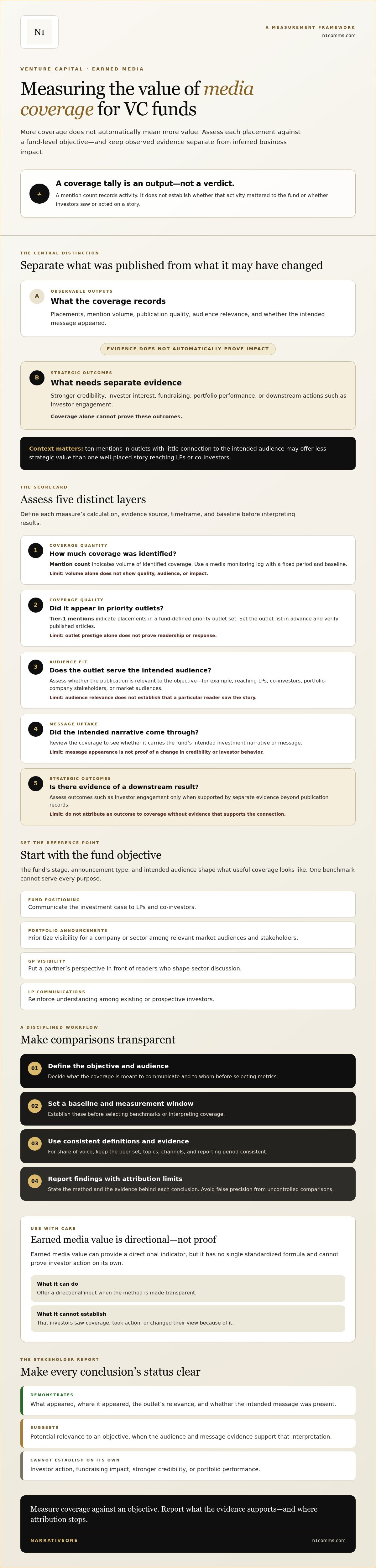
A coverage tally records activity. It doesn’t establish whether that activity mattered to a fund. Ten mentions in outlets with little connection to the intended audience may provide less strategic value than one well-placed story that reaches LPs or co-investors. The count is an output, not a verdict.
For a venture fund, media coverage value is an evidence-based assessment of coverage against a defined objective. Start with observable details: what appeared, where it appeared, which audience the outlet serves, and whether the intended message came through. Claims about changes in credibility, investor interest, fundraising, or portfolio performance need separate evidence. Coverage alone cannot prove those outcomes.
This distinction reflects the broader practice of Public relations, where communication activity and its effectiveness are not the same measure. A fund’s stage, announcement type, and intended audience shape what useful coverage looks like. A new fund may need to establish its investment case; a portfolio announcement may prioritize visibility for a company or sector; a GP commentary piece may aim to build authority on a particular market issue. One benchmark cannot serve all three.
A clear fund brand positioning strategy helps define which coverage is relevant. It gives measurement a reference point: the investment case the fund needs to communicate and the audiences for whom that case matters.
What does media coverage value mean for a venture fund?
It is an evidence-based assessment of coverage against a communications objective, with observed results kept separate from inferred business impact. For example, a mention in a publication read by LPs may be more relevant to an investor narrative than broader reach in a general outlet. That still doesn’t establish that LPs saw or acted on the story. Measurement should guide communications allocation and narrative decisions, not manufacture certainty.
Which fund objectives should the measurement serve?
Choose the objective and audience before selecting metrics. Fund positioning may target LPs and co-investors with the investment case. Portfolio announcements may serve portfolio-company stakeholders and relevant market audiences. GP visibility may put a partner’s perspective in front of readers who shape sector discussion. LP communications may reinforce understanding among existing or prospective investors. Each objective needs a message and evidence suited to its purpose.
Keep the measurement layers distinct: coverage outputs show what was published; audience relevance indicates who the outlet serves; narrative outcomes assess whether the intended message appeared; downstream business outcomes concern actions such as investor engagement. One coverage report cannot prove every fund-level outcome. Calculating the value of media coverage for VCs means stating what the evidence supports and where attribution stops.
Which metrics can show the value of VC media coverage?
A useful scorecard separates five layers: coverage quantity, coverage quality, audience fit, message uptake, and strategic outcomes. Mention counts show volume. Tier-1 mentions indicate placement in outlets the fund has defined as priorities. Audience fit asks whether those outlets reach people relevant to the objective. Message uptake checks whether coverage carries the intended investment narrative. Strategic outcomes require evidence beyond publication records.
Before calculating the value of media coverage for VCs, define each metric’s calculation, evidence source, timeframe, and baseline. For example, compare share of voice only when the peer set, topics, channels, and reporting period stay consistent. Without these controls, comparisons can create false precision. The table shows what each measure can establish and where its limits begin.
| Metric | What it indicates | Limitation | Evidence source |
|---|---|---|---|
| Mention count | Volume of identified coverage | Does not show quality, audience, or impact | Media monitoring log; fixed period and baseline |
| Tier-1 mentions | Coverage in a fund-defined priority outlet set | Outlet prestige alone does not prove readership or response | Outlet list set in advance; published articles |
| Share of voice | Coverage relative to a defined peer set | Changes if peers, topics, channels, or period change | Consistent monitoring of specified peers and topics |
| Sentiment and message uptake | How coverage is classified and whether priority messages appear | Classification can be subjective; presence does not prove persuasion | Coded article review; documented rules and review process |
| Earned media value | A modeled estimate under a stated methodology | Not cash received or verified business impact | Calculation inputs, assumptions, and source records |
How should VCs interpret earned media value?
Earned media value (EMV) assigns a monetary estimate to coverage using a chosen methodology. There is no single standardized formula, so disclose the inputs and assumptions, including how reach, placement, engagement, or sentiment are treated. An advertising-rate comparison is not proof of equivalent paid exposure, investor attention, or commercial value. NarrativeOne reports Earned media value: $50 M+ (200+ mentions). Use that exact label and review the calculation methodology and attribution basis before drawing comparisons or presenting it as evidence of impact.
How do share of voice, sentiment, and Tier-1 coverage add context?
Share of voice is meaningful only when the peer set, topic, channel set, and measurement period are fixed. Sentiment should be reported as a coded classification, with the coding rules and review process stated. Tier-1 coverage can signal placement quality against a fund’s defined priorities. It cannot establish LP response or fundraising success.
Use the measures together, not as substitutes. A fund assessing its reporting approach can review NarrativeOne’s investment-firm communications as one reference point for disciplined measurement.
How to compare media coverage value without overstating attribution
No single valuation method answers every fund-level question. Output-based reporting documents what was published. Advertising-equivalent valuation assigns a modeled comparison value. Audience-quality analysis examines whether coverage reached relevant readers. Objective-linked evaluation tests whether coverage supports a defined communications goal. Each method answers a different question; combining them without clear labels creates false precision.
| Method | Evidence required | Strength | Limitation | Suitable use |
|---|---|---|---|---|
| Output-based reporting | Verified coverage records, outlet, date, and content | Shows what was published and when | Does not establish relevance or impact | Tracking delivery against a communications plan |
| Advertising-equivalent valuation | Disclosed rate source, placement treatment, calculation period, and formula | Provides a monetary proxy for comparison | Does not measure commercial or investment value | Directional context, clearly labeled as a proxy |
| Audience-quality analysis | Defined target audiences, outlet rationale, and audience evidence | Tests whether coverage is relevant to LPs, co-investors, or other intended readers | Outlet fit does not prove an individual read or acted on coverage | Comparing the strategic relevance of placements |
| Objective-linked evaluation | Predefined objective, baseline, measurement window, coverage, and supporting indicators | Connects communications evidence to a fund priority | Cannot establish sole causation without direct evidence | Assessing contribution to a specific narrative or visibility objective |
What can advertising-equivalent valuation tell a fund?
It can show an estimated comparison under stated assumptions. It cannot show what the coverage was worth to the fund in capital, investor decisions, or portfolio performance. Any report using this proxy should name the rate source, explain how placement differences are treated, and specify the calculation period. A high estimate can still reflect poor audience fit or little relevance to the fund’s message. Label the figure as an estimate, not a business result.
How can a fund assess contribution without claiming causation?
Communications can contribute to an outcome without being its sole cause. Fundraising, investment decisions, and portfolio performance are shaped by multiple factors. Assess media evidence separately from those business results, then look for supporting indicators: timing against the objective, stakeholder feedback, message uptake, and coverage quality. Together, these can support a careful contribution assessment. They do not establish that coverage caused an LP decision.
Attribution requires direct, verifiable evidence linking exposure to the outcome. Without it, report the sequence and supporting signals, then state the limit plainly. This is the discipline at the center of calculating the value of media coverage for VCs: make a defensible claim about contribution, not an unsupported claim of causation.
How to calculate media coverage value for a VC fund step by step
A defensible calculation starts before coverage is reviewed. Set the objective, baseline, and measurement window first. Otherwise, the period and benchmarks can shift to fit the results, weakening the report’s credibility.
- 1. Define the fund objective. Specify what communications is intended to support, such as fund positioning, a portfolio announcement, GP visibility, or LP communications. Identify the audience and the message that audience should take away.
- 2. Set the baseline and comparison period. Choose a period tied to the objective or communications activity, then record pre-activity measures before comparing results. If assessing Tier-1 mentions or share of voice, define the priority outlet list, peer set, topics, and channels in advance. Keep those definitions consistent. Mark unavailable or incomplete data rather than treating it as zero.
- 3. Establish the measurement window. State the dates covered and apply the same window to the baseline and comparison. Note other activity that may affect coverage, such as overlapping fund or portfolio announcements. This context helps prevent a report from assigning every change to one communications effort.
- 4. Record and verify coverage. For each item, log the outlet, publication date, prominence, intended audience relevance, and whether the priority message appears. Record sentiment only with its classification method and review process. Keep source evidence, such as the article or monitoring record, so each reported result can be checked.
- 5. Compare results against the objective. Report observed outputs first, then assess audience and message evidence against the baseline. Apply any valuation method only with its formula, inputs, and assumptions disclosed. Don’t turn a change in coverage into a claim about investor behavior without direct supporting evidence.
- 6. Report conclusions, limits, and next decisions. Separate observed results from interpretation. Label correlation, communications contribution, and confirmed business outcomes distinctly. State data gaps and attribution limits, then identify what the evidence suggests should continue, change, or be measured next.
What should a defensible media value report include?
Include the fund objective, metric definitions, source records, baseline, comparison period, and calculation assumptions. Show coverage outputs alongside audience and message evidence, not as one unexplained score. Explain what the data supports and what it cannot establish. That is the practical discipline behind calculating the value of media coverage for VCs.
For a fund communications approach grounded in clear objectives and evidence, explore Narrative One’s fund communications approach.
How NarrativeOne can help investment firms measure coverage with discipline
For venture capital, private equity, and multi-strategy investment firms, measurement must reflect the investment narrative and the audiences it needs to reach. Narrative One connects communications planning with evidence through one senior strategist, one journalist network, and one compliance workflow shared across the firm and its portfolio companies. This is an operating model, not a promise of coverage, investor decisions, or fundraising outcomes.
A 12-month narrative plan, executed weekly and reported monthly, provides continuity. It allows a fund to set objectives, maintain consistent metric definitions, and review results against an established baseline rather than treating each announcement as an isolated event. That discipline matters when calculating the value of media coverage for VCs, especially where fundraising, portfolio activity, and broader market coverage overlap.
What does an investment-firm communications infrastructure include?
Narrative One’s relevant services include Strategy & narrative, Media relations, and Monitoring & crisis management. Together, these support a defined fund narrative, media engagement, and ongoing awareness of coverage. Placement in publications read by LPs and co-investors can be assessed for audience relevance, but publication alone does not show that a specific stakeholder read or acted on a story.
English and Arabic content is drafted natively, rather than translated after drafting, to meet senior financial-journalist standards. Compliance rules are embedded before the compliance director reviews drafts. This makes review part of the workflow and keeps claims and approvals visible before reporting begins.
What should a fund clarify before engaging a communications partner?
Require a clear answer on how each metric is defined, baselined, sourced, and reported. Ask how the partner will separate published coverage from interpretation, and what evidence would support any claim about audience or message uptake. Confirm how English and Arabic content is drafted for senior financial journalists and how stakeholders contribute to review.
Document the objective, claims, approval responsibilities, source records, comparison period, and reporting cadence at the outset. If a partner presents earned media value, share of voice, sentiment, or speed metrics, ask for the methodology, baseline, and measurement period. Treat disclosed figures as examples, not transferable benchmarks, until their basis is understood. A credible partner makes limitations explicit rather than hiding them behind a single score.
If your fund is reviewing its positioning or the way media performance is assessed, discuss the objectives, evidence standards, and reporting approach with Narrative One. Start with the measurement questions, then decide whether the communications model fits.
Make media measurement a fund-level discipline
Coverage volume is an output, not a measure of investor impact. A defensible approach starts with the fund objective, sets a baseline and measurement window, then assesses coverage quality, audience relevance, and message uptake. It distinguishes observed evidence from interpretation and never treats correlation as proof that media caused a fundraising or portfolio outcome.
That discipline is central to calculating the value of media coverage for VCs. Narrative One reports Earned media value: $50 M+ (200+ mentions); review its methodology and attribution basis before using it as a comparative benchmark. The firm also reports ▲ 10 pts share-of-voice improvement and ▲ 20 % faster coverage. Check the comparison periods, baselines, and measurement methods before treating those figures as performance evidence. Forbes Middle East named Narrative One among the Middle East’s Most Influential CMOs, 2026.
For investment firms, credible reporting begins with clear definitions and transparent limits. If your fund is ready to connect its communications objectives with a disciplined measurement approach, discuss a disciplined media strategy for your fund. A rigorous framework gives leadership a stronger basis for deciding what to measure next.
Frequently Asked Questions
How do you calculate the value of media coverage for a VC?
Start with the fund objective and intended audience, then select indicators that match the goal, such as coverage quality, message inclusion, Tier-1 mentions, or share of voice. For each metric, record its definition, source, timeframe, baseline, and assumptions. In calculating the value of media coverage for VCs, keep observed evidence separate from inferred contribution. A valuation estimate is not cash value or proof that coverage caused a fundraising or investment outcome.
Is earned media value a reliable measure for venture capital firms?
Earned media value can support directional comparisons when the methodology is transparent and consistently applied. It isn’t revenue, capital raised, or a guaranteed return. Disclose the rate source, how placements are treated, and the measurement period. Then pair the estimate with audience relevance, message uptake, and the fund objective. This lets executives assess what the figure captures, what assumptions shape it, and what it cannot establish.
What media coverage metrics matter most to VCs?
The right metrics depend on the fund objective. Mention volume tracks activity; Tier-1 mentions and outlet relevance indicate placement quality; share of voice compares visibility within a defined peer set. Sentiment and message inclusion add context about how coverage is framed and whether priority points appear. No single metric establishes LP interest or fundraising impact. Report the definitions, sources, timeframe, and limitations alongside each figure.
Can media coverage be directly attributed to a successful fundraise?
Don’t claim direct causation unless verifiable evidence supports the link. Fundraising reflects multiple factors, including investment performance, relationships, timing, and market conditions. Coverage may contribute to visibility or reinforce a fund narrative, but contribution isn’t the same as sole attribution. Record the timing of coverage and relevant stakeholder feedback, then report confirmed fundraising outcomes separately from communications indicators. This keeps the account credible without dismissing communications’ potential contribution.
How should a VC measure share of voice?
Define the peer set, topic, media channels, and reporting period before collecting coverage. Apply the same inclusion rules to the fund and its comparison set, and document how mentions are counted. Share of voice provides context about relative visibility within those boundaries. It doesn’t establish audience quality, message understanding, or business impact. Pair it with outlet relevance and message analysis, and keep definitions consistent across reporting periods.
How often should venture funds report on media coverage?
Set reporting frequency around the communications plan and the decisions stakeholders need to make. A consistent monthly report can track activity and emerging patterns; an individual announcement may also warrant a separate review. Keep timeframes and metric definitions stable to support comparisons. Narrative One’s stated model uses a 12-month narrative plan, executed weekly and reported monthly. Choose a cadence that produces evidence leaders can use, not reporting for its own sake.
What evidence should be included in a VC media coverage report?
Include the fund objective, measurement period, metric definitions, source records, outlet and placement details, and calculation assumptions. Add evidence of message inclusion, audience fit, and stakeholder response when available. Separate verified observations from interpretation, and identify data gaps or attribution limits. A report structured this way can be reviewed and challenged. It also prevents a single headline figure from implying more certainty than the evidence supports.
Frequently Asked Questions
What does media coverage value mean for a venture fund?
It is an evidence-based assessment of coverage against a communications objective, with observed results kept separate from inferred business impact. For example, a mention in a publication read by LPs may be more relevant to an investor narrative than broader reach in a general outlet. That still doesn’t establish that LPs saw or acted on the story. Measurement should guide communications allocation and narrative decisions, not manufacture certainty.
Which fund objectives should the measurement serve?
Choose the objective and audience before selecting metrics. Fund positioning may target LPs and co-investors with the investment case. Portfolio announcements may serve portfolio-company stakeholders and relevant market audiences. GP visibility may put a partner’s perspective in front of readers who shape sector discussion. LP communications may reinforce understanding among existing or prospective investors. Each objective needs a message and evidence suited to its purpose. Keep the measurement layers distinct: coverage outputs show what was published; audience relevance indicates who the outlet serves; narrative outcomes assess whether the intended message appeared; downstream business outcomes concern actions such as investor engagement. One coverage report cannot prove every fund-level outcome. Calculating the value of media coverage for VCs means stating what the evidence supports and where attribution stops. A useful scorecard separates five layers: coverage quantity, coverage quality, audience fit, message uptake, and strategic outcomes. Mention counts show volume. Tier-1 mentions indicate placement in outlets the fund has defined as priorities. Audience fit asks whether those outlets reach people relevant to the objective. Message uptake checks whether coverage carries the intended investment narrative. Strategic outcomes require evidence beyond publication records. Before calculating the value of media coverage for VCs, define each metric’s calculation, evidence source, timeframe, and baseline. For example, compare share of voice only when the peer set, topics, channels, and reporting period stay consistent. Without these controls, comparisons can create false precision. The table shows what each measure can establish and where its limits begin.
How should VCs interpret earned media value?
Earned media value (EMV) assigns a monetary estimate to coverage using a chosen methodology. There is no single standardized formula, so disclose the inputs and assumptions, including how reach, placement, engagement, or sentiment are treated. An advertising-rate comparison is not proof of equivalent paid exposure, investor attention, or commercial value. Narrative One reports Earned media value: $50 M+ (200+ mentions). Use that exact label and review the calculation methodology and attribution basis before drawing comparisons or presenting it as evidence of impact.
How do share of voice, sentiment, and Tier-1 coverage add context?
Share of voice is meaningful only when the peer set, topic, channel set, and measurement period are fixed. Sentiment should be reported as a coded classification, with the coding rules and review process stated. Tier-1 coverage can signal placement quality against a fund’s defined priorities. It cannot establish LP response or fundraising success. Use the measures together, not as substitutes. A fund assessing its reporting approach can review Narrative One’s investment-firm communications as one reference point for disciplined measurement. No single valuation method answers every fund-level question. Output-based reporting documents what was published. Advertising-equivalent valuation assigns a modeled comparison value. Audience-quality analysis examines whether coverage reached relevant readers. Objective-linked evaluation tests whether coverage supports a defined communications goal. Each method answers a different question; combining them without clear labels creates false precision.
What can advertising-equivalent valuation tell a fund?
It can show an estimated comparison under stated assumptions. It cannot show what the coverage was worth to the fund in capital, investor decisions, or portfolio performance. Any report using this proxy should name the rate source, explain how placement differences are treated, and specify the calculation period. A high estimate can still reflect poor audience fit or little relevance to the fund’s message. Label the figure as an estimate, not a business result.
How can a fund assess contribution without claiming causation?
Communications can contribute to an outcome without being its sole cause. Fundraising, investment decisions, and portfolio performance are shaped by multiple factors. Assess media evidence separately from those business results, then look for supporting indicators: timing against the objective, stakeholder feedback, message uptake, and coverage quality. Together, these can support a careful contribution assessment. They do not establish that coverage caused an LP decision. Attribution requires direct, verifiable evidence linking exposure to the outcome. Without it, report the sequence and supporting signals, then state the limit plainly. This is the discipline at the center of calculating the value of media coverage for VCs: make a defensible claim about contribution, not an unsupported claim of causation. A defensible calculation starts before coverage is reviewed. Set the objective, baseline, and measurement window first. Otherwise, the period and benchmarks can shift to fit the results, weakening the report’s credibility.
What should a defensible media value report include?
Include the fund objective, metric definitions, source records, baseline, comparison period, and calculation assumptions. Show coverage outputs alongside audience and message evidence, not as one unexplained score. Explain what the data supports and what it cannot establish. That is the practical discipline behind calculating the value of media coverage for VCs. For a fund communications approach grounded in clear objectives and evidence, explore Narrative One’s fund communications approach. For venture capital, private equity, and multi-strategy investment firms, measurement must reflect the investment narrative and the audiences it needs to reach. Narrative One connects communications planning with evidence through one senior strategist, one journalist network, and one compliance workflow shared across the firm and its portfolio companies. This is an operating model, not a promise of coverage, investor decisions, or fundraising outcomes. A 12-month narrative plan, executed weekly and reported monthly, provides continuity. It allows a fund to set objectives, maintain consistent metric definitions, and review results against an established baseline rather than treating each announcement as an isolated event. That discipline matters when calculating the value of media coverage for VCs, especially where fundraising, portfolio activity, and broader market coverage overlap.
What does an investment-firm communications infrastructure include?
Narrative One’s relevant services include Strategy & narrative, Media relations, and Monitoring & crisis management. Together, these support a defined fund narrative, media engagement, and ongoing awareness of coverage. Placement in publications read by LPs and co-investors can be assessed for audience relevance, but publication alone does not show that a specific stakeholder read or acted on a story. English and Arabic content is drafted natively, rather than translated after drafting, to meet senior financial-journalist standards. Compliance rules are embedded before the compliance director reviews drafts. This makes review part of the workflow and keeps claims and approvals visible before reporting begins.
What should a fund clarify before engaging a communications partner?
Require a clear answer on how each metric is defined, baselined, sourced, and reported. Ask how the partner will separate published coverage from interpretation, and what evidence would support any claim about audience or message uptake. Confirm how English and Arabic content is drafted for senior financial journalists and how stakeholders contribute to review. Document the objective, claims, approval responsibilities, source records, comparison period, and reporting cadence at the outset. If a partner presents earned media value, share of voice, sentiment, or speed metrics, ask for the methodology, baseline, and measurement period. Treat disclosed figures as examples, not transferable benchmarks, until their basis is understood. A credible partner makes limitations explicit rather than hiding them behind a single score. If your fund is reviewing its positioning or the way media performance is assessed, discuss the objectives, evidence standards, and reporting approach with Narrative One. Start with the measurement questions, then decide whether the communications model fits. Coverage volume is an output, not a measure of investor impact. A defensible approach starts with the fund objective, sets a baseline and measurement window, then assesses coverage quality, audience relevance, and message uptake. It distinguishes observed evidence from interpretation and never treats correlation as proof that media caused a fundraising or portfolio outcome. That discipline is central to calculating the value of media coverage for VCs. Narrative One reports Earned media value: $50 M+ (200+ mentions); review its methodology and attribution basis before using it as a comparative benchmark. The firm also reports ▲ 10 pts share-of-voice improvement and ▲ 20 % faster coverage. Check the comparison periods, baselines, and measurement methods before treating those figures as performance evidence. Forbes Middle East named Narrative One among the Middle East’s Most Influential CMOs, 2026. For investment firms, credible reporting begins with clear definitions and transparent limits. If your fund is ready to connect its communications objectives with a disciplined measurement approach, discuss a disciplined media strategy for your fund. A rigorous framework gives leadership a stronger basis for deciding what to measure next.
How do you calculate the value of media coverage for a VC?
Start with the fund objective and intended audience, then select indicators that match the goal, such as coverage quality, message inclusion, Tier-1 mentions, or share of voice. For each metric, record its definition, source, timeframe, baseline, and assumptions. In calculating the value of media coverage for VCs, keep observed evidence separate from inferred contribution. A valuation estimate is not cash value or proof that coverage caused a fundraising or investment outcome.
Is earned media value a reliable measure for venture capital firms?
Earned media value can support directional comparisons when the methodology is transparent and consistently applied. It isn’t revenue, capital raised, or a guaranteed return. Disclose the rate source, how placements are treated, and the measurement period. Then pair the estimate with audience relevance, message uptake, and the fund objective. This lets executives assess what the figure captures, what assumptions shape it, and what it cannot establish.
What media coverage metrics matter most to VCs?
The right metrics depend on the fund objective. Mention volume tracks activity; Tier-1 mentions and outlet relevance indicate placement quality; share of voice compares visibility within a defined peer set. Sentiment and message inclusion add context about how coverage is framed and whether priority points appear. No single metric establishes LP interest or fundraising impact. Report the definitions, sources, timeframe, and limitations alongside each figure.
Can media coverage be directly attributed to a successful fundraise?
Don’t claim direct causation unless verifiable evidence supports the link. Fundraising reflects multiple factors, including investment performance, relationships, timing, and market conditions. Coverage may contribute to visibility or reinforce a fund narrative, but contribution isn’t the same as sole attribution. Record the timing of coverage and relevant stakeholder feedback, then report confirmed fundraising outcomes separately from communications indicators. This keeps the account credible without dismissing communications’ potential contribution.
How should a VC measure share of voice?
Define the peer set, topic, media channels, and reporting period before collecting coverage. Apply the same inclusion rules to the fund and its comparison set, and document how mentions are counted. Share of voice provides context about relative visibility within those boundaries. It doesn’t establish audience quality, message understanding, or business impact. Pair it with outlet relevance and message analysis, and keep definitions consistent across reporting periods.
How often should venture funds report on media coverage?
Set reporting frequency around the communications plan and the decisions stakeholders need to make. A consistent monthly report can track activity and emerging patterns; an individual announcement may also warrant a separate review. Keep timeframes and metric definitions stable to support comparisons. Narrative One’s stated model uses a 12-month narrative plan, executed weekly and reported monthly. Choose a cadence that produces evidence leaders can use, not reporting for its own sake.
What evidence should be included in a VC media coverage report?
Include the fund objective, measurement period, metric definitions, source records, outlet and placement details, and calculation assumptions. Add evidence of message inclusion, audience fit, and stakeholder response when available. Separate verified observations from interpretation, and identify data gaps or attribution limits. A report structured this way can be reviewed and challenged. It also prevents a single headline figure from implying more certainty than the evidence supports.