
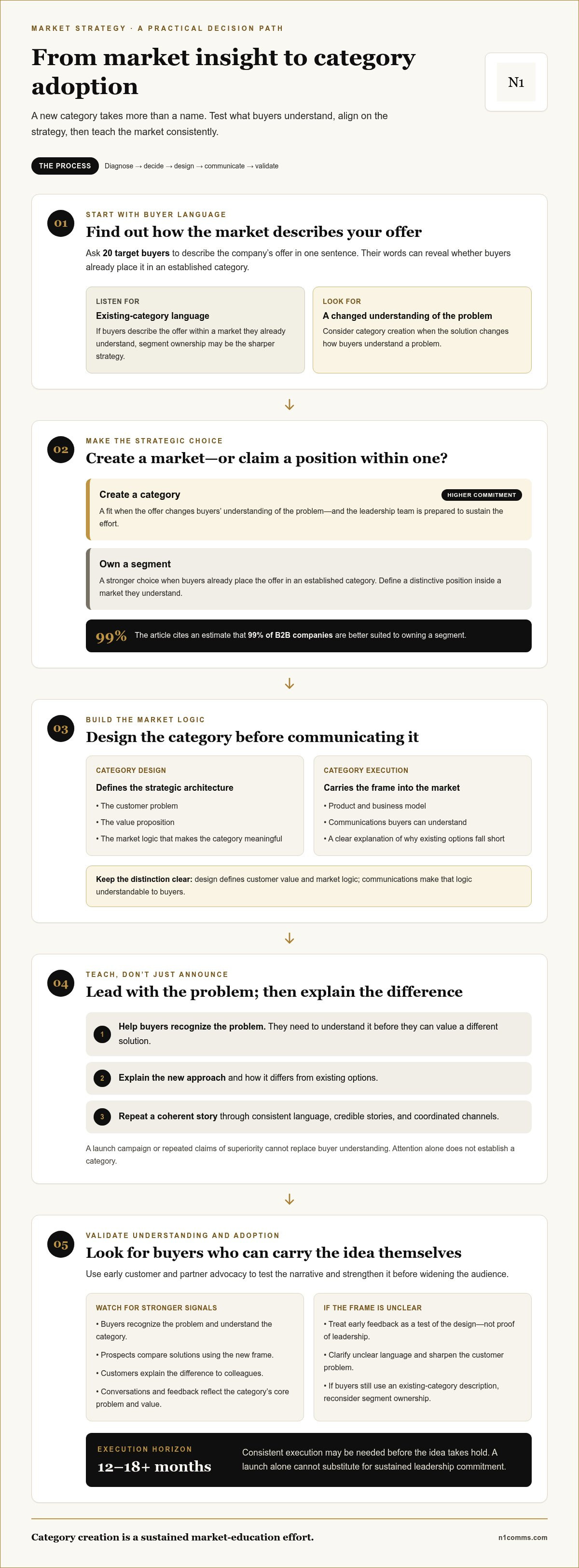
A new category is not a naming exercise. Pursue category creation when your solution changes how buyers understand a problem and your leadership team is prepared to sustain the effort; otherwise, owning a segment within an existing category is the stronger choice. Category creation communications must educate the market, and it can take 12-18+ months of consistent execution before the idea takes hold.
The distinction matters because a compelling launch cannot make up for weak strategic commitment. Buyers need to understand the problem before they can value a different solution, and repeated claims of superiority rarely create that understanding.
This article explains how category creation differs from category design and segment ownership, what shapes its cost and timeline, and how coordinated communications can build recognition and trust. You’ll see when creating a new category makes strategic sense, why many companies are better served by defining a segment, and how leadership, customer insight, media, and early advocates contribute to adoption.
Key Takeaways
Test whether buyers already place your offer in an established market before committing to a new category. Their language can reveal whether segment ownership is the more disciplined route.
Separate category design from execution: design defines the customer value and market logic, while communications make that logic understandable to buyers.
Secure executive alignment before pursuing category leadership. A new market position requires sustained commitment, not a launch campaign alone.
Build communications around the customer problem first, then explain how the solution differs. Consistent language, credible stories, and coordinated channels help the market absorb the idea.
Use early customer and partner advocacy to test the category narrative and strengthen it before expanding to a wider audience.
Table of Contents
Category creation versus category design and segment ownership
Category creation introduces a new product or service category; category design defines the value and market logic behind it. The decision is strategic: create a market, or claim a distinctive position within one buyers already understand.
Defining Category Creation and Design
Category creation brings a new category to market, while category design shapes the customer problem, value proposition, and framework that make the category meaningful. That distinction matters because a new label cannot create demand by itself. Dyson’s bagless vacuum, introduced in the 1990s, shows how a product can help buyers understand an alternative to an established category.
Category creation differs from category marketing in its objective. Marketing promotes an offer, while category creation teaches buyers to understand a problem and solution through a new market frame. A campaign can support that work, but attention alone does not establish a category. Buyers must recognize the problem, understand the new approach, and share language for describing it.
Category design is the strategic architecture; category creation is the market-facing effort to establish it. Design defines the customer value and why existing options fall short. Execution carries that frame through the product, business model, and communications. Customers, not companies or analysts alone, ultimately build categories by adopting the language and connecting the problem to a solution.
A practical test is to ask 20 target buyers to describe the company’s offer in one sentence. If their answers place it inside an existing category, segment ownership may be the sharper strategy. The estimate that 99% of B2B companies are better suited to owning a segment reinforces the need to define the market before claiming to reinvent it. Category creation is generally reserved for unusually disruptive offers and long-term commitment.
Measuring Category Creation Success
Category creation is succeeding when buyers recognize the problem, understand the new category, and use its language without relying solely on the company’s explanation. Awareness can rise without changing how customers evaluate solutions. Measure whether customer conversations, sales discussions, and market descriptions increasingly reflect the category’s core problem and value.
Look for evidence across the buyer journey: do prospects identify the problem, compare solutions using the new frame, and explain the difference to colleagues? Track how consistently those descriptions appear in interviews, sales calls, and customer feedback. More mentions alone are not enough. The stronger signal is whether buyers connect the category to a real need and understand how the approach differs.
Category design may take months of strategic work before shared understanding becomes visible. Treat early feedback as a test of the design, not proof of leadership: clarify unclear language, sharpen the customer problem, and assess whether buyers recognize the distinction. If the market still describes the offer through an existing category, owning a specific segment may be the more coherent strategy.
Category leadership and competitive advantage
Category leaders shape how buyers frame a problem, compare solutions, and allocate attention. Their advantage is not simply being first or loudest. It comes from making their interpretation of the market the reference point for customers, partners, and investors. Harvard Business Review research says category leaders capture approximately 76% of a market’s total value. Leadership, then, is a strategic position with economic consequences.
That position changes the conversation. A company selling within an established category competes against familiar alternatives and inherited assumptions. A category leader can influence which problem receives attention and what buyers consider a credible solution. Salesforce’s “cloud CRM” and HubSpot’s “inbound marketing” illustrate how a named frame can organize product value and market understanding. The label matters only when customers use it to make sense of their needs.
Founder leadership matters because a founder can make the category’s thesis clear through a consistent public point of view. The founder explains why existing approaches fall short, what has changed, and how the company’s product responds. This is not personal visibility for its own sake. It connects the category’s argument to the decisions, trade-offs, and operating convictions behind the company.
Apple’s 2014 smartphone economics show the potential value of market leadership: the company earned 91% of smartphone market profits that year. This example does not establish a universal outcome for category creators. It demonstrates why leaders seek a defensible position. A strong category frame can make product differentiation easier to understand, strengthen strategic leverage, and give customers a clearer reason to choose.
Inventing a category also creates exposure. The executive team must support the strategy, align product decisions with the market promise, and keep conversations coherent across sales, leadership, and communications. If one team describes a new market while another sells the offer as a standard product, buyers receive conflicting signals. Internal alignment is not a launch-stage formality; it is part of the market architecture.
Before making category leadership a company-wide priority, executives should align on three points: the customer problem, the category’s defining language, and the evidence that the solution creates distinct value. Product, sales, and leadership teams should use those same points in customer conversations. This discipline reduces narrative drift and gives employees a shared basis for explaining why the category exists.
Founder positioning can help sustain that shared argument as the market evaluates a new idea. A founder’s public perspective should reinforce the company’s category thesis, not compete with it. For executives shaping that alignment, founder positioning and profile building can connect leadership visibility to a clear market position.
Benefits of creating a category
A new category can shift a company from competing on familiar features to defining the problem buyers recognize. That change gives the business a clearer strategic frame for product decisions, customer education, and market expansion. The benefit is not novelty alone, but a stronger connection between a distinct customer challenge and the company’s vision for solving it.
The growth figures associated with category creation are substantial: category creators account for 74% of incremental market capitalization growth and 53% of incremental revenue growth. These figures describe shares of incremental growth, not a forecast for any individual company. They help explain why executives consider category strategy: a market position that shapes buyer understanding can create value beyond a single product comparison.
Category definition can also make a complex offer easier to discuss. HubSpot’s “inbound marketing” gives buyers a phrase for an approach they can evaluate, share, and apply to business challenges. A useful category name compresses an argument: it identifies a problem, signals a different approach, and gives customers language to explain their choice. Without that clarity, sales conversations often start with product mechanics instead of the need those mechanics address.
A distinct category can support expansion when the original product is only one part of a broader solution. The company can align new features, product lines, and improvements with the same customer problem rather than presenting each addition as an unrelated offer. That coherence helps teams assess whether a proposed investment reinforces the category vision or dilutes it. The position becomes a decision framework, not just a market label.
Category creation can also help a company attract partners and advocates. When customers understand the problem and proposed change, they can explain the value in their own terms. That advocacy offers another route to wider awareness, while feedback reveals where the category story fails to match customer experience. The test is whether the language travels beyond the company’s own channels.
These benefits come with a governance cost. Executives may value category participation for its potential to increase market capitalization while resisting the transformational risk of building a new market. That tension matters: a category strategy requires decisions across product, sales, and leadership, not just a communications push. Before committing, define the customer challenge, market position, and organizational changes needed to support the vision. If those elements conflict, segment ownership may be a more coherent path.
Category creation costs and timelines
Category creation demands sustained investment because the company must build more than a product. It must establish a market insight, align its offer and business model, and teach buyers a new way to interpret the problem. For genuine B2B category creation, the estimate is at least $100 million and 6 to 10 years. That scale makes executive commitment and investor expectations central from the start.
Those long-range estimates describe category development, not the first market response. An idea may need 12-18+ months of consistent execution before it takes hold. Early communications can clarify the problem and test the language, but they do not compress the work of changing buyer expectations. Play Bigger’s research puts the average category creation timeline at 6 to 10 years, reinforcing the difference between initial traction and durable market adoption.
The investment follows the work itself. A company developing a new product, business model, and category at once must coordinate all three. Product decisions shape the promise; customer insight shapes the category; communications help buyers understand the connection. If one part moves ahead without the others, the company risks making claims the product cannot support or building a market narrative without a usable offer.
Segment ownership involves a different capital and timing decision. It can be pursued with weeks of research, as the company focuses on defining a distinctive position within a market buyers already recognize. That route still requires disciplined analysis, but avoids the broader burden of establishing a new category. The practical comparison is not simply a smaller or larger campaign. It is a different level of organizational effort and market education.
The risks are substantial: buyers may not understand the problem, adoption may take longer than the business can sustain, and fast followers may capture demand after the company has educated the market. The 47% failure rate among first movers, compared with 8% among fast followers, underscores the exposure described in the research. Investors and executives must weigh that risk against the company’s ability to maintain a long-term commitment.
That commitment must extend beyond communications. Leadership needs to align product development, customer experience, sales, and funding around the same market insight. Investors need a credible explanation of why the company is taking on extended market-building work instead of pursuing faster results within an existing category. If the organization cannot support that commitment, category creation becomes a costly distraction rather than a strategic asset.
Before choosing a route, compare its time horizon with the company’s operating needs. If the business needs faster results, category creation may not fit; segment ownership can focus effort on a defined buyer and problem. If the company can sustain a long build, its category strategy should connect product milestones, customer evidence, and investor communications. The decisive cost is not one campaign, but the continued effort required to help the market understand and adopt the new frame.
Launching a category through coordinated communications
A category launch succeeds through sustained market education, not a single announcement. Effective category creation communications align the customer problem, the new concept, and evidence from people who experience its value.
Steps in Creating a New Market Category
Creating a market category means aligning its language, customer evidence, product story, and audience engagement around one market insight. Buyers need to understand the problem before they can assess an unfamiliar solution. Start with the problem, name the new frame simply, then explain how the offer differs from existing approaches without making generic claims of superiority.
Next, focus on an underserved niche whose members feel the problem acutely. Their experience can test whether the concept is clear and useful before it reaches a broader audience. Use concrete stories: describe where existing approaches fail, then show how customers experience the new solution. This makes the launch an evidence-based argument, not a slogan without operational meaning.
Build a coordinated sequence around that argument. A category creation communications plan can include three to six audience engagements over six months. Trade shows, industry conferences, podcasts, press, social media, and customer advocacy each have a role, but all must reinforce the same language. Gather feedback after each engagement and refine the story before widening distribution.
Concentrate attention when the niche is ready. Dave Bailey recommends creating a short, high-impact period when people discuss the insight, rather than spreading awareness slowly. His contrast is a three-day burst of category attention versus becoming somewhat known over a year. The aim is not activity for its own sake, but a focused conversation that makes the new frame easier to recognize.
Examples of Successful Campaigns
Examples include Salesforce’s “cloud CRM” and HubSpot’s “inbound marketing,” category frames connecting a named concept with a distinct offer. Regis’s public-relations-led approach helped create dozens of new categories. These examples show how category communications extend beyond product announcements into sustained market education.
A campaign should match its audience. Technical press can help technologists assess the product concept, while business press addresses executive concerns. Events can bring a target audience together, and early believers can carry the story into wider networks. Loyal customers offer more than testimonials: their explanations reveal whether the category language works beyond the company’s own communications.
Advertising alone cannot explain every unfamiliar high-tech purchase. Buyers may need to understand both the product and its effects on business processes. Use human-to-human communication to build trust, then coordinate customer stories, press, events, partnerships, and direct engagement. For a launch, the sequence is clear: establish the problem, define the difference, engage a focused audience, and use feedback to sharpen the next communication.
NarrativeOne: Fund Positioning
NarrativeOne helps investment firms define a clear fund position and communicate its strategic case to investors. When a fund’s differentiation is difficult to articulate, disciplined positioning can connect its investment thesis, market context, and leadership perspective in a coherent narrative.
That foundation supports related work, including LP Communications, Portfolio Announcements, and Partner Thought Leadership. Each communication should reinforce the fund’s central position rather than introduce competing claims. This creates a more consistent account across investor conversations and public-facing milestones.
For fund leaders clarifying their market position or investor narrative, contact NarrativeOne to discuss the communications challenge.
Make the Market Position Operational
The next decision is whether your organization can put its market position into practice. Assign ownership of the narrative, connect it to leadership priorities, and give teams a shared standard for decisions. Category creation communications work best as infrastructure, not as a launch message detached from the business.
NarrativeOne’s Fund Positioning, Portfolio Announcements, and LP Communications support investment firms that need a coherent account of their strategy across key stakeholder conversations. The priority is alignment: each communication should reinforce the same investment narrative while respecting the distinct purpose of each audience.
If your team is ready to sharpen its category communications and align them with business priorities, contact NarrativeOne about category communications. A clear position gives the next conversation a stronger foundation.
Frequently Asked Questions
Changing the game or just a new label?
A new label changes the game only when it changes how buyers assess their problem and available options. If prospects still use the old category’s criteria, the new term is branding, not market change. Test the distinction in real buying conversations: listen for whether customers use the new concept to explain their needs, compare solutions, or brief colleagues without relying on your company’s explanation.
What is category creation in communications and marketing?
Category creation in communications and marketing is the coordinated work of establishing a new market frame and helping relevant audiences understand it. It goes beyond promoting a product: teams create consistent language for sales discussions, executive commentary, customer materials, and launch announcements. For example, a company introducing a new approach should ensure its sales deck and executive interview explain the same customer problem and category idea.
How do companies position and name a new category?
Position and name a category by defining its boundaries: the customer problem it addresses, the approach it represents, and what falls outside it. A simple name should help buyers recognize the concept, not make them learn internal jargon. Test the wording in customer conversations, then refine it if buyers interpret the term as different products or existing categories.
What messaging strategies help educate customers about a new category?
Use a narrative sequence that makes the change understandable: describe a recognizable failure of the current approach, explain its consequence, introduce the new principle, and show a customer’s positive experience with the solution. This gives audiences more than a claim to repeat. It gives them evidence and a practical way to explain the concept to colleagues who missed the original conversation.
What are the costs and timelines for a category creation campaign?
There is no single campaign price or schedule that applies to every company. The investment depends on the work required across product development, customer education, leadership alignment, and communications execution. A company with a proven offer and clear buyer evidence faces different demands from one still testing its business model. Plan for sustained operating capacity and market learning, not just the date of a public launch.
How do public relations and media relations support category creation?
Public relations helps make a new category clear to distinct audiences. Technical press can help technologists assess how an innovation works; business press can help executives consider its commercial implications. Media relations is most useful when the story provides evidence, context, and a clear explanation of the customer problem. A launch announcement alone may report that a product exists without explaining why the market needs a new frame.