Announcements don’t make a system. When fund, partner and portfolio messages move on separate tracks, the firm can lose control of its narrative, stretch senior attention and fragment compliance review. Effective communications infrastructure for funds connects those moving parts before the next announcement creates pressure.
The challenge isn’t a lack of activity. It’s the absence of shared governance: one clear fund narrative, coordinated media relations and LP communications, and a compliance workflow that reaches drafts before they reach the compliance director. Without that structure, each message is managed in isolation. With it, communications become an operating capability that supports the firm and its portfolio over time.
This article explains the capabilities and governance a fund-wide system needs, then compares fragmented, in-house and embedded operating models against practical criteria. You’ll see how one senior strategist, one journalist network and one compliance workflow can coordinate fund positioning, portfolio announcements and compliance review. The aim is to align narrative with activity, reduce fragmentation and build institutional credibility through disciplined execution.
Key Takeaways
Distinguish fund communications infrastructure from investment in connectivity assets such as fibre or towers. This article focuses on the systems that coordinate a fund’s communications.
Use five layers to assess communications infrastructure for funds: narrative, channels, operating ownership, compliance and measurement.
Compare fragmented support, in-house ownership and an embedded shared function by strategic continuity, senior access, portfolio coordination, compliance integration and reporting.
Build the system in sequence: diagnose current activity, define the narrative and stakeholders, establish governance, execute, then review.
See how a shared senior strategist, journalist network and compliance workflow can connect fund and portfolio communications without treating each announcement as a standalone campaign.
Table of Contents
What communications infrastructure for funds means beyond media coverage
The five layers that make communications infrastructure work for funds
How to implement communications infrastructure across a fund and portfolio
NarrativeOne’s fund communications infrastructure: shared capability, senior execution
What communications infrastructure for funds means beyond media coverage
Communications infrastructure for funds is the people, processes, governance and channels that coordinate how a fund communicates with limited partners, partners, media and portfolio companies. It is not a press office activated only when a transaction closes. It is an ongoing operating capability that keeps the fund’s positioning coherent as its investment activity, audiences and priorities change.
The distinction matters because “communications infrastructure” can also refer to telecoms towers, fibre networks or other connectivity assets. A telecommunications network carries information through physical and technical systems. Fund communications infrastructure coordinates the people and decisions responsible for the fund’s messages. The phrase is the same, but the subject is different.
Without coordination, announcements can send inconsistent signals. A fund may describe its investment thesis one way, a partner may frame it differently, and a portfolio company may announce a milestone without connecting it to the wider investment strategy. Each message may be accurate on its own, yet together they can leave LPs and other stakeholders without a consistent view of what the fund stands for.
What belongs inside a fund communications system?
A system connects several functions that are often managed separately:
Strategy and narrative: the fund thesis, investment strategy and partner messaging.
Channels: media relations, LP communications and relevant owned or public-facing communications.
Portfolio activity: announcements and milestones coordinated with the fund’s broader narrative.
Governance: decision rights, review routes and clear ownership for communications.
These capabilities operate continuously; an announcement is a discrete event within them. For example, a portfolio company’s funding milestone needs its own story and voice, while the fund’s contribution can be framed consistently with its investment thesis. Shared narrative creates alignment, not uniformity. Each company keeps its identity, while the fund’s communications explain how its activity fits the wider strategy.
Why fund communications differ from infrastructure investing
Fund communications infrastructure is an organisational capability; telecommunications infrastructure is a physical asset base. Fund leaders evaluating this capability are assessing how the firm sets its narrative, coordinates stakeholders and governs messages, not whether towers or fibre fit an investment thesis.
This distinction also sets a practical expectation. A disciplined communications system can support positioning and institutional trust by making the fund’s strategy and activity more coherent. It cannot guarantee capital formation, investor decisions or fundraising outcomes. Its role is to provide a reliable operating foundation: clear ownership, consistent messages and communications that reflect the fund’s actual activity.
The five layers that make communications infrastructure work for funds
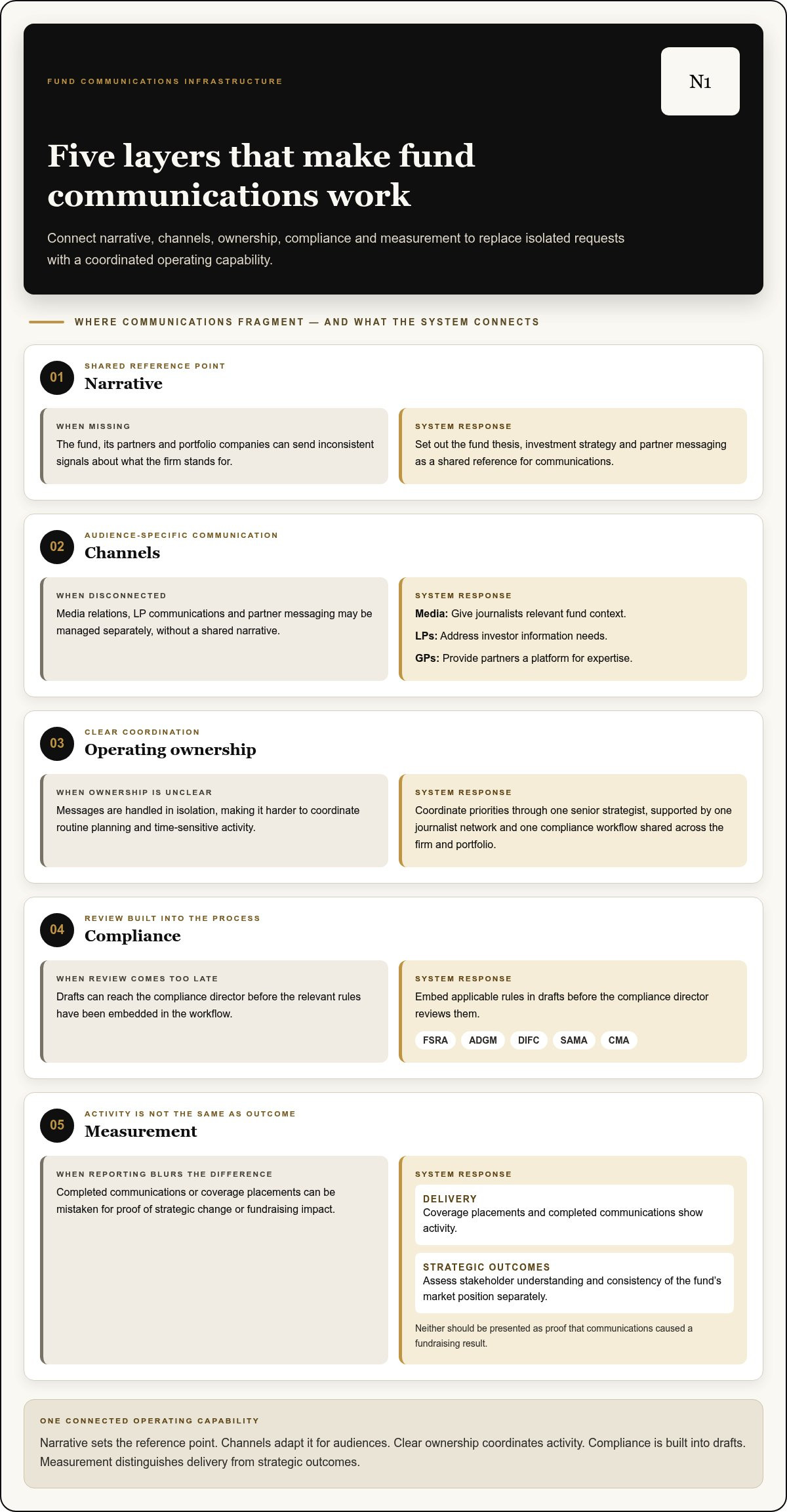
A fund-wide system works when five layers connect: narrative, channels, operating ownership, compliance and measurement. Each has a distinct job. Together, they prevent communications from becoming a queue of unrelated requests and give partners a consistent basis for decisions across the firm and portfolio.
Narrative: Strategy & narrative sets out the fund thesis, investment strategy and partner messaging. It gives each communication a shared reference point.
Channels: Media relations, LP communications and GP thought leadership serve different audiences. Media relations turns relevant fund activity into journalist-facing context; LP communications addresses investor information needs; GP thought leadership gives partners a platform to express their expertise.
Operating ownership: One senior strategist coordinates priorities, supported by one journalist network and one compliance workflow shared across the firm and portfolio. Clear ownership connects routine planning to time-sensitive activity.
Compliance: Rules are embedded in drafts before the compliance director reviews them. The workflow includes FSRA, ADGM, DIFC, SAMA and CMA rules.
Measurement: Reporting separates delivery from strategic outcomes. Coverage placements and completed communications show activity; shifts in stakeholder understanding or the consistency of the fund’s market position require separate assessment. Neither should be presented as proof that communications caused a fundraising result.
Narrative and channels: the system’s strategic layer
The fund narrative is the source for partner, LP and media messaging, not a script every audience receives unchanged. It defines the thesis and priorities; each channel adapts the emphasis to its audience. English and Arabic content should be drafted natively as parallel communications, rather than written in one language and translated after drafting. This helps preserve meaning and audience fit across both versions. A considered fundraise communications strategy connects the investor narrative to channel choices and timing.
Portfolio announcements, Events & speaking, and Monitoring & crisis also connect to this layer. An announcement can reflect a company’s milestones while remaining coherent with the fund’s investment thesis. Events & speaking create planned opportunities for partner visibility; Monitoring & crisis supports coordinated attention to issues. Each output has a distinct purpose, and none should pull the fund narrative in a different direction.
Governance, compliance and measurement: the control layer
Governance assigns decision rights: who shapes the message, who contributes portfolio facts, and who reviews the draft. The compliance director remains part of the review process, but compliance rules are embedded in drafts first. This makes review an integrated control, not a last-minute repair. For a practical model of how these capabilities fit together, explore NarrativeOne’s fund communications approach.
Architecture at a glance: Shared foundation: narrative, ownership, compliance and measurement. Shared channels: LP communications, media relations and GP thought leadership. Fund-specific outputs: partner messages, portfolio announcements, events and issue responses. Each output draws from the same strategic foundation while retaining its audience, purpose and voice.
How to compare communications models for an investment fund
The right operating model depends on the fund’s structure, portfolio needs and internal decision rights. A lean firm with limited recurring activity may not need the same setup as a multi-stage platform coordinating partner visibility and announcements across portfolio companies. Compare how work gets done, not just who produces the next release.
Decision criterion
Fragmented support
In-house ownership
Embedded shared function
Strategic continuity
Built around separate requests; context can be lost between assignments.
Maintained internally when the role has a clear mandate and continuity.
A shared narrative informs recurring work across the firm and portfolio.
Senior access
Depends on the assignment and access arranged for it.
Direct access can support fast internal coordination.
A senior strategist works within the shared communications function.
Portfolio coordination
Separate requests can produce disconnected messages.
Internal teams can coordinate closely, subject to available capacity.
Shared ownership connects portfolio activity to fund positioning while preserving each company’s story.
Compliance integration
Review may be added separately to each task.
Internal accountability is clear when review pathways are defined.
A common workflow can incorporate compliance into drafts and approvals.
Reporting
Often tied to individual deliverables.
Can reflect internal priorities and reporting routines.
Can assess recurring activity and patterns across the firm and portfolio.
When fragmented, in-house or embedded support fits
Fragmented support is task-led. It can suit occasional, clearly scoped communications, but separate announcements may diverge without a coordinating owner. In-house ownership gives the firm direct control and internal accountability; it fits when leaders can assign the mandate, capacity and approval authority. Embedded support functions as a shared operating layer across the firm and portfolio. It suits recurring needs that require continuity without forcing identical messages.
Questions that expose the real operating gap
Before choosing, identify who owns the core narrative, approvals, media relationships and recurring communications cadence. Then examine how a portfolio announcement connects to fund positioning. Does it reinforce the investment case while allowing the company’s distinct strategy and voice to stand on their own? Fund distinction depends on a coherent investment case, not interchangeable company stories. A considered fund brand positioning strategy can help clarify that distinction.
These questions reveal where communications infrastructure for funds needs to sit. If requests are occasional and bounded, task-based support may be proportionate. If internal leaders need direct control and have the capacity to sustain the function, in-house ownership can fit. If narrative, approvals and portfolio activity must work together across recurring communications, an embedded shared function can provide continuity. No model is universally superior. The operating gap determines the choice.
How to implement communications infrastructure across a fund and portfolio
Implementation starts with operating reality, not a calendar of announcements. Map the fund’s thesis, stakeholder groups, portfolio activity and existing approval pathways. Then build communications infrastructure for funds around clear ownership and a repeatable cadence. The sequence is practical: diagnose, define, govern, execute and review.
Diagnose. Inventory current communications across the firm and portfolio. Note recurring LP materials, partner visibility, planned portfolio milestones, active channels and where approvals stall or duplicate.
Define. Set the fund narrative around its thesis and investment strategy. Identify what partners, LPs, media and portfolio companies need to understand, and where their information needs differ.
Govern. Assign decision rights for narrative changes, releases, media engagement, LP materials and crisis response. Record who provides facts, who drafts, who approves and how a decision is escalated.
Execute. Translate the plan into recurring communications and event-driven work. Use shared standards while preserving company-specific approvals, facts and voice.
Review. Assess activity and coordination against the plan. Identify what needs adjustment without treating coverage or communications activity as proof of a particular business result.
A documented operating example is a 12-month narrative plan, executed weekly and reported monthly. The annual horizon establishes direction; weekly execution keeps the plan connected to live activity; monthly reporting creates a structured review point. It is a management cadence, not a promise of a particular outcome. A clear LP communications strategy can also help align investor updates with the fund’s broader narrative.
Set the cadence and shared ownership
One senior strategist, one journalist network and one compliance workflow can support the firm and portfolio as shared capabilities. That does not transfer every decision to a central function. The fund owns its positioning and approvals; each company remains responsible for its announcement facts and company-specific sign-off. The shared function coordinates the work, connects messages to the fund narrative and makes ownership visible.
Build a repeatable announcement workflow
Use the documented sequence exactly: T-14 → T-10 → T-5 → T-2 → Day 0 → +7. Treat each point as a stage in coordinated announcement preparation and follow-up. Align the announcement with the fund narrative, prepare English and Arabic drafts natively as parallel communications, and embed compliance rules before the compliance director reviews drafts. Coordinate journalist targeting through the journalist network, then track follow-up after release. Tier-1 coverage is achievable within 14 days, but the sequence does not guarantee coverage.
Make the process usable: keep the approval path clear, separate shared coordination from company-specific sign-off, and use the monthly review to refine the next cycle. For a coordinated fund and portfolio communications function, explore NarrativeOne’s fund communications support.
NarrativeOne’s fund communications infrastructure: shared capability, senior execution
The operating framework is the standard to evaluate. NarrativeOne applies it to investment firms, including private equity, venture capital and multi-strategy platforms. Its focus is fund positioning and coordinated communications across the firm and portfolio, rather than isolated campaign support. The work draws on 17 years of operating experience inside recognised investment institutions and $2 B+ AUM across 150+ funds/clients.
The model centres on one senior strategist, one journalist network and one compliance workflow shared across the firm and portfolio. That shared capability coordinates priorities and execution while leaving fund leaders and portfolio companies responsible for their own facts, approvals and decisions. It creates continuity without flattening distinct investment strategies or company voices.
What the embedded model centralises
Strategy & narrative establishes the fund’s positioning and investment case. Media relations and Bilingual content connect that foundation to journalist engagement and English and Arabic communications, drafted natively rather than translated after drafting. Together, these capabilities keep the strategic core aligned while adapting each message to its audience.
GP thought leadership, Events & speaking and Monitoring & crisis support partner visibility, planned participation and issue response. The Portfolio announcement service coordinates announcement execution from term-sheet through the coverage timeline. Its documented sequence is T-14 → T-10 → T-5 → T-2 → Day 0 → +7, with Tier-1 coverage achievable within 14 days. This structure supports preparation and follow-up without guaranteeing coverage.
These capabilities work as a connected function, not a requirement to route every portfolio decision through the fund. Shared coordination aligns narrative and process. Company-specific facts, approvals and voice remain distinct. Consistency should clarify the relationship between fund strategy and portfolio activity, not make every company sound the same.
What a fund-wide programme looks like in practice
A 12-month narrative plan, executed weekly and reported monthly, gives the function a defined horizon and a recurring review cadence. Releases, pitches, op-eds and LP materials are drafted simultaneously in English and Arabic, with compliance rules embedded before the compliance director reviews drafts. Monthly reporting provides a point to assess execution and adjust priorities, not a promise of a particular result.
The resulting system makes ownership and cadence visible across fund positioning, media relations, partner communications and portfolio announcements. It gives investment teams a shared operating foundation while preserving the discretion required for each fund and company. Communications infrastructure for funds should be judged by that balance: clear strategic direction, coordinated execution and accountable review.
Discuss how NarrativeOne’s fund positioning and shared communications infrastructure could fit your fund and portfolio structure.
Make the next communications decision deliberate
The next step is not to add another announcement to the calendar. Identify where your fund’s communications lose continuity, then assign ownership to close that gap. A system compounds when each decision strengthens the next, from fund positioning to portfolio activity, without mistaking visibility for guaranteed capital formation.
NarrativeOne brings investment-firm focus to this work, backed by 17 years of operating experience inside investment institutions and $2 B+ AUM across 150+ funds/clients. Forbes Middle East named its founder among the Middle East’s Most Influential CMOs in 2026. These credentials inform the work; the operating fit depends on your fund’s structure, priorities and governance.
Set a clear agenda for the conversation: where coordination breaks down, who needs to be aligned, and what should change in the operating model. Discuss communications infrastructure for your fund and define a practical path forward.
Frequently Asked Questions
What is communications infrastructure for funds?
Communications infrastructure for funds is the coordinated capability a fund uses to manage its narrative, media relations, LP communications, portfolio announcements, governance and measurement. It describes how communications work is organised, not investment in telecoms towers, fibre or connectivity assets. In practice, a fund can use the system to coordinate a partner update and a portfolio milestone while preserving each message’s distinct facts, audience and approval path.
How is fund communications infrastructure different from a PR campaign?
A campaign centres on a defined announcement or period of activity; infrastructure is the ongoing capability that supports those moments. A fund might run a campaign for a new investment, but its underlying system determines who owns the message, how it is reviewed and how it fits the fund’s positioning. A useful diagnostic is whether the communications function remains active between news events or mobilises only when one occurs.
Can one communications function support both a fund and its portfolio companies?
Yes. A shared function can coordinate strategic direction and process while each portfolio company retains control of its own facts and approvals. For a company milestone, the fund can provide context on its investment perspective, while the company confirms the operational details and approves its own message. Clear decision rights prevent coordination from becoming centralised control. NarrativeOne’s investment-firm model shares a senior strategist, journalist network and compliance workflow across the firm and portfolio.
How should funds measure communications infrastructure?
Measure execution and strategic indicators separately. Track whether planned communications occurred, whether releases moved through the agreed approval path, and what media placements resulted. Then assess strategic indicators against a defined starting point and context, such as whether stakeholders can clearly identify the fund’s investment focus. Reporting should help leadership decide what to continue or adjust. Coverage volume alone does not establish that communications caused fundraising interest or investment decisions.
How are compliance reviews built into fund communications?
Build the compliance workflow into drafting, before a draft reaches the compliance director. In NarrativeOne’s process, rules are embedded before that review, including FSRA, ADGM, DIFC, SAMA and CMA rules. The fund should also define who has approval authority for each communication and how review is recorded. This workflow organises communications review; it does not replace the firm’s own legal or compliance authority.
Why do funds need bilingual communications rather than translated releases?
Native English and Arabic drafting treats each version as an authored communication, not a copy converted after the message is finished. That matters when the same release, pitch, op-ed or LP material must preserve strategic meaning and financial precision in both languages. Drafting in parallel also gives reviewers a clearer basis for checking that key facts and positioning remain consistent across versions before publication.
What is the difference between LP communications and media relations?
LP communications serve limited partners and prospective investors; media relations serves journalists and publications. An LP update might explain a portfolio development in the context of the fund’s relationship with investors, while a media pitch frames the development for a publication’s audience. The underlying facts and strategic position should remain consistent, but the purpose, emphasis and approval path differ. Treating the channels as interchangeable risks giving each audience the wrong level of context.
Frequently Asked Questions
What belongs inside a fund communications system?
A system connects several functions that are often managed separately: These capabilities operate continuously; an announcement is a discrete event within them. For example, a portfolio company’s funding milestone needs its own story and voice, while the fund’s contribution can be framed consistently with its investment thesis. Shared narrative creates alignment, not uniformity. Each company keeps its identity, while the fund’s communications explain how its activity fits the wider strategy.
What is communications infrastructure for funds?
Communications infrastructure for funds is the coordinated capability a fund uses to manage its narrative, media relations, LP communications, portfolio announcements, governance and measurement. It describes how communications work is organised, not investment in telecoms towers, fibre or connectivity assets. In practice, a fund can use the system to coordinate a partner update and a portfolio milestone while preserving each message’s distinct facts, audience and approval path.
How is fund communications infrastructure different from a PR campaign?
A campaign centres on a defined announcement or period of activity; infrastructure is the ongoing capability that supports those moments. A fund might run a campaign for a new investment, but its underlying system determines who owns the message, how it is reviewed and how it fits the fund’s positioning. A useful diagnostic is whether the communications function remains active between news events or mobilises only when one occurs.
Can one communications function support both a fund and its portfolio companies?
Yes. A shared function can coordinate strategic direction and process while each portfolio company retains control of its own facts and approvals. For a company milestone, the fund can provide context on its investment perspective, while the company confirms the operational details and approves its own message. Clear decision rights prevent coordination from becoming centralised control. NarrativeOne’s investment-firm model shares a senior strategist, journalist network and compliance workflow across the firm and portfolio.
How should funds measure communications infrastructure?
Measure execution and strategic indicators separately. Track whether planned communications occurred, whether releases moved through the agreed approval path, and what media placements resulted. Then assess strategic indicators against a defined starting point and context, such as whether stakeholders can clearly identify the fund’s investment focus. Reporting should help leadership decide what to continue or adjust. Coverage volume alone does not establish that communications caused fundraising interest or investment decisions.
How are compliance reviews built into fund communications?
Build the compliance workflow into drafting, before a draft reaches the compliance director. In NarrativeOne’s process, rules are embedded before that review, including FSRA, ADGM, DIFC, SAMA and CMA rules. The fund should also define who has approval authority for each communication and how review is recorded. This workflow organises communications review; it does not replace the firm’s own legal or compliance authority.
Why do funds need bilingual communications rather than translated releases?
Native English and Arabic drafting treats each version as an authored communication, not a copy converted after the message is finished. That matters when the same release, pitch, op-ed or LP material must preserve strategic meaning and financial precision in both languages. Drafting in parallel also gives reviewers a clearer basis for checking that key facts and positioning remain consistent across versions before publication.
What is the difference between LP communications and media relations?
LP communications serve limited partners and prospective investors; media relations serves journalists and publications. An LP update might explain a portfolio development in the context of the fund’s relationship with investors, while a media pitch frames the development for a publication’s audience. The underlying facts and strategic position should remain consistent, but the purpose, emphasis and approval path differ. Treating the channels as interchangeable risks giving each audience the wrong level of context.