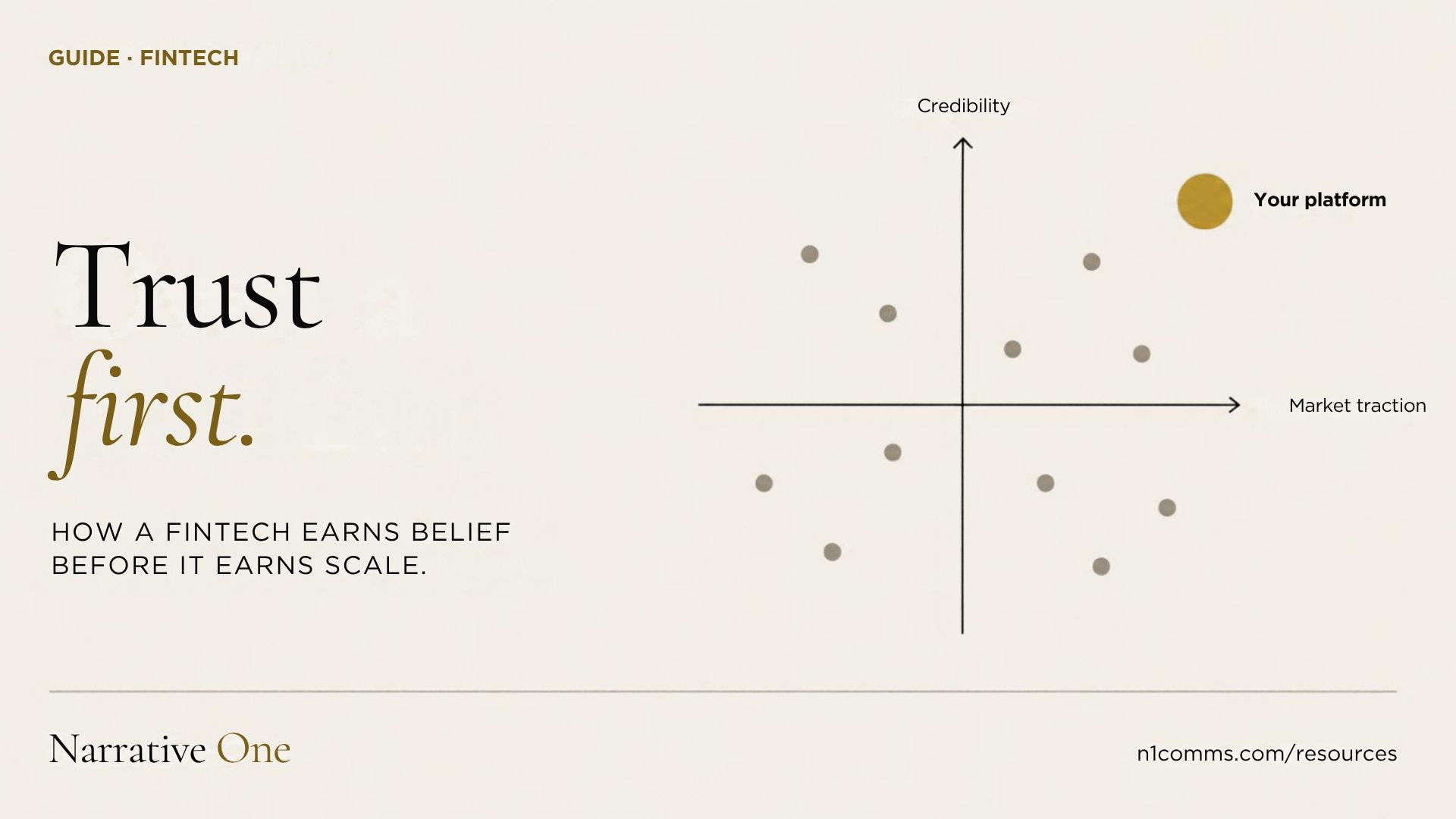
A fintech launch can earn attention and still weaken trust. A communications strategy for fintech founders is not a press calendar. It’s the operating system that keeps claims clear, consistent and credible as the company grows.
Founders need to explain their product to customers, investors, employees and partners. The challenge is making the same core story relevant to each audience without overstating what the technology does or letting claims drift across channels. Under regulatory and reputational scrutiny, improvisation is a liability. A sound system puts accuracy and review before visibility, including compliance-officer workflow and legal sign-off before a release reaches journalists.
This practical framework shows what fintech communications should include and how to put it into practice. It covers narrative, stakeholder messaging, channel consistency, bilingual content and review processes, so communication supports growth beyond individual launches. The objective is clear: explain the company plainly, align the people who matter and protect credibility as the business moves forward.
Key Takeaways
Build a communications strategy for fintech founders around clear claims, supporting evidence and consistent approval, not just launch announcements.
Shape a core company narrative by defining the problem, product, audience, evidence and ambition, then adapt its explanation for each stakeholder.
Settle message ownership, evidence and review paths before high-attention moments. Communications review supports accuracy but does not replace legal advice or regulatory approval.
Turn the strategy into a repeatable system with defined objectives, owners, channels, schedules and separate paths for planned and reactive communications.
See how a twelve-month programme and one senior operator can connect narrative development, English and Arabic drafting, journalist targeting and compliance review.
Table of Contents
Why fintech founders need a communications strategy before the next milestone
Build a fintech narrative that makes the business easy to understand
Address fintech trust, compliance and reputation before scrutiny arrives
Turn the strategy into a repeatable communications operating system
How NarrativeOne builds communications infrastructure for fintech founders
Why fintech founders need a communications strategy before the next milestone
A fintech company communicates long before its next funding announcement or product launch. Customers assess whether a service is understandable. Investors test whether the opportunity is credible. Employees and partners need a consistent account of what the business does and where it is going. Without a system, each interaction can produce a slightly different version of the company.
A communications strategy for fintech founders is the operating system that governs what the company says, to whom, when and with whose approval. It sets the core claims, evidence, audience priorities and review paths that guide communications across channels. Strategic communication is the purposeful use of communication to achieve specific goals. For fintech, that purpose includes building stakeholder confidence through clear claims and consistent execution.
Quotable definition: Fintech communications is the disciplined system that aligns what a company says with what stakeholders need to know, building confidence through accurate claims and operational consistency.
Which stakeholders does a fintech founder need to reach?
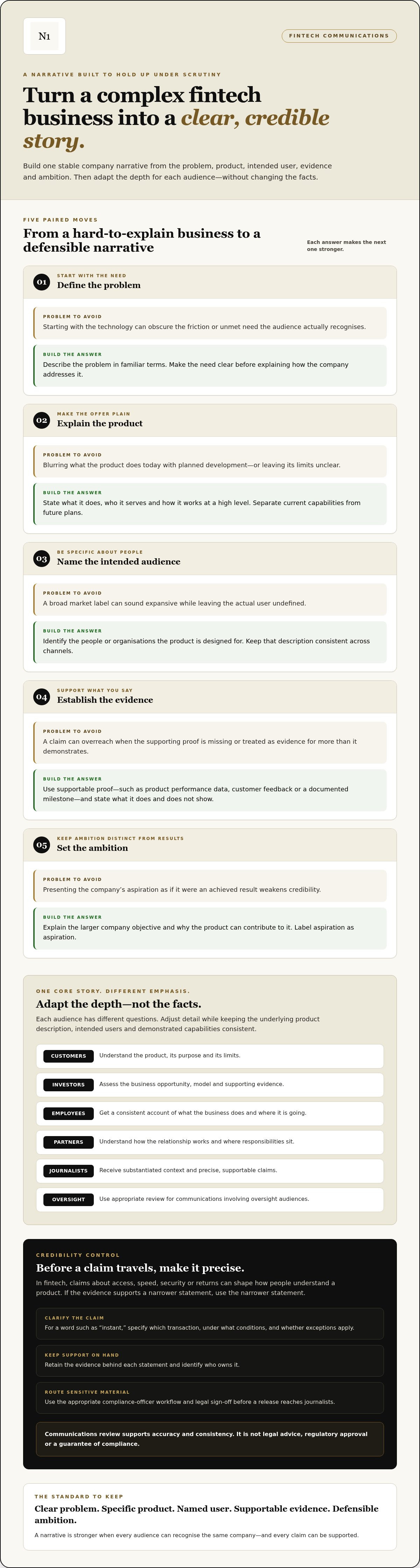
One company narrative must serve audiences with different questions. Customers need to understand the product and its limits; investors need a credible view of the business and its evidence. Employees need direction, partners need clarity on how the relationship works, journalists need substantiated context, and communications for oversight audiences need appropriate review.
Product validation: Prioritise customer understanding and evidence that the problem and product are clear.
Growth: Equip employees, partners and investors with consistent explanations of progress and strategic priorities.
Institutional credibility: Prepare precise, supportable messaging for journalists and other audiences assessing the company’s claims.
Adjust depth, not facts. A customer-facing explanation may avoid technical detail; an investor briefing may examine the business model more closely. Neither should change the underlying description of the product, its intended users or its demonstrated capabilities.
What changes when the company operates in fintech?
Financial products leave little room for ambiguity. A claim about access, speed, security or returns can shape how people understand a product and decide whether to use it. Founders should be able to explain plainly what the product does, who it is designed for, what evidence supports its claims and where its limits sit. Precision is a trust control.
For example, describing a payment tool as “instant” invites questions about which transaction, under what conditions and whether exceptions apply. If the evidence supports a narrower claim, use the narrower claim. Keep supporting evidence on hand, identify who owns each statement and route sensitive material through the appropriate review. Communications review helps control accuracy and consistency; it is not legal advice, regulatory approval or a guarantee of compliance.
Publicity has a role, but it cannot substitute for this foundation. A press release, content calendar or launch announcement is a single output. Strategy connects those outputs to company objectives, stakeholder needs and approval discipline. Build that system before a milestone creates pressure to improvise.
Build a fintech narrative that makes the business easy to understand
A strong narrative makes a technically complex business legible without flattening its value. It gives founders a stable account of the problem, solution and evidence, then lets them adjust detail for the audience and moment. That’s the practical core of a communications strategy for fintech founders: clarity that holds across investor conversations, product materials and public commentary.
Quotable distinction: A fintech narrative explains why the company exists and what supports its claims; a product pitch sells one offer to one audience.
Build the narrative in sequence. Each step should answer a question a skeptical reader could reasonably ask.
Define the problem. Describe the friction or unmet need in terms the intended audience recognises. Avoid starting with the technology.
Explain the product. State what it does, who it serves and how it works at a high level. Separate current capabilities from planned development.
Name the audience. Identify the people or organisations the product is designed for. A broad market label is not a substitute for a clear user.
Establish the evidence. Use supportable proof, such as product performance data, customer feedback or a documented milestone. Make clear what each piece of evidence does and does not demonstrate.
Set the ambition. Explain the larger company objective and why the product can contribute to it. Keep aspiration distinct from achieved results.
What should a fintech founder’s core narrative contain?
The core narrative should connect a recognisable problem to a specific product, intended user, credible evidence and an ambition the company can defend. Test every sentence: could the team support this claim with facts, and would a customer understand what it means? Replace generic phrases such as “revolutionary platform” with a concrete explanation of the task the product performs and the evidence behind its distinction.
Technical language often hides the value rather than proving it. Translate features into their practical significance, then preserve the mechanism when it matters. For example, instead of saying a platform uses a complex data architecture, explain what information it brings together and what task that enables. Don’t claim faster decisions, lower costs or better outcomes unless evidence supports those claims. A useful editing test is to mark each statement as a fact, interpretation or aspiration, then make sure the wording doesn’t blur the categories.
How should the narrative adapt for different audiences?
Keep the central facts fixed; vary emphasis and depth. Customers need a clear account of use and limits. Investors need the market rationale, business logic and evidence. Employees need strategic direction they can apply. Partners need to understand the product’s role in the relationship. Founder thought leadership should extend the company’s expertise, not become disconnected personal commentary.
Keep three layers distinct: the core company narrative, audience-specific explanations and campaign messages tied to a particular announcement. This prevents a launch headline from becoming the company’s entire identity. For founders developing that narrative into sustained market positioning, founder narrative development can connect the company story with its communications programme.
Address fintech trust, compliance and reputation before scrutiny arrives
High-attention moments compress decision time. A funding announcement, product change, service disruption or public challenge can put company claims under immediate examination. If ownership, evidence and approval paths are unclear, teams may publish inconsistent explanations or make assurances they can’t support.
Quotable principle: Compliance-aware communication starts before publication, with claims, evidence, ownership and review built into the process.
A communications strategy for fintech founders should make review part of the operating model, not an emergency step. Disciplined review can add time. Unmanaged speed can cost more: conflicting statements require correction, weaken confidence and complicate the response. Communications review helps assess clarity, accuracy and consistency. It is not legal advice, regulatory approval or a guarantee of compliance. Questions about legal or regulatory requirements belong with qualified advisers.
How can founders make communications compliance-aware?
Set responsibility before drafting begins. Assign an owner to prepare the message, a subject-matter owner to verify product and performance claims, and a defined reviewer for approval. Keep a central record of approved claims, evidence, dates and the versions used across channels. This gives the team a clear reference point when a release, website statement or investor message needs updating.
For any release intended for journalists, build the compliance-officer workflow and mandatory legal sign-off into the process before distribution. If legal review is required for another communication, complete it before publication as well. No deadline should bypass the assigned approval path.
What belongs in a fintech reputation response plan?
A response plan should specify what triggers escalation, who convenes decision-makers and who is authorised to speak. Define internal responsibilities in advance, including who gathers facts, who checks them and who approves an external update. The plan should also distinguish routine customer questions from events that may affect confidence in the product or company.
Before drafting a public statement, establish what is known, what remains unverified and when the next update can responsibly be made. Accuracy comes first. Timeliness matters too, but speed is not a reason to speculate.
Escalation: Identify the event or claim that requires senior review, and name the person who initiates it.
Fact gathering: Confirm the timeline, affected product or service, available evidence and unresolved questions with accountable internal owners.
Spokespeople: Select an authorised voice and ensure employees know where to direct external inquiries.
Updates: Share verified information, state what is still being assessed and avoid unsupported assurances about outcomes or timing.
After the immediate response, preserve the approved statements and record what changed as facts developed. Review whether the escalation path worked and whether customer, employee and partner communications remained aligned. This turns a difficult event into a controlled process, not a series of improvised messages.
Turn the strategy into a repeatable communications operating system
A strategy only creates value when the team can execute it repeatedly. The communications strategy for fintech founders should function like an operating system: objectives guide activity, owners control execution, approvals protect accuracy and evidence informs the next decision. It must work between announcements, not only when a milestone creates a reason to publish.
Build the system in sequence:
Set objectives. Define the outcome communication should support, such as improving customer understanding of a product feature or giving investors a clearer account of a business milestone.
Assign owners. Name the person responsible for the message, factual input, review and final approval. Make decision rights explicit.
Choose channels. Select channels according to audience and objective, not habit. Give each channel a defined role.
Schedule activity. Map planned communications to company priorities and a sustainable cadence. Leave capacity for material developments and response work.
Review evidence. Compare results with the objective and baseline. Record what changed, what did not and what the team will adjust.
Separate planned communications from reactive responses. Planned work can follow a calendar and standard review path. Reactive work needs an escalation owner, a fact-gathering process and an approval route that can be activated quickly without bypassing necessary review. A product update and an unexpected service issue shouldn’t compete for the same process.
How should founders choose channels and cadence?
Match the channel to its job. Company-owned content can explain product changes in depth; founder visibility can articulate the company’s perspective; press engagement can add external context to a substantiated milestone; internal updates can help employees communicate consistently. Choose a cadence the team can sustain. A regular, useful update is stronger than a burst of announcements followed by silence.
Plan activity around the company’s actual operating rhythm: product milestones, evidence worth sharing, investor communications and meaningful changes in the market. Don’t manufacture news to fill a calendar. Consistency comes from a clear narrative and dependable execution, not constant publication.
How can founders assess whether communications is working?
Choose measures that correspond to the objective. For customer understanding, review relevant questions and feedback. For press engagement, assess the accuracy and relevance of coverage, not just its volume. For stakeholder alignment, look for recurring inconsistencies in how employees, partners or investors describe the company. Impressions show distribution; they don’t prove trust, comprehension or commercial impact.
Record a baseline before changing the channel mix or message. At each review, compare observed results with the stated objective, note what evidence supports the conclusion and adjust the narrative, cadence or approval process accordingly. Use findings to make the system more precise, not to inflate activity.
For a structured approach to founder communications, explore NarrativeOne's founder communications approach.
How NarrativeOne builds communications infrastructure for fintech founders
A communications strategy for fintech founders needs continuity: the company’s story, stakeholder priorities and review requirements evolve as the business develops. NarrativeOne delivers twelve-month communications programmes, not isolated announcement projects. The work connects narrative development, market authority, investor-grade press presence and thought leadership within a sustained programme, giving founders a consistent operating structure across milestones.
What does a NarrativeOne communications programme involve?
One senior operator leads the work, providing a clear point of accountability rather than implying separate senior teams. Narrative development informs market positioning, press activity and founder thought leadership. Content is drafted in English and Arabic, with native Arabic writing rather than after-the-fact translation. Journalist targeting, monitoring and reporting connect distribution to ongoing assessment.
Review is built into the workflow. The compliance-officer workflow includes mandatory legal sign-off before any release reaches journalists. That sequence establishes an approval checkpoint before distribution, rather than treating review as an optional final pass.
Narrative and authority: Clarify the company’s position and develop a credible presence in its market.
Press and thought leadership: Connect investor-grade press presence with founder perspectives that support the company’s wider story.
Bilingual execution: Draft English and Arabic content, with native Arabic writing, then align journalist targeting and review before distribution.
Monitoring and reporting: Track communications activity and report on its execution over the programme.
The experience informing this work includes 17 years building companies, running accelerators and leading communications. NarrativeOne’s technology-firm material records 200+ startup milestones announced and placed. It also reports $1 B+ valuation impact; that figure does not establish that communications alone caused those outcomes. Neither coverage nor business results should be treated as guaranteed.
When should a fintech founder consider structured communications support?
Structured support becomes valuable when the company is preparing for a raise, entering a market, announcing a product milestone or building a more visible founder profile. It also matters when teams struggle to explain the business consistently, when communications span English and Arabic, or when approval processes need more discipline.
A sustained programme gives these demands a shared narrative and repeatable workflow as priorities change. The objective is not constant publicity. It is reliable communication between milestones, with the right evidence, audience and review path behind each message. NarrativeOne’s communications approach provides a structured way to develop that consistency.
Put the next communications decision on a stronger footing
The next step isn’t to publish more. It’s to decide what your company needs its communications to make possible, then give that priority the attention and ownership it deserves. A communications strategy for fintech founders becomes valuable when it informs real decisions: what to explain, what evidence to lead with and when to hold a claim back.
Start with one upcoming business priority. Ask what customers, investors or partners need to understand to engage with it confidently. Then identify the message that can help, the proof behind it and the person accountable for carrying it forward. This creates a practical starting point, not another document that sits untouched.
NarrativeOne’s technology-firm material records 200+ startup milestones announced and placed, alongside an attributed aggregate of $1 B+ in valuation impact. These figures are context, not a promise of coverage or business results. The work begins with the communications needs of your company and the discipline required to address them.
Start a conversation about your communications priorities. Build deliberately, and give stakeholder confidence a stronger foundation to grow.
Frequently Asked Questions
What is the difference between fintech marketing and communications?
Marketing primarily supports demand, customer acquisition and product adoption. Communications manages how the company is understood across a wider set of relationships, including customers, investors, employees, partners and the media. The functions can share messages, but they serve different objectives. For example, a campaign may encourage people to try a product, while company communications clarifies how the business works and what stakeholders can reasonably expect.
When should a fintech startup develop its communications strategy?
Develop it before the company begins making consequential external claims, not after a high-profile announcement creates pressure. For an early-stage team, that may mean setting message ownership before product validation interviews or investor discussions. As the company changes its offering, enters a new market or prepares for a fundraising milestone, revisit the communications strategy for fintech founders so explanations reflect the current business rather than an outdated pitch.
Can a fintech founder communicate publicly before product launch?
Yes, if the founder can distinguish what exists now from what is still being built. Public communication can explain the problem, the company’s perspective or the development process without presenting an unreleased feature as available. Before publishing, check that statements about capabilities, timing and intended users are supportable and approved through the company’s review process. Clear boundaries help founders build understanding without creating expectations the product cannot yet meet.
How should fintech founders explain a complex product to non-experts?
Start with the task the product helps a user complete, then explain the product’s role in that process. Introduce technical terms only when they clarify how it works, and define them in plain language. For instance, replace an internal description of an API architecture with an explanation of what information is exchanged and why that matters to the user. Ask someone outside the product team to explain it back; gaps reveal where the explanation needs work.
What should a fintech communications plan include for a product issue?
Include a decision owner, a verified fact source, an escalation route and a process for coordinating updates across customer-facing and internal channels. The first message should identify what is confirmed, what remains under review and where affected stakeholders can find the next update, if that channel is established. Avoid speculating about causes or promising resolution times without evidence. Keep a dated record of approved statements so teams don’t circulate conflicting versions.
How can a fintech founder measure communications effectiveness?
Test whether the intended audience understands the message, not only whether it was distributed. After an investor briefing, for example, note which questions repeatedly expose gaps in the company’s explanation. In customer conversations, check whether people can describe the product’s purpose accurately. Pair these qualitative signals with channel-specific data, then assess whether results align with the original objective. Treat business outcomes as influenced by many factors, not as automatic proof of communications impact.
Frequently Asked Questions
Which stakeholders does a fintech founder need to reach?
One company narrative must serve audiences with different questions. Customers need to understand the product and its limits; investors need a credible view of the business and its evidence. Employees need direction, partners need clarity on how the relationship works, journalists need substantiated context, and communications for oversight audiences need appropriate review. Adjust depth, not facts. A customer-facing explanation may avoid technical detail; an investor briefing may examine the business model more closely. Neither should change the underlying description of the product, its intended users or its demonstrated capabilities.
What changes when the company operates in fintech?
Financial products leave little room for ambiguity. A claim about access, speed, security or returns can shape how people understand a product and decide whether to use it. Founders should be able to explain plainly what the product does, who it is designed for, what evidence supports its claims and where its limits sit. Precision is a trust control. For example, describing a payment tool as “instant” invites questions about which transaction, under what conditions and whether exceptions apply. If the evidence supports a narrower claim, use the narrower claim. Keep supporting evidence on hand, identify who owns each statement and route sensitive material through the appropriate review. Communications review helps control accuracy and consistency; it is not legal advice, regulatory approval or a guarantee of compliance. Publicity has a role, but it cannot substitute for this foundation. A press release, content calendar or launch announcement is a single output. Strategy connects those outputs to company objectives, stakeholder needs and approval discipline. Build that system before a milestone creates pressure to improvise. A strong narrative makes a technically complex business legible without flattening its value. It gives founders a stable account of the problem, solution and evidence, then lets them adjust detail for the audience and moment. That’s the practical core of a communications strategy for fintech founders: clarity that holds across investor conversations, product materials and public commentary. Quotable distinction: A fintech narrative explains why the company exists and what supports its claims; a product pitch sells one offer to one audience. Build the narrative in sequence. Each step should answer a question a skeptical reader could reasonably ask.
What should a fintech founder’s core narrative contain?
The core narrative should connect a recognisable problem to a specific product, intended user, credible evidence and an ambition the company can defend. Test every sentence: could the team support this claim with facts, and would a customer understand what it means? Replace generic phrases such as “revolutionary platform” with a concrete explanation of the task the product performs and the evidence behind its distinction. Technical language often hides the value rather than proving it. Translate features into their practical significance, then preserve the mechanism when it matters. For example, instead of saying a platform uses a complex data architecture, explain what information it brings together and what task that enables. Don’t claim faster decisions, lower costs or better outcomes unless evidence supports those claims. A useful editing test is to mark each statement as a fact, interpretation or aspiration, then make sure the wording doesn’t blur the categories.
How should the narrative adapt for different audiences?
Keep the central facts fixed; vary emphasis and depth. Customers need a clear account of use and limits. Investors need the market rationale, business logic and evidence. Employees need strategic direction they can apply. Partners need to understand the product’s role in the relationship. Founder thought leadership should extend the company’s expertise, not become disconnected personal commentary. Keep three layers distinct: the core company narrative, audience-specific explanations and campaign messages tied to a particular announcement. This prevents a launch headline from becoming the company’s entire identity. For founders developing that narrative into sustained market positioning, founder narrative development can connect the company story with its communications programme. High-attention moments compress decision time. A funding announcement, product change, service disruption or public challenge can put company claims under immediate examination. If ownership, evidence and approval paths are unclear, teams may publish inconsistent explanations or make assurances they can’t support. Quotable principle: Compliance-aware communication starts before publication, with claims, evidence, ownership and review built into the process. A communications strategy for fintech founders should make review part of the operating model, not an emergency step. Disciplined review can add time. Unmanaged speed can cost more: conflicting statements require correction, weaken confidence and complicate the response. Communications review helps assess clarity, accuracy and consistency. It is not legal advice, regulatory approval or a guarantee of compliance. Questions about legal or regulatory requirements belong with qualified advisers.
How can founders make communications compliance-aware?
Set responsibility before drafting begins. Assign an owner to prepare the message, a subject-matter owner to verify product and performance claims, and a defined reviewer for approval. Keep a central record of approved claims, evidence, dates and the versions used across channels. This gives the team a clear reference point when a release, website statement or investor message needs updating. For any release intended for journalists, build the compliance-officer workflow and mandatory legal sign-off into the process before distribution. If legal review is required for another communication, complete it before publication as well. No deadline should bypass the assigned approval path.
What belongs in a fintech reputation response plan?
A response plan should specify what triggers escalation, who convenes decision-makers and who is authorised to speak. Define internal responsibilities in advance, including who gathers facts, who checks them and who approves an external update. The plan should also distinguish routine customer questions from events that may affect confidence in the product or company. Before drafting a public statement, establish what is known, what remains unverified and when the next update can responsibly be made. Accuracy comes first. Timeliness matters too, but speed is not a reason to speculate. After the immediate response, preserve the approved statements and record what changed as facts developed. Review whether the escalation path worked and whether customer, employee and partner communications remained aligned. This turns a difficult event into a controlled process, not a series of improvised messages. A strategy only creates value when the team can execute it repeatedly. The communications strategy for fintech founders should function like an operating system: objectives guide activity, owners control execution, approvals protect accuracy and evidence informs the next decision. It must work between announcements, not only when a milestone creates a reason to publish. Build the system in sequence: Separate planned communications from reactive responses. Planned work can follow a calendar and standard review path. Reactive work needs an escalation owner, a fact-gathering process and an approval route that can be activated quickly without bypassing necessary review. A product update and an unexpected service issue shouldn’t compete for the same process.
How should founders choose channels and cadence?
Match the channel to its job. Company-owned content can explain product changes in depth; founder visibility can articulate the company’s perspective; press engagement can add external context to a substantiated milestone; internal updates can help employees communicate consistently. Choose a cadence the team can sustain. A regular, useful update is stronger than a burst of announcements followed by silence. Plan activity around the company’s actual operating rhythm: product milestones, evidence worth sharing, investor communications and meaningful changes in the market. Don’t manufacture news to fill a calendar. Consistency comes from a clear narrative and dependable execution, not constant publication.
How can founders assess whether communications is working?
Choose measures that correspond to the objective. For customer understanding, review relevant questions and feedback. For press engagement, assess the accuracy and relevance of coverage, not just its volume. For stakeholder alignment, look for recurring inconsistencies in how employees, partners or investors describe the company. Impressions show distribution; they don’t prove trust, comprehension or commercial impact. Record a baseline before changing the channel mix or message. At each review, compare observed results with the stated objective, note what evidence supports the conclusion and adjust the narrative, cadence or approval process accordingly. Use findings to make the system more precise, not to inflate activity. For a structured approach to founder communications, explore NarrativeOne's founder communications approach. A communications strategy for fintech founders needs continuity: the company’s story, stakeholder priorities and review requirements evolve as the business develops. NarrativeOne delivers twelve-month communications programmes, not isolated announcement projects. The work connects narrative development, market authority, investor-grade press presence and thought leadership within a sustained programme, giving founders a consistent operating structure across milestones.
What does a NarrativeOne communications programme involve?
One senior operator leads the work, providing a clear point of accountability rather than implying separate senior teams. Narrative development informs market positioning, press activity and founder thought leadership. Content is drafted in English and Arabic, with native Arabic writing rather than after-the-fact translation. Journalist targeting, monitoring and reporting connect distribution to ongoing assessment. Review is built into the workflow. The compliance-officer workflow includes mandatory legal sign-off before any release reaches journalists. That sequence establishes an approval checkpoint before distribution, rather than treating review as an optional final pass. The experience informing this work includes 17 years building companies, running accelerators and leading communications. NarrativeOne’s technology-firm material records 200+ startup milestones announced and placed. It also reports $1 B+ valuation impact; that figure does not establish that communications alone caused those outcomes. Neither coverage nor business results should be treated as guaranteed.
When should a fintech founder consider structured communications support?
Structured support becomes valuable when the company is preparing for a raise, entering a market, announcing a product milestone or building a more visible founder profile. It also matters when teams struggle to explain the business consistently, when communications span English and Arabic, or when approval processes need more discipline. A sustained programme gives these demands a shared narrative and repeatable workflow as priorities change. The objective is not constant publicity. It is reliable communication between milestones, with the right evidence, audience and review path behind each message. NarrativeOne’s communications approach provides a structured way to develop that consistency. The next step isn’t to publish more. It’s to decide what your company needs its communications to make possible, then give that priority the attention and ownership it deserves. A communications strategy for fintech founders becomes valuable when it informs real decisions: what to explain, what evidence to lead with and when to hold a claim back. Start with one upcoming business priority. Ask what customers, investors or partners need to understand to engage with it confidently. Then identify the message that can help, the proof behind it and the person accountable for carrying it forward. This creates a practical starting point, not another document that sits untouched. NarrativeOne’s technology-firm material records 200+ startup milestones announced and placed, alongside an attributed aggregate of $1 B+ in valuation impact. These figures are context, not a promise of coverage or business results. The work begins with the communications needs of your company and the discipline required to address them. Start a conversation about your communications priorities. Build deliberately, and give stakeholder confidence a stronger foundation to grow.
What is the difference between fintech marketing and communications?
Marketing primarily supports demand, customer acquisition and product adoption. Communications manages how the company is understood across a wider set of relationships, including customers, investors, employees, partners and the media. The functions can share messages, but they serve different objectives. For example, a campaign may encourage people to try a product, while company communications clarifies how the business works and what stakeholders can reasonably expect.
When should a fintech startup develop its communications strategy?
Develop it before the company begins making consequential external claims, not after a high-profile announcement creates pressure. For an early-stage team, that may mean setting message ownership before product validation interviews or investor discussions. As the company changes its offering, enters a new market or prepares for a fundraising milestone, revisit the communications strategy for fintech founders so explanations reflect the current business rather than an outdated pitch.
Can a fintech founder communicate publicly before product launch?
Yes, if the founder can distinguish what exists now from what is still being built. Public communication can explain the problem, the company’s perspective or the development process without presenting an unreleased feature as available. Before publishing, check that statements about capabilities, timing and intended users are supportable and approved through the company’s review process. Clear boundaries help founders build understanding without creating expectations the product cannot yet meet.
How should fintech founders explain a complex product to non-experts?
Start with the task the product helps a user complete, then explain the product’s role in that process. Introduce technical terms only when they clarify how it works, and define them in plain language. For instance, replace an internal description of an API architecture with an explanation of what information is exchanged and why that matters to the user. Ask someone outside the product team to explain it back; gaps reveal where the explanation needs work.
What should a fintech communications plan include for a product issue?
Include a decision owner, a verified fact source, an escalation route and a process for coordinating updates across customer-facing and internal channels. The first message should identify what is confirmed, what remains under review and where affected stakeholders can find the next update, if that channel is established. Avoid speculating about causes or promising resolution times without evidence. Keep a dated record of approved statements so teams don’t circulate conflicting versions.
How can a fintech founder measure communications effectiveness?
Test whether the intended audience understands the message, not only whether it was distributed. After an investor briefing, for example, note which questions repeatedly expose gaps in the company’s explanation. In customer conversations, check whether people can describe the product’s purpose accurately. Pair these qualitative signals with channel-specific data, then assess whether results align with the original objective. Treat business outcomes as influenced by many factors, not as automatic proof of communications impact.