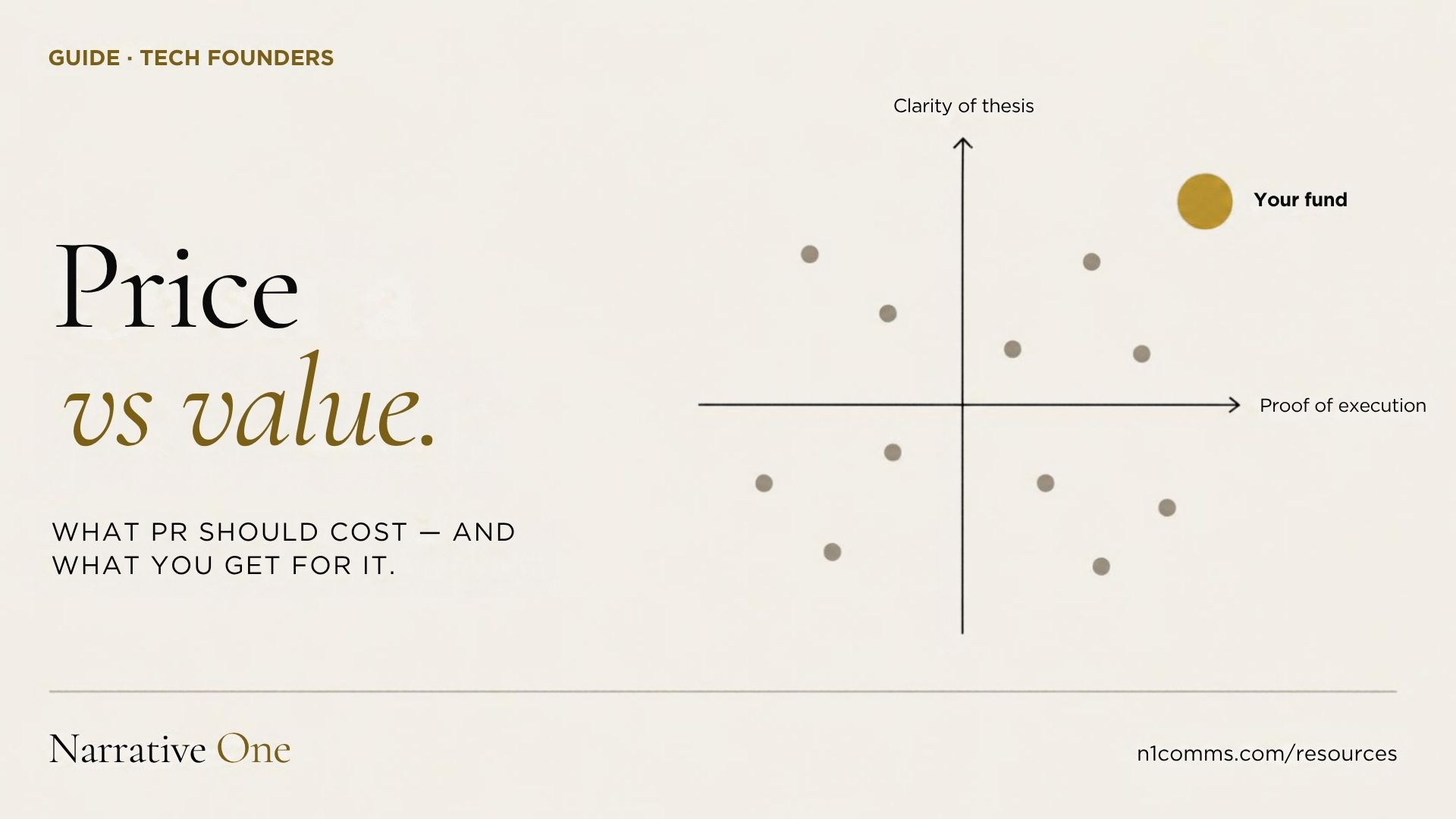
A tech PR retainer doesn’t buy headlines. It funds the operating system behind communications: strategic counsel, narrative development, disciplined execution, and accountability. The cost of tech PR agency 2026 is difficult to assess when proposals define scope differently, retainer language obscures who does the work, and coverage is presented without a clear link to business priorities. A fee should be judged by the work and operating model it funds, not by headline promises.
This guide explains what a tech PR engagement can deliver and how to compare commercial models against your company’s stage and communications priorities. It distinguishes strategic communications from one-off press release distribution, clarifies what senior operator involvement and delivery responsibilities mean, and shows how to assess coverage as an objective of targeted execution, not a guaranteed result. Use the practical framework to evaluate scope, operating rhythm, and accountability before committing. The central test is simple: does the engagement build communications capacity that compounds, or pay for isolated activity?
Key Takeaways
Assess the cost of tech PR agency 2026 by defining scope, seniority, operating model, and delivery responsibilities, not by comparing headline fees alone.
Separate strategic communications work, including narrative, media relations, compliance, and reporting, from a one-off project or distribution-only transaction.
Use a proposal review to connect objectives, ownership, workflow, reporting, and success measures to concrete company priorities.
Account for bilingual native drafting as distinct English and Arabic content and pitches, with mandatory legal sign-off before a release reaches journalists.
See how NarrativeOne’s twelve-month communications programme pairs a senior operator with journalist targeting, monitoring, and reporting.
Table of Contents
Which Tech PR Agency Services Drive the Scope of an Engagement?
Tech PR Retainer, Project, or Distribution: What Are You Comparing?
How to Evaluate a Tech PR Agency Proposal Without a Price Benchmark
What Determines the Cost of a Tech PR Agency in 2026?
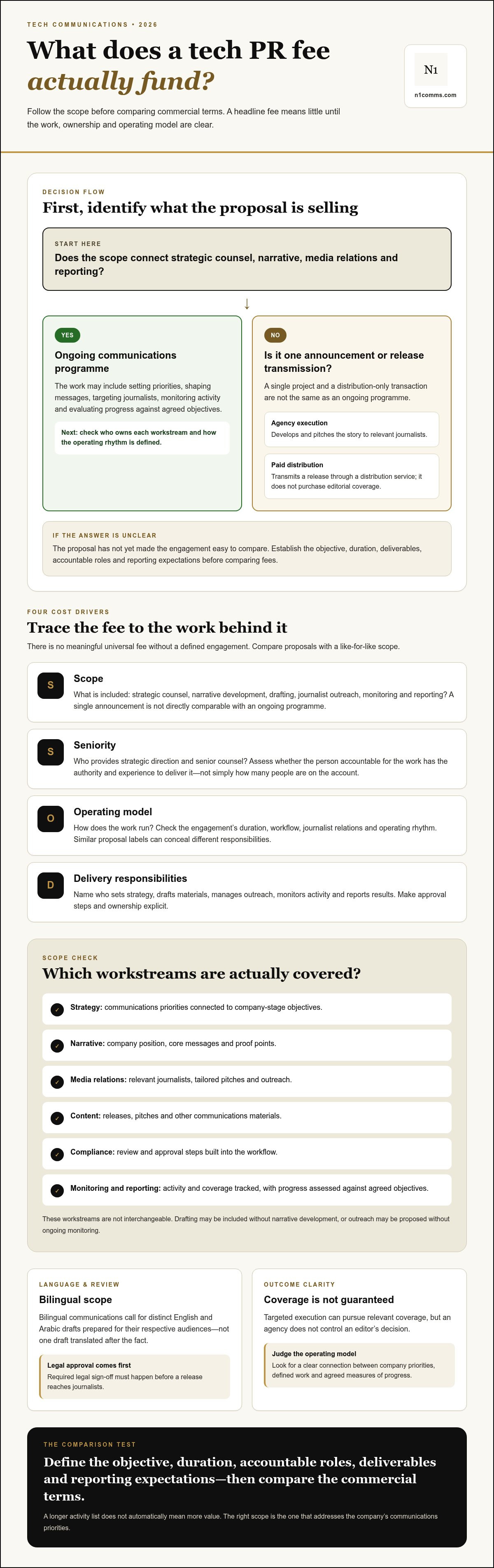
The cost of a tech PR agency in 2026 reflects four variables: scope, seniority, operating model, and delivery responsibilities. There is no meaningful universal fee without a defined engagement. A proposal for one announcement cannot be compared directly with an ongoing programme that covers company narrative, media relations, and reporting. Specify the work first, then assess the commercial terms.
Public relations includes more than publicity. Its functions can span strategic counsel, communication planning, and relationships with media, as outlined in this overview of public relations. For a technology company, the practical question is which functions support its current priorities, such as explaining a new category, building founder credibility, or communicating a company milestone.
What does a technology PR agency fee pay for?
A defined engagement may include several workstreams, each with a different purpose:
Strategic counsel: setting priorities and deciding which developments merit communication.
Narrative development and drafting: shaping the company’s messages and preparing materials for specific audiences.
Media relations: identifying relevant journalists, tailoring pitches, and managing outreach.
Monitoring and reporting: tracking activity and assessing results against agreed objectives.
Compliance workflow can also affect responsibilities and timing. When legal approval is required, it must happen before a release reaches journalists. A well-defined scope connects these tasks to the company’s stage and priorities instead of treating activity volume as the goal.
Agency execution develops and pitches the story; paid distribution transmits a release through a distribution service. These are different transactions. Distribution does not purchase editorial coverage, and coverage remains an editorial outcome, not a guaranteed deliverable. Targeted execution can pursue relevant coverage, but an agency does not control an editor’s decision.
Why do tech PR proposals vary so widely?
Proposals can differ in who provides strategic direction, how much senior attention is assigned, which deliverables are included, whether English and Arabic content is drafted natively, and how long the engagement runs. One proposal may cover narrative development and ongoing journalist relations; another may focus on a single announcement. Similar labels can conceal different responsibilities.
A longer activity list does not automatically mean more value. It may still miss the company’s central communications priority, while a narrower scope may address it directly. Compare like with like: define the objective, duration, accountable roles, deliverables, and reporting expectations first. Comparable scope is the starting point for a sound buying decision.
Which Tech PR Agency Services Drive the Scope of an Engagement?
The cost of tech PR agency 2026 depends in part on what the engagement actually includes. A complete scope connects strategy to execution. PRSA describes public relations as a strategic communication process, not simply the act of distributing announcements. For a technology company, assess the work across these areas:
Strategy: setting communications priorities against company-stage objectives.
Narrative: defining the company’s position, core messages, and proof points.
Media relations: identifying relevant journalists and conducting tailored outreach.
Content: developing releases, pitches, and other communications materials.
Compliance: building review and approval steps into the workflow.
Monitoring: tracking coverage and relevant media activity.
Reporting: documenting work and evaluating progress against agreed objectives.
These workstreams are not interchangeable. A proposal may include drafting but not narrative development, or outreach without ongoing monitoring. The distinction matters: targeted journalist outreach involves selecting relevant reporters and pitching a story; wire distribution transmits a release through a distribution service. Neither is paid media buying, and distribution itself does not secure editorial coverage.
How do seniority and delivery ownership affect value?
Look for clear ownership of each task. Who sets the strategy? Who drafts materials, manages journalist outreach, and reports results? When responsibility shifts across layers, context can be lost and senior counsel may become less direct. The issue isn’t the number of people on an account. It’s whether the person accountable for the work has the authority and experience to deliver it.
Narrative One’s technology communications programme assigns a single senior operator, alongside journalist targeting, monitoring, and reporting. That model makes ownership explicit. It does not replace the need for a defined scope: the proposal should still show what the operator will deliver and how the work connects to your priorities.
How do bilingual and compliance requirements shape scope?
Bilingual communications require two native-language drafts prepared for their respective audiences, not a single draft translated after the fact. That changes the content and pitch deliverables. English and Arabic releases are prepared for simultaneous distribution after review.
Compliance belongs in the operating workflow, not at the end as an administrative check. The compliance officer’s review and mandatory legal sign-off must happen before a release reaches journalists. These steps establish review responsibilities and sequence; they aren’t legal advice or a certification claim. Narrative One’s technology programme takes 6-8 weeks to define the narrative, followed by 3 weeks to draft, review, and distribute releases. Explore Narrative One’s technology communications programme to see how those responsibilities fit together.
Tech PR Retainer, Project, or Distribution: What Are You Comparing?
These arrangements solve different problems. An ongoing communications programme builds and maintains a system of work. A bounded project addresses a defined objective, such as preparing a launch announcement. Distribution sends an approved release through a service. Comparing them by one headline fee obscures what the buyer receives.
DimensionOngoing programmeBounded projectDistribution-only serviceDurationContinues across an agreed programme period.Runs to a defined brief or milestone.Covers a specific release and distribution cycle.Strategic ownershipCan include continuing narrative and communications direction.Focuses on strategy for the stated project, if scoped.Does not inherently provide ongoing narrative ownership.DeliverablesMay combine planning, content, outreach, monitoring, and reporting.Defined materials or actions tied to one objective.Distribution of a release, potentially with service-specific targeting or reporting.AccessOngoing contact within the agreed operating model.Access linked to the project and its delivery.Service support for the distribution transaction.ReportingCan track activity and progress over the programme.Can report against the project brief.May report distribution activity or performance.ExclusionsCoverage remains an editorial decision, not a guaranteed outcome.Work outside the defined brief is separate.Does not itself equal agency-led strategy or earned coverage.
When does an ongoing communications programme make sense?
Continuity matters when a company has recurring milestones, needs a consistent narrative across announcements, or is building authority over time. A programme keeps those efforts connected instead of treating each release as an isolated event. An ongoing commitment makes sense when its scope, ownership, deliverables, and accountability are explicit.
Narrative One’s technology communications programme runs for twelve months. That describes the programme duration, not a promise of results. Its purpose is to build communications infrastructure over time, from narrative foundation toward market authority and institutional credibility, rather than simply stringing together disconnected announcement projects.
How is agency work different from press release distribution?
Distribution services such as Business Wire provide a route for disseminating releases and may include functions such as targeting and reporting. Agency work can extend upstream: setting communications strategy, developing the narrative, drafting materials, selecting journalists for tailored outreach, and monitoring activity. These are distinct scopes, even when both involve a press release.
Distribution delivers a release; editorial coverage remains an independent decision. A retainer or programme can fund sustained counsel and execution, but it cannot guarantee headlines. The right model depends on whether the need is a transmission transaction, a defined project, or continuing communications capacity. That distinction is central to assessing the cost of tech PR agency 2026.
How to Evaluate a Tech PR Agency Proposal Without a Price Benchmark
Without a reliable like-for-like price comparison, evaluate the architecture of the proposed work. The cost of tech PR agency 2026 matters only in relation to the priorities, ownership, and accountability the engagement puts in place. Use the same review across proposals, then compare what each one commits to deliver.
Objectives: Identify the company priority the work serves, such as explaining a new category, supporting a fundraising narrative, or building founder visibility. Avoid activity targets with no clear connection to a business objective.
Scope: List the included strategy, narrative development, drafting, journalist outreach, monitoring, and reporting. Record exclusions too, so a missing workstream doesn’t later appear as an assumption.
Ownership: Establish who leads strategy, drafts materials, manages outreach, and presents results. Clarify the senior operator’s role and how much direct access the company has to that accountable lead.
Workflow: Map briefing, drafting, internal review, compliance-officer review, and approval. For releases, mandatory legal sign-off must occur before journalists receive them. Define how monitoring and any crisis communications work fit the agreed process.
Reporting: Set the reporting cadence and specify what it covers: work completed, outreach activity, media response, and progress against objectives. Reporting should make delivery visible, not blur activity with impact.
Success measures: Agree how progress will be assessed across outputs, media outcomes, and business outcomes. Keep each category distinct.
Resolve scope and accountability before comparing proposals
A proposal should show the chain from narrative foundation to execution. If the company needs to clarify its market position before pitching, the scope should explain how that foundation informs messages and journalist targeting. The same logic applies to category positioning: define the positioning work and how it connects to later communications, rather than treating it as a standalone label.
Ask how the workflow handles monitoring, crisis readiness, and compliance review. These responsibilities should be explicit, with named owners and review stages. Compare proposals against the same checklist; don’t reward a longer activity list if ownership or decision points remain unclear.
Measure progress without treating coverage as a commitment
Delivery measures cover work within the agency’s control, such as agreed materials drafted, pitches prepared, and reporting delivered. Media outcomes record responses and independent editorial coverage. Business outcomes relate communications to company priorities, but they can be influenced by factors beyond PR execution. Treat coverage as an objective, never a guaranteed result, and don’t convert past reach or valuation impact into a forecast for your company.
Use this framework to assess whether the proposed work fits your communications priorities and has clear accountability. Review Narrative One’s technology communications programme.
How Narrative One Structures a Tech PR Programme
Narrative One works with technology founders as a communications partner, not as a release-distribution desk. Its twelve-month Narrative One communications programme is designed to develop a company’s narrative foundation and support progress toward market authority, category leader positioning, and institutional credibility. The programme’s duration defines the operating model, not a promise of coverage or business results.
Delivery is organized around a single senior operator, with journalist targeting, monitoring, and reporting built into the programme. The aim is to connect communications work to a company’s priorities over time, rather than treat every milestone as a disconnected announcement. Tier-1 media coverage without a Tier-1 agency retainer is part of the positioning. It is not a claim that the programme has no fees, nor a guarantee of placement.
What happens during Narrative One’s programme timeline?
The technology programme takes 6-8 weeks to define the narrative, followed by 3 weeks to draft, review, and distribute releases. English and Arabic releases are prepared through native bilingual drafting for their respective audiences and distributed simultaneously. This is not a single-language draft translated after completion.
The workflow includes compliance review. Mandatory legal sign-off takes place before a release reaches journalists. That sequence makes approval responsibility part of delivery, rather than an afterthought once outreach is ready to begin.
What evidence supports Narrative One’s operating model?
Narrative One’s record includes 200+ startup milestones announced and placed and a $1 B+ total valuation impact. These are reported experience figures, not a forecast or promise of comparable outcomes for another company. Valuation is shaped by many factors beyond communications; the figure is context for the firm’s experience, not a causal guarantee.
Forbes Middle East named Tarek Fouad among the Middle East’s Most Influential CMOs, 2026. That recognition is a distinct proof point. It does not replace the buyer’s need to assess the proposed scope, operator responsibilities, workflow, and measures of progress against company priorities.
The right programme fit depends on whether your company needs sustained narrative development and accountable execution, rather than a one-off distribution transaction. If those priorities align, explore how Narrative One’s technology communications programme could support your stage and communications objectives.
Choose Communications Scope That Matches the Next Stage
The cost of tech PR agency 2026 is meaningful only when weighed against a defined scope, accountable delivery, and priorities that matter to the company. Compare what each engagement includes, who owns the work, and how progress will be assessed. A retainer, a bounded project, and release distribution serve different needs. None can guarantee independent editorial coverage.
Narrative One’s documented experience includes 200+ startup milestones announced and placed and a $1 B+ total valuation impact. These figures describe its record, not a forecast for another company. Forbes Middle East named Tarek Fouad among the Middle East’s Most Influential CMOs, 2026. Together, these points offer context for evaluating the operating model, not a substitute for assessing programme fit.
For founders building a communications foundation and institutional credibility, the next decision is whether a sustained programme aligns with the company’s objectives. Explore Narrative One’s technology communications programme and assess how its scope and delivery model fit your priorities. Start a conversation with Narrative One to discuss your communications priorities and programme fit.
Frequently Asked Questions
How much does a tech PR agency cost in 2026?
There is no universal fee for a tech PR engagement because cost depends on scope, seniority, duration, and delivery responsibilities. The cost of tech PR agency 2026 is best assessed by defining the work first, then comparing what each proposal assigns, produces, and reports. A one-off announcement, ongoing strategic communications, and release distribution are different engagements, so a headline figure alone isn’t a meaningful comparison.
What is usually included in a tech PR agency retainer?
A retainer may cover strategic counsel, narrative development, drafting, journalist outreach, monitoring, and reporting. The actual scope varies: some engagements focus on a specific campaign, while others support continuing communications priorities. Review who leads each workstream, what materials and outreach are included, how approvals are handled, and how progress is reported. A retainer funds defined expertise and execution, not guaranteed editorial coverage.
Is a tech PR agency retainer worth it for a startup?
It can be worthwhile when a startup has continuing communications needs, such as recurring milestones, narrative development, or sustained founder positioning. It may be less suited to a single, clearly bounded announcement. The decision turns on whether the scope maps to company priorities and has accountable ownership. Narrative One’s technology communications programme runs for twelve months, a programme duration rather than a promise of results.
What is the difference between a PR agency fee and press release distribution?
An agency engagement can include strategy, narrative development, drafting, tailored journalist outreach, and monitoring. Press release distribution is a separate transaction that transmits an approved release through a distribution service. Distribution may provide targeting or reporting features, but it doesn’t replace strategic counsel or individualized media relations. Distribution delivers a release; independent editors decide whether to cover it. Neither distribution nor an agency fee guarantees headlines.
Can a tech PR agency guarantee media coverage?
No agency can guarantee independent editorial decisions. A communications team can develop a relevant story, identify journalists, tailor pitches, and follow up. Those are execution activities, not control over whether an editor publishes coverage. Treat coverage as an objective of targeted work, not a guaranteed deliverable. If a proposal promises headlines, distinguish earned editorial coverage from paid placement or distribution before assessing what the promise means.
How should a startup compare technology PR agency proposals?
Compare proposals against the same criteria: objectives, included work, accountable owners, senior access, workflow, reporting, and success measures. Require each activity to connect to a concrete company priority, such as explaining a product milestone or strengthening category positioning. Separate controllable outputs, like drafted materials and outreach, from external media outcomes and broader business results. This creates a more useful comparison than activity volume or a headline fee alone.
How long does it take to establish a tech company narrative?
Narrative One’s technology programme takes 6-8 weeks to define the narrative. A following 3-week period is allocated to draft, review, and distribute releases. English and Arabic releases are prepared through native bilingual drafting and distributed simultaneously. Mandatory legal sign-off occurs before a release reaches journalists. These are programme workflow timings, not a guarantee of coverage or a fixed timeline for every communications objective.
Frequently Asked Questions
What does a technology PR agency fee pay for?
A defined engagement may include several workstreams, each with a different purpose: Compliance workflow can also affect responsibilities and timing. When legal approval is required, it must happen before a release reaches journalists. A well-defined scope connects these tasks to the company’s stage and priorities instead of treating activity volume as the goal. Agency execution develops and pitches the story; paid distribution transmits a release through a distribution service. These are different transactions. Distribution does not purchase editorial coverage, and coverage remains an editorial outcome, not a guaranteed deliverable. Targeted execution can pursue relevant coverage, but an agency does not control an editor’s decision.
Why do tech PR proposals vary so widely?
Proposals can differ in who provides strategic direction, how much senior attention is assigned, which deliverables are included, whether English and Arabic content is drafted natively, and how long the engagement runs. One proposal may cover narrative development and ongoing journalist relations; another may focus on a single announcement. Similar labels can conceal different responsibilities. A longer activity list does not automatically mean more value. It may still miss the company’s central communications priority, while a narrower scope may address it directly. Compare like with like: define the objective, duration, accountable roles, deliverables, and reporting expectations first. Comparable scope is the starting point for a sound buying decision. The cost of tech PR agency 2026 depends in part on what the engagement actually includes. A complete scope connects strategy to execution. PRSA describes public relations as a strategic communication process, not simply the act of distributing announcements. For a technology company, assess the work across these areas: These workstreams are not interchangeable. A proposal may include drafting but not narrative development, or outreach without ongoing monitoring. The distinction matters: targeted journalist outreach involves selecting relevant reporters and pitching a story; wire distribution transmits a release through a distribution service. Neither is paid media buying, and distribution itself does not secure editorial coverage.
How do seniority and delivery ownership affect value?
Look for clear ownership of each task. Who sets the strategy? Who drafts materials, manages journalist outreach, and reports results? When responsibility shifts across layers, context can be lost and senior counsel may become less direct. The issue isn’t the number of people on an account. It’s whether the person accountable for the work has the authority and experience to deliver it. Narrative One’s technology communications programme assigns a single senior operator, alongside journalist targeting, monitoring, and reporting. That model makes ownership explicit. It does not replace the need for a defined scope: the proposal should still show what the operator will deliver and how the work connects to your priorities.
How do bilingual and compliance requirements shape scope?
Bilingual communications require two native-language drafts prepared for their respective audiences, not a single draft translated after the fact. That changes the content and pitch deliverables. English and Arabic releases are prepared for simultaneous distribution after review. Compliance belongs in the operating workflow, not at the end as an administrative check. The compliance officer’s review and mandatory legal sign-off must happen before a release reaches journalists. These steps establish review responsibilities and sequence; they aren’t legal advice or a certification claim. Narrative One’s technology programme takes 6–8 weeks to define the narrative, followed by 3 weeks to draft, review, and distribute releases. Explore Narrative One’s technology communications programme to see how those responsibilities fit together. These arrangements solve different problems. An ongoing communications programme builds and maintains a system of work. A bounded project addresses a defined objective, such as preparing a launch announcement. Distribution sends an approved release through a service. Comparing them by one headline fee obscures what the buyer receives.
When does an ongoing communications programme make sense?
Continuity matters when a company has recurring milestones, needs a consistent narrative across announcements, or is building authority over time. A programme keeps those efforts connected instead of treating each release as an isolated event. An ongoing commitment makes sense when its scope, ownership, deliverables, and accountability are explicit. Narrative One’s technology communications programme runs for twelve months. That describes the programme duration, not a promise of results. Its purpose is to build communications infrastructure over time, from narrative foundation toward market authority and institutional credibility, rather than simply stringing together disconnected announcement projects.
How is agency work different from press release distribution?
Distribution services such as Business Wire provide a route for disseminating releases and may include functions such as targeting and reporting. Agency work can extend upstream: setting communications strategy, developing the narrative, drafting materials, selecting journalists for tailored outreach, and monitoring activity. These are distinct scopes, even when both involve a press release. Distribution delivers a release; editorial coverage remains an independent decision. A retainer or programme can fund sustained counsel and execution, but it cannot guarantee headlines. The right model depends on whether the need is a transmission transaction, a defined project, or continuing communications capacity. That distinction is central to assessing the cost of tech PR agency 2026. Without a reliable like-for-like price comparison, evaluate the architecture of the proposed work. The cost of tech PR agency 2026 matters only in relation to the priorities, ownership, and accountability the engagement puts in place. Use the same review across proposals, then compare what each one commits to deliver.
What happens during Narrative One’s programme timeline?
The technology programme takes 6–8 weeks to define the narrative, followed by 3 weeks to draft, review, and distribute releases. English and Arabic releases are prepared through native bilingual drafting for their respective audiences and distributed simultaneously. This is not a single-language draft translated after completion. The workflow includes compliance review. Mandatory legal sign-off takes place before a release reaches journalists. That sequence makes approval responsibility part of delivery, rather than an afterthought once outreach is ready to begin.
What evidence supports Narrative One’s operating model?
Narrative One’s record includes 200+ startup milestones announced and placed and a $1 B+ total valuation impact. These are reported experience figures, not a forecast or promise of comparable outcomes for another company. Valuation is shaped by many factors beyond communications; the figure is context for the firm’s experience, not a causal guarantee. Forbes Middle East named Tarek Fouad among the Middle East’s Most Influential CMOs, 2026. That recognition is a distinct proof point. It does not replace the buyer’s need to assess the proposed scope, operator responsibilities, workflow, and measures of progress against company priorities. The right programme fit depends on whether your company needs sustained narrative development and accountable execution, rather than a one-off distribution transaction. If those priorities align, explore how Narrative One’s technology communications programme could support your stage and communications objectives. The cost of tech PR agency 2026 is meaningful only when weighed against a defined scope, accountable delivery, and priorities that matter to the company. Compare what each engagement includes, who owns the work, and how progress will be assessed. A retainer, a bounded project, and release distribution serve different needs. None can guarantee independent editorial coverage. Narrative One’s documented experience includes 200+ startup milestones announced and placed and a $1 B+ total valuation impact. These figures describe its record, not a forecast for another company. Forbes Middle East named Tarek Fouad among the Middle East’s Most Influential CMOs, 2026. Together, these points offer context for evaluating the operating model, not a substitute for assessing programme fit. For founders building a communications foundation and institutional credibility, the next decision is whether a sustained programme aligns with the company’s objectives. Explore Narrative One’s technology communications programme and assess how its scope and delivery model fit your priorities. Start a conversation with Narrative One to discuss your communications priorities and programme fit.
How much does a tech PR agency cost in 2026?
There is no universal fee for a tech PR engagement because cost depends on scope, seniority, duration, and delivery responsibilities. The cost of tech PR agency 2026 is best assessed by defining the work first, then comparing what each proposal assigns, produces, and reports. A one-off announcement, ongoing strategic communications, and release distribution are different engagements, so a headline figure alone isn’t a meaningful comparison.
What is usually included in a tech PR agency retainer?
A retainer may cover strategic counsel, narrative development, drafting, journalist outreach, monitoring, and reporting. The actual scope varies: some engagements focus on a specific campaign, while others support continuing communications priorities. Review who leads each workstream, what materials and outreach are included, how approvals are handled, and how progress is reported. A retainer funds defined expertise and execution, not guaranteed editorial coverage.
Is a tech PR agency retainer worth it for a startup?
It can be worthwhile when a startup has continuing communications needs, such as recurring milestones, narrative development, or sustained founder positioning. It may be less suited to a single, clearly bounded announcement. The decision turns on whether the scope maps to company priorities and has accountable ownership. Narrative One’s technology communications programme runs for twelve months, a programme duration rather than a promise of results.
What is the difference between a PR agency fee and press release distribution?
An agency engagement can include strategy, narrative development, drafting, tailored journalist outreach, and monitoring. Press release distribution is a separate transaction that transmits an approved release through a distribution service. Distribution may provide targeting or reporting features, but it doesn’t replace strategic counsel or individualized media relations. Distribution delivers a release; independent editors decide whether to cover it. Neither distribution nor an agency fee guarantees headlines.
Can a tech PR agency guarantee media coverage?
No agency can guarantee independent editorial decisions. A communications team can develop a relevant story, identify journalists, tailor pitches, and follow up. Those are execution activities, not control over whether an editor publishes coverage. Treat coverage as an objective of targeted work, not a guaranteed deliverable. If a proposal promises headlines, distinguish earned editorial coverage from paid placement or distribution before assessing what the promise means.
How should a startup compare technology PR agency proposals?
Compare proposals against the same criteria: objectives, included work, accountable owners, senior access, workflow, reporting, and success measures. Require each activity to connect to a concrete company priority, such as explaining a product milestone or strengthening category positioning. Separate controllable outputs, like drafted materials and outreach, from external media outcomes and broader business results. This creates a more useful comparison than activity volume or a headline fee alone.
How long does it take to establish a tech company narrative?
Narrative One’s technology programme takes 6–8 weeks to define the narrative. A following 3-week period is allocated to draft, review, and distribute releases. English and Arabic releases are prepared through native bilingual drafting and distributed simultaneously. Mandatory legal sign-off occurs before a release reaches journalists. These are programme workflow timings, not a guarantee of coverage or a fixed timeline for every communications objective.