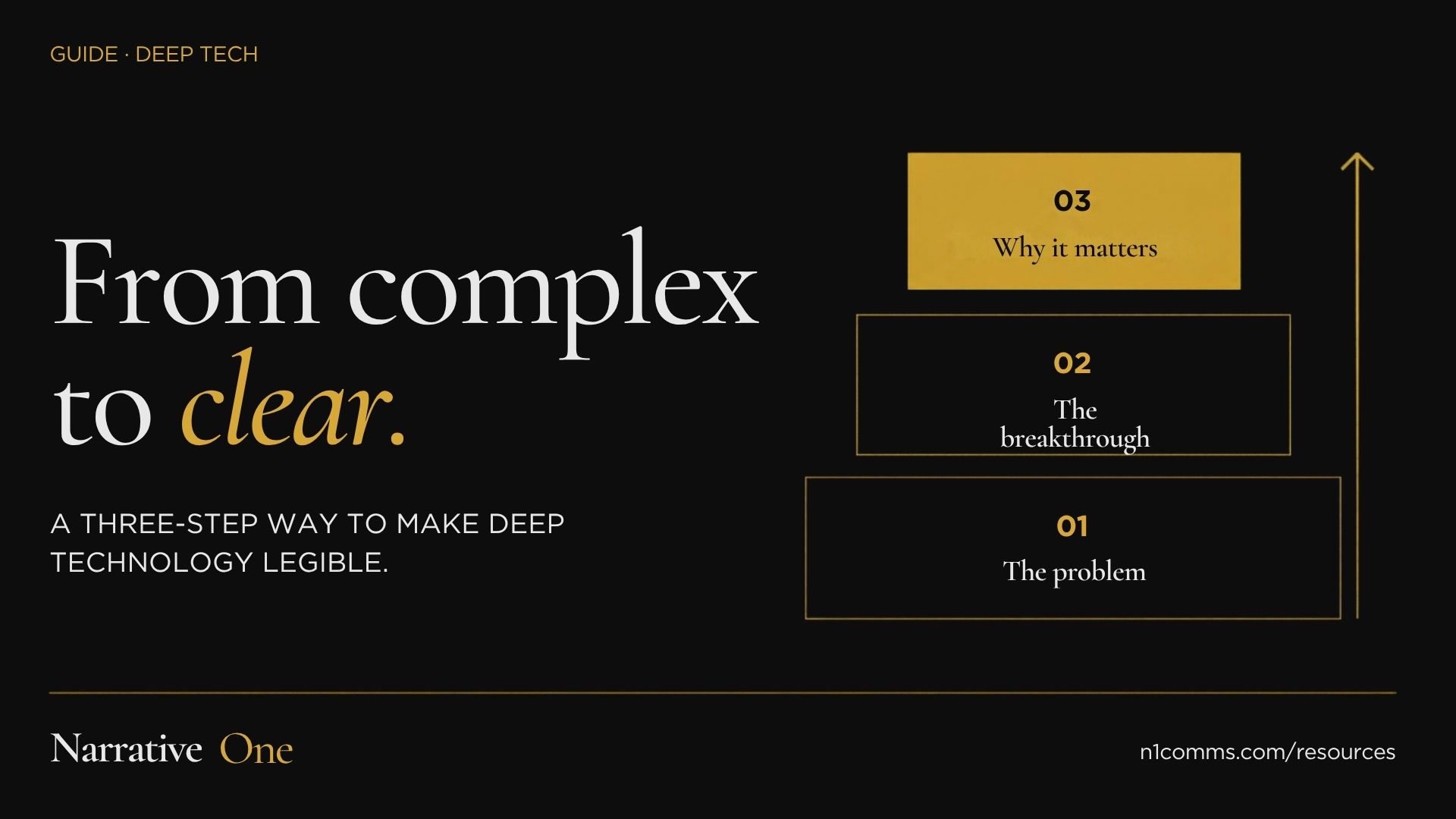
A strong deep tech PR strategy makes technical proof clear without overstating what it shows. When technical language overwhelms the evidence, investors may struggle to see commercial relevance, customers may miss the practical value, and journalists may be left with claims they cannot verify. The goal is not to simplify the science until it loses meaning. It is to make the proof legible.
Deep tech companies need communications that distinguish what has been demonstrated from what remains possible. That discipline protects credibility while giving each audience a clear reason to pay attention. Technical teams know their innovation is complex. The harder task is explaining its significance without blurring the company’s contribution or promising beyond the evidence.
This article sets out how to build a repeatable communications approach around verifiable milestones, precise language, and audience relevance. It covers how technical proof can support a stronger market narrative for investors, customers, and journalists, and why bilingual content, media relations, and compliance workflows need to operate as one system. Mandatory legal sign-off must happen before any journalist sees a release. Authority is earned through evidence, not amplification.
Key Takeaways
Build a deep tech PR strategy around verifiable evidence, then connect that proof to the problem it addresses and the audience’s interests.
Separate peer-reviewed, independently validated, internal, and planned evidence so each claim reflects its actual level of validation.
Use 44.01’s documented $37M Series A as a carbon-mineralisation example without implying communications caused the raise.
Make accuracy repeatable with a claims checklist, clear spokesperson roles, deliberate timing, and approval before publication.
See how a twelve-month communications programme can connect Bilingual content, Media relations, and monitoring and reporting, with mandatory legal sign-off before a release reaches journalists.
Table of Contents
Why deep tech PR strategy must explain proof, not just complexity
Build a deep tech PR strategy from evidence to audience relevance
How to make a deep tech PR programme accurate and repeatable
Why deep tech PR strategy must explain proof, not just complexity
A deep tech PR strategy is strategic communication built around technical evidence. It is not simply publicity. Its task is to establish what a technology does, what supports that claim, and why the result matters to a defined audience. This distinction is essential when development cycles are long and the science is specialised. A research milestone may matter to a technical team but be difficult for an investor, customer, or journalist to interpret without context.
Deep technology is commonly associated with substantial scientific or engineering foundations. A useful starting point is What is Deep Technology? But defining the category does not explain a company’s specific contribution. Communication must connect the underlying science to an identifiable problem while preserving the limits of what has been shown.
Technical novelty describes what is new or distinct about the approach.
Validated performance describes what tests or other evidence demonstrate under stated conditions.
Commercial relevance explains why that demonstrated capability could matter to a buyer, partner, or investor.
These concepts are related, but they are not interchangeable. Novelty alone does not prove performance. A successful test does not establish commercial readiness. A credible narrative makes the connections explicit without skipping a stage.
What makes deep tech communication different?
The technology may require detailed explanation, but an audience’s first questions are simpler: What problem does it address? What has been demonstrated? Why does that matter now? Founders may emphasise the original insight; technical teams may focus on methods and test conditions; investors may look for relevance to market assumptions; journalists need a precise account they can independently understand. There is one body of proof, but several legitimate ways to interpret it.
The narrative must separate established findings from hypotheses and future plans. State the conditions behind a result when they affect its meaning, and identify what remains untested. This is not a concession. It gives readers a reliable frame for judging the evidence and prevents potential from being mistaken for demonstrated performance.
Why generic technology messaging misses the point
Calling a technology “transformative” offers little information unless the claim is tied to a specific, supportable change. A feature list can fail in a different way: it describes components but leaves the audience to infer the problem, the evidence, and the significance. Precision is more persuasive than grand language.
Before drafting, ask whether each sentence answers a distinct question: What is the problem? What has the company built or demonstrated? What evidence supports that statement? What is the practical implication, and what remains uncertain? Trace every factual claim to a source, or clearly label it as interpretation.
That separation also governs how to use a case study. Keep documented facts distinct from strategic analysis. A funding announcement, for example, establishes that a raise occurred. By itself, it cannot prove technical performance or explain why investors acted. The analysis below follows that discipline: evidence first, interpretation second. This is how complex science becomes accessible without being reduced to a claim it cannot support.
Build a deep tech PR strategy from evidence to audience relevance
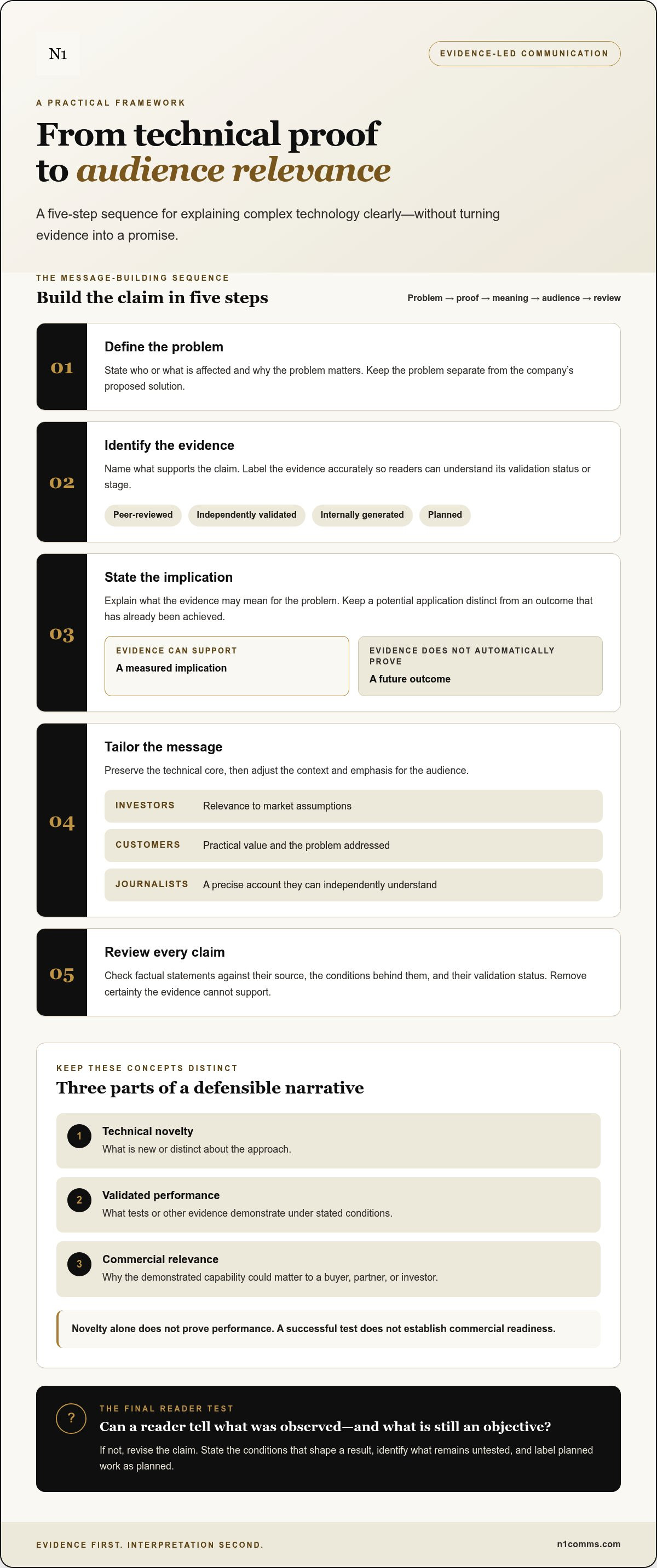
A defensible message follows a sequence. Begin with the problem and the evidence, not the adjective the company wants attached to its technology. Use this five-step process to move from technical detail to audience relevance without turning a test result into a promise:
Define the problem. State who or what is affected and why the problem matters. Keep this separate from the company’s proposed solution.
Identify the evidence. Name what supports the claim and classify it where applicable: peer-reviewed, independently validated, internally generated, or planned. These categories indicate different levels or stages of support.
State the implication. Explain what the evidence may mean for the problem. Do not present a potential application as an achieved outcome.
Tailor the message. Preserve the technical core, then adjust context and emphasis for each audience.
Review the claims. Check every factual statement against its source, conditions, and validation status. Remove unsupported certainty.
Map technical evidence to a defensible claim
Start with the technical problem, then name the company’s specific approach. Connect each claim to evidence that supports it. Keep demonstrated results distinct from roadmap milestones, ambitions, and commercial projections. Each belongs in a different category. When conditions shape what a result means, state them. Terms such as “in testing,” “internally assessed,” or “planned” are useful only when accurate. Precision protects the meaning.
Use a practical test: could a reader tell which statement describes an observed result and which describes a future objective? If not, revise it before publication. This distinction keeps the technical mechanism intact while making its relevance understandable.
Adapt the narrative to the audience
Different stakeholders need different context, not different facts. Investors need to understand how evidence relates to the company’s commercial assumptions. Prospective customers need the use case and the limits of what has been demonstrated. Partners need to see where the technology may fit alongside their capabilities. Journalists need clear, attributable claims they can accurately explain. Leadership alignment helps maintain one technical core across these accounts; a considered executive communications strategy can establish that shared frame.
Keep the level of detail appropriate to the audience. An investor briefing may explain validation status and commercial implications; a statement for journalists may lead with the problem and a carefully bounded result. Neither should imply more than the evidence supports.
Evidence-led deep tech PR makes technical proof understandable, connects it to audience relevance, and keeps every claim within what the evidence supports. That is the operating standard: clarity without distortion. Teams looking to put this discipline into practice can explore technology communications support.
What the 44.01 example can teach about deep tech PR
A case study is useful only when the record and the interpretation remain separate. The documented portfolio fact is narrow: 44.01 is a carbon-mineralisation company listed with a $37M Series A raise. That fact establishes a company description and a funding milestone. It does not establish why the raise occurred, what communications supported it, or whether PR influenced the outcome.
That boundary is central to a responsible deep tech PR strategy. The example can inform narrative planning without being presented as proof of campaign performance. A communications team can use it to identify the questions a credible account would need to answer before describing technical significance or commercial relevance.
Separate the company fact from the communications analysis
Use the known information as a fixed starting point. Treat every further point as a question for research, not as a claim about 44.01’s actual campaign. This protects the company’s record from invented tactics or outcomes. It also gives a communications team a disciplined way to identify what documentation and audience context a technical milestone would require.
Documented factStrategic question for a communications team44.01 is described as a carbon-mineralisation company.What specific problem does the company address, and what source supports that description?44.01 is listed with a $37M Series A raise.How should the funding milestone be stated, and what separate evidence supports any claims about technology or market relevance?
The questions are analytical prompts, not disclosures about the company’s communications. Before making a technical claim, identify its source, validation status, and scope. Before interpreting a milestone for a particular audience, understand what that audience needs to assess. Funding and technical validation are distinct facts; neither should substitute for the other.
Turn a milestone into a credible story structure
A clear account moves from the underlying problem to the company’s approach, then to evidence and significance. Each link needs support. If evidence or context is unavailable, keep the statement within what is documented rather than filling the gap with assumptions.
For any milestone, use this sequence as an editorial test:
Milestone: What verifiable event can be stated?
Problem: What challenge does the company say it addresses, and how is that description supported?
Evidence: What demonstrates the technology’s capabilities, and what are the limits of that evidence?
Significance: What can the evidence reasonably imply for the intended audience, without claiming an unproven outcome?
Do not add quotes, scientific results, media placements, or investor reactions unless they are documented. Executive commentary can provide context, but it must not turn analysis into evidence. For leadership perspectives that build authority around investment and venture themes, thought leadership for VC partners offers a related framework. The case study’s value is not a causal claim. It is a model for disciplined separation: state the fact, then ask what evidence a stronger narrative would require.
How to make a deep tech PR programme accurate and repeatable
A deep tech PR strategy needs an operating system, not a collection of one-off announcements. The process should make clear which claims are approved, who can explain them, when information can be shared, how each language version is developed, and what approval must happen before distribution. Without that structure, the same technical milestone can take on different meanings across a release, a pitch, and a spokesperson interview.
Use a checklist before each external communication:
Claims: Record the approved wording, supporting evidence, limitations, and date of review. Flag statements that describe plans or projections rather than demonstrated results.
Spokespeople: Agree who can address each technical or commercial topic. Prepare them to explain evidence and uncertainty in consistent language.
Timing: Confirm that the milestone is ready to communicate and that the people responsible for the evidence and approvals are aligned before drafting begins.
Language: Develop each audience-facing version from the same approved facts. Check that changes in emphasis do not alter the claim.
Approval: Keep review in the publication workflow. NarrativeOne requires mandatory legal sign-off before any journalist sees a release.
Create a claims and approval workflow
Maintain a central record that connects each material claim to its evidence source, known limitations, accountable reviewer, and approved wording. When the evidence changes, revisit the claim rather than relying on an old draft. Spokesperson preparation should use the same record, so technical detail and stated uncertainty remain consistent. Build compliance requirements into the drafting workflow, with mandatory legal sign-off before external distribution.
Set a clear release gate: the communication is ready only when the evidence, spokesperson, timing, language versions, and approvals are aligned. This makes review a control point rather than a last-minute obstacle. It also gives teams a repeatable basis for deciding whether a new milestone supports an announcement, an interview, or no external claim yet.
Keep communications consistent across formats and languages
A release, journalist pitch, and thought leadership article each serve a different purpose. They can lead with different context, but must preserve the same evidence boundaries. Native English and Arabic drafting treats both versions as parallel content creation, not as translation after one draft is finished. Each version can address its audience clearly while maintaining the approved facts and limitations.
That discipline matters in media relations, where a concise pitch may frame a technical development differently from a detailed release. The underlying claim must still match. Teams developing outreach can use tech founder media relations guidance to consider how founder expertise and journalist relevance fit into the process.
Consistency does not mean identical wording. It means controlled meaning across formats, languages, and spokespeople. To establish that structure across your communications, build an evidence-led communications programme.
Where NarrativeOne fits in a deep tech PR strategy
For a technology company, communications should operate as infrastructure, not as a burst of activity around one announcement. NarrativeOne’s twelve-month communications programme connects narrative development, media relations, thought leadership, and monitoring across a longer operating cycle. This structure helps teams communicate verified milestones while maintaining a consistent account of the company’s work between them.
The model is senior-led: one senior operator connects the technical narrative with journalist targeting, approvals, bilingual drafting, and reporting. For founders working in fields such as AI and climate-tech, that coordination helps keep evidence and its limitations consistent as the message moves between audiences and formats. NarrativeOne’s documented experience includes 200+ startup milestones announced and placed. That figure describes communications activity; it does not establish that PR caused a funding or valuation outcome.
A senior-led communications system for technology firms
A disciplined programme links components that are often handled in isolation. Narrative development establishes the claims and context. Media relations identifies relevant journalists and shapes outreach around their coverage interests. Thought leadership gives company leaders a channel to explain industry questions and technical implications. Monitoring and reporting tracks communications activity and coverage over time. Each component should work from the same factual foundation.
Bilingual content is drafted natively in English and Arabic, rather than written once and translated after the fact. This supports distinct language versions while preserving the approved technical meaning. Compliance is built into the workflow, too: mandatory legal sign-off occurs before any release reaches journalists. The approval step is operational, not optional. It safeguards claims before external distribution.
Move from technical narrative to sustained market authority
A twelve-month programme creates continuity beyond a single milestone. The company can prepare for relevant announcements, develop leadership perspectives, maintain journalist relationships, and review how its narrative is being understood. That does not mean every month requires a public announcement. It means the communications system remains connected to the company’s evidence, priorities, and readiness to speak.
NarrativeOne positions itself as a communications partner for technology founders, aligning technical narrative, Bilingual content, Media relations, and compliance workflows within a sustained programme. The objective is not to amplify every claim. It is to build a coherent account of what the company has demonstrated, why it matters, and what remains ahead. That is the practical value of a deep tech PR strategy: authority built through disciplined repetition, not inflated language.
Explore NarrativeOne’s communications programmes to consider a sustained communications framework for your technology company.
Make the next milestone easier to understand
The next step is operational: decide which evidence is ready to communicate, who needs to understand it, and what the claim must not imply. A disciplined deep tech PR strategy gives technical teams and leadership a shared standard for making those decisions. It turns communications into a durable capability, not a reaction to the next funding round or product milestone.
NarrativeOne reports $1B+ valuation impact, without implying that communications caused any valuation outcome. Forbes Middle East named Tarek Fouad among the Middle East’s Most Influential CMOs in 2026. These credentials sit alongside the central requirement: market authority must be built on substantiated claims and clear boundaries.
For technology founders ready to build that discipline into their communications, explore Narrative One’s communications programmes. The strongest narrative is one your evidence can sustain and your next milestone can strengthen.
Frequently Asked Questions
What is deep tech PR?
Deep tech PR is evidence-led communication for technology grounded in substantial scientific or engineering innovation. Unlike generic technology publicity, it explains what has been technically established, how that finding was validated, and why it matters to a specific audience. The term covers fields with different development paths and proof standards. Calling a company deep tech does not independently verify a product, certify its performance, or establish commercial readiness.
How do you explain complex technology to a non-technical audience?
Explain the problem first, then describe the approach in plain language and connect it to evidence readers can assess. For example, replace an unexplained technical label with a short account of what the system does, while retaining the precise term in supporting material. A deep tech PR strategy should keep detailed methods available for specialist readers, distinguish observed results from planned work, and ensure simplification does not imply stronger performance than the evidence supports.
Can PR help a deep tech startup build credibility before commercial scale?
Yes. PR can help a startup communicate credibly before commercial scale, provided it presents progress within its actual limits. A company preparing for a pilot, for instance, can explain the problem, its current stage, and what the pilot is designed to examine, without implying proven adoption. Credibility comes from accurate, consistent information. Communications cannot replace technical validation, customer evidence, or product readiness, and should not frame future performance as settled.
When should a deep tech company begin its PR strategy?
Begin when leadership can describe the problem, the company’s approach, the current evidence status, and the audiences that need the information. That may be before a broad press push. An effective early step is to prepare approved language for likely milestones and identify who can verify each claim. Then time external communication to evidence maturity and completed approvals, rather than treating every funding or product event as automatic news.
Does deep tech PR need technical subject-matter experts?
Yes. Subject-matter experts should verify mechanisms, test conditions, limitations, and technical terms, but they do not need to deliver every public explanation. Assign a technical reviewer to approve factual content and prepare spokespeople to answer likely questions in plain language. For example, agree in advance how to describe a result that applies only under specified conditions. Clear ownership preserves accuracy while allowing communications leads to make the explanation accessible.
How can a deep tech company avoid overstating its technology in the press?
Create a claim record that links every public statement to its source, validation status, relevant limitations, and reviewer. Keep internal findings, validated results, planned work, and commercial projections distinct in drafts and briefing notes. Prepare spokespeople with approved phrasing. Mandatory legal sign-off must occur before any journalist sees a release. If a claim cannot be supported or its conditions cannot be explained clearly, narrow or remove it. Precision preserves credibility without weakening the story.
Frequently Asked Questions
What makes deep tech communication different?
The technology may require detailed explanation, but an audience’s first questions are simpler: What problem does it address? What has been demonstrated? Why does that matter now? Founders may emphasise the original insight; technical teams may focus on methods and test conditions; investors may look for relevance to market assumptions; journalists need a precise account they can independently understand. There is one body of proof, but several legitimate ways to interpret it. The narrative must separate established findings from hypotheses and future plans. State the conditions behind a result when they affect its meaning, and identify what remains untested. This is not a concession. It gives readers a reliable frame for judging the evidence and prevents potential from being mistaken for demonstrated performance.
What is deep tech PR?
Deep tech PR is evidence-led communication for technology grounded in substantial scientific or engineering innovation. Unlike generic technology publicity, it explains what has been technically established, how that finding was validated, and why it matters to a specific audience. The term covers fields with different development paths and proof standards. Calling a company deep tech does not independently verify a product, certify its performance, or establish commercial readiness.
How do you explain complex technology to a non-technical audience?
Explain the problem first, then describe the approach in plain language and connect it to evidence readers can assess. For example, replace an unexplained technical label with a short account of what the system does, while retaining the precise term in supporting material. A deep tech PR strategy should keep detailed methods available for specialist readers, distinguish observed results from planned work, and ensure simplification does not imply stronger performance than the evidence supports.
Can PR help a deep tech startup build credibility before commercial scale?
Yes. PR can help a startup communicate credibly before commercial scale, provided it presents progress within its actual limits. A company preparing for a pilot, for instance, can explain the problem, its current stage, and what the pilot is designed to examine, without implying proven adoption. Credibility comes from accurate, consistent information. Communications cannot replace technical validation, customer evidence, or product readiness, and should not frame future performance as settled.
When should a deep tech company begin its PR strategy?
Begin when leadership can describe the problem, the company’s approach, the current evidence status, and the audiences that need the information. That may be before a broad press push. An effective early step is to prepare approved language for likely milestones and identify who can verify each claim. Then time external communication to evidence maturity and completed approvals, rather than treating every funding or product event as automatic news.
Does deep tech PR need technical subject-matter experts?
Yes. Subject-matter experts should verify mechanisms, test conditions, limitations, and technical terms, but they do not need to deliver every public explanation. Assign a technical reviewer to approve factual content and prepare spokespeople to answer likely questions in plain language. For example, agree in advance how to describe a result that applies only under specified conditions. Clear ownership preserves accuracy while allowing communications leads to make the explanation accessible.
How can a deep tech company avoid overstating its technology in the press?
Create a claim record that links every public statement to its source, validation status, relevant limitations, and reviewer. Keep internal findings, validated results, planned work, and commercial projections distinct in drafts and briefing notes. Prepare spokespeople with approved phrasing. Mandatory legal sign-off must occur before any journalist sees a release. If a claim cannot be supported or its conditions cannot be explained clearly, narrow or remove it. Precision preserves credibility without weakening the story.