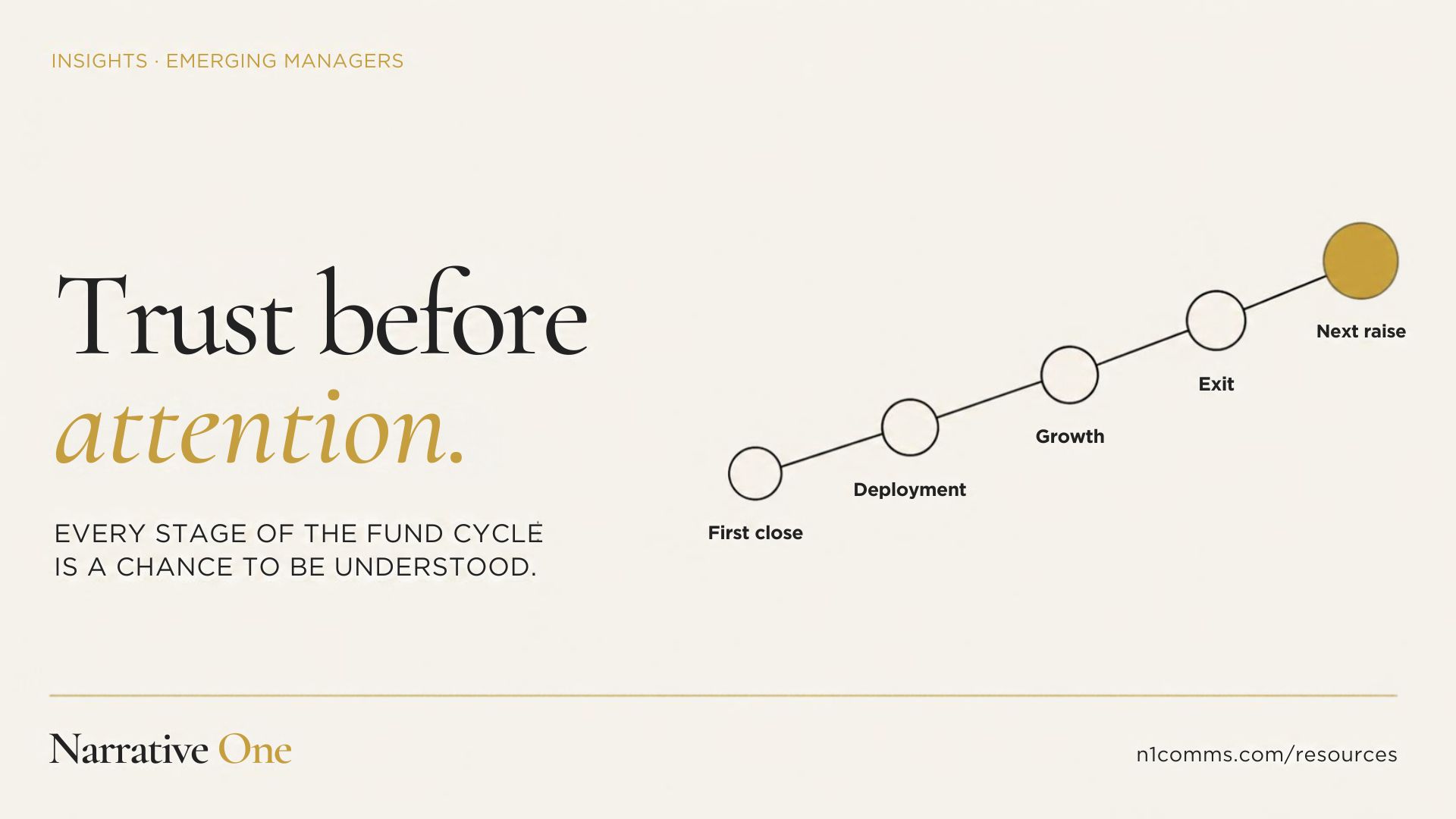
A fund’s first communications test often arrives before it has a track record to speak for itself. Emerging VC fund communications can’t rely on headline exits or a long history of returns. They need to make the investment thesis clear, show how decisions are made, and establish credibility without overstating the evidence. Attention can be won for a moment. LP confidence is earned through consistency.
That challenge is familiar to emerging managers. A thesis that sounds interchangeable gets lost, while communications that happen only around a fundraise, investment, or announcement leave long gaps for stakeholders to draw their own conclusions. Limited history makes precision and discipline more important, not less. The answer isn’t more promotion. It’s a system that earns trust before attention is needed.
This article explains how to build communications infrastructure that supports LP confidence, portfolio visibility, and long-term market authority. It covers how to express strategy consistently across audiences and channels, establish a cadence that doesn’t depend on news, and use partner perspective and portfolio updates as evidence rather than hype. The objective is a credible operating record that compounds before the next fundraising conversation begins.
Key Takeaways
Build a core narrative that moves from market context and investment thesis to evidence and differentiation, keeping the strategy consistent as emphasis shifts by audience.
Use emerging VC fund communications to address what LPs, founders, and journalists need to understand, with relevant proof and formats for each audience.
Establish a lean operating cadence: assign ownership, map milestones, prepare messages, approve claims, and review what works.
Prioritize essential communications systems over constant publishing, especially when a small team has limited capacity.
Recognize when senior strategic support is needed to align fund positioning, LP communications, partner visibility, and media relations.
Table of Contents
Why Emerging VC Fund Communications Must Establish Trust Before Visibility
Build an Emerging VC Fund Communications Architecture Around One Core Narrative
Adapt Emerging VC Fund Communications for LPs, Founders, and the Press
Install a Lean Communications Operating Cadence Before the Next Fund Milestone
Turn Fund Communications into Durable Infrastructure with Senior Strategic Support
Why Emerging VC Fund Communications Must Establish Trust Before Visibility
Visibility is an amplifier, not a credibility strategy. If a fund’s thesis, investment decisions, and portfolio activity don’t reinforce one another, more attention makes the inconsistency easier to see. Emerging VC fund communications should establish clarity before pursuing reach.
Fund communications are the coordinated system of messages, evidence, and stakeholder updates that shapes how people understand a fund’s strategy, decisions, and progress. Media relations can be one part of that system. Publicity, paid promotion, and one-off fundraising announcements are not substitutes for it. A useful system connects what GPs say about the thesis with what they do, what they share with LPs, and what they can substantiate publicly.
What makes communications different for an emerging venture fund?
An emerging manager has less operating history for stakeholders to assess. That creates a credibility gap, not a communications problem that can be solved with stronger claims. Communications can make the strategy and available evidence easier to evaluate, but they can’t replace investment performance or establish a track record that doesn’t yet exist.
Precision matters. A GP should be able to explain the fund’s focus, decision logic, and portfolio activity without implying broader results than the evidence supports. If public statements describe a thesis that portfolio choices don’t appear to reflect, the gap can weaken confidence. Keep the fund thesis, investment decisions, and external claims aligned.
Which stakeholders must an emerging fund communicate with?
The Venture capital (VC) ecosystem connects general partners, limited partners, and portfolio companies, but a fund’s communications responsibilities extend further. LPs assess strategy, stewardship, and material developments. Portfolio founders need relevant context and clarity about the fund’s role. Prospective founders look for signals about investment focus and how the partnership works. Journalists need accurate, supportable information. The wider investment ecosystem forms impressions through all of these interactions.
These audiences need different information, evidence, and timing. An LP update may require decision context and portfolio developments. A public statement about an investment should be accurate, aligned with the company, and limited to claims the fund can support. Consistency doesn’t mean sending identical messages to everyone. It means adapting the emphasis without changing the underlying facts or fund position.
Communications shouldn’t wait for a large portfolio or established track record. Starting early gives the fund a disciplined way to explain what it knows, what it is doing, and what supports its claims. Trust grows through that consistency, not through a burst of attention.
Build an Emerging VC Fund Communications Architecture Around One Core Narrative
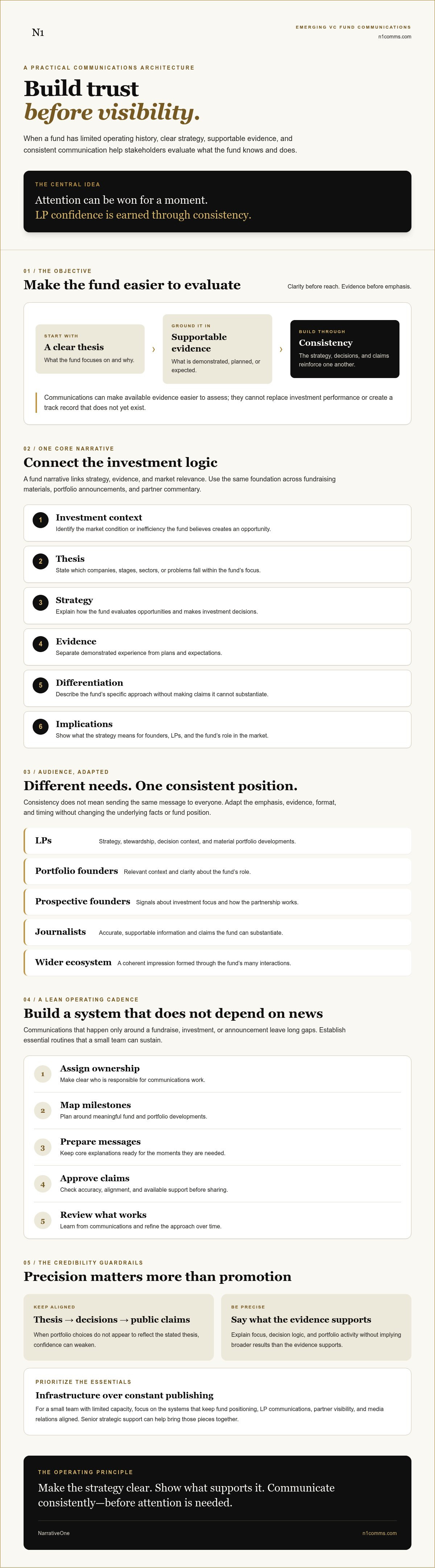
A fund narrative is the logic connecting its strategy, evidence, and relevance to the market. It gives every communication a common foundation, from fundraising materials to portfolio announcements and partner commentary. For emerging VC fund communications, the goal isn’t to repeat a slogan. It’s to make the fund’s investment logic clear wherever stakeholders encounter it.
Build that narrative in sequence:
Investment context: Identify the market condition or inefficiency the fund believes creates an opportunity.
Thesis: State which companies, stages, sectors, or problems fall within the fund’s focus.
Strategy: Explain how the fund evaluates opportunities and makes investment decisions.
Evidence: Identify the facts that support the thesis, separating demonstrated experience from plans and expectations.
Differentiation: Describe the fund’s specific approach without claiming uniqueness that can’t be substantiated.
Implications: Show what the strategy means for founders, LPs, and the fund’s role in the market.
Translate the investment thesis into institutional language
Use plain, precise language. Name the market inefficiency, define the investment focus, and explain the decision logic. Avoid broad claims such as “we back the next generation of category leaders” unless the fund can clarify what that means and support it. Differentiation is strongest when it describes observable choices, such as a defined focus or consistent evaluation method, rather than asserting that no other manager operates the same way.
Examples should be accurate, approved, and relevant to the claim they support. The NVCA resources can provide useful context for emerging managers communicating with LPs, but a fund’s narrative still needs to reflect its own strategy and record.
Create proof points without overstating an emerging fund’s record
Keep evidence in distinct categories. Realized outcomes are not the same as current portfolio facts. A partner’s prior experience is not automatically a result attributable to the new fund. A forward-looking intention, such as a target market or planned investment approach, is not proof of execution. Label each clearly, provide relevant context, and verify that portfolio details are accurate and approved for disclosure.
Performance, fundraising, and market claims deserve particular scrutiny. Route them for legal and compliance review where applicable, and make sure the wording matches the evidence. This discipline helps prevent contradictions across LP materials, portfolio communications, and media statements. It also gives the team a practical standard for deciding what can be said, by whom, and in which channel.
When fund positioning, LP communications, and portfolio announcements need sharper alignment, fund positioning support can help establish the underlying communications architecture.
Adapt Emerging VC Fund Communications for LPs, Founders, and the Press
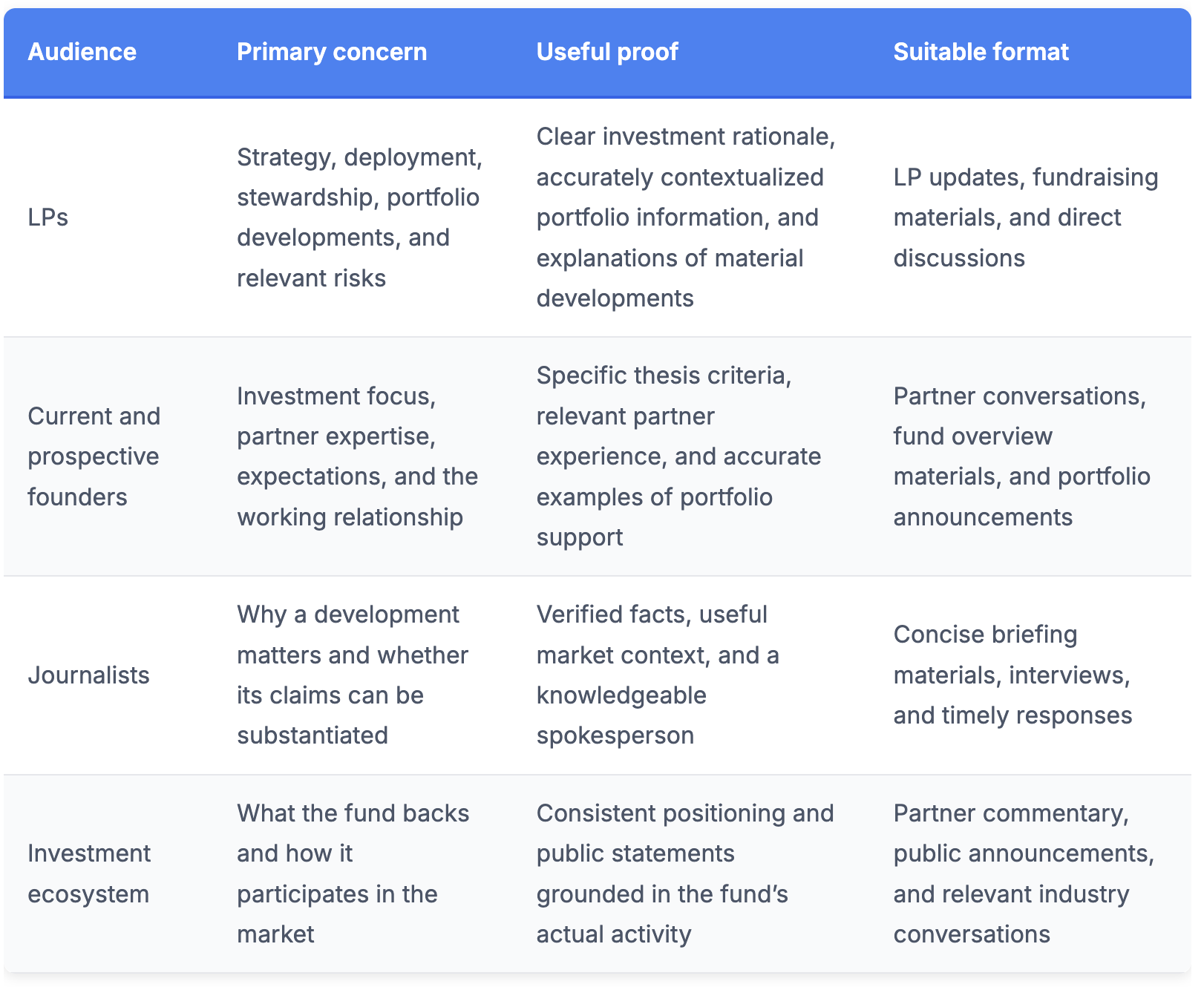
One fund narrative must serve audiences with different decisions to make. LPs evaluate strategy and stewardship. Founders assess whether the fund understands their company and how the partnership may work. Journalists need a relevant story supported by reliable information and an available spokesperson. Emerging VC fund communications should adapt the emphasis and format without changing the underlying facts.
What do LPs need from an emerging fund’s communications?
LP communications should make the fund’s strategy and stewardship understandable. Provide context for deployment and portfolio developments, explain what has changed, and address relevant risks with appropriate precision. The purpose is to help existing investors interpret fund activity, not to turn every update into public-facing promotion or fundraising outreach.
Keep those channels distinct. LP communications are shaped by the relationship and the information appropriate to it. Media relations serve a public audience and require a different level of context and scrutiny. The fund’s governing documents and circumstances determine its specific disclosure practices, so don’t assume a universal cadence or obligation.
How should funds communicate with founders and journalists?
Founders need a clear account of the fund’s investment focus, partner expertise, expectations, and any portfolio support the fund can accurately describe. Avoid implying a standard level of involvement if the fund’s approach varies. Clear expectations make the potential working relationship easier to assess.
For journalists, prepare a concise explanation of the fund’s position, substantiated context for the specific story, and a spokesperson able to address the subject. A pitch is not a placement. Coverage remains an editorial decision, never a guaranteed deliverable.
Audience adaptation changes the emphasis, not the underlying facts of the fund. That discipline keeps LP updates, founder conversations, and public statements aligned while giving each audience information suited to its needs.
Install a Lean Communications Operating Cadence Before the Next Fund Milestone
A lean team doesn’t need to publish constantly. It needs clear ownership and preparation before communications carry reputational weight. An operating cadence turns emerging VC fund communications from last-minute drafting into a repeatable process tied to the fund’s actual activity.
Use this sequence:
Assign ownership: Name the person responsible for core messaging, the person who approves claims, and the spokesperson for each subject area.
Map milestones: Track fundraising activity, investments, portfolio announcements, partner commentary, and material developments that may require a response.
Prepare messages: Draft key points and supporting facts ahead of predictable announcements. Not every milestone warrants public attention.
Verify and approve: Check names, dates, figures, portfolio details, and claim context. Route legal or compliance questions to qualified advisers familiar with the fund, its jurisdiction, and applicable requirements.
Review outcomes: Assess whether the intended audience received and understood the message. Update materials when the strategy or supporting evidence changes.
Set ownership, approvals, and message control
Keep a current source of approved fund facts, partner biographies, investment focus, and portfolio information. Record the source and context for claims so the team can distinguish verified facts from outdated language or forward-looking intent. Set a clear approval path before a deadline creates pressure to publish. Communications review helps maintain accuracy and coherence; it does not replace legal or regulatory advice.
Spokesperson preparation matters, too. Partners should know which points they own, what evidence supports those points, and when a question needs a different expert or a considered response. A short briefing before an interview or announcement can help prevent inconsistent descriptions of the fund’s strategy.
Plan communications around the fund’s actual operating calendar
Map events the team can anticipate, such as a fund launch, investment announcement, partner commentary, or material portfolio development. For each, identify the audience, purpose, facts to confirm, approvals required, and likely questions. Prepare holding language for developments where details are still being verified. This gives the team a responsible way to respond without speculating.
After a communication, review more than reach. Did it reach the intended stakeholders? Were the fund’s position and supporting facts clear? Did questions reveal a gap in the materials? Use the answers to improve the next update. Keep the process proportionate: a focused review after meaningful milestones is more useful than constant publishing without a clear objective.
For help aligning fund positioning, LP communications, and portfolio announcements, explore fund communications support.
Turn Fund Communications into Durable Infrastructure with Senior Strategic Support
Senior communications counsel is useful when the fund’s narrative lacks coherence, partner messaging varies, or a milestone carries reputational stakes the team cannot manage alongside its core responsibilities. The trigger isn’t fund size. It’s whether the fund can explain its position consistently, support its claims, and meet communications needs with available internal capacity.
For emerging VC fund communications, strategy, messaging infrastructure, media relations, and executive counsel should work as one system. A message developed for LPs should not contradict partner commentary or a portfolio announcement. Media engagement should draw on the same approved fund position while adapting context for the audience and channel. Publicity alone cannot create that alignment.
What senior communications support should establish
Start with a diagnostic assessment: Is the fund’s positioning clear? Do messages reflect the strategy and available evidence? Which audiences need communication, and what milestones are approaching? From there, establish usable frameworks for GP messaging, LP communications, portfolio announcements, and partner thought leadership.
Before work begins, define decision rights, scope, and evaluation measures. Clarify who provides facts, who approves claims, and who speaks for the fund. Agree on what the work is intended to improve, such as message consistency, stakeholder understanding, or readiness for a specific milestone. Do not treat media coverage, investor commitments, or fundraising results as guaranteed outputs.
When to formalize an emerging fund’s communications system
Repeated reactive requests are a signal. So are inconsistent partner descriptions of the thesis, uncertainty about who can approve a claim, and major fund or portfolio milestones approaching without prepared messaging. Assess whether the internal team has the ownership and capacity to manage the work. If not, senior support can establish operating discipline without requiring constant publication.
NarrativeOne provides fund positioning, LP communications, fundraise narratives, partner thought leadership, and portfolio announcements. The firm is founded and led by a former Chief Communications Officer with investment-firm experience. The relevant question is whether those capabilities match the fund’s specific gaps, not whether more visibility is always better.
Assess the communications architecture before the next milestone. Identify where the narrative breaks down, which audiences need clearer communication, and what internal capacity is available. Assess your fund's communications architecture with NarrativeOne.
Build Communications Before the Next Fund Milestone
Emerging VC fund communications work best as infrastructure, not a sequence of announcements. A clear core narrative connects investment strategy to credible evidence. Audience-specific messaging gives LPs, founders, and journalists the context they need without changing the fund’s underlying facts. A lean operating cadence puts ownership, approvals, and preparation in place before a milestone demands attention.
That discipline doesn’t replace investment performance or manufacture a track record. It helps stakeholders assess the fund through its strategy, decisions, and supportable claims. When the narrative is coherent and the process is deliberate, each communication can reinforce the fund’s position over time.
NarrativeOne is founded and led by a former Chief Communications Officer with investment-firm experience. Its capabilities span fund positioning, LP communications, partner thought leadership, and portfolio announcements, alongside direct media relationships with Bloomberg, Financial Times, and TechCrunch. Media relationships don’t guarantee coverage, and communications can’t guarantee fundraising outcomes. They can support a more prepared, consistent approach.
Identify where your messaging, ownership, or milestone planning needs more structure. Assess your fund's communications architecture with NarrativeOne, and build a system that’s ready before attention arrives.
Frequently Asked Questions
What does emerging VC fund communications include?
Emerging VC fund communications include the strategy, messages, evidence, and processes a fund uses to communicate with LPs, founders, journalists, and the wider investment ecosystem. This can cover fund positioning, LP updates, portfolio announcements, partner thought leadership, fundraising narratives, and media relations. It is broader than publicity: the core task is to keep the fund’s claims accurate and its strategy understandable across audiences and channels.
Why does a new VC fund need communications before it has a long track record?
A new fund needs communications early because stakeholders still need to understand its strategy, decision-making, and available evidence. Clear messaging can explain the thesis and contextualize partner experience or portfolio activity, but it can’t replace investment performance or create a track record. Establishing disciplined communications before a major fundraising or portfolio milestone also helps prevent rushed claims and inconsistent explanations when attention increases.
How should an emerging VC fund communicate its investment thesis?
Explain the market inefficiency the fund sees, the companies or opportunities it targets, and the logic behind its investment decisions. Use plain language and describe what the fund does differently through specific choices, not unsupported claims of uniqueness. Separate current evidence from ambition or forecasts. Keep the underlying thesis consistent across fundraising materials, LP communications, founder conversations, and public statements, while adjusting detail to suit each audience.
What should an emerging VC fund communicate to LPs between reports?
Communicate material developments that help LPs understand the fund’s strategy, deployment, portfolio activity, and relevant risks. Provide clear context: what changed, why it matters, and what evidence supports the update. Don’t treat every event as news or assume a universal reporting schedule. Review the fund’s governing documents and applicable requirements with qualified advisers to determine what information should be shared, when, and through which channels.
Can a small VC fund manage communications without a PR agency?
Yes. A small fund can manage essential communications internally if it assigns ownership, maintains approved facts and biographies, defines who reviews claims, and prepares for predictable milestones. It doesn’t need to publish constantly. The key is a process that keeps LP, founder, and public messages consistent. If capacity is limited or partner messaging repeatedly conflicts, senior communications support can help establish a more durable system.
How can an emerging VC fund get media coverage?
Present a timely, relevant story supported by verifiable facts, useful context, and an available spokesperson with expertise on the subject. A fund launch or investment announcement may be a starting point, but the pitch must explain why the development matters to the publication’s audience. Prepare concise messages and respond accurately to questions. Journalists make independent editorial decisions, so media outreach can’t guarantee coverage.
When should a VC fund hire communications support?
Consider communications support when the investment narrative lacks clarity, partners describe the fund inconsistently, a reputationally significant milestone is approaching, or internal capacity can’t sustain the required work. NarrativeOne provides fund positioning, LP communications, partner thought leadership, and portfolio announcements. The firm is founded and led by a former Chief Communications Officer with investment-firm experience. Define the needs, decision rights, scope, and evaluation measures before engaging support.
Frequently Asked Questions
What makes communications different for an emerging venture fund?
An emerging manager has less operating history for stakeholders to assess. That creates a credibility gap, not a communications problem that can be solved with stronger claims. Communications can make the strategy and available evidence easier to evaluate, but they can’t replace investment performance or establish a track record that doesn’t yet exist. Precision matters. A GP should be able to explain the fund’s focus, decision logic, and portfolio activity without implying broader results than the evidence supports. If public statements describe a thesis that portfolio choices don’t appear to reflect, the gap can weaken confidence. Keep the fund thesis, investment decisions, and external claims aligned.
Which stakeholders must an emerging fund communicate with?
The Venture capital (VC) ecosystem connects general partners, limited partners, and portfolio companies, but a fund’s communications responsibilities extend further. LPs assess strategy, stewardship, and material developments. Portfolio founders need relevant context and clarity about the fund’s role. Prospective founders look for signals about investment focus and how the partnership works. Journalists need accurate, supportable information. The wider investment ecosystem forms impressions through all of these interactions. These audiences need different information, evidence, and timing. An LP update may require decision context and portfolio developments. A public statement about an investment should be accurate, aligned with the company, and limited to claims the fund can support. Consistency doesn’t mean sending identical messages to everyone. It means adapting the emphasis without changing the underlying facts or fund position. Communications shouldn’t wait for a large portfolio or established track record. Starting early gives the fund a disciplined way to explain what it knows, what it is doing, and what supports its claims. Trust grows through that consistency, not through a burst of attention. A fund narrative is the logic connecting its strategy, evidence, and relevance to the market. It gives every communication a common foundation, from fundraising materials to portfolio announcements and partner commentary. For emerging VC fund communications, the goal isn’t to repeat a slogan. It’s to make the fund’s investment logic clear wherever stakeholders encounter it. Build that narrative in sequence:
What do LPs need from an emerging fund’s communications?
LP communications should make the fund’s strategy and stewardship understandable. Provide context for deployment and portfolio developments, explain what has changed, and address relevant risks with appropriate precision. The purpose is to help existing investors interpret fund activity, not to turn every update into public-facing promotion or fundraising outreach. Keep those channels distinct. LP communications are shaped by the relationship and the information appropriate to it. Media relations serve a public audience and require a different level of context and scrutiny. The fund’s governing documents and circumstances determine its specific disclosure practices, so don’t assume a universal cadence or obligation.
How should funds communicate with founders and journalists?
Founders need a clear account of the fund’s investment focus, partner expertise, expectations, and any portfolio support the fund can accurately describe. Avoid implying a standard level of involvement if the fund’s approach varies. Clear expectations make the potential working relationship easier to assess. For journalists, prepare a concise explanation of the fund’s position, substantiated context for the specific story, and a spokesperson able to address the subject. A pitch is not a placement. Coverage remains an editorial decision, never a guaranteed deliverable. Audience adaptation changes the emphasis, not the underlying facts of the fund. That discipline keeps LP updates, founder conversations, and public statements aligned while giving each audience information suited to its needs. A lean team doesn’t need to publish constantly. It needs clear ownership and preparation before communications carry reputational weight. An operating cadence turns emerging VC fund communications from last-minute drafting into a repeatable process tied to the fund’s actual activity. Use this sequence:
What does emerging VC fund communications include?
Emerging VC fund communications include the strategy, messages, evidence, and processes a fund uses to communicate with LPs, founders, journalists, and the wider investment ecosystem. This can cover fund positioning, LP updates, portfolio announcements, partner thought leadership, fundraising narratives, and media relations. It is broader than publicity: the core task is to keep the fund’s claims accurate and its strategy understandable across audiences and channels.
Why does a new VC fund need communications before it has a long track record?
A new fund needs communications early because stakeholders still need to understand its strategy, decision-making, and available evidence. Clear messaging can explain the thesis and contextualize partner experience or portfolio activity, but it can’t replace investment performance or create a track record. Establishing disciplined communications before a major fundraising or portfolio milestone also helps prevent rushed claims and inconsistent explanations when attention increases.
How should an emerging VC fund communicate its investment thesis?
Explain the market inefficiency the fund sees, the companies or opportunities it targets, and the logic behind its investment decisions. Use plain language and describe what the fund does differently through specific choices, not unsupported claims of uniqueness. Separate current evidence from ambition or forecasts. Keep the underlying thesis consistent across fundraising materials, LP communications, founder conversations, and public statements, while adjusting detail to suit each audience.
What should an emerging VC fund communicate to LPs between reports?
Communicate material developments that help LPs understand the fund’s strategy, deployment, portfolio activity, and relevant risks. Provide clear context: what changed, why it matters, and what evidence supports the update. Don’t treat every event as news or assume a universal reporting schedule. Review the fund’s governing documents and applicable requirements with qualified advisers to determine what information should be shared, when, and through which channels.
Can a small VC fund manage communications without a PR agency?
Yes. A small fund can manage essential communications internally if it assigns ownership, maintains approved facts and biographies, defines who reviews claims, and prepares for predictable milestones. It doesn’t need to publish constantly. The key is a process that keeps LP, founder, and public messages consistent. If capacity is limited or partner messaging repeatedly conflicts, senior communications support can help establish a more durable system.
How can an emerging VC fund get media coverage?
Present a timely, relevant story supported by verifiable facts, useful context, and an available spokesperson with expertise on the subject. A fund launch or investment announcement may be a starting point, but the pitch must explain why the development matters to the publication’s audience. Prepare concise messages and respond accurately to questions. Journalists make independent editorial decisions, so media outreach can’t guarantee coverage.
When should a VC fund hire communications support?
Consider communications support when the investment narrative lacks clarity, partners describe the fund inconsistently, a reputationally significant milestone is approaching, or internal capacity can’t sustain the required work. NarrativeOne provides fund positioning, LP communications, partner thought leadership, and portfolio announcements. The firm is founded and led by a former Chief Communications Officer with investment-firm experience. Define the needs, decision rights, scope, and evaluation measures before engaging support.