A fund that sounds like every competitor is asking LPs to work out the difference for themselves. A strong fund brand positioning strategy makes the investment case clear: what the fund does, why its approach is distinct, and what evidence supports that distinction. Without it, the thesis can blur into familiar language about access, discipline, or alpha. A sharper tagline won’t fix that. The position has to hold up against the fund’s portfolio, decision process, and record.
Partners may explain the strategy differently in an LP meeting, a founder conversation, and a media interview. But if those explanations conflict, they weaken the signal. LPs need a clear account of why the fund fits their objectives and why its differentiation is credible.
This article explains how to define the fund’s market position, test claims against investment evidence, and give partners language they can use consistently. You’ll learn how to turn the thesis into a concise, defensible investment case, then apply it across fundraising and market communications. The result is not just a slogan. It is a positioning system that can build recognition and reinforce authority over time.
Key Takeaways
Define positioning as the fund’s defensible place in an LP’s consideration set, distinct from its narrative, visual identity, or tagline.
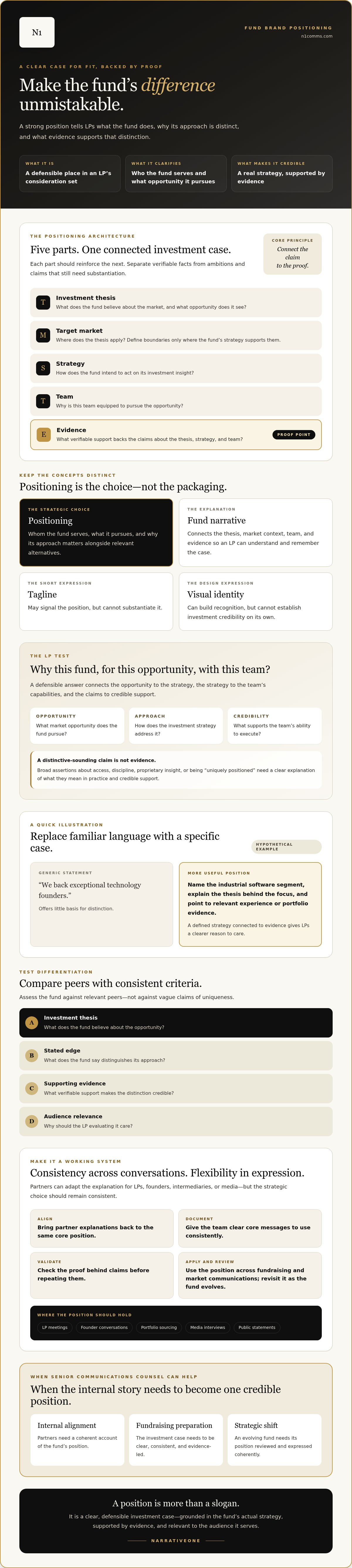
Build a fund brand positioning strategy around the thesis, target market, strategy, team, and evidence. Separate verifiable facts from ambitions and claims that need substantiation.
Assess differentiation against relevant peers using consistent criteria, including investment thesis, stated edge, supporting evidence, and audience relevance.
Turn the position into a working system: align partners, document core messages, validate proof, apply the language across communications, and review it as the fund evolves.
Know when senior communications counsel can help bring internal alignment, fundraising preparation, or a strategic shift into a coherent, evidence-led position.
Table of Contents
What a Fund Brand Positioning Strategy Must Make Clear to LPs
Test Whether Your Fund Positioning Is Distinctive and Credible
Turn Fund Positioning into Consistent Decisions and Communications
When to Bring in Senior Communications Counsel for Fund Positioning
What a Fund Brand Positioning Strategy Must Make Clear to LPs
Positioning is a fund’s defensible place in an LP’s consideration set. It clarifies whom the fund serves, what investment opportunity it pursues, and why its approach merits attention alongside relevant alternatives. A fund brand positioning strategy is not a claim of superiority. It is a case for fit, grounded in the fund’s actual strategy and supported by evidence.
That distinction matters in practice. During fundraising, clear positioning helps LPs decide whether the fund belongs in their allocation discussion. In portfolio sourcing, it gives founders and intermediaries a clearer reason to engage. In partner communications, it offers a stable reference point across meetings, commentary, and public statements. The expression can change by audience, but the strategic choice should remain consistent.
Positioning is not a tagline or a fund narrative
Positioning concerns the distinct space a brand occupies in its audience’s mind. For a fund, it is the strategic choice about whom the fund serves and why its investment approach differs in a way that matters to that audience.
The fund narrative explains that choice. It connects the investment thesis, market context, team, and evidence so an LP can understand and remember the case. A tagline compresses the idea into a short phrase. It may signal the position, but it cannot substantiate it. Visual identity expresses the position through design and presentation. It can build recognition, but it cannot establish investment credibility on its own. The underlying case has to carry that weight.
The LP question behind fund differentiation
Every position should withstand one direct test: Why this fund, for this opportunity, with this team? LPs need an answer that connects the opportunity to the strategy, the strategy to the team’s capabilities, and the claims to credible support. “Uniquely positioned” is not evidence. Neither is a broad assertion of access, discipline, or proprietary insight without a clear explanation of what those terms mean in practice.
Hypothetical example: Imagine a fund investing in early-stage industrial software. “We back exceptional technology founders” offers little basis for distinction. A more useful position would identify the segment of industrial software the fund targets, explain the investment thesis behind that focus, and point to relevant experience or portfolio evidence that supports the team’s ability to pursue it. This example is illustrative, not a description of a specific fund.
Credible positioning connects a defined strategy to verifiable evidence and a specific audience’s reasons to care. If one of those elements is missing, the position may be difficult to defend or irrelevant to the LP evaluating it. The test is not whether the statement sounds distinctive. It is whether the fund can explain and support the distinction consistently.
Build Fund Positioning Around Thesis, Proof, and Audience
A fund position becomes credible when its parts connect. The investment thesis identifies the opportunity the fund believes the market is missing. The target market defines where that thesis applies. The strategy explains how the fund intends to act on it. The team shows why it is equipped to execute. Evidence supports the claims made about each part.
This architecture is the working core of a fund brand positioning strategy. It prevents a broad thesis from being mistaken for a distinctive position and keeps communications anchored to what the fund can substantiate. The Elements of Value framework can help clarify what an audience values. LP priorities should shape how the fund explains its strategy, not rewrite the strategy itself.
Translate the investment thesis into a clear market position
Start with the actual mandate. Specify target companies, stages, sectors, or geographies only where the fund’s strategy supports those boundaries. Then state the investment insight: What does the fund believe about this market, and how does that belief influence investment selection or value creation?
For example, a fund might focus on a defined stage and sector because its thesis identifies a particular market inefficiency. The position should make that connection explicit rather than relying on generic claims of superior access or exceptional judgment. If access is central to the claim, identify the relevant relationships or sourcing evidence that supports it. If the fund cannot support the claim, leave it out.
Match positioning claims to proof
Before finalizing the language, build a simple claim-to-evidence register. For each central statement, note what type of statement it is and what supports it:
Verifiable fact: Team experience, stated investment criteria, or documented portfolio activity.
Interpretation: What the fund believes that evidence indicates about its approach or market.
Ambition: A future objective, clearly presented as an intention rather than an established outcome.
Claim requiring validation: Performance, track record, portfolio outcomes, or forecasts that need careful review before use.
A team’s relevant operating experience may support a claim about familiarity with a sector. It does not, by itself, prove superior returns. Likewise, a market forecast is not a fund-specific advantage. Keep these distinctions visible in LP materials and partner talking points. If evidence is incomplete, flag the gap and narrow the claim. Don’t fill it with invented statistics or implied outcomes.
An evidence-backed fund position links a specific thesis and strategy to a defined audience, a capable team, and proof that supports each material claim. If that connection is difficult to articulate consistently, fund positioning counsel can help translate the investment logic into disciplined messaging without changing the underlying strategy.
Test Whether Your Fund Positioning Is Distinctive and Credible
A positioning statement can sound compelling in isolation and still fall short when compared with alternatives. Test it against funds an LP could reasonably consider. The aim is not to claim superiority or criticize competitors. It is to determine whether your fund’s differences are observable, supported, and relevant to the audience making an allocation decision.
Compare the fund against relevant alternatives
Choose peers using clear criteria, such as comparable strategy, stage, geography, or investment focus. Review current public materials, including fund websites and published investment criteria. Record the source and review date. If information is unavailable or cannot be verified, label it as unknown instead of treating an assumption as fact.
Use a consistent comparison framework:
Target market: What companies, stages, sectors, or geographies does each fund publicly identify?
Investment thesis: What opportunity or market belief does each fund articulate?
Stated edge: What does each fund say differentiates its approach or team?
Evidence: What public information supports those statements? Mark gaps as unavailable or unverified.
Audience relevance: Why might this distinction matter to the LPs the fund intends to reach?
Look for language shared across the peer set before declaring a difference meaningful. Terms such as “sector expertise” or “founder support” may describe several funds. The distinction lies in the investment choices, capabilities, or evidence behind the phrase, not in the phrase itself.
Check distinctiveness, credibility, and relevance
Evaluate each proposed position against three tests. Distinctiveness: Is it specific enough to separate the fund from credible peers? Credibility: Can the fund support it with evidence? Relevance: Does it address a priority for the intended LP audience? A position needs all three. A distinctive claim without proof is still only a claim. A credible difference that LPs do not value has limited strategic force.
Separate observable distinctions from subjective judgments. “Invests at a defined stage in a specified sector” may be verifiable in public materials. “Best-in-class access” is a comparative claim that needs a clear basis. Avoid turning incomplete peer information into a conclusion about another firm. State what the sources show, what remains unknown, and where the fund’s own evidence is stronger or weaker.
A rigorous fund brand positioning strategy survives comparison without inflated language. Remove statements that are broad, unprovable, or inconsistent with the actual mandate. Retain the distinctions the fund can demonstrate and the right LPs have reason to value.
Turn Fund Positioning into Consistent Decisions and Communications
A position has value only if the partnership can use it consistently. Build it into a working system, not a statement that sits in a fundraising deck. Partners should understand the core investment case, know which evidence supports it, and recognize where individual commentary must stay within agreed boundaries.
Create a usable positioning system for the partnership
Document the core position alongside audience-specific supporting points, approved evidence, and claims that require review or should not be used. Assign an owner to maintain the document and identify who approves material changes. Partners can bring their expertise and judgment to conversations, but the underlying investment case should remain stable.
Use this implementation sequence:
1. Align partners. Agree on the fund’s position, intended audience, and supporting rationale.
2. Document messages. Record the core statement, audience-specific points, approved proof, and restricted claims.
3. Validate evidence. Confirm that each material claim is accurate, current, and supported before external use.
4. Apply the position. Use it to guide LP materials, partner commentary, portfolio announcements, and press conversations.
5. Review and update. Reassess when the strategy changes, a new fund is formed, or the market focus shifts materially.
Apply the position across the fund lifecycle
Consistency does not mean using identical copy everywhere. It means carrying the same investment logic into different conversations, with the right level of detail for each audience. Fundraising materials can explain the strategy and its fit with LP priorities. Portfolio announcements can show how an investment reflects the thesis. Partner thought leadership can explain the market insight behind it. Press conversations can convey the same position without turning every answer into a pitch.
Ongoing LP communications should preserve that continuity while addressing investor questions with appropriate context. A dedicated LP communications strategy can develop that discipline in more detail. An institutional fund narrative can also explain how the central position becomes a coherent account of the fund, while leaving the governance and review steps outlined here in place.
A fund brand positioning strategy becomes an operating asset when partners can apply it, adapt its emphasis, and keep its claims tied to evidence. If your partnership needs to translate its investment case into consistent communications, work with NarrativeOne on fund positioning.
When to Bring in Senior Communications Counsel for Fund Positioning
Outside counsel is useful when the issue is strategic, not cosmetic. Consider it when partners give different accounts of the fund, a raise requires a coherent investor narrative, or a material shift in strategy changes how the fund should be understood. The need is not simply for more copy. It is for experienced judgment that can align the investment case, test its claims, and carry it consistently into external communications.
Before engaging an adviser, define the decision you need help making. Then assess whether the adviser can work at that level:
Investment-firm experience: Ask what direct experience the adviser has with investment firms and the operating realities of fund communications.
Senior involvement: Establish who will lead the work, how closely senior counsel will participate, and who will be accountable for the recommendations.
Evidence discipline: Ask how claims will be tested, unsupported statements flagged, and partners aligned around language they can defend.
Execution capability: Confirm the adviser can translate the position into relevant communications, such as fundraise communications, LP communications, partner thought leadership, or portfolio announcements.
Evaluate advisers on strategic judgment, not press lists alone
Media relationships may matter for some communications objectives, but they do not establish strategic judgment. Ask how an adviser will understand the fund’s thesis, distinguish fact from interpretation, and handle gaps in evidence. The work should strengthen the investment case without overstating it.
Be clear about scope. Senior communications counsel is distinct from paid advertising, media buying, or standalone design work. Those activities do not resolve disagreement about whom the fund serves, what makes its strategy distinct, or which claims the evidence supports.
Translate a clear position into communications infrastructure
Once the evaluation criteria are clear, consider whether outside counsel can make the position usable across fundraising and ongoing communications. NarrativeOne advises investment firms on fund positioning, fundraise communications, investor narratives, LP communications, and partner thought leadership. The agency is founded and led by a former Chief Communications Officer with in-house investment firm experience. That background is relevant to the work, but it is not a promise of fundraising outcomes or specific media placements.
A disciplined fund brand positioning strategy gives partners a consistent basis for explaining the fund while keeping claims tied to evidence. If your team is facing a positioning challenge, discuss fund positioning with NarrativeOne.
Make the Investment Case Clear and Consistent
A durable fund position connects a defined investment thesis to evidence LPs can assess and priorities they value. It distinguishes the fund from relevant alternatives without relying on broad claims. It then becomes a practical reference point for partner conversations, fundraising materials, portfolio announcements, and ongoing investor communications.
A fund brand positioning strategy is strongest when the partnership can explain it consistently and support its claims as the fund evolves. If alignment is difficult or a new raise requires a sharper investor narrative, experienced counsel can help translate the investment case into disciplined communications.
NarrativeOne advises investment firms and technology founders on communications strategy and media relations. Founded and led by a former Chief Communications Officer with in-house investment firm experience, the firm also reports direct media relationships with Bloomberg, Financial Times, and TechCrunch. Those relationships do not guarantee coverage. The work is grounded in strategic counsel and coherent messaging.
Discuss your fund positioning with NarrativeOne and give your investment case a clearer, more consistent signal. The strategy stays yours. Make its distinction unmistakable.
Frequently Asked Questions
What is a fund brand positioning strategy?
A fund brand positioning strategy defines the distinctive place an investment fund intends to occupy in the minds of relevant LPs and market participants. It connects the fund’s investment thesis and target opportunity to the team and evidence that support its case. It is not simply a tagline or visual identity. A useful position helps stakeholders understand why the fund is relevant and how it differs from credible alternatives.
How do you differentiate a venture capital fund?
Differentiate a venture capital fund by starting with its actual investment strategy: target companies, stage, sector, or geography, where applicable. Identify the insight behind that strategy, then establish what evidence supports the team’s ability to act on it. Compare the fund with relevant peers and remove generic claims. Effective differentiation must be specific, credible, and meaningful to LPs. Novelty alone does not make an investment case persuasive.
What should a fund positioning statement include?
A fund positioning statement should identify the target opportunity, investment approach, and relevant point of distinction in concise, clear language. It should reflect the fund’s actual strategy and be understandable to its intended LP audience. Support each material claim with evidence. Do not include performance claims, privileged access, or capabilities unless the fund can substantiate them and has approval to use them. The precise statement will vary with the fund’s mandate.
How is fund positioning different from a fund narrative?
Fund positioning defines the strategic place a fund aims to hold relative to relevant alternatives. A fund narrative explains that position through a coherent account of the opportunity, thesis, team, and evidence. They work together but serve different purposes. Positioning sets the strategic choices. The narrative gives partners a consistent way to explain those choices to LPs, founders, media, and other stakeholders without changing the underlying investment case.
When should a fund revisit its positioning strategy?
Revisit positioning when the investment strategy, target market, fund structure, or leadership changes materially. A new fundraise can also reveal a gap between how partners describe the fund and how LPs understand it. Review the evidence behind central claims as part of that process. A scheduled review helps maintain consistency, but updated language should reflect real strategic developments, not simply a desire for a fresher tagline.
Can a first-time fund manager establish credible positioning without a long track record?
Yes. A first-time manager can build credible positioning without implying an established fund history. The case can draw on the stated thesis, relevant professional experience, investment discipline, and operating approach, provided each claim is accurate. Clearly distinguish what is already demonstrated from what remains an ambition. LPs should be able to see what evidence supports the manager’s current capabilities and where the fund is making a forward-looking case.
Should a fund hire a communications agency for positioning?
A fund may benefit from outside counsel when partners cannot align on the position, fundraising preparation requires a coherent investor narrative, or messages need to work consistently across audiences. Evaluate advisers for investment-firm experience, senior strategic involvement, evidence discipline, and relevant execution capability. Agree on scope and deliverables before engagement. The adviser should clarify the fund’s real strategic case, not manufacture differentiation or promise fundraising outcomes.
Frequently Asked Questions
What is a fund brand positioning strategy?
A fund brand positioning strategy defines the distinctive place an investment fund intends to occupy in the minds of relevant LPs and market participants. It connects the fund’s investment thesis and target opportunity to the team and evidence that support its case. It is not simply a tagline or visual identity. A useful position helps stakeholders understand why the fund is relevant and how it differs from credible alternatives.
How do you differentiate a venture capital fund?
Differentiate a venture capital fund by starting with its actual investment strategy: target companies, stage, sector, or geography, where applicable. Identify the insight behind that strategy, then establish what evidence supports the team’s ability to act on it. Compare the fund with relevant peers and remove generic claims. Effective differentiation must be specific, credible, and meaningful to LPs. Novelty alone does not make an investment case persuasive.
What should a fund positioning statement include?
A fund positioning statement should identify the target opportunity, investment approach, and relevant point of distinction in concise, clear language. It should reflect the fund’s actual strategy and be understandable to its intended LP audience. Support each material claim with evidence. Do not include performance claims, privileged access, or capabilities unless the fund can substantiate them and has approval to use them. The precise statement will vary with the fund’s mandate.
How is fund positioning different from a fund narrative?
Fund positioning defines the strategic place a fund aims to hold relative to relevant alternatives. A fund narrative explains that position through a coherent account of the opportunity, thesis, team, and evidence. They work together but serve different purposes. Positioning sets the strategic choices. The narrative gives partners a consistent way to explain those choices to LPs, founders, media, and other stakeholders without changing the underlying investment case.
When should a fund revisit its positioning strategy?
Revisit positioning when the investment strategy, target market, fund structure, or leadership changes materially. A new fundraise can also reveal a gap between how partners describe the fund and how LPs understand it. Review the evidence behind central claims as part of that process. A scheduled review helps maintain consistency, but updated language should reflect real strategic developments, not simply a desire for a fresher tagline.
Can a first-time fund manager establish credible positioning without a long track record?
Yes. A first-time manager can build credible positioning without implying an established fund history. The case can draw on the stated thesis, relevant professional experience, investment discipline, and operating approach, provided each claim is accurate. Clearly distinguish what is already demonstrated from what remains an ambition. LPs should be able to see what evidence supports the manager’s current capabilities and where the fund is making a forward-looking case.
Should a fund hire a communications agency for positioning?
A fund may benefit from outside counsel when partners cannot align on the position, fundraising preparation requires a coherent investor narrative, or messages need to work consistently across audiences. Evaluate advisers for investment-firm experience, senior strategic involvement, evidence discipline, and relevant execution capability. Agree on scope and deliverables before engagement. The adviser should clarify the fund’s real strategic case, not manufacture differentiation or promise fundraising outcomes.