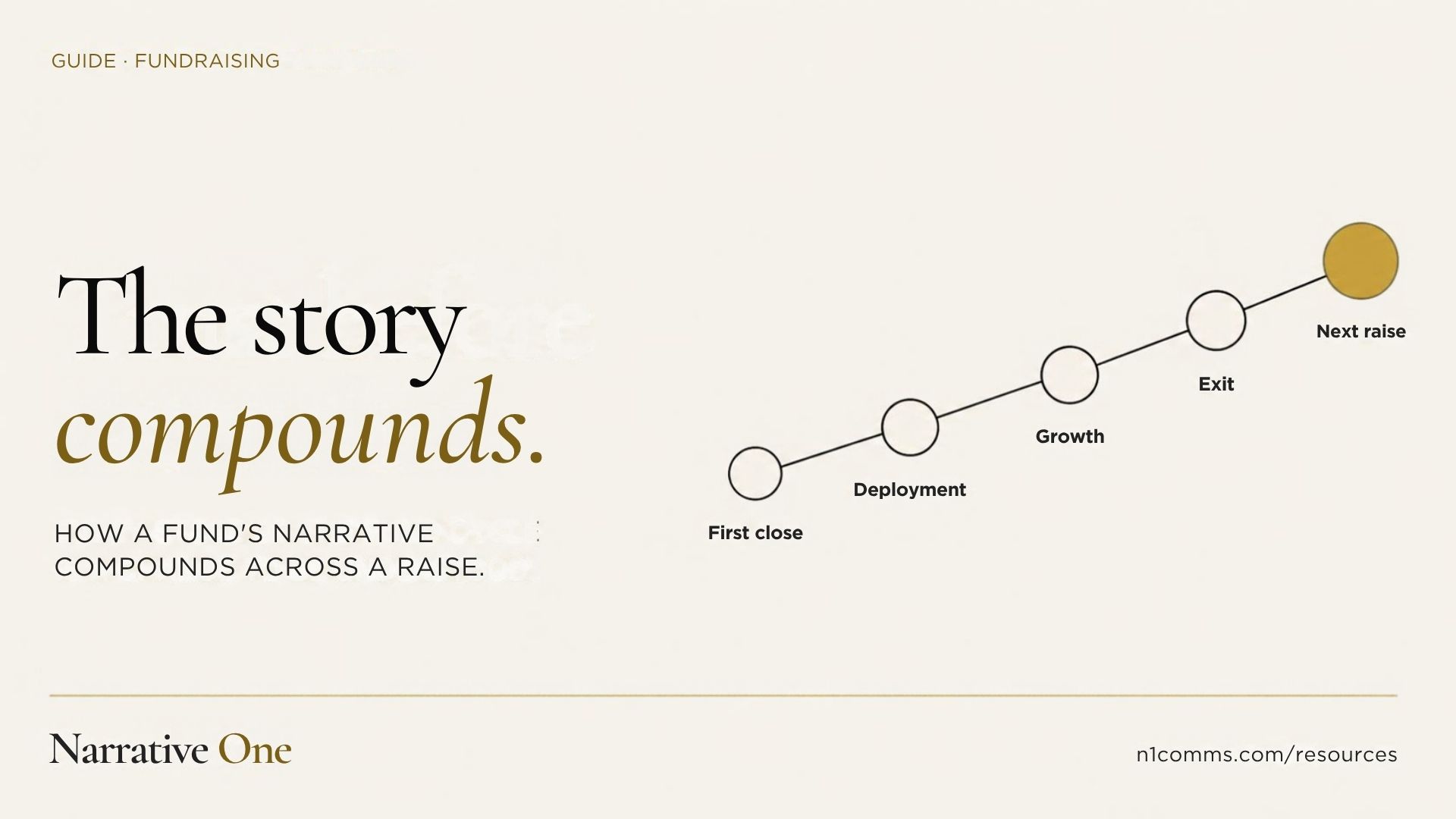
Investor conviction builds through disciplined communications, not a launch campaign. A fundraise communications strategy must do more than announce that a fund is open. It should explain the investment case consistently, sustain engagement across the raise, and align execution with internal review and compliance requirements. If the thesis shifts between meetings, materials, and public statements, investors can struggle to understand the fund’s approach. If communications stop after the announcement, the narrative loses continuity.
Investment firms need a coherent system, not a sequence of disconnected deliverables. That system should include a clear fund narrative, a communications cadence tied to raise milestones, and defined controls for messaging, media, approvals, and measurement. Strategy & narrative, Media relations, Bilingual content, and GP thought leadership each play a distinct role. English and Arabic content should be drafted natively, with compliance rules embedded before the compliance director reviews drafts. The operating model brings together one senior strategist, one journalist network, and one shared compliance workflow. The goal is disciplined execution from the first conversation through follow-up, with every communication reinforcing the same investment case.
Key Takeaways
Define the fundraise communications strategy as a governed system, distinct from investor relations, fundraising activity, and a one-off launch announcement.
Build a message architecture around the fund’s thesis, strategy, target market, and supporting evidence before selecting channels.
Match LP materials, GP thought leadership, media relations, and portfolio announcements to their audiences, purposes, and review requirements.
Use a repeatable cadence for planning, drafting, review, execution, monitoring, and refinement, with weekly activity and monthly reporting.
Assess communications partners for investment-firm experience, senior ownership, narrative capability, and a shared compliance workflow.
Table of Contents
What a fundraise communications strategy must accomplish beyond announcing a raise
Build the investor narrative before choosing channels or announcements
Compare communication channels by their role in the fundraise
Run the fundraise communications strategy as a governed operating cadence
Choose a fundraise communications partner built for institutional execution
What a fundraise communications strategy must accomplish beyond announcing a raise
A fundraise is not a press release with investor meetings attached. It is an ongoing explanation of why the fund exists, how it will invest, and what distinguishes its approach. That explanation needs to hold across LP materials, GP communications, and earned media, even when the audience and format change.
A fundraise communications strategy is the governed system that aligns a fund’s investment case, messages, channels, approvals, and timing throughout capital formation. A campaign calendar records planned activity. Strategy defines what each communication should establish, which claims it can make, and how it supports the fund’s central case.
Fundraise communications strategy versus investor relations
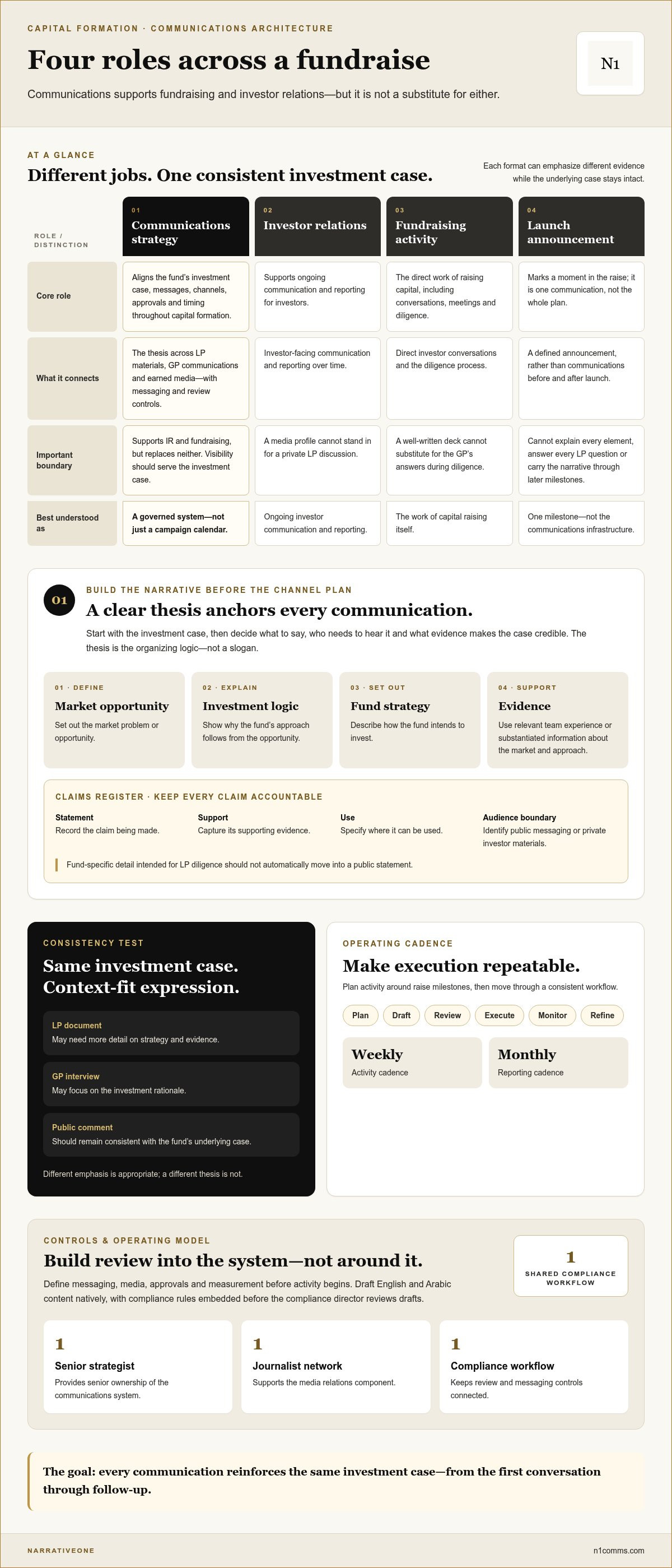
Investor relations supports ongoing communication and reporting for investors. Fundraising activity is the direct work of raising capital, including conversations, meetings, and diligence. Communications supports both functions, but replaces neither. A media profile cannot stand in for a private LP discussion, and a well-written deck cannot substitute for the GP’s answers during diligence.
The strategic role is to keep the fund thesis, investment strategy, and leadership messages consistent across these touchpoints. For example, if LP materials describe a focused investment mandate, a GP interview should not imply a broader approach just to make a headline more appealing. Each format can emphasize different evidence, but the underlying investment case should remain intact.
General references to Fundraising describe a broad set of methods and communication practices. An investment fund needs a more specific architecture: one that connects positioning to LP materials, direct conversations, and appropriate public statements without confusing visibility with capital formation.
Why a launch-only approach leaves gaps
A launch announcement marks a moment. It cannot explain every element of the fund’s case, answer every LP’s questions, or carry the narrative through later milestones. Treating the announcement as the whole communications plan leaves the periods before and after launch without a deliberate structure.
The risk is fragmentation. One spokesperson may stress market opportunity, another may foreground the team, while written materials describe a different source of differentiation. Even if each statement is accurate on its own, the combined impression can be unclear. That makes it harder for an investor to understand what the fund is designed to do.
A disciplined approach treats communications as infrastructure, not episodic publicity. It establishes a core narrative, defines how that narrative adapts by audience and channel, and sets review boundaries before activity begins. Each milestone can then have a clear purpose without forcing every communication to repeat the same wording.
Use a simple test: can the fund’s investment case be stated consistently in an LP document, a GP conversation, and a public comment, with each version suited to its context? If not, the issue is not a shortage of announcements. The narrative system needs work.
Build the investor narrative before choosing channels or announcements
Choose channels only after the investment case is clear. A fundraise communications strategy should start with a message architecture that connects the fund’s thesis, investment strategy, target market, leadership, and supporting evidence. Without that structure, teams risk choosing channels for visibility before deciding what each communication needs to establish.
A clear fund thesis anchors every communications choice: it determines what to say, who needs to hear it, and which evidence makes the case credible. The thesis is not a slogan. It is the organizing logic behind the fund’s investment approach and differentiation.
Translate the fund thesis into an investor-grade narrative
Build the narrative in a sequence an investor can assess: define the market problem or opportunity, explain the fund’s investment logic, set out its strategy, then present relevant evidence. That evidence might include the team’s experience or substantiated information about the target market and approach. Make sure every claim supports a specific part of the case.
Separate distinctive claims from generic market language. Phrases such as “large opportunity” or “leading platform” carry little weight without precise meaning and evidence. Create a claims register that records each statement, its supporting evidence, where it can be used, and whether it belongs in public messaging or private investor materials. Fund-specific detail intended for LP diligence should not automatically move into a public statement.
Keep the core narrative stable, then adjust the emphasis by context. An LP document may need more detail on strategy and evidence; a GP interview may focus on the investment rationale. Neither should create a different thesis. Guidance such as PR strategy for a fundraising can inform press visibility, but visibility should serve the investment case, not dictate it.
Align GP messaging, LP materials, and public statements
Set approved language for the fund, its strategy, and senior spokespeople. This does not mean scripting every answer. It means agreeing on the central explanation, defining terms consistently, and identifying claims that need further review. GP thought leadership should extend the fund’s perspective through relevant analysis, rather than repeat the pitch in every article or interview.
Public statements and LP communications have different jobs. Public messaging can establish a clear point of view; private materials can address fund-specific detail in the appropriate investor context. Draw both from the same narrative architecture, with clear boundaries on what can be shared. For ongoing stewardship beyond the raise, a considered LP communications strategy helps connect the initial case to the investor relationship over time.
Build governance into the architecture from the start. Compliance rules should be embedded before the compliance director reviews drafts, so the review assesses prepared language instead of repairing fragmented messaging. For investment firms building this foundation, fund positioning and fundraise communications connect narrative, execution, and review in one operating model.
Compare communication channels by their role in the fundraise
Channels are not interchangeable. LP materials carry detailed information to intended investors. GP thought leadership develops the fund’s point of view. Media relations can establish market authority when there is a credible editorial rationale. Portfolio announcements communicate a company milestone, not the fund’s full investment case.
A disciplined fundraise communications strategy gives each channel a defined job, audience, level of message control, review requirement, and place in the raise. Use the comparison below to choose channels based on purpose, not activity for its own sake.
ChannelAudience and purposeMessage control and reviewSuitable fundraise momentLP materialsProspective and current investors; explain the fundraise case, strategy, and relevant supporting detail.High control over structure and detail. Requires careful review of claims and investor-facing content.Throughout direct investor conversations and diligence.GP thought leadershipInvestors and wider market audiences; articulate informed perspectives connected to the fund’s thesis.Moderate control, shaped by format and spokesperson. Review for consistency, accuracy, and appropriate disclosure.Before and during the raise, when a perspective adds context rather than repeating the pitch.Media relationsRelevant public audiences; communicate a newsworthy development or substantive insight through earned media.Less control over the final coverage. Review statements and spokespeople’s preparation before engagement.At a credible announcement or when the fund can contribute a useful, supportable perspective.Portfolio announcementsStakeholders interested in a portfolio company; explain that company’s milestone and the fund’s relevant role.Shared context requires coordination with the company and appropriate review of claims.When a company milestone merits communication and its announcement supports, but does not replace, the fund narrative.
Match each channel to a defined communications job
Start with the audience and the decision or understanding the communication should support. Use LP materials to make the fundraise case directly to investors. Use GP thought leadership to show how the investment thesis informs a broader view of the market. Use media relations when a development or insight has genuine editorial value. Earned media can support market authority; it cannot guarantee investor interest, meetings, or commitments.
Clarify what differentiates the fund before selecting a channel. A clear fund brand positioning strategy establishes what the fund stands for, giving the team a basis for deciding where and how to express it.
Choose coverage and announcements with discipline
Before announcing a milestone, ask whether it adds material context to the fund’s case or gives its intended audience useful information. If it only creates activity, hold it. Keep portfolio company news distinct from the fund’s investor narrative: a company’s progress may illustrate the portfolio, but it should not become a proxy for the fund’s strategy. The portfolio company PR guide offers further context on portfolio-level communications.
Run the fundraise communications strategy as a governed operating cadence
A fundraise communications strategy needs a repeatable operating rhythm. A 12-month narrative plan provides the long-range structure, while weekly execution turns that plan into messages, media activity, and stakeholder communications. Monthly reporting makes progress visible and creates a regular point to adjust priorities. This is a delivery model, not a claim that every fundraise follows an identical timeline.
Execution should follow a clear sequence:
Plan the narrative. Set the fundraise objectives, core messages, key audiences, milestones, and evidence that supports the investment case.
Draft messages. Prepare the right materials for each audience and channel, keeping the thesis consistent while adapting detail and emphasis.
Review content. Confirm strategic accuracy and apply the relevant review process. Compliance rules are embedded before the compliance director reviews drafts.
Execute communications. Coordinate approved LP materials, GP communications, media activity, and relevant announcements against the plan.
Monitor response. Review coverage, stakeholder feedback, message consistency, and emerging issues.
Refine the plan. Use those observations to adjust upcoming communications without letting short-term reactions displace the fund’s core narrative.
Set ownership, review gates, and a working cadence
Accountability depends on clear roles, not more message owners. An embedded model aligns one senior strategist, one journalist network, and one shared compliance workflow across the firm. The strategist coordinates narrative and execution; compliance review assesses drafts against applicable rules; spokespeople receive preparation for their roles; and the firm retains publication decisions. Weekly work keeps delivery moving, while monthly reporting gives leadership a structured view of activity and issues.
For a public announcement, preserve the planned sequence of checkpoints: T-14, T-10, T-5, T-2, Day 0, +7. Treat each as a scheduled control point in the announcement process. The sequence creates space for coordination and follow-through without implying that coverage or investor outcomes are assured.
Measure communications without claiming fundraising causation
Measurement should show whether the communications system is working as designed. Track message consistency across materials and spokespeople, relevant earned coverage, sentiment, and share of voice where applicable. Monthly reporting can document what was executed, what response it generated, and what needs attention next. These are indicators of communications performance, not proof that communications alone secured capital. Avoid unsupported benchmarks or return-on-investment claims.
For investment firms that need strategy, execution, and governance connected in one operating model, a governed fundraise communications system brings those elements together.
Choose a fundraise communications partner built for institutional execution
A partner should bring more than media access. Assess whether its operating model can keep the investment case steady across strategy, execution, and review. A strong fundraise communications strategy depends on senior judgement, fund-specific understanding, and disciplined governance, not a high volume of disconnected activity.
Evaluate strategic depth and operating accountability
Look for direct understanding of fundraising, exits, term sheets, and investment-firm communications. Establish who owns the work, how narrative decisions are made, and how compliance review fits before drafts reach the compliance director. Continuity matters: one senior strategist should coordinate the firm’s narrative, supported by a journalist network and a shared workflow rather than fragmented ownership.
Investment context: The partner understands how a fund’s investment case must hold across LP materials, GP communications, and public statements.
Senior ownership: A senior strategist leads the work and maintains narrative continuity across the firm and portfolio.
Language capability: English and Arabic content is drafted natively and simultaneously to meet senior financial-journalist standards, not translated after drafting.
Governance: Compliance rules are embedded before the compliance director reviews drafts, with clear responsibilities for strategic approval, spokesperson preparation, and publication decisions.
What NarrativeOne brings to fundraise communications
NarrativeOne connects Strategy & narrative, Media relations, Bilingual content, and GP thought leadership within an embedded model: one senior strategist, one journalist network, and one shared compliance workflow. Together, these capabilities shape the investment case and prepare communications for the appropriate audience and channel.
The firm brings 17 years of operating experience inside recognised investment institutions, and its founder has direct fund-raising, exit, and term-sheet experience. NarrativeOne reports $2 B+ AUM across 150+ funds and clients. These figures provide context about its investment-firm experience, not guarantees of coverage or fundraising outcomes.
Media relations can pursue placement in publications read by LPs and co-investors when a story has a credible editorial rationale. Editorial decisions remain outside the firm’s control. The work is to align the fund’s perspective, spokesperson, and supporting material for a relevant opportunity while keeping communications governed and consistent.
The evaluation criteria above help determine whether a partner can integrate narrative, execution, and compliance in one operating model. Learn more about NarrativeOne’s fundraise communications strategy.
Put the narrative system to work
The next fundraise is an opportunity to make communications part of the operating infrastructure, not a task reserved for launch. A disciplined fundraise communications strategy gives leadership a consistent basis for decisions as priorities, audiences, and milestones evolve.
NarrativeOne brings 17 years of operating experience inside recognised investment institutions. Its model pairs one senior strategist with one journalist network and one shared compliance workflow. A 12-month narrative plan, executed weekly and reported monthly, provides continuity and accountability.
Start by identifying where the current system breaks down: an investment case that shifts between materials, gaps between milestones, or review processes that stall execution. From there, build a communications operating model around the fund’s needs and governance requirements.
Discuss a fundraise communications strategy with NarrativeOne to define a more disciplined path through the raise.
Frequently Asked Questions
What is a fundraise communications strategy?
A fundraise communications strategy gives the team a practical framework for explaining the fund consistently as the raise progresses. It helps answer questions such as whether a new market insight belongs in a GP interview, an LP briefing, or neither. It also clarifies who owns each message and what evidence supports it. Communications can strengthen understanding, but it cannot replace investor discussions or assure commitments.
How is fundraise communications different from investor relations?
Investor relations manages the ongoing exchange between a fund and its investors; communications shapes how the fund presents its investment case across relevant touchpoints. For example, an LP’s question about a portfolio update belongs in the investor relationship. The language used to describe the fund’s strategy in broader GP commentary is a communications consideration. Coordinating these functions helps prevent public commentary from conflicting with information shared directly with investors.
When should a fund start its communications strategy?
Start when the fund’s objectives and investment approach are taking shape, before a public announcement creates a deadline. Early preparation gives the team time to identify evidence gaps, agree on spokesperson roles, and organize materials for investor conversations. Review existing decks, biographies, announcements, and GP statements for inconsistencies. Then set the cadence around actual fundraise milestones, not an arbitrary publicity schedule.
Which channels should a fund use during a raise?
Choose channels based on the audience, the information’s sensitivity, and the action the communication should support. Detailed fund-specific information may be more appropriate in direct investor materials than in a public interview. A GP’s commentary can contribute a market perspective, while media relations may suit a substantiated, newsworthy development. Before using a channel, confirm that the message is appropriate for its audience and can pass the required review.
How can a fund communicate its investment thesis clearly?
Use a short explanation that connects the opportunity to the fund’s investment logic, approach, and evidence. Then test it against likely investor questions: What makes this approach distinct? What supports the claim? What would change the thesis? Replace broad claims about an attractive market with a specific rationale the team can substantiate. Keep the underlying explanation stable, and update it when the strategy or supporting evidence materially changes.
How should compliance be built into fundraise communications?
Build review responsibilities into the workflow before content is drafted. Identify who checks strategic accuracy, who reviews compliance, who prepares the spokesperson, and who approves publication. Maintain a clear record of approved versions so a revised statement or reused passage does not bypass review. For example, reassess a previously approved media quote if its context changes. Communications must remain accurate and must not imply promised performance or fundraising results.
How do you measure whether fundraise communications are working?
Start with a baseline and define what each measure is intended to show. A review might examine whether spokespeople describe the strategy consistently, whether coverage reaches relevant audiences, and whether reporting identifies changes in tone or visibility. Record the period, sources, and method so results can be compared responsibly. These indicators help assess communications execution; they do not establish that communications alone generated investor interest or commitments.
Can one communications strategy cover a fund and its portfolio companies?
Yes. A shared framework can align governance while preserving each company’s distinct identity. Define the boundary before announcing a portfolio milestone: which statements describe the company, which describe the fund’s role, and who approves each. For instance, a company’s financing announcement should not be written as though it explains the fund’s entire investment strategy. Clear ownership and separate message records help keep both narratives accurate and recognizable.