
A Series B is not simply a larger Series A. The difference is what the company needs to prove: Series A makes the case for a model that can work; Series B makes the case that it can scale. Typical round-size ranges overlap, so capital raised alone does not define the stage. For tech founders raising Series A and Series B, communications affect fundraising by shaping how investors understand the company’s evidence, direction, and execution risks.
That distinction changes the work. At Series A, the narrative must connect market need, early traction, and a credible path to repeatability. At Series B, investors expect a sharper account of growth, operating performance, and how new capital will extend the company’s position. The story should evolve with the business, not get ahead of it.
This article explains what separates the rounds, how runway affects timing, why a disciplined investor narrative matters, and how pitching and due diligence test a company’s claims. The central point is simple: communications are not decoration around a fundraise. They are part of its operating infrastructure.
Key Takeaways
Series A asks investors to believe the business model can work; Series B asks them to believe it can scale. Frame the raise around the proof required at your stage.
Build runway plans around the time fundraising takes and the milestones investors need to see, not just the date you want to close.
Make the pitch deck connect market need, traction, and capital deployment in one consistent narrative.
Prepare for due diligence by keeping investor claims aligned with company data, financial updates, and strategic plans.
Before a Series B, show how growth translates into a focused plan for using capital and strengthening execution.
Table of Contents
Considerations before Series B fundraising
Before a Series B, founders need to show that growth comes from repeatable execution, not isolated wins. Investors assess whether the next capital plan follows from evidence the company can clearly explain.
Preparing for a Series B
Preparing for a Series B means bringing performance, strategy, and capital needs together in one evidence-based case. Investors will test whether the company can turn earlier traction into durable growth. Compare actual performance with the milestones set after Series A. Explain material gaps directly, then show how the operating plan has changed. The case must hold up across leadership, financials, and market position.
Start with operating evidence. Identify which customer segments retain, expand, or generate repeatable demand, then connect those patterns to the growth plan. A single large customer may demonstrate demand, but it does not establish a broad acquisition engine. Use company data and specific examples to explain the difference. Investors need to see how the business creates value beyond its strongest account.
Next, connect the capital requested to defined priorities. If the plan expands sales capacity, explain how that supports the go-to-market strategy. If investment targets technology, show how product development supports customer needs or execution. Avoid presenting hiring, product work, and market expansion as disconnected ambitions. Each allocation should reinforce the same strategic thesis.
Review how the company describes its results before investor conversations begin. Ensure leadership uses consistent definitions for core metrics, customer segments, and milestones. If a board update calls a product launch a milestone, the pitch materials should explain what the launch achieved. Inconsistency creates unnecessary diligence questions and can weaken confidence in management’s command of the business.
Investor Updates Around a Funding Round
Investor updates are regular communications about financial performance, key milestones, and strategic plans. They matter before and during a raise because investors need a consistent view of progress, obstacles, and decisions. Share material changes to the plan alongside their business context. During active fundraising, keep updates aligned with the claims in pitches and supporting materials, so each conversation builds on the same record.
Before the round, use updates to establish a clear record of execution. Report progress against previously shared milestones, explain meaningful variances, and state the next strategic priorities. For example, if customer expansion has become the focus, describe the evidence behind that decision and its effect on the operating plan. Investors can then assess progress over time rather than rely on a last-minute summary.
During the raise, communicate significant developments consistently to current investors and prospective backers. Keep figures, milestone language, and strategic rationale aligned across updates, pitch materials, and management conversations. When new information changes the case, explain what changed and why. A disciplined record makes the fundraising narrative easier to evaluate and reduces avoidable discrepancies during diligence.
Fundraising runway and timing
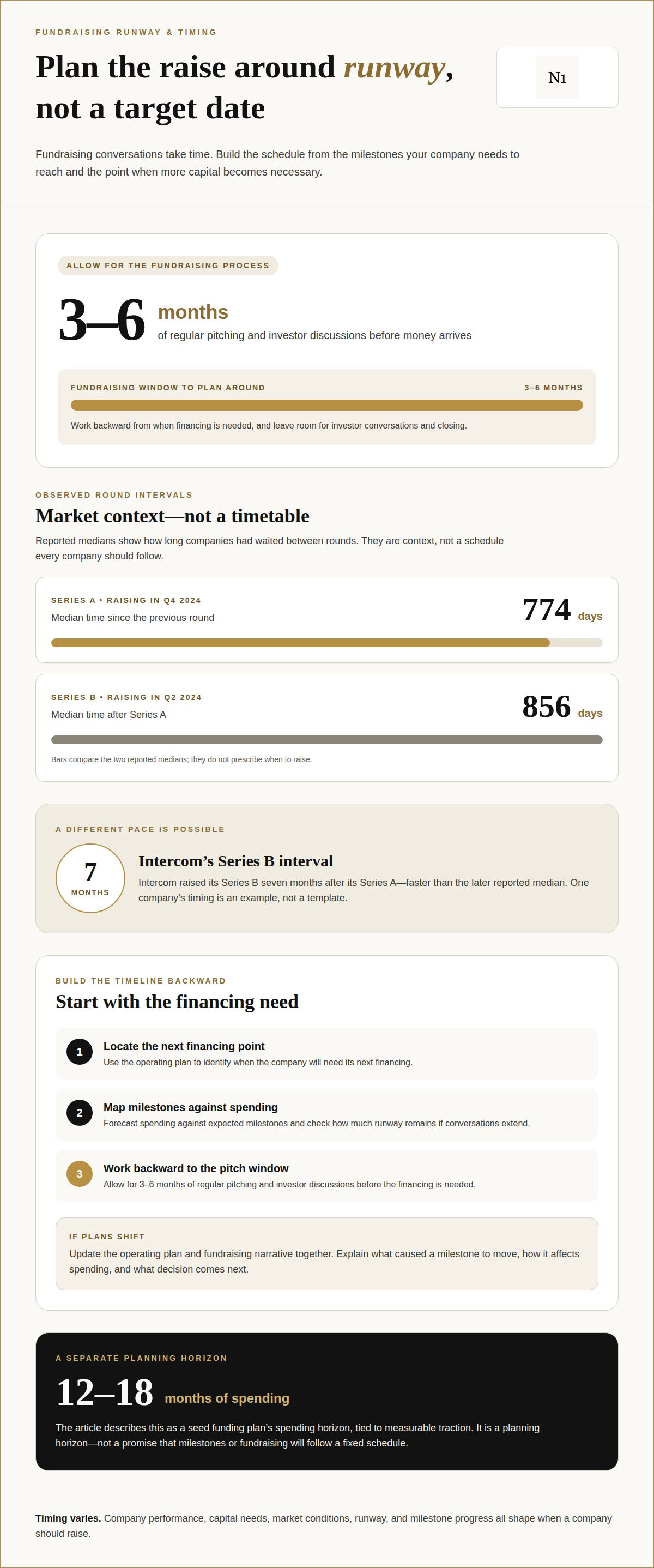
Runway and fundraising timing are linked: a raise must begin while the company can still operate through investor conversations and closing. Fundraising can take 3-6 months of regular pitching and discussions before money arrives. Founders who plan around an intended close date alone risk running short before capital reaches the bank.
Use the operating plan to determine when the process must start. Forecast spending against expected milestones, then identify how much runway remains if investor conversations extend. A seed funding plan, for example, should cover 12 to 18 months of spending and convert it into measurable traction. That window is a planning horizon, not a promise that each milestone or fundraise will follow a fixed schedule.
Round intervals offer context, not a timetable. Startups raising a Series A in Q4 2024 had waited a median of 774 days since their previous round. Startups raising a Series B in Q2 2024 had waited a median of 856 days after Series A. Those figures describe observed fundraising intervals, not the time every company should wait. Company performance, capital needs, and market conditions shape the decision.
Build the timeline around evidence investors will evaluate. Map the company’s key operating milestones, the spending required to reach them, and the point when the next financing becomes necessary. Then work backward from that point to allow for 3-6 months of regular pitching and investor discussions. If customer growth or product delivery takes longer than forecast, update the operating plan and fundraising narrative together. An unchanged timeline paired with revised performance assumptions creates a credibility gap.
Historical examples show why timing varies. Intercom raised its Series B seven months after its Series A, a faster interval than the later reported median. That comparison does not establish a template. It shows that a company’s financing schedule can differ sharply from broad market patterns. Founders should set their sequence according to their own runway, milestones, and capital requirements.
Communication becomes part of runway management when plans shift. If a milestone moves, explain the cause, its effect on spending, and the next decision point in investor updates. During the raise, keep those explanations consistent with pitch materials and conversations. This gives investors a coherent view of how the company is managing time and capital, rather than leaving them to reconcile an old plan with new performance.
A useful timing review connects four items: current cash position, expected spending, milestones required before the raise, and the time needed for investor discussions. Revisit the sequence whenever an assumption changes. This discipline helps founders avoid treating fundraising as a last-minute response to runway pressure.
Pitch decks, traction, and company storytelling
A fundraising deck turns company performance into an investment case. Its claims must match the evidence founders can explain in investor conversations.
Communication and Investor Confidence
Founder communication shapes investor confidence by showing how clearly leadership connects claims to evidence. For tech founders raising Series A and Series B, communications affect fundraising by influencing how investors interpret performance, risks, and decisions. For example, explain a change in customer retention by stating what shifted, what the team learned, and how that affects the plan. Clear answers give investors a coherent basis for evaluating the opportunity.
Build the deck as a sequence of decisions, not a catalogue of slides. Start with the customer problem, then show the product’s role, evidence of demand, and the company’s next growth priorities. A workflow startup, for example, could connect a recurring customer bottleneck to product usage, repeat purchases, and a defined expansion strategy. Each transition should explain why the next piece of evidence supports the investment case.
Traction needs context. A customer count means little without explaining who those customers are, how they use the product, and what the company has learned from serving them. If a startup’s early demand comes from one segment, explain why that segment matters and whether the product is designed to serve it better. Do not imply broader market adoption than the evidence supports.
Make every chart legible and relevant to a decision. Label the period, define the metric, and explain a meaningful change rather than relying on a rising line alone. If revenue increased while customer acquisition slowed, show both movements and describe the operating choice they inform. Investors can then assess the company’s reasoning instead of guessing what the slide leaves unsaid.
Fundraising Communication Mistakes and Risks
Fundraising communication mistakes include unsupported claims, inconsistent metrics, and narratives that overstate what traction proves. An avoidable discrepancy can redirect investor attention from the opportunity to management’s credibility. If a deck describes a customer as a repeat user while the supporting data shows only an initial purchase, correct the claim before presenting it.
A common risk is treating a forecast as established performance. Separate actual results from projections in every chart and explain the assumptions behind the forward view. For example, distinguish signed customer contracts from expected pipeline conversions. This prevents a persuasive estimate from being mistaken for completed business and makes the underlying growth logic easier to assess.
Another mistake is changing the story between investor meetings. Tech founders raising Series A and Series B should keep communications consistent, because conflicting messages can affect fundraising by raising doubts about the company’s strategy. Agree on the central narrative, the metrics that support it, and the language used to describe material risks. Update the materials when the underlying facts change, not to suit each audience.
Before each meeting, compare the deck with the latest financial reporting, product milestones, and customer examples. Correct mismatched dates, definitions, and claims. A concise explanation of a missed target is stronger than an optimistic slide that ignores it. Precision keeps the pitch persuasive without separating the story from the company’s actual performance.
Pitching and due diligence
Choose investors whose stage focus, sector experience, and decision process fit the company’s financing needs. A climate software founder, for example, should prioritize investors who understand enterprise sales cycles and can assess that business model.
Investor fit also depends on the role capital will play. Before outreach, define the company’s strategic priorities and the expertise that could support them. A healthcare startup pursuing hospital customers may value an investor familiar with procurement complexity. Another company may prioritize operational guidance or access to relevant industry networks. These criteria make investor selection deliberate, rather than driven solely by a name or reputation.
Present valuation, terms, and runway as connected parts of one financing proposal. Explain the rationale behind the valuation, outline the proposed terms clearly, and show how the capital supports the operating plan. For example, connect hiring plans to product delivery or customer expansion. Investors can then evaluate the request against the company’s milestones and capital needs.
In negotiations, keep the assumptions consistent across the pitch, financial model, and management discussions. If a proposed valuation changes, explain the rationale and how the revised financing affects the plan. Describe runway using current spending assumptions and planned priorities, not as an isolated headline. Clear framing helps prevent negotiations from producing conflicting accounts of the company’s position.
Due diligence tests whether the fundraising narrative matches the underlying records. Prepare organized materials on financial performance, customer contracts, product milestones, and ownership. Assign a clear internal owner to each category. If an investor asks about a renewal, for example, the response should match the contract and the company’s reported customer data.
Consistency matters across every document. A pitch deck might describe a customer as active, while a contract record shows the relationship has ended. That discrepancy can prompt questions beyond the customer itself. Keep source documents current, use consistent metric definitions, and explain material changes directly. A precise correction is stronger than leaving conflicting evidence unexplained.
During investor meetings, answer the question asked before expanding on the case. If a partner asks why gross margins changed, identify the relevant cost driver and its effect on performance. Then connect that explanation to management’s response. A concise answer demonstrates command of the underlying business; a rehearsed pitch that avoids the issue does not.
Track diligence questions and responses through one shared process. Record the question, the responsible executive, the supporting document, and any follow-up required. If the same question arises in separate meetings, the company can provide a consistent answer. This discipline also reveals recurring concerns, allowing founders to clarify the narrative where investors repeatedly need more evidence.
Raising a Series B
A Series B funds the transition from demonstrated demand to a company built for larger-scale growth. The round is usually between $7 million and $10 million, while companies raising one can expect valuations between $30 million and $60 million. These figures describe common ranges, not a formula for setting a company’s target.
Market context shows why founders should explain their own financing case. The median Series B round size was $15 million in Q3 2023, above the usual range stated here. Canva raised a $15 million Series B in September 2016. Those figures are reference points, not benchmarks every company should copy. A founder’s raise should reflect its operating plan, progress, and intended use of capital.
Investors need to see what changes after the financing. Connect each major use of funds to a specific business priority: hiring key personnel, investing in technology, or expanding execution capacity. For example, a company moving from 100 users toward 1,000 must explain how product reliability, support, and acquisition will scale together. Growth is not a user-count target alone. It requires operating systems that can sustain the increase.
Capital allocation also requires discipline after the round closes. A company that raises to invest in technology should explain how that investment supports its product and competitive position. A hiring plan should identify the organizational capability it adds. In both cases, leadership must tie spending to core objectives rather than treat a larger balance as permission to pursue unrelated priorities.
Execution depends on alignment. Keep teams focused on the company’s mission and the operating goals that justified the raise. If a Series B funds expansion into a new market, explain how that work relates to the core business and who owns the result. Without a clear priority, teams can divide attention across initiatives competing for people, budget, and leadership time.
The external narrative must evolve as the company grows. A Series A story centered on early product validation cannot, on its own, support a Series B case. Founders should show how the company has converted early evidence into broader execution, then explain what remains to prove. Keep investor communications grounded in actual progress, strategic choices, and the next operating priorities.
After closing, communicate material milestones and strategic plans to investors, then keep the team focused on execution rather than the financing headline. For founders shaping that capital-formation narrative, align Series B fundraising communications with the company’s growth priorities.
NarrativeOne: Fund Positioning
NarrativeOne helps founders align fundraising communications with the company’s investment case through Fundraise Communications & Investor Narrative. Turn to this work when the business has credible evidence but needs a clearer structure for its case for capital, growth, and execution. The narrative should connect what the company has achieved with what the next round will enable, without overstating results.
As the company grows, Portfolio Announcements can communicate meaningful milestones, while LP Communications and Partner Thought Leadership support consistent investor and leadership communications. Each has a distinct role. The objective is a coherent account of the business across fundraising and ongoing stakeholder engagement.
Contact NarrativeOne to discuss how Fund Positioning can support your company’s communications.
Make the Next Fundraise a Strategic Decision
Treat communications as part of capital formation, not an asset assembled at the last minute. For tech founders raising Series A and Series B, understanding how communications affect fundraising means aligning the investment case with the company’s direction, evidence, and leadership voice. That discipline can continue beyond the raise, shaping how the business communicates with investors and stakeholders as it grows.
NarrativeOne supports this work through Fund Positioning, Portfolio Announcements, and LP Communications. These offerings help establish a coherent position for the fundraise and maintain clear communication as the company and its investor relationships develop. The work starts with the strategic case the company needs to express.
When that case needs sharper structure, discuss fundraising communications with NarrativeOne. Put the narrative in place with intention, and move into the next stage of growth ready to communicate with clarity.
Frequently Asked Questions
What sets a Series A round apart?
A Series A centers on establishing a repeatable business model; a Series B centers on expanding a model with evidence behind it. The practical difference is the proof investors need. A Series A founder may explain how early customers validate a product. A Series B founder must show how the company can extend that result across customers, teams, or markets. The round’s label matters less than the company’s stage of execution.
What are investors looking for?
Investors look for a credible opportunity, evidence of demand, and leadership that understands the company’s risks and decisions. Their emphasis shifts with the stage: early investors assess whether customers need the product, while later-stage investors examine whether the company can execute growth consistently. Founders should be ready to explain a weak metric, a strategic trade-off, or a customer concentration issue directly. Candor and command of the details strengthen the investment case.
What are some of the things a business should do before seeking Series B funding?
Before seeking Series B funding, compare company performance with the milestones established after Series A. Identify where results diverged, what drove the change, and how the operating plan responds. Confirm that leadership, financial reporting, and customer evidence support the same account of progress. For example, if expansion depends on a new customer segment, clarify what has been learned from that segment and what remains to prove before making it central to the raise.
What traction, revenue, and growth metrics do investors expect at Series A and Series B?
There is no single metric threshold that applies to every company or business model. Investors assess whether the chosen metrics demonstrate the company’s stage-specific case. A Series A company might explain product use, customer retention, and early revenue quality. A Series B company should connect growth to repeatable acquisition, customer expansion, and operational capacity. Define each metric, its time period, and its relevance. For a subscription business, separate recurring revenue from one-time implementation fees.
How should founders prepare a pitch deck and fundraising materials for Series A and Series B?
Build one evidence trail across the deck, financial model, and supporting documents. For Series A, show how customer evidence supports the business thesis. For Series B, make clear how operating results support the proposed growth plan. Label actual results separately from forecasts, define each metric, and use dated source materials. For example, ensure the customer count in the deck uses the same definition as the customer records provided during diligence.
How do fundraising timelines and processes differ between Series A and Series B in the United States?
Both rounds involve investor outreach, meetings, evaluation, diligence, negotiation, and closing, but the questions usually reflect different company stages. Series A conversations test the business thesis and early evidence; Series B discussions examine execution and capacity to scale. Fundraising can involve 3-6 months of regular pitching and investor conversations before a company receives money. Plan the process against operating needs, and keep investor materials aligned as negotiations and diligence progress.
Frequently Asked Questions
What sets a Series A round apart?
A Series A centers on establishing a repeatable business model; a Series B centers on expanding a model with evidence behind it. The practical difference is the proof investors need. A Series A founder may explain how early customers validate a product. A Series B founder must show how the company can extend that result across customers, teams, or markets. The round’s label matters less than the company’s stage of execution.
What are investors looking for?
Investors look for a credible opportunity, evidence of demand, and leadership that understands the company’s risks and decisions. Their emphasis shifts with the stage: early investors assess whether customers need the product, while later-stage investors examine whether the company can execute growth consistently. Founders should be ready to explain a weak metric, a strategic trade-off, or a customer concentration issue directly. Candor and command of the details strengthen the investment case.
What are some of the things a business should do before seeking Series B funding?
Before seeking Series B funding, compare company performance with the milestones established after Series A. Identify where results diverged, what drove the change, and how the operating plan responds. Confirm that leadership, financial reporting, and customer evidence support the same account of progress. For example, if expansion depends on a new customer segment, clarify what has been learned from that segment and what remains to prove before making it central to the raise.
What traction, revenue, and growth metrics do investors expect at Series A and Series B?
There is no single metric threshold that applies to every company or business model. Investors assess whether the chosen metrics demonstrate the company’s stage-specific case. A Series A company might explain product use, customer retention, and early revenue quality. A Series B company should connect growth to repeatable acquisition, customer expansion, and operational capacity. Define each metric, its time period, and its relevance. For a subscription business, separate recurring revenue from one-time implementation fees.
How should founders prepare a pitch deck and fundraising materials for Series A and Series B?
Build one evidence trail across the deck, financial model, and supporting documents. For Series A, show how customer evidence supports the business thesis. For Series B, make clear how operating results support the proposed growth plan. Label actual results separately from forecasts, define each metric, and use dated source materials. For example, ensure the customer count in the deck uses the same definition as the customer records provided during diligence.
How do fundraising timelines and processes differ between Series A and Series B in the United States?
Both rounds involve investor outreach, meetings, evaluation, diligence, negotiation, and closing, but the questions usually reflect different company stages. Series A conversations test the business thesis and early evidence; Series B discussions examine execution and capacity to scale. Fundraising can involve 3-6 months of regular pitching and investor conversations before a company receives money. Plan the process against operating needs, and keep investor materials aligned as negotiations and diligence progress.