A fund launch is a coordinated capital event, not just a press release. If the story could describe a competing strategy, or approvals arrive after the news is already moving, the announcement loses force before it reaches LPs. That’s the challenge behind how to announce a new fund: make the investment case distinct, govern the claims, and coordinate each audience around a deliberate release.
A press release has a role. On its own, it can’t align stakeholders, secure timely approvals, or ensure the story reaches LPs, co-investors, and relevant financial media. The communications plan must connect narrative, governance, and distribution from the outset.
This guide explains how to shape a clear, defensible fund story and build a disciplined announcement plan. It covers stakeholder alignment, compliance review, and a sequenced timeline from T-14, T-10, T-5, and T-2 through Day 0 and +7. The objective is a launch that reaches the right audiences with a consistent account of what the fund is built to do.
Key Takeaways
Distinguish a new fund launch from a portfolio announcement or fundraising update by defining the strategy, mandate, leadership, and capital formation at its core.
Build a defensible narrative from approved facts, separating the investment thesis from positioning language and forward-looking statements.
Use a structured approval and materials plan to coordinate stakeholders, spokespersons, and launch-day distribution. Treat the schedule as a planning framework, not a promise of coverage.
For how to announce a new fund effectively, match each channel to its audience: investor communications serve LPs and co-investors, while earned media builds broader visibility.
After launch, assess message accuracy, coverage quality, stakeholder questions, and follow-up needs to maintain continuity.
Table of Contents
Why a new fund announcement needs more than a press release
A new fund announcement is more than news that a fund exists. It is a coordinated statement of strategy, mandate, leadership, and capital formation. A press release can carry that statement, but it cannot replace the decisions behind it: what the fund stands for, which facts are approved for disclosure, and how each audience receives the message.
A fund narrative is the strategic account of why the fund exists and what it is designed to do; a press release is one format used to communicate that account. The distinction matters. A release can announce a close or describe a strategy, but it won’t resolve an unclear mandate or align stakeholders using different versions of the story.
The fund itself provides context for the announcement. For example, a private equity fund is commonly structured as a limited partnership, with a defined relationship between the fund’s managers and investors. The announcement should make the strategy and mandate legible without confusing that institutional context with promotional claims.
What should a new fund announcement accomplish?
First, clarify the investment focus, target market, and strategic rationale. “We invest in growth” is not a distinct position. Explain what the fund intends to pursue, which part of the market it addresses, and why that focus makes sense.
Next, give LPs and co-investors a consistent account of the mandate. Journalists need an accurate, usable explanation of the fund’s purpose. Internal stakeholders need approved language they can repeat without changing its meaning. Each audience has a different role, but the underlying facts and strategic logic must hold together.
A disciplined launch also creates a foundation for future updates, market commentary, and GP thought leadership. The announcement is an opening reference point, not a one-day communications asset.
When should a fund manager make an announcement?
Set timing around approved, material facts, not a communications calendar alone. Confirm that the fund’s focus, leadership, and any disclosed capital information can be stated consistently. Map confidentiality requirements, investor expectations, and approval dependencies before selecting a date. If a key approval remains unresolved, the announcement plan is not ready.
Keep launch news distinct from interim fundraising updates and portfolio milestones. A new fund launch introduces a strategy and its mandate. A fundraising update reports progress; a portfolio-company announcement concerns an investment or company development. Blending these signals can obscure what has actually happened.
That distinction is central to how to announce a new fund clearly: establish what is being announced, secure alignment on the facts, then sequence communications around a credible release point. The press release is an output of that work, not the work itself.
Build the fund announcement narrative from approved facts
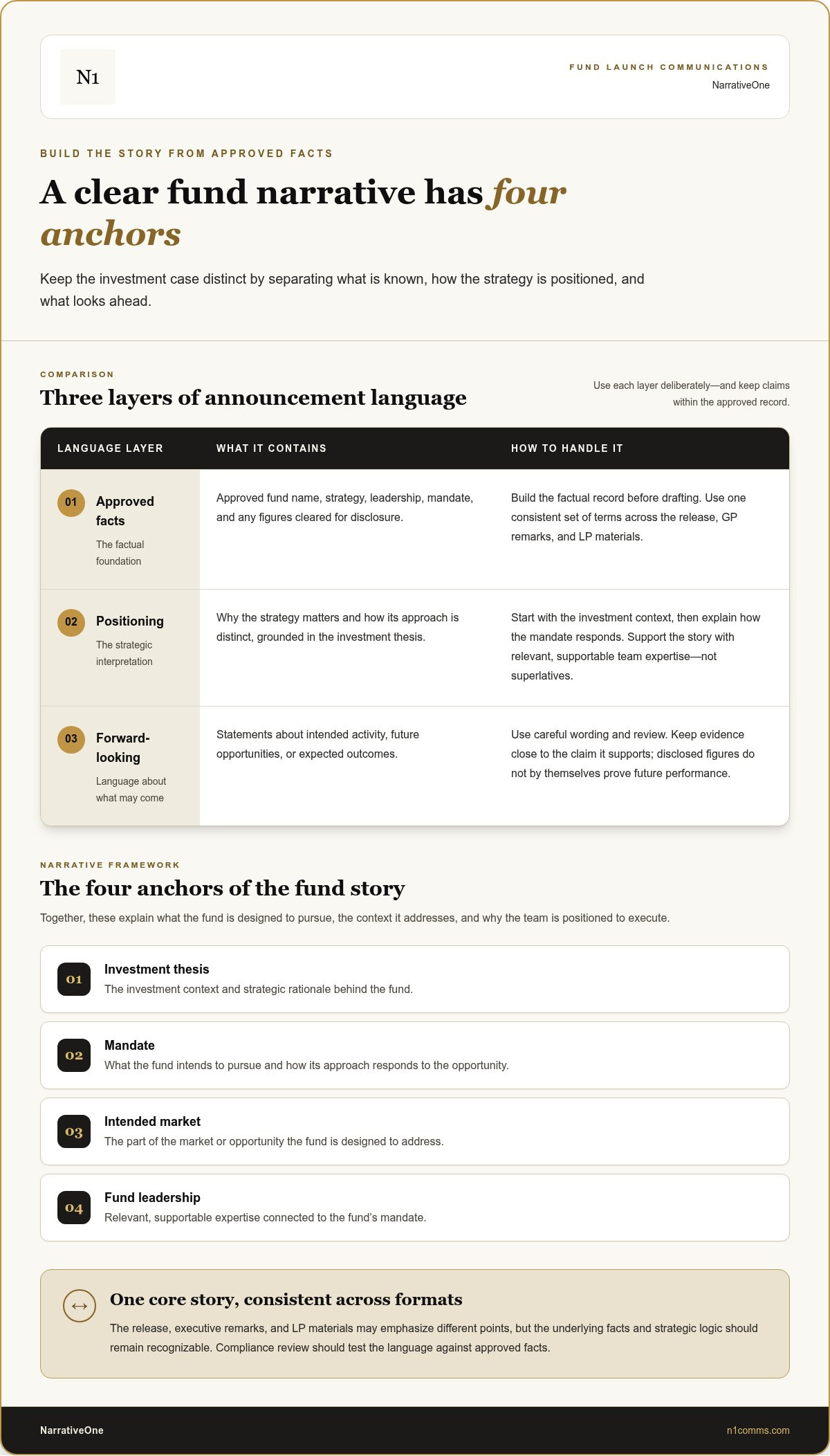
A strong fund narrative starts with four anchors: investment thesis, mandate, intended market, and fund leadership. Together, they explain what the fund is designed to pursue, the context it addresses, and why this team is positioned to execute the strategy. Without those anchors, an announcement can list fund details and still leave readers unclear about its purpose.
A fund thesis becomes a clear announcement narrative when it connects an investment context, a defined mandate, and the team’s relevant expertise using facts that are approved for disclosure. That account should remain recognizable across the release, executive remarks, and LP materials. Different formats can emphasize different points, but the core story should not shift.
Which facts belong in a fund launch announcement?
Build the factual record before drafting. Include only the approved fund name, strategy, leadership, mandate, and disclosed figures. Separate those facts from two other kinds of language:
Positioning: The interpretation of why the strategy matters or how its approach is distinct.
Forward-looking statements: Claims about intended activity, future opportunities, or expected outcomes.
Positioning should be supported by the investment thesis. Future-oriented claims need careful wording and review. Identify which details require investor, legal, or compliance approval before publication, then use one set of terms across the release, GP remarks, and LP materials. Compliance rules should be embedded before the compliance director reviews drafts. The review should test the language against approved facts, not repair a story built without them.
How do you make the fund story distinctive?
Start with the investment context, not a superlative. Explain what market or opportunity the fund is designed to address, then state how its mandate and approach respond. Connect GP expertise to that mandate with relevant, supportable experience. “Experienced team” is a label; a concise account of expertise related to the strategy gives readers a reason to believe the positioning.
Evidence should demonstrate alignment, not imply outcomes. A disclosed figure may establish scale or progress, but it does not by itself prove future performance. Keep evidence close to the claim it supports, and remove language that implies certainty beyond the approved record. For a deeper framework on differentiating an investment case, see the guide to fund brand positioning strategy.
That discipline is central to how to announce a new fund: build one defensible narrative, then adapt its emphasis for each audience without changing its substance. A focused fund positioning approach helps keep the investment case clear from first draft through publication.
Plan the fund launch timeline, approvals, and materials
A launch schedule is an operating framework, not a promise of media coverage. Its purpose is to give the investment team, communications lead, and approvers a shared sequence, with clear owners and dependencies. The pace depends on when material facts are approved and when required stakeholders are ready.
Use one senior strategist to maintain narrative consistency, one journalist network for relevant media outreach, and one compliance workflow shared across the firm and portfolio companies. Assign an owner to each deliverable. Track factual checks, disclosure permissions, review status, spokesperson readiness, and final release approval in a single record.
What happens at each stage of the announcement timeline?
The sequence is T-14, T-10, T-5, T-2, Day 0, +7. Treat each stage as a decision gate. The next step depends on the previous one being complete, not simply on the calendar advancing.
StageDeliverablesDecision-makers and dependenciesT-14Set the narrative, approved-facts record, target outlets, and initial materials.Fund leadership confirms the thesis and mandate; factual owners verify source information.T-10Develop the release, LP materials, media pitch, and spokesperson messages.The strategist coordinates drafts; fund leadership confirms positioning and permitted disclosures.T-5Refine content and complete factual and compliance reviews.The compliance director reviews after applicable compliance rules have been embedded; unresolved claims return to their factual owners.T-2Lock approved materials and prepare spokespersons for likely questions.Final approvers confirm wording, timing, and distribution readiness.Day 0Coordinate the release, investor communications, media outreach, and monitoring.Release only after final approval and confirmation that channels are aligned.+7Review the response, correct factual issues where needed, and identify relevant follow-up.The communications lead assesses coverage and stakeholder questions with the fund team.
How should compliance and approvals work?
Build the review around claims, not just documents. For each material statement, record its factual owner, evidence, approval status, and permitted disclosure. A claim approved for LP materials may not automatically be cleared for public release. Resolve that distinction before publication.
Draft English and Arabic materials natively in each language, then check that both versions express the same approved facts and positioning. Keep LP materials, releases, and media pitches aligned. That discipline is central to how to announce a new fund without letting timing pressure create inconsistent claims. A coordinated fund launch communications plan can establish ownership and review gates before distribution begins.
Choose channels and coordinate LP, co-investor, and media communications
Channel selection is an audience decision, not a distribution checklist. LPs, co-investors, journalists, and the wider market need different levels of detail, but they should encounter the same approved account of the fund. A prominent article can extend visibility; it cannot replace direct investor communication.
How should LPs and co-investors hear about the fund?
Coordinate direct outreach with the public release and its permitted disclosures. Decide who receives tailored LP materials, who receives a direct briefing, and who should see the public announcement. If the communications plan calls for direct outreach first, investors should not learn material launch information from a media story.
Adapt the depth, not the facts. LP materials can provide detail relevant to existing investor relationships; co-investor outreach can focus on the mandate and areas of strategic alignment. Owned channels, such as the firm’s website or approved executive communications, provide a reference point after launch. Each asset should use the same approved terms and figures.
How should a fund approach financial media?
Prioritize journalists and publications relevant to the fund’s investment sectors and the audiences it needs to reach. A pitch about a venture capital mandate should explain the investment context and thesis, not simply announce a new fund. Support the angle with approved evidence that directly substantiates the claim. An undifferentiated release gives journalists little reason to distinguish the story from routine market news.
Use earned media for independent visibility and broader context. Use direct stakeholder outreach for investor communication. Use owned channels for an authoritative, reusable source. These channels reinforce one another, but they are not interchangeable. Coverage in a prominent outlet does not confirm that LPs received the information, understood the mandate, or had the opportunity to ask questions.
Where both language audiences are relevant, prepare English and Arabic materials natively in each language. Keep the underlying facts and positioning aligned while shaping each version for its intended readers. Media relations should connect the fund’s specific story with journalists covering private equity, venture capital, and multi-strategy investment platforms. Relevant outreach may include journalists at outlets such as Bloomberg, Reuters, the Financial Times, Forbes, Arabian Business, and AGBI. Coverage is not assured; the objective is to make the story clear, credible, and pertinent to the right desks.
That is the practical discipline behind how to announce a new fund: match each channel to its job, coordinate release timing, and protect consistency across audiences. Explore NarrativeOne’s fund communications approach to see how coordinated investor and media communications support a fund launch.
Execute the announcement and build continuity after launch
Publication is a handoff point, not the finish line. On announcement day, the team must control what goes out, who receives it, and how the firm responds. A concise checklist keeps execution disciplined:
Approval: Confirm the final release, approved claims, and stakeholder distribution sequence.
Spokesperson readiness: Align GP remarks and responses to likely questions with the approved narrative.
Distribution: Release investor and media materials through their intended channels, using consistent facts.
Monitoring: Track coverage, inbound questions, and factual errors. Address corrections through agreed channels.
Measure more than placement. Record whether coverage accurately reflects the fund’s mandate, whether key messages are intact, what LPs and co-investors ask, and where follow-up is needed. A prominent mention can create visibility, but message quality and stakeholder understanding show whether the communications did its job.
What should the team do on announcement day and afterward?
Keep one owner responsible for the live status of approvals, distribution, and response coordination. If a journalist or investor raises a question, route it to the appropriate factual owner and respond using approved information. Don’t improvise new claims under deadline pressure.
At +7, review the response and decide which follow-up communications are useful. A recurring question may warrant a clearer explanation; accurate coverage may provide a basis for continued GP commentary. Follow-up should answer a real communications need, not manufacture news to extend attention.
How can a fund sustain the story beyond launch?
Treat the announcement as the first point in a 12-month narrative plan, executed weekly and reported monthly. The plan can connect GP thought leadership, Events & speaking, and the Portfolio announcement service where relevant. Each activity should reinforce the fund’s approved investment case rather than introduce a disconnected message.
NarrativeOne’s model connects one senior strategist, one journalist network, and one compliance workflow shared across the firm and portfolio companies. Compliance rules are embedded before the compliance director reviews drafts. This structure keeps the launch, future commentary, and relevant portfolio communications aligned without turning every update into another fund announcement.
Strong execution is the practical answer to how to announce a new fund: approve the facts, coordinate the release, monitor the response, then sustain the narrative with purposeful communications. The announcement creates the opening. Disciplined follow-through gives it continuity.
Make the Fund Launch the Start of a Stronger Narrative
A disciplined launch rests on three controls: a distinct investment case built from approved facts, a coordinated sequence of approvals and communications, and channels matched to LPs, co-investors, journalists, and internal stakeholders. The release carries the story. The operating plan gives it credibility and continuity.
That is the core of how to announce a new fund: align the mandate, evidence, timing, and follow-through before the news goes public. NarrativeOne brings 17 years of operating experience inside investment institutions and experience across $2 B+ AUM and 150+ funds/clients. The Portfolio announcement service supports a sequenced process from term-sheet to Tier-1 coverage in fourteen days.
A launch should open a sustained communications program, not close one. Discuss a disciplined fund announcement strategy with NarrativeOne and build a communications framework that supports the announcement and the story that follows. Your fund’s investment case deserves to be clear, credible, and consistently told.
Frequently Asked Questions
How do you announce a new fund?
Announce a new fund with a coordinated plan for the narrative, approvals, audiences, and channels. Start with the investment thesis, mandate, intended market, and leadership. Verify each material fact and confirm what can be disclosed. Align LP communications, co-investor outreach, media materials, and public channels around the same approved account. The release is one component of the launch, not a substitute for investor communication or a post-announcement plan.
When should a fund announce its launch?
Announce when the material facts are approved and stakeholders are aligned, not simply because a preferred date is approaching. Confirm the fund’s mandate, leadership, and any figures intended for disclosure. Resolve confidentiality considerations, investor expectations, and approval dependencies before setting timing. If the facts or permissions are unsettled, revise the schedule. A communications calendar should support readiness, not force publication before the announcement can be made accurately.
What should a new fund announcement include?
A new fund announcement should clearly state the approved fund name, investment strategy, mandate, intended market, leadership, and any figures cleared for disclosure. Explain the investment rationale and what distinguishes the approach, using evidence that supports the claims without implying future outcomes. Prepare consistent versions for the release, spokesperson remarks, LP materials, and media outreach. Keep positioning language distinct from verifiable facts and forward-looking statements.
How far in advance should you prepare a fund announcement?
Use a staged schedule that gives the team time to align facts, prepare materials, complete reviews, and ready spokespeople. One planning sequence is T-14, T-10, T-5, T-2, Day 0, +7. Establish the narrative and target outlets early, refine drafts and complete reviews before launch, then monitor the response afterward. This is a planning framework, not a guarantee of media coverage. Adjust it when approvals or disclosures require more time.
Should LPs hear about a new fund before the press?
Coordinate direct investor communication with public release timing so LPs receive information through the intended channel and in line with approved disclosures. Whether LPs should hear first depends on investor expectations, confidentiality, and the communications plan. Decide who receives tailored LP materials, who receives direct outreach, and who can access the public announcement. Keep the facts consistent while adapting the level of detail to each audience’s role.
How do you measure whether a fund announcement worked?
Assess whether the announcement reached its intended audiences and communicated the fund accurately. Review coverage for factual accuracy and message quality, then track LP and co-investor questions, inbound media interest, and follow-up needs. A prominent placement alone is not a complete measure of success. Use the post-launch review to identify what audiences understood, where clarification is needed, and which future communications would serve a genuine purpose.
How much does it cost to announce a new fund?
The cost depends on the scope of the communications work, including the narrative and materials required, the audiences and channels involved, language needs, and the approval process. A release-only task differs from a coordinated program involving LP communications, stakeholder outreach, media relations, spokesperson preparation, and post-launch monitoring. Set the scope before comparing costs. Resource the announcement to meet its strategic and governance requirements, rather than treating it as a document alone.
Frequently Asked Questions
What should a new fund announcement accomplish?
First, clarify the investment focus, target market, and strategic rationale. “We invest in growth” is not a distinct position. Explain what the fund intends to pursue, which part of the market it addresses, and why that focus makes sense. Next, give LPs and co-investors a consistent account of the mandate. Journalists need an accurate, usable explanation of the fund’s purpose. Internal stakeholders need approved language they can repeat without changing its meaning. Each audience has a different role, but the underlying facts and strategic logic must hold together. A disciplined launch also creates a foundation for future updates, market commentary, and GP thought leadership. The announcement is an opening reference point, not a one-day communications asset.
When should a fund manager make an announcement?
Set timing around approved, material facts, not a communications calendar alone. Confirm that the fund’s focus, leadership, and any disclosed capital information can be stated consistently. Map confidentiality requirements, investor expectations, and approval dependencies before selecting a date. If a key approval remains unresolved, the announcement plan is not ready. Keep launch news distinct from interim fundraising updates and portfolio milestones. A new fund launch introduces a strategy and its mandate. A fundraising update reports progress; a portfolio-company announcement concerns an investment or company development. Blending these signals can obscure what has actually happened. That distinction is central to how to announce a new fund clearly: establish what is being announced, secure alignment on the facts, then sequence communications around a credible release point. The press release is an output of that work, not the work itself. A strong fund narrative starts with four anchors: investment thesis, mandate, intended market, and fund leadership. Together, they explain what the fund is designed to pursue, the context it addresses, and why this team is positioned to execute the strategy. Without those anchors, an announcement can list fund details and still leave readers unclear about its purpose. A fund thesis becomes a clear announcement narrative when it connects an investment context, a defined mandate, and the team’s relevant expertise using facts that are approved for disclosure. That account should remain recognizable across the release, executive remarks, and LP materials. Different formats can emphasize different points, but the core story should not shift.
Which facts belong in a fund launch announcement?
Build the factual record before drafting. Include only the approved fund name, strategy, leadership, mandate, and disclosed figures. Separate those facts from two other kinds of language: Positioning should be supported by the investment thesis. Future-oriented claims need careful wording and review. Identify which details require investor, legal, or compliance approval before publication, then use one set of terms across the release, GP remarks, and LP materials. Compliance rules should be embedded before the compliance director reviews drafts. The review should test the language against approved facts, not repair a story built without them.
How do you make the fund story distinctive?
Start with the investment context, not a superlative. Explain what market or opportunity the fund is designed to address, then state how its mandate and approach respond. Connect GP expertise to that mandate with relevant, supportable experience. “Experienced team” is a label; a concise account of expertise related to the strategy gives readers a reason to believe the positioning. Evidence should demonstrate alignment, not imply outcomes. A disclosed figure may establish scale or progress, but it does not by itself prove future performance. Keep evidence close to the claim it supports, and remove language that implies certainty beyond the approved record. For a deeper framework on differentiating an investment case, see the guide to fund brand positioning strategy. That discipline is central to how to announce a new fund: build one defensible narrative, then adapt its emphasis for each audience without changing its substance. A focused fund positioning approach helps keep the investment case clear from first draft through publication. A launch schedule is an operating framework, not a promise of media coverage. Its purpose is to give the investment team, communications lead, and approvers a shared sequence, with clear owners and dependencies. The pace depends on when material facts are approved and when required stakeholders are ready. Use one senior strategist to maintain narrative consistency, one journalist network for relevant media outreach, and one compliance workflow shared across the firm and portfolio companies. Assign an owner to each deliverable. Track factual checks, disclosure permissions, review status, spokesperson readiness, and final release approval in a single record.
What happens at each stage of the announcement timeline?
The sequence is T-14, T-10, T-5, T-2, Day 0, +7. Treat each stage as a decision gate. The next step depends on the previous one being complete, not simply on the calendar advancing.
How should compliance and approvals work?
Build the review around claims, not just documents. For each material statement, record its factual owner, evidence, approval status, and permitted disclosure. A claim approved for LP materials may not automatically be cleared for public release. Resolve that distinction before publication. Draft English and Arabic materials natively in each language, then check that both versions express the same approved facts and positioning. Keep LP materials, releases, and media pitches aligned. That discipline is central to how to announce a new fund without letting timing pressure create inconsistent claims. A coordinated fund launch communications plan can establish ownership and review gates before distribution begins. Channel selection is an audience decision, not a distribution checklist. LPs, co-investors, journalists, and the wider market need different levels of detail, but they should encounter the same approved account of the fund. A prominent article can extend visibility; it cannot replace direct investor communication.
How should LPs and co-investors hear about the fund?
Coordinate direct outreach with the public release and its permitted disclosures. Decide who receives tailored LP materials, who receives a direct briefing, and who should see the public announcement. If the communications plan calls for direct outreach first, investors should not learn material launch information from a media story. Adapt the depth, not the facts. LP materials can provide detail relevant to existing investor relationships; co-investor outreach can focus on the mandate and areas of strategic alignment. Owned channels, such as the firm’s website or approved executive communications, provide a reference point after launch. Each asset should use the same approved terms and figures.
How should a fund approach financial media?
Prioritize journalists and publications relevant to the fund’s investment sectors and the audiences it needs to reach. A pitch about a venture capital mandate should explain the investment context and thesis, not simply announce a new fund. Support the angle with approved evidence that directly substantiates the claim. An undifferentiated release gives journalists little reason to distinguish the story from routine market news. Use earned media for independent visibility and broader context. Use direct stakeholder outreach for investor communication. Use owned channels for an authoritative, reusable source. These channels reinforce one another, but they are not interchangeable. Coverage in a prominent outlet does not confirm that LPs received the information, understood the mandate, or had the opportunity to ask questions. Where both language audiences are relevant, prepare English and Arabic materials natively in each language. Keep the underlying facts and positioning aligned while shaping each version for its intended readers. Media relations should connect the fund’s specific story with journalists covering private equity, venture capital, and multi-strategy investment platforms. Relevant outreach may include journalists at outlets such as Bloomberg, Reuters, the Financial Times, Forbes, Arabian Business, and AGBI. Coverage is not assured; the objective is to make the story clear, credible, and pertinent to the right desks. That is the practical discipline behind how to announce a new fund: match each channel to its job, coordinate release timing, and protect consistency across audiences. Explore NarrativeOne’s fund communications approach to see how coordinated investor and media communications support a fund launch. Publication is a handoff point, not the finish line. On announcement day, the team must control what goes out, who receives it, and how the firm responds. A concise checklist keeps execution disciplined: Measure more than placement. Record whether coverage accurately reflects the fund’s mandate, whether key messages are intact, what LPs and co-investors ask, and where follow-up is needed. A prominent mention can create visibility, but message quality and stakeholder understanding show whether the communications did its job.
What should the team do on announcement day and afterward?
Keep one owner responsible for the live status of approvals, distribution, and response coordination. If a journalist or investor raises a question, route it to the appropriate factual owner and respond using approved information. Don’t improvise new claims under deadline pressure. At +7, review the response and decide which follow-up communications are useful. A recurring question may warrant a clearer explanation; accurate coverage may provide a basis for continued GP commentary. Follow-up should answer a real communications need, not manufacture news to extend attention.
How can a fund sustain the story beyond launch?
Treat the announcement as the first point in a 12-month narrative plan, executed weekly and reported monthly. The plan can connect GP thought leadership, Events & speaking, and the Portfolio announcement service where relevant. Each activity should reinforce the fund’s approved investment case rather than introduce a disconnected message. NarrativeOne’s model connects one senior strategist, one journalist network, and one compliance workflow shared across the firm and portfolio companies. Compliance rules are embedded before the compliance director reviews drafts. This structure keeps the launch, future commentary, and relevant portfolio communications aligned without turning every update into another fund announcement. Strong execution is the practical answer to how to announce a new fund: approve the facts, coordinate the release, monitor the response, then sustain the narrative with purposeful communications. The announcement creates the opening. Disciplined follow-through gives it continuity. A disciplined launch rests on three controls: a distinct investment case built from approved facts, a coordinated sequence of approvals and communications, and channels matched to LPs, co-investors, journalists, and internal stakeholders. The release carries the story. The operating plan gives it credibility and continuity. That is the core of how to announce a new fund: align the mandate, evidence, timing, and follow-through before the news goes public. NarrativeOne brings 17 years of operating experience inside investment institutions and experience across $2 B+ AUM and 150+ funds/clients. The Portfolio announcement service supports a sequenced process from term-sheet to Tier-1 coverage in fourteen days. A launch should open a sustained communications program, not close one. Discuss a disciplined fund announcement strategy with NarrativeOne and build a communications framework that supports the announcement and the story that follows. Your fund’s investment case deserves to be clear, credible, and consistently told.
How do you announce a new fund?
Announce a new fund with a coordinated plan for the narrative, approvals, audiences, and channels. Start with the investment thesis, mandate, intended market, and leadership. Verify each material fact and confirm what can be disclosed. Align LP communications, co-investor outreach, media materials, and public channels around the same approved account. The release is one component of the launch, not a substitute for investor communication or a post-announcement plan.
When should a fund announce its launch?
Announce when the material facts are approved and stakeholders are aligned, not simply because a preferred date is approaching. Confirm the fund’s mandate, leadership, and any figures intended for disclosure. Resolve confidentiality considerations, investor expectations, and approval dependencies before setting timing. If the facts or permissions are unsettled, revise the schedule. A communications calendar should support readiness, not force publication before the announcement can be made accurately.
What should a new fund announcement include?
A new fund announcement should clearly state the approved fund name, investment strategy, mandate, intended market, leadership, and any figures cleared for disclosure. Explain the investment rationale and what distinguishes the approach, using evidence that supports the claims without implying future outcomes. Prepare consistent versions for the release, spokesperson remarks, LP materials, and media outreach. Keep positioning language distinct from verifiable facts and forward-looking statements.
How far in advance should you prepare a fund announcement?
Use a staged schedule that gives the team time to align facts, prepare materials, complete reviews, and ready spokespeople. One planning sequence is T-14, T-10, T-5, T-2, Day 0, +7. Establish the narrative and target outlets early, refine drafts and complete reviews before launch, then monitor the response afterward. This is a planning framework, not a guarantee of media coverage. Adjust it when approvals or disclosures require more time.
Should LPs hear about a new fund before the press?
Coordinate direct investor communication with public release timing so LPs receive information through the intended channel and in line with approved disclosures. Whether LPs should hear first depends on investor expectations, confidentiality, and the communications plan. Decide who receives tailored LP materials, who receives direct outreach, and who can access the public announcement. Keep the facts consistent while adapting the level of detail to each audience’s role.
How do you measure whether a fund announcement worked?
Assess whether the announcement reached its intended audiences and communicated the fund accurately. Review coverage for factual accuracy and message quality, then track LP and co-investor questions, inbound media interest, and follow-up needs. A prominent placement alone is not a complete measure of success. Use the post-launch review to identify what audiences understood, where clarification is needed, and which future communications would serve a genuine purpose.
How much does it cost to announce a new fund?
The cost depends on the scope of the communications work, including the narrative and materials required, the audiences and channels involved, language needs, and the approval process. A release-only task differs from a coordinated program involving LP communications, stakeholder outreach, media relations, spokesperson preparation, and post-launch monitoring. Set the scope before comparing costs. Resource the announcement to meet its strategic and governance requirements, rather than treating it as a document alone.