
A Series A announcement is not a press-release problem; it’s a relationship and positioning problem. The practical answer to how to announce a Series A in MENA press is to build a focused list of 10 to 20 relevant reporters, shape a concise pitch around the funding and its purpose, and prepare distinct Arabic- and English-language coverage. Give journalists at least one or two weeks’ notice.
For founders, announcing a Series A in MENA press means more than sharing that the round closed. The challenge is to make the news relevant to journalists and clear across markets with different audiences, languages, and business contexts. A broad press blast rarely achieves that.
This guide sets out how to build journalist relationships before the raise is public, structure a pitch under 200 words, and follow up with discipline. It also explains how to use traction metrics and coordinate Arabic- and English-language materials so the announcement carries a consistent narrative without flattening regional differences.
Key Takeaways
Lead with the funding amount, its intended use, and a clear reason the news matters to the region.
Choose traction metrics that demonstrate business momentum, then connect each figure to what it signals about the company.
Build journalist relationships before the announcement by tailoring outreach to each reporter’s beat and audience.
Prepare Arabic- and English-language materials as coordinated versions, adapting context and framing rather than translating word for word.
Use a deliberate follow-up plan and supporting creative assets to extend the announcement beyond its initial release.
Table of Contents
How should founders structure a pitch email to a MENA tech journalist?
How do you build genuine relationships with MENA tech journalists?
How should founders structure a pitch email to a MENA tech journalist?
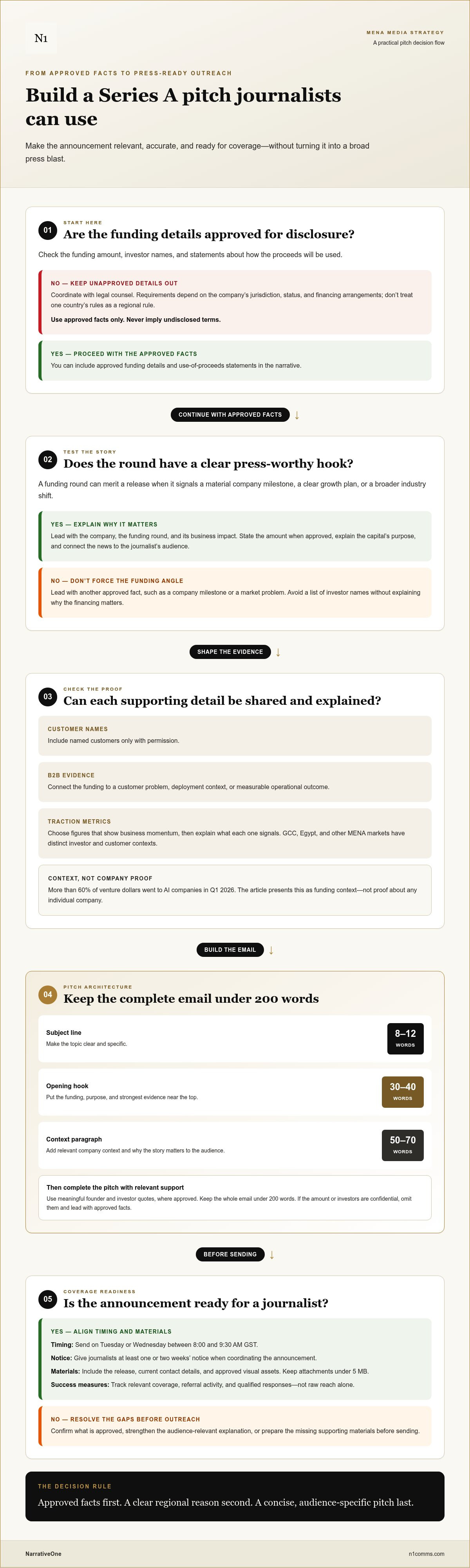
Set the disclosure boundary before drafting. Confirm which funding details, investor names, and statements about use of proceeds stakeholders have approved. Legal and regulatory disclosures depend on the company’s jurisdiction, status, and financing arrangements. Coordinate with legal counsel, and don’t treat one country’s requirements as a regional rule. A sound approach to how to announce Series A in MENA press starts with approved facts, not assumptions.
Build the funding narrative around the round’s purpose. State the amount when approved, explain where the capital will go, and include meaningful founder and investor quotes. For B2B technology, connect the funding to a customer problem, deployment context, or measurable operational outcome. A strong headline identifies the company, funding round, and business impact. Don’t make the release a list of investor names without explaining why the financing matters.
Assess whether the round has a press-worthy hook. A closed funding round can merit a release when it signals a material company milestone, a clear growth plan, or a broader industry shift. Add named customers only with permission, and explain why the announcement matters to the journalist’s audience. AI is part of the funding context: more than 60% of venture dollars went to AI companies in Q1 2026. That figure is context, not company-specific proof.
Prepare a concise, structured email. Keep the pitch under 200 words, with an 8 to 12-word subject line, a 30 to 40-word opening hook, and a 50 to 70-word context paragraph. Put the funding, purpose, and strongest supporting evidence near the top. If investors or the amount are confidential, omit those details and lead with approved facts, such as a company milestone or market problem. Never imply undisclosed terms.
Make the announcement ready for coverage. Send the pitch on Tuesday or Wednesday between 8:00 and 9:30 AM GST, allowing at least one or two weeks’ notice when coordinating the announcement. Include the release, current contact details, and approved visual assets; keep attachments under 5 MB. Founders asking how to announce Series A in MENA press should also define success in advance, tracking relevant coverage, referral activity, and qualified responses instead of treating raw reach as business impact.
Journalist outreach timing and follow-ups
Treat the close, media outreach, and public release as separate milestones. Each has its own deadline and stakeholders.
Set the Announcement Timing
Set the release date against the financing close, not just the preferred news cycle. A Series A close typically takes 6-8 weeks from term sheet to close, while legal negotiations and closing typically take 4-8 weeks after a term sheet is signed. Coordinate with existing and new investors three weeks before announcement day. Send the release on closing day or within a few days; funding news has a 48-72-hour relevance window.
Time Journalist Pitches and Follow-Ups
Pitch a small, selected group under embargo, with clear terms and a specific response deadline. The suggested embargo pitch targets 2-3 reporters; offer the same verified facts to each and avoid implying exclusivity unless agreed. If a journalist doesn’t respond, use one relevant follow-up rather than repeating the original paragraph. A journalist survey found 51% considered 3-7 days the ideal wait before an email follow-up.
Make every follow-up useful. Add a material detail, such as an approved investor quote or a clearer explanation of the startup’s expansion plan. Limit follow-ups to two. If neither gets a response, pause outreach and return with a genuinely new milestone after three months.
Choose Distribution Timing and Channels
Publish the release on the company website, social channels, and email newsletter in a coordinated sequence. For Series A and later rounds, the distribution plan recommends premium wire distribution; pair it with CEO and founder LinkedIn posts within one hour. Avoid timing the release alongside a major global event or industry announcement that could bury the headline. Keep the same factual core across channels.
Coordinate internal communications. Notify employees, investors, and other relevant stakeholders the day before publication, and ask them to wait until the company posts. This helps prevent an early social post from disrupting the agreed timing or revealing details before the official release. Give stakeholders approved copy and visuals so their posts reinforce one announcement rather than introduce conflicting wording.
Extend the announcement after publication. Share additional launch materials over the following 1-2 weeks, using each asset to add context rather than repeat the funding headline. Track coverage, referral activity, and investor or customer responses against the announcement’s purpose. The first 48 hours after the release goes live are the peak period for journalist interest, investor attention, and buyer awareness, so assign an owner to respond promptly.
Using traction metrics to support the announcement
Choose metrics that show business progress, not figures selected only for scale. GCC, Egypt, and other MENA markets have distinct investor and customer contexts. Explain why a metric matters instead of treating the region as a single audience.
Establish Company Context and Traction
Give the journalist a compact reference point: what the company sells, who uses it, and how adoption is changing. A B2B founder might pair threefold year-over-year ARR growth with 120 enterprise customers. Another company could report net revenue retention above 100%, showing existing customers are expanding their use. Select one or two metrics that support the funding narrative, then define the period and metric clearly.
Separate product-market fit signals from activity counts. A large number of sign-ups means less without evidence of active use, repeat transactions, retention, or revenue. For example, more than 2 million transactions in the 90 days after a Series A describes product adoption more precisely than “rapid growth.” Use the metric the business can substantiate consistently.
Connect Traction Data to Regional Relevance
Explain where the evidence comes from and why it matters to the target market. MENA startups raised $7.5 billion across 647 companies in 2025, while GCC venture funding reached approximately $3.3 billion across 541 deals. Those figures provide ecosystem context, not proof of one startup’s performance. Add the company’s own customer, revenue, or usage data to make the connection specific.
Don’t assume a traction story will mean the same thing across GCC, Egypt, and other MENA markets. Specify the customer segment, operating market, and local business problem. If the company serves several markets, separate figures by geography when that distinction affects the story. Define metrics consistently throughout the release.
Match each metric to the claim it supports. Revenue growth indicates commercial expansion; customer counts indicate adoption; retention can signal continued value. A beta that organically attracted 20,000 users offers an early-use signal, but it doesn’t establish revenue traction by itself. Pair it with a clear explanation of active usage or conversion, if those measures support the company’s case.
Use comparisons carefully. A 4x year-over-year revenue claim needs a clear comparison period and consistent accounting basis. If a metric depends on a narrow cohort, say so rather than presenting it as company-wide performance. The journalist needs a defensible figure and a founder who can explain its business meaning in one sentence.
Build a simple evidence check before publication. Confirm every number against the same reporting period, define terms such as “customer” or “active user,” and align the CEO’s quote with the data. A fundraising announcement plan can help connect the selected metrics to the company’s investor narrative without turning the release into a data dump.
How do you build genuine relationships with MENA tech journalists?
Build relevance before asking for coverage. Strong journalist relationships come from accurate, useful contact, not just one funding announcement.
Create a curated list of 10 to 20 reporters before the announcement date. Record each person’s publication, language, beat, and recent coverage. Separate technology reporters from finance, enterprise, and sector specialists. A startup selling B2B software, for example, should target journalists covering enterprise technology or its customer industry, not every outlet with a technology section.
Prioritize fit over outlet size. Review recent articles from each publication to see what its journalists actually cover. Niche industry publications and local media may reach relevant investors, partners, and potential customers. Add a reporter to your list only when the company’s market, product, or founder perspective connects to their coverage.
Make each first contact specific. Refer to a recent article by title or subject, then explain how it connects to the startup’s business. For example, a founder approaching a journalist covering payment infrastructure can explain how the product addresses a related operational challenge. Skip generic compliments and don’t send the same pitch to everyone on the list.
Offer value between funding rounds. Share a concise, relevant insight when the founder can contribute expertise, explain a market shift, or clarify a technical issue. Follow the journalist’s preferred language and publication style. Apply AP guidelines to names, titles, and figures, while respecting each outlet’s own editorial conventions. Accuracy builds a stronger basis for future contact than repeated announcements.
Keep the relationship organized. Track outreach, replies, topics covered, and agreed next steps. If a journalist declines a story, acknowledge the decision without pressing for an explanation. When the company has a genuinely new development, contact only reporters whose beats match it. A focused list helps founders share relevant information without making every interaction a funding request.
Limit follow-ups to two. If both go unanswered, wait three months and try again only with a genuinely new milestone. Use clear, engaging language rather than technical jargon.
Arabic- and English-language coverage
Create two editorial versions of the announcement, not one release mechanically translated. Arabic- and English-language coverage should share verified facts while reflecting each audience’s context.
Agree on the factual core before drafting either version: the company name, funding amount, investor names, use of capital, approved quotes, and milestone descriptions. Then decide what each audience needs explained. A regional customer expansion, for example, may be central to Arabic-language outreach, while an English-language publication may need more context about the company’s category or international market.
Draft each version for its readers rather than translating word for word. Arabic and English differ in sentence structure, terminology, and conventions for names and titles. Preserve the founder’s meaning, but shape the quote so it sounds direct and credible in each language. Keep funding facts identical, and have a fluent editor review both versions for meaning, tone, and consistency before distribution.
Adapt the headline and opening to each publication’s audience. One version might foreground the capital raised and regional expansion; another might lead with the product milestone or customer problem. Both should explain who raised the funding, what the capital supports, and why the news matters. Avoid translating idioms or technical terms literally if that obscures the business model.
Build separate media lists for each language. Match Arabic-language outreach to journalists and outlets covering the relevant market, sector, or business audience. Use the same beat-based approach for English-language publications. Language is only one filter: a reporter’s coverage focus and readership determine whether the announcement belongs in their inbox.
Coordinate release timing and spokesperson readiness across both versions. Prepare approved answers in Arabic and English to questions about use of capital, hiring, product milestones, and regional plans. Keep figures and claims aligned across the release, website, and social posts. If a journalist asks for clarification in either language, route the question to a spokesperson ready to respond accurately.
Review the final materials side by side. Check that company and investor names, figures, dates, and claims match, while the framing remains native to each audience. For a market-entry announcement, explain the regional value proposition and relevant market opportunity instead of relying on a generic claim of expansion. Shape Arabic and English market-entry messaging around that distinction.
NarrativeOne: Fund Positioning
NarrativeOne helps founders and investment firms build a coherent communications system around capital formation. Its Fund Positioning work clarifies a fund’s investment narrative, while Fundraise Communications & Investor Narrative aligns the funding story with the company’s strategic direction.
Turn to NarrativeOne when a Series A announcement needs more than a release: a disciplined narrative, coordinated stakeholder communications, or a plan for Arabic- and English-language coverage. Portfolio Announcements, LP Communications, and Partner Thought Leadership support the wider communications strategy for a fund and its portfolio.
The goal is consistency for journalists, investors, and portfolio stakeholders. Contact NarrativeOne to discuss your announcement and communications priorities.
Make the announcement part of the capital strategy
A Series A announcement should do more than create a moment of visibility. It should strengthen how founders, investors, and the market understand the company’s direction. Deciding how to announce Series A in MENA press is part of a broader capital strategy, with a clear narrative carried consistently across audiences.
NarrativeOne’s Fund Positioning can help shape that foundation. Portfolio Announcements and LP Communications support consistent messaging across portfolio and investor relationships. The right starting point depends on what the announcement needs to achieve and which stakeholders must understand it.
Use the announcement as a strategic asset, not a one-day communications task. Contact NarrativeOne to plan your announcement and align the narrative with your next phase of growth.
Frequently Asked Questions
What angles make a MENA startup story newsworthy to regional press?
Make a funding announcement relevant by explaining the customer problem, the market affected, and what the company plans to do next. For example, a fintech startup expanding access to business payments can connect the funding to a practical change for local merchants. A founder’s sector insight adds another editorial angle. The strongest story gives readers a reason to care beyond the round.
What are the biggest mistakes founders make when seeking MENA tech press coverage?
Common mistakes include treating every outlet as interchangeable, overstating traction, and publishing before investors and spokespeople are aligned. Claiming regional leadership without defining the market invites scrutiny, not credibility. So does a release whose investor quote, funding figure, and company website tell different stories. Assign one owner to reconcile approved facts and prepare clear answers before outreach begins.
Which MENA business media outlets cover Series A funding announcements?
Relevant outlets include regional business and technology publications such as Wamda, Arabian Business, AGBI, and ME, as well as international titles including Bloomberg, Reuters, Financial Times, and TechCrunch. Match the outlet to the company’s sector, geography, and audience instead of pitching every publication. A fintech story, for example, belongs with a journalist covering financial technology or business finance. Recent coverage is a better guide than the publication’s name alone.
What information and metrics should a Series A funding press release include?
Include the company, round, approved funding amount, participating investors, announcement date, and intended use of the capital. Add a founder quote explaining the business decision behind the raise, not just expressing gratitude. Support claims with a small set of clearly defined metrics, such as recurring revenue growth, customer retention, or active enterprise accounts. State each metric’s timeframe and scope so readers can interpret it accurately.
When is the best time to announce a Series A in MENA, including local holidays and time zones?
Schedule the announcement for a weekday morning in the primary target market, then coordinate publication across other time zones. Tuesday or Wednesday, between 8:00 and 9:30 AM GST, is a practical pitch window. Check national and religious holiday calendars for each intended market, since observance dates and working patterns differ. Avoid major industry events that compete for the same reporters’ attention.
How can founders coordinate an exclusive or embargo with MENA journalists?
Offer an exclusive only when the journalist’s beat and audience fit the story, and set out the terms in writing. Specify the release time, what remains confidential, and whether the journalist has agreed to the embargo. Silence does not mean acceptance. Keep one approved fact sheet and respond promptly to clarification requests. If the journalist declines, respect the decision before approaching another outlet.
What common mistakes and reputational risks should founders avoid in a MENA funding announcement?
Don’t disclose confidential investor terms, name customers without permission, or present projections as achieved results. In bilingual materials, inconsistent wording can create conflicting claims even when the figures match. Have relevant decision-makers review the final copy, including quotes, metrics, and descriptions of how funds will be used. Correct errors directly and promptly; defensiveness or silent edits can deepen reputational damage.