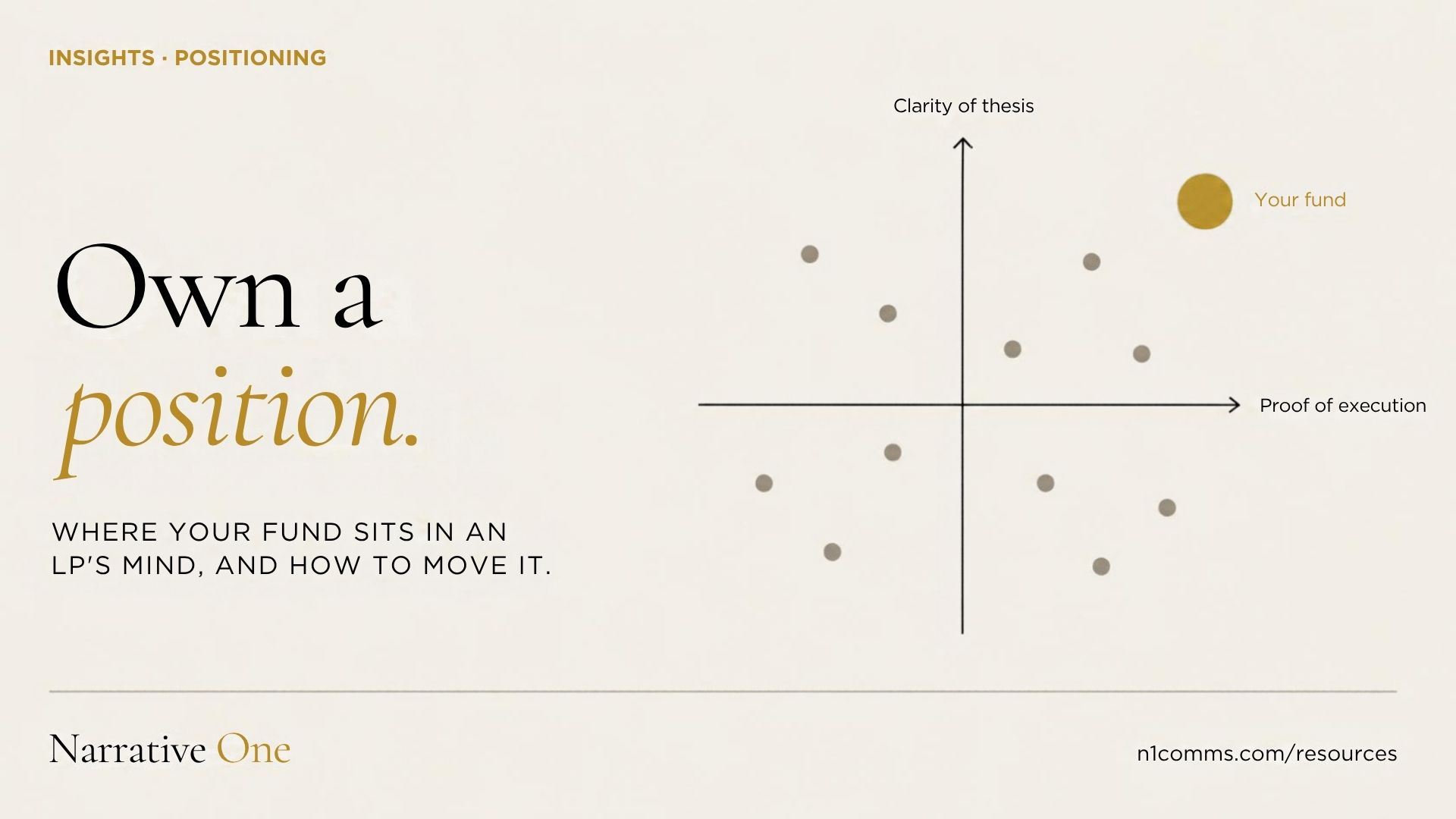
A fund narrative built on claims of access, conviction, or operational edge isn’t differentiated by those words alone. It needs evidence. If LPs hear the same thesis from competing managers, the question isn’t how polished the deck looks. It’s whether they can understand, test, and trust the investment logic. Learning how to build a fund narrative starts with evidence, not a slogan.
The challenge is familiar: a strategy can be clear inside the partnership yet sound generic outside it. Even a strong thesis loses credibility when partner conversations, fundraising materials, and public communications tell different versions. LP confidence depends on coherence as much as conviction.
This guide sets out a practical framework for articulating your thesis, placing it in market context, and connecting it to defensible investment logic. You’ll identify the evidence behind your edge, distinguish proof from assertion, and build a consistent narrative across LP meetings and communications. The objective isn’t a better pitch line. It’s an evidence-backed way to explain why this fund, why this market, and why your team can execute.
Key Takeaways
Learn how to build a fund narrative that connects market conditions to investment logic, rather than relying on a slogan or market-size claim.
Map each part of your thesis to the evidence an LP needs to assess its credibility.
Test differentiation against actual investment decisions and operating behavior, not distinctive-sounding language.
Adapt the emphasis for LPs, partners, and public communications while keeping the core investment logic consistent.
Set clear ownership, sourcing, review, and approval practices so the narrative stays aligned over time.
Table of Contents
Build the Fund Narrative from Market Context to Investment Logic
Translate the Fund Narrative for LPs, Partners, and Public Communications
Turn the Fund Narrative into Durable Communications Infrastructure
What a Fund Narrative Does, and What It Is Not
A fund narrative explains the investment logic behind a fund and the evidence that makes that logic credible. It is not a slogan, a market-size claim, or a polished substitute for a clear strategy.
That distinction matters because a narrative serves more than prospective LPs. Existing LPs use it to understand how the fund’s decisions relate to its stated mandate. The investment team uses it to communicate priorities. Portfolio founders and relevant market stakeholders need a clear account of what the fund backs and why. A coherent explanation makes the strategy easier to understand, question, and scrutinize across those audiences.
For a venture fund, the narrative must make sense within the structure and investment stages of venture capital. This section focuses on constructing that explanation, not designing a complete fund positioning strategy or fundraising communications plan. Those involve broader decisions about market perception, audience engagement, and communication channels. Here, the task is narrower: establish the logic that connects what the fund believes to how it invests.
Fund narrative, fund thesis, and fund positioning: how they differ
The thesis is the investment logic guiding where and why the fund invests. Positioning defines the fund’s relative place in the market and LP landscape, including how it compares with other available strategies. The narrative connects the thesis to its supporting evidence and explains that logic in a form others can assess. These concepts inform one another, but they are not interchangeable. A thesis sets direction; positioning establishes context; narrative makes the relationship clear.
Why LPs need more than a compelling opening line
An opening line can earn attention, but it cannot resolve diligence. LPs need to assess whether the opportunity, investment approach, and fund capabilities form a coherent case, and whether that case fits their investment objectives. A statement such as “we back the next generation of category leaders” leaves key questions open: which companies qualify, why this fund can identify them, and what decisions follow from the claim? Conviction without decision logic is difficult to evaluate.
Learning how to build a fund narrative means making the reasoning inspectable, not simply memorable. A clear narrative gives LPs a framework for understanding the fund and testing its claims. It does not guarantee commitments or investment performance. Its role is to support a more informed assessment.
Build the Fund Narrative from Market Context to Investment Logic
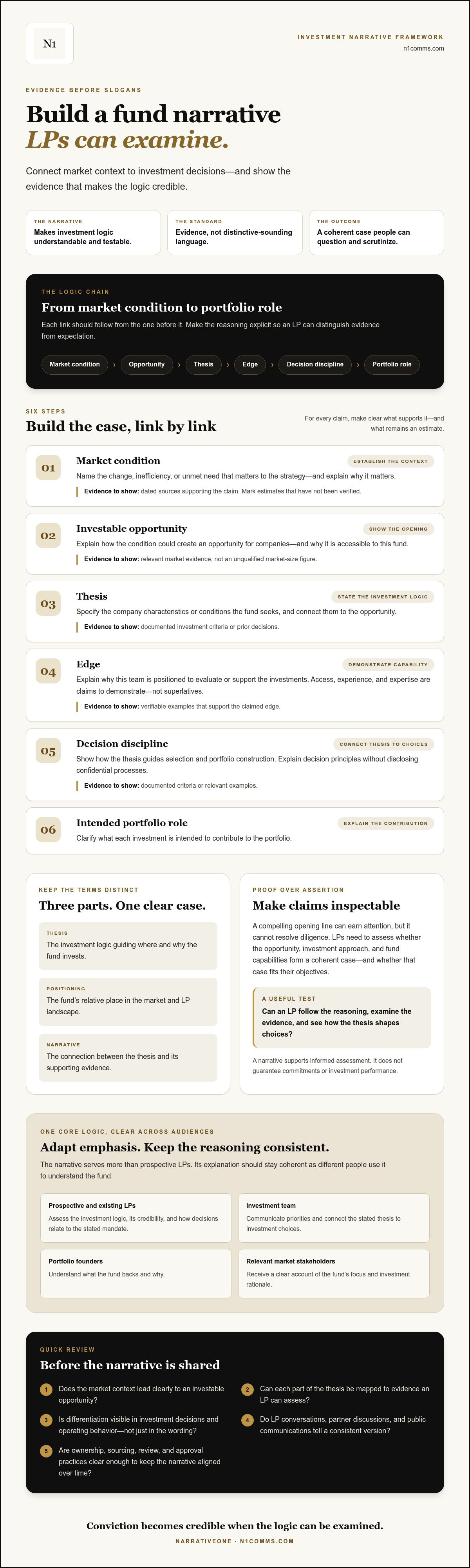
A fund narrative connects a defined market condition to the investment decisions the fund makes, the evidence behind those decisions, and the role each investment is intended to play in the portfolio. To understand how to build a fund narrative, make each link in that chain explicit. An LP should be able to follow the reasoning, distinguish evidence from expectation, and see how the thesis shapes choices.
This structure also disciplines the claims themselves. Yale’s course on how narratives shape economic events explores how narratives influence economic behavior. For a fund, the narrative must do more than frame a market. It must explain how the manager interprets it and acts on that interpretation.
Build the logic in six steps
Market condition: What change, inefficiency, or unmet need matters to the strategy? What should an LP understand about why it matters, and which dated sources support the claim? Mark estimates that have not been verified.
Investable opportunity: How does the condition create a potential opportunity for companies, and what makes that opportunity accessible to this fund? Support the answer with relevant market evidence, not an unqualified market-size figure.
Thesis: What investment logic follows? State the company characteristics or conditions the fund seeks, and show how they connect to the opportunity. Evidence might include documented investment criteria or prior decisions.
Edge: Why is this team positioned to evaluate or support those investments? Treat access, experience, or expertise as claims to demonstrate with verifiable examples, not as superlatives.
Decision discipline: How does the thesis guide selection and portfolio construction? Explain the principles behind decisions without disclosing confidential processes. Use documented criteria or examples where appropriate.
Intended portfolio role: What is each investment meant to contribute to the portfolio? Clarify its role in the strategy and distinguish intent from a promised outcome.
Separate facts from hypotheses
Label structural fund facts, such as mandate or stage, separately from market hypotheses, portfolio targets, and claims about capability. Each category carries a different evidentiary burden. A target is not an achieved result; a hypothesis is not a verified market condition. Clear labels make the narrative easier to diligence and maintain.
Illustrative example, not client evidence: A hypothetical fund observes that a defined customer group faces a costly workflow problem. It identifies companies addressing that problem, explains its selection criteria, documents relevant team experience, and states the intended role of those investments in the portfolio. Each link needs its own evidence; the example alone proves nothing about a real fund.
For firms formalizing this logic into investor-facing language, fundraise communications and investor narrative can help connect the thesis to a consistent explanation.
Make the Fund Narrative Distinctive Without Overclaiming
Differentiation is not a vocabulary exercise. A fund that claims “proprietary access,” “deep insight,” or “superior selection” sounds like its competitors unless those claims affect how it invests and can be supported with evidence. Defensible differentiation links specific investment behavior to verifiable proof; promotional claims rely on broad language without a substantiated basis.
A useful test is whether the stated edge affects sourcing, underwriting, ownership, or portfolio support. Compare the narrative with investment criteria and examples approved for external use. If the claim says the team specializes in a particular type of opportunity, but the criteria and documented decisions do not show how that focus works, flag the mismatch for internal review. A thesis can evolve; the explanation must accurately reflect the fund’s current practice.
Compare claims against evidence and diligence questions
Generic claimSpecific strategic claimEvidence requiredDiligence question answered“We have proprietary access.”“We source through documented relationships with operators in the target market.”Approved examples showing the relevant relationship and sourcing pathway.How does this access affect the opportunities the fund sees?“We are disciplined investors.”“We assess opportunities against defined criteria tied to the fund’s thesis.”Approved investment criteria and examples that demonstrate their application.How does the thesis influence selection decisions?“We create exceptional value.”“The team supports portfolio companies in specific, documented ways.”Verified examples of support, clearly distinguished from promised outcomes.What does the GP contribute after investment?
The test is not whether the wording sounds distinctive. It is whether an LP can connect the claim to observable behavior and ask a precise follow-up. A written strategic blueprint for the investment thesis can help make that connection explicit, but the fund’s own evidence must support its claims.
Maintain an evidence trail and label claims accurately
For each material claim, record its source, owner, approval status, and last review date. Use performance, portfolio, and market claims only when they are substantiated and approved for the intended communication. Separate documented track record from forward-looking strategy: describe past activity as history and future plans as intent, not results. Remove unsupported statistics, vague advantages, implied guarantees, and details that could disclose confidential information or conflict with approved materials.
Claims about performance and disclosure can raise legal or regulatory questions. Refer those questions to qualified counsel rather than treating narrative review as legal approval. Learning how to build a fund narrative means making the fund’s edge legible without making it larger than the evidence allows. Credibility comes from evidence and consistency, not polish.
Translate the Fund Narrative for LPs, Partners, and Public Communications
A fund narrative should travel across audiences without changing its underlying investment logic. The emphasis can shift; the facts cannot. Build a message map that records the core narrative, audience-specific emphasis, supporting evidence, and approved language. This gives partners room to communicate naturally while keeping the fund’s explanation coherent across meetings, materials, and public statements.
Core narrative: The stable explanation of the fund’s opportunity, thesis, and investment approach.
Audience emphasis: The questions and context most relevant to each group.
Supporting evidence: The approved facts and examples that substantiate each claim.
Approved language: Clear phrasing partners can use consistently, with boundaries for sensitive or unverified topics.
What prospective LPs need to understand
In a diligence conversation, prospective LPs need a clear account of the opportunity, thesis, strategy, and supporting evidence. Prepare direct answers about what differentiates the fund, how the team executes its approach, and why the strategy may fit the LP’s objectives. Keep responses grounded in current information and aligned with approved fund materials. If a question cannot be answered with substantiated information, identify what needs follow-up rather than filling the gap with speculation.
What partners and public audiences need to hear
General Partners need shared language for explaining the thesis and each partner’s role. They do not need identical scripts; they need a consistent account of the fund’s logic and approved facts. Public communications require a different level of detail. Use relevant, authorized points without reproducing confidential LP materials or implying that public announcements reveal the full investment case. Portfolio announcements and partner thought leadership should reinforce the fund’s underlying narrative, not introduce conflicting claims.
How to pressure-test the message before using it
Ask someone unfamiliar with the fund to read or hear the narrative, then summarize its thesis and evidence in their own words. Their summary is a practical test of clarity. Record terms they found unclear, conclusions that lack support, and questions the explanation leaves unanswered. Review revisions with relevant fund leadership and qualified advisers where appropriate, especially before sharing material externally.
Before release, compare the pitch materials, partner talking points, LP updates, and portfolio announcements. Check that core claims, supporting facts, and descriptions of the strategy align, while confirming that each audience receives only information appropriate to that communication. This is how to build a fund narrative that remains recognizable across channels without flattening the differences between them.
For support aligning investor narratives and fund communications, NarrativeOne’s communications approach describes the firm’s work.
Turn the Fund Narrative into Durable Communications Infrastructure
A fund narrative is not finished when the deck is approved. It needs governance. Market assumptions change, fund priorities evolve, and new portfolio evidence emerges. Without clear ownership and review, materials drift: one version describes the intended strategy, while another relies on older claims or different assumptions. Treating narrative maintenance as an operating discipline helps protect accuracy and institutional credibility.
Set ownership and review rules
Assign a senior owner accountable for narrative accuracy and define who approves material changes. Maintain a record of core claims, supporting sources, approved versions, and review dates. Revisit market assumptions, strategy language, and evidence when the fund’s context changes, not just when a new fundraising document is drafted. Clear review pathways make it easier to identify outdated statements and prevent unapproved edits from becoming accepted language.
Use the narrative across the fund lifecycle
The narrative should inform fundraising materials, LP communications, and partner messaging. Fund launches establish the investment logic; portfolio announcements can illustrate it when the connection is relevant and approved; LP updates can show how the strategy is being applied; and partner thought leadership can explain the market context behind it. Each communication serves a different purpose, but each should reflect the same core logic.
Measure clarity through signals that recur in actual conversations. Do LPs repeatedly ask what differentiates the strategy? Do partners explain the thesis consistently? Do public statements create interpretations the fund did not intend? Track recurring questions, misinterpretations, and points of divergence. Use them to refine the explanation, not to expand claims beyond the evidence.
Know when senior communications counsel adds value
Outside counsel can be useful when a fund must address multiple audiences, coordinate cross-border messaging, handle a sensitive announcement, or reconcile inconsistent materials. NarrativeOne advises investment firms on fund positioning, investor narratives, and LP communications. The agency’s founder is a former Chief Communications Officer with in-house investment firm experience, bringing relevant operational context to this work. Communications can support understanding and credibility. They cannot replace investment performance, resolve diligence concerns by themselves, or guarantee LP commitments.
Learning how to build a fund narrative includes deciding how to maintain it. A coherent narrative supports broader positioning and ongoing LP communications, but it does not substitute for either discipline. When ownership, evidence, and review are built into the communications process, the narrative can stay consistent as the fund and its portfolio develop.
For a focused discussion about your fund’s narrative, contact NarrativeOne.
Make the Fund Narrative a Discipline, Not a Deliverable
Knowing how to build a fund narrative means more than sharpening the pitch. It means connecting market context to investment decisions, supporting differentiation with evidence, and keeping the core logic consistent across LP conversations, partner messaging, and public communications. Assign ownership and review claims as the fund evolves. A clear narrative supports understanding and institutional credibility; it does not replace performance or diligence.
NarrativeOne advises investment firms on fund positioning, investor narratives, and LP communications. Founded and led by a former Chief Communications Officer with in-house investment firm experience, the firm provides strategic communications and media relations support to investment firms and technology companies.
If your thesis is difficult to explain, your evidence is scattered, or your materials tell different stories, discuss a fund narrative with NarrativeOne. A disciplined narrative gives LPs a clearer basis for evaluating the strategy and gives your team a consistent framework for communicating it. Build that foundation, then keep it aligned as the fund moves forward.
Frequently Asked Questions
What is a fund narrative?
A fund narrative is an evidence-backed explanation of why a fund invests as it does and how its investment logic relates to market conditions. It connects the thesis to decisions and supports material claims with verifiable facts. Unlike a slogan or market-size figure, it helps prospective and existing LPs, partners, and other stakeholders understand the strategy and assess its coherence in context.
How is a fund narrative different from a fund thesis?
A fund thesis is the investment logic guiding where and why the fund invests. The narrative explains that logic, the evidence behind it, and how it informs decisions in a way others can evaluate. Positioning is distinct: it describes the fund’s relative place in the market and LP landscape. The concepts are connected, but each answers a different question about the fund.
How do you make a venture fund narrative distinctive?
Make the fund’s specific investment choices explain its claimed edge. Describe the opportunity and decision criteria, then support claims about expertise, access, or portfolio support with approved, verifiable examples. Compare the narrative with actual sourcing, underwriting, and ownership behavior. Learning how to build a fund narrative means replacing interchangeable phrases such as “deep insight” with precise claims an LP can test, not stronger adjectives.
What should a fund narrative include for prospective LPs?
Give prospective LPs a clear account of the market condition, investable opportunity, thesis, investment approach, and evidence supporting the fund’s claims. Explain how the strategy informs selection and the intended role of investments in the portfolio. Prepare direct responses about differentiation, execution, and fit with LP objectives. Clearly distinguish fund facts and documented history from targets, hypotheses, and future intentions.
Can a fund narrative include track record or performance claims?
Yes, if track record or performance information is substantiated, current, approved for use, and presented with appropriate context. Separate documented results from forward-looking strategy, and avoid language that implies future outcomes are assured. Keep a record of sources and approvals for material claims. Performance advertising and disclosure can raise legal and regulatory issues, so have qualified counsel review relevant materials rather than relying on narrative review alone.
How often should a fund manager update the fund narrative?
Review it on a planned basis and whenever a material change could affect its accuracy. Triggers may include a shift in fund strategy, changed market assumptions, new evidence, or a difference between stated priorities and investment practice. Set a review interval suited to the fund’s circumstances. Record the current approved version, supporting sources, owner, and review date so partners don’t rely on outdated language.
What happens if a fund narrative differs from the investment strategy in practice?
The discrepancy creates a credibility problem and can leave LPs with an inaccurate understanding of the fund. Identify whether the narrative is outdated, the strategy has changed, or investment practice is diverging from stated criteria. Review the issue with fund leadership, then update the strategy or the explanation as appropriate. Don’t defend an unsupported claim with more polished wording; align external communications with approved facts and actual decisions.
How can a fund manager test whether LPs understand the narrative?
Ask a reader unfamiliar with the fund to explain its thesis and supporting evidence in their own words, without prompting. Compare their summary with the intended message. Note confusing terminology, unsupported conclusions, and questions that remain unanswered. Use those observations to revise the explanation, then check whether partners communicate it consistently. Recurring questions in LP discussions can also reveal where the narrative needs clarification or stronger evidence.
Frequently Asked Questions
What is a fund narrative?
A fund narrative is an evidence-backed explanation of why a fund invests as it does and how its investment logic relates to market conditions. It connects the thesis to decisions and supports material claims with verifiable facts. Unlike a slogan or market-size figure, it helps prospective and existing LPs, partners, and other stakeholders understand the strategy and assess its coherence in context.
How is a fund narrative different from a fund thesis?
A fund thesis is the investment logic guiding where and why the fund invests. The narrative explains that logic, the evidence behind it, and how it informs decisions in a way others can evaluate. Positioning is distinct: it describes the fund’s relative place in the market and LP landscape. The concepts are connected, but each answers a different question about the fund.
How do you make a venture fund narrative distinctive?
Make the fund’s specific investment choices explain its claimed edge. Describe the opportunity and decision criteria, then support claims about expertise, access, or portfolio support with approved, verifiable examples. Compare the narrative with actual sourcing, underwriting, and ownership behavior. Learning how to build a fund narrative means replacing interchangeable phrases such as “deep insight” with precise claims an LP can test, not stronger adjectives.
What should a fund narrative include for prospective LPs?
Give prospective LPs a clear account of the market condition, investable opportunity, thesis, investment approach, and evidence supporting the fund’s claims. Explain how the strategy informs selection and the intended role of investments in the portfolio. Prepare direct responses about differentiation, execution, and fit with LP objectives. Clearly distinguish fund facts and documented history from targets, hypotheses, and future intentions.
Can a fund narrative include track record or performance claims?
Yes, if track record or performance information is substantiated, current, approved for use, and presented with appropriate context. Separate documented results from forward-looking strategy, and avoid language that implies future outcomes are assured. Keep a record of sources and approvals for material claims. Performance advertising and disclosure can raise legal and regulatory issues, so have qualified counsel review relevant materials rather than relying on narrative review alone.
How often should a fund manager update the fund narrative?
Review it on a planned basis and whenever a material change could affect its accuracy. Triggers may include a shift in fund strategy, changed market assumptions, new evidence, or a difference between stated priorities and investment practice. Set a review interval suited to the fund’s circumstances. Record the current approved version, supporting sources, owner, and review date so partners don’t rely on outdated language.
What happens if a fund narrative differs from the investment strategy in practice?
The discrepancy creates a credibility problem and can leave LPs with an inaccurate understanding of the fund. Identify whether the narrative is outdated, the strategy has changed, or investment practice is diverging from stated criteria. Review the issue with fund leadership, then update the strategy or the explanation as appropriate. Don’t defend an unsupported claim with more polished wording; align external communications with approved facts and actual decisions.
How can a fund manager test whether LPs understand the narrative?
Ask a reader unfamiliar with the fund to explain its thesis and supporting evidence in their own words, without prompting. Compare their summary with the intended message. Note confusing terminology, unsupported conclusions, and questions that remain unanswered. Use those observations to revise the explanation, then check whether partners communicate it consistently. Recurring questions in LP discussions can also reveal where the narrative needs clarification or stronger evidence.