
A media valuation is not a financial return. Yet calculating financial PR value is often reduced to assigning a cash figure to coverage, a shortcut that can weaken rather than strengthen the case for communications.
Senior stakeholders are right to ask what communications changed. They need evidence that separates outputs, such as coverage and message inclusion, from outcomes such as shifts in share of voice, investor attention, or referral activity. The distinction matters: the Barcelona Principles 4.0, released by AMEC in June 2025, reject advertising value equivalents as an invalid measure. No single metric proves financial impact.
This guide provides a repeatable framework for assessing financial PR value without presenting coverage estimates as cash returns. It shows how to set a baseline, choose metrics tied to strategic priorities, interpret evidence across outputs and outcomes, and state attribution limits clearly. The result is a more defensible account of communications contribution, built for senior review rather than a clip report.
Key Takeaways
- Define the fund or communications objective before selecting metrics, so every measure has a clear purpose.
- Build a repeatable scorecard by setting a baseline, choosing relevant indicators, and recording evidence consistently.
- When calculating financial PR value, distinguish media outputs from audience outcomes and business contribution.
- Make any ROI claim auditable by stating the costs and results it includes, its attribution assumptions, and the reporting window.
- Compare performance on consistent terms and use recurring reviews to turn findings into better communications decisions.
What Does Financial PR Value Actually Measure?
Financial PR value is the documented contribution of communications to organizational and stakeholder objectives. It is not a dollar figure attached to press coverage. For a private equity firm, venture capital firm, or multi-strategy platform, the relevant question is whether communications advanced a defined objective, such as improving visibility among a priority audience or strengthening understanding of the fund’s strategy.
That requires a clear distinction between activity and effect. A placement, mention, or interview is an output: evidence that communication reached a channel. An outcome is a change in audience response, such as stronger awareness, recall, message understanding, or engagement. Public relations measurement methods cover a broad range of measures, from impressions to engagement. The measure still has to fit the objective.
Coverage is evidence, not financial return. It can show that a message entered the public record. On its own, it cannot prove that an LP changed their view, that a fundraising conversation began, or that capital was committed.
Earned media value versus financial PR ROI
An earned media value estimate assigns a monetary proxy to exposure from earned coverage, often by comparing it with advertising rates. That comparison does not establish equivalence. An editorial article differs from an advertisement in placement, control, context, audience response, and message delivery. Advertising-rate equivalency cannot show what a specific placement caused.
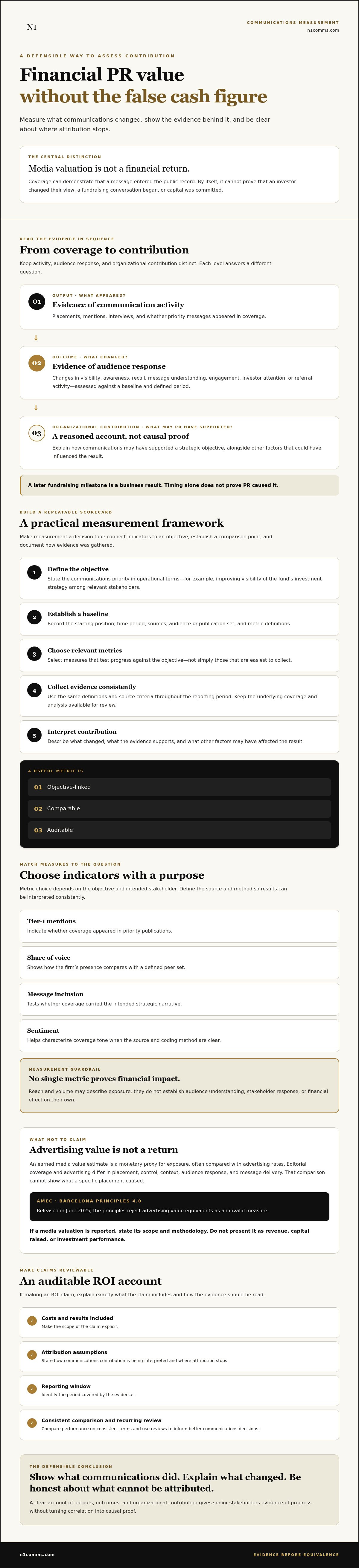
AMEC’s Barcelona Principles 4.0 reject advertising value equivalents as an invalid measure. Treat earned media value as an estimate with a stated method, not as revenue, capital raised, or investment performance. Any reported media valuation should identify its scope and methodology. It does not mean that communications generated an equivalent amount in financial returns.
Outputs, outcomes, and organizational contribution
Use three levels to keep reporting disciplined:
- Outputs: placements, mentions, interviews, and whether priority messages appeared.
- Outcomes: changes in visibility, message penetration, or stakeholder response, assessed against a baseline and a defined period.
- Organizational contribution: a reasoned account of how communications may have supported a strategic objective, alongside other factors that could have influenced the result.
For example, coverage that accurately explains a fund’s investment strategy is an output that demonstrates message pull-through. Increased visibility among a defined audience may indicate an outcome if it is measured consistently. A later fundraising milestone is a business result, but timing alone does not prove PR caused it.
When calculating financial PR value, document the evidence at each level and state where attribution stops. This gives senior stakeholders a credible account of contribution without turning correlation into causal proof.
How to Build a Financial PR Measurement Framework
A useful framework makes measurement a decision tool, not a reporting ritual. Before calculating financial PR value, connect each indicator to an objective, establish a comparison point, and record how the evidence was gathered. A useful PR metric is objective-linked, comparable, and auditable.
Use this sequence:
- Define the objective. State the fund or communications priority in operational terms, such as improving visibility of the fund’s investment strategy among relevant stakeholders.
- Establish a baseline. Record the starting position, including the time period, sources, audience or publication set, and metric definitions.
- Choose the metrics. Select measures that test progress against the objective, not simply those that are easiest to collect.
- Collect evidence consistently. Apply the same definitions and source criteria throughout the reporting period. Keep the underlying coverage and analysis available for review.
- Interpret contribution. Describe what changed, what the evidence supports, and what other factors may have affected the result.
Choose metrics that answer a decision
Metric selection depends on the objective and intended stakeholder. Tier-1 mentions can indicate whether coverage appeared in priority publications. Share of voice can show how the firm’s presence compares with a defined peer set. Message inclusion can test whether coverage carried the intended strategic narrative. Sentiment can help characterize the tone of coverage, provided its source and coding method are clear.
None of these measures proves financial impact on its own. Reach and volume may describe exposure, but they don’t establish audience understanding, stakeholder response, or a contribution to fundraising. The PRSA’s guidance on how to measure PR performance, value and ROI can help teams consider measures beyond activity totals. Choose the metric that informs a decision, then report its limits.
Set baselines and document the evidence
Capture the pre-engagement baseline before activity begins. Document the measurement window, data sources, inclusion rules, and definitions, then preserve them for later comparisons. Use the same period and basis when assessing movement. If no defensible industry benchmark exists, don’t manufacture one; compare against the organization’s own baseline instead.
Separate observation from interpretation. “Share of voice increased within the selected publication set” is an observation. A claim that communications caused the change is an interpretation requiring further evidence and consideration of external market conditions.
Assign a clear owner for metric definitions and methodology review. A senior strategist can maintain consistency across objectives and reporting. Compliance rules should be embedded before the compliance director reviews drafts. For investment firms aligning measurement with Fund Positioning communications, this discipline helps connect reporting to strategic priorities without overstating what the evidence proves.
How to Calculate Financial PR Value Without Overclaiming ROI
A defensible calculation does not compress every result into one headline number. Use a layered scorecard to show what communications produced, how audiences responded, and where the evidence supports a contribution to organizational objectives. The AMEC Integrated Evaluation Framework provides a structure for connecting communication activity with outcomes and impact.
Use a layered scorecard instead of one headline number
| Layer | What to assess | What it can support |
|---|---|---|
| Media outputs | Coverage quality, outlet relevance, placement context, and inclusion of priority messages | Evidence of where communications appeared and what the coverage conveyed |
| Audience and message outcomes | Audience relevance, share of voice, sentiment, and documented stakeholder response | Evidence of visibility or response changes, when compared with a defined baseline |
| Business contribution | Evidence connecting communications activity to a stated strategic objective | A reasoned contribution assessment, with attribution limits made explicit |
The layers prevent a common reporting error: treating coverage volume as proof of business impact. A relevant placement that carries a fund’s intended message may be stronger evidence than a larger volume of low-relevance mentions. Even a favorable audience outcome does not, on its own, prove that PR caused a financial result.
When earned media value belongs in the analysis
Earned media value can appear as a labeled proxy for exposure, provided the calculation method, scope, and limitations are disclosed. It cannot stand in for financial ROI. NarrativeOne reports $50 M+ in earned media value across 200+ mentions and $1 B+ in total earned media value for clients. These figures should be reported with their verified scope and methodology. Neither represents client revenue, capital raised, or investment performance.
If reporting ROI, define the calculation before presenting a result. Specify the financial return included in the numerator, the costs included in the denominator, the attribution assumptions, and the reporting window. Keep the cost basis consistent, and state whether the return is directly observed or estimated. If a financial outcome cannot be credibly attributed to communications, report the measured contribution instead of calling it ROI.
For teams calculating financial PR value, the governing test is simple: every monetary figure needs a defined method, and every claim needs evidence proportionate to its strength.
How to Compare PR Performance and Attribute Contribution
Comparisons are useful only when the terms stay fixed. Assess campaigns against the same objective, baseline, measurement period, audience or publication set, and metric definitions. If those inputs change, a reported increase or decline may reflect a change in measurement rather than a change in performance.
Each method has limits. A before-and-after comparison shows what changed over time, but cannot isolate PR from market events or other firm activity. Benchmarks can provide context only when their sources, definitions, and comparison groups are genuinely comparable. Qualitative evidence, such as whether coverage accurately represented the fund’s strategy, adds depth but requires consistent criteria and documented judgment.
Build a credible attribution narrative
PR contribution can be evaluated without claiming sole causation. Map the sequence: communications activity, observed evidence, audience or message outcome, then plausible contribution to an objective. Record other influences, including market events, fund activity, and third-party coverage. Use language proportionate to the evidence: “supported” or “contributed to” when multiple factors are involved. Reserve stronger causal claims for evidence that can substantiate them.
For example, a campaign may precede increased share of voice within a defined media set, while a market announcement also draws attention to the sector. Report the observed movement, identify the concurrent event, and explain why the communications may have contributed. This is more credible than assigning the entire change to PR.
Report results for investment-firm decision-makers
Lead with the objective, then show the evidence, comparison period, and implication for the next decision. Keep verified metrics separate from interpretation and recommendations. A concise monthly report tied to the 12-month narrative plan can identify what changed, which messages gained traction, and what should be adjusted in the next period. The report is an operating record, not a claim of automatic financial causation.
For teams calculating financial PR value, consistency across reporting periods makes strategic learning possible. One senior strategist can maintain alignment between the narrative objective and measurement definitions, while a journalist network supports relevant media activity. The evidence still needs to carry its own limits.
NarrativeOne’s fund positioning approach connects communications measurement with fund positioning.
Turn Financial PR Measurement into an Operating Discipline
Measurement becomes useful when it shapes decisions repeatedly, not when it appears as a retrospective scorecard. Establish metric owners, written definitions, data sources, and review points. Keep those controls consistent across the firm and its portfolio. That operating discipline makes calculating financial PR value more credible because each reporting period can be assessed against the same strategic architecture.
Connect measurement to narrative and execution
Align Strategy & narrative with Media relations around fund positioning objectives. One senior strategist, one journalist network, and one compliance workflow can support a consistent operating model across the firm and its portfolio. Weekly execution should advance the 12-month narrative plan; monthly reporting should record evidence, identify changes, and inform the next set of priorities.
For investment firms communicating in English and Arabic, content should be natively drafted for senior financial journalists in each language, not translated after drafting. Compliance rules are embedded before the compliance director reviews drafts. That sequence makes review part of the workflow while preserving a clear record of how communications activity and measurement are governed.
Keep the scorecard operational. Assign an owner to each metric, record any definition changes, and set review points to test whether measures still serve the fund’s objectives. If the objective shifts, document the change rather than quietly changing the metric midstream.
What to assess before selecting a communications partner
Test the measurement method before accepting the headline results. Ask how the provider defines baselines, outlet quality, sentiment, and earned media value. Request the underlying scope and methodology for any valuation estimate. Check whether reports distinguish verified results from interpretation, assumptions, and business impact. A credible framework makes its limits visible.
Assess whether the provider understands private equity, venture capital, and multi-strategy platforms. Review the compliance workflow, the intended stakeholder for each communication, and how media relevance is evaluated. The right approach should connect audience and outlet choices to fund positioning objectives, not simply maximize coverage volume.
The standard is straightforward: consistent definitions, accountable ownership, controlled review, and reporting that informs the next decision. NarrativeOne’s fund communications measurement framework can help align measurement with the narrative plan and communications priorities.
Make PR Measurement Part of the Operating Model
Financial PR value is not a coverage estimate relabeled as return. It is an evidence-based view of how communications support defined organizational and stakeholder objectives. Keep outputs distinct from outcomes, establish a consistent baseline, and describe contribution without claiming causation the evidence cannot prove. That is the discipline behind calculating financial PR value in a way senior stakeholders can trust.
For investment firms, measurement must connect strategy to execution. NarrativeOne brings 17 years of operating experience inside MENA’s most recognised investment institutions, supported by one senior strategist, one journalist network, and one compliance workflow. Monthly reporting within a 12-month narrative plan creates a recurring basis for review and learning.
Set the standard now: define what success means, document how it will be measured, and make limitations visible. To align your communications objectives with a practical measurement framework, discuss a fund communications measurement framework. A clear baseline turns reporting into a stronger basis for action.
Frequently Asked Questions
How do you calculate financial PR value?
Calculate financial PR value by connecting communications evidence to a defined organizational or stakeholder objective. Set a baseline, choose relevant measures, collect them consistently, then assess what changed and how communications may have contributed. Track outputs such as placements separately from outcomes such as message inclusion or stakeholder response. State the measurement period, sources, definitions, and limitations so decision-makers can distinguish observed results from interpretation.
Is earned media value the same as PR ROI?
No. Earned media value is an estimate that assigns a monetary proxy to media exposure, often using advertising-rate comparisons. It does not establish revenue, capital raised, or investment performance, and it cannot show what a placement caused. PR ROI requires a defined financial return, a clear account of included costs, stated attribution assumptions, and a reporting window. Keep any media value estimate labeled as a proxy, not a return.
Can financial PR value be measured without a direct link to revenue?
Yes. Communications can be evaluated through changes in visibility, message penetration, share of voice, or stakeholder response, even when no direct revenue link can be established. Compare these outcomes with a documented baseline and explain how they relate to the stated objective. Then describe business contribution cautiously. The evidence may support a reasoned account of influence without proving that PR alone caused a financial result.
What metrics should fund managers use to assess PR?
Choose metrics based on the fund’s objective and intended stakeholder. Relevant measures can include Tier-1 mentions, outlet relevance, share of voice, inclusion of priority messages, sentiment, and documented stakeholder response. Define the audience, sources, period, and calculation method before reporting. Coverage volume and reach can describe exposure, but neither proves financial impact. A useful scorecard combines evidence of media activity with measures of audience or message outcomes.
How do you calculate PR ROI when attribution is difficult?
Don’t claim a precise ROI if the return cannot be credibly attributed. If calculating one, define the financial outcome in the numerator, the costs included, attribution assumptions, and reporting window. Identify other influences, such as market events or fund activity. Where causation remains uncertain, report observed outcomes and explain PR’s plausible contribution instead. That distinction preserves decision value without presenting correlation as proof.
How often should financial PR performance be reported?
Report often enough to support decisions and maintain consistent comparisons. Monthly reporting can track progress against a longer-term communications plan, surface changes, and inform the next period’s priorities. Use the same metric definitions and comparison basis each time. Review objectives and methodology when strategy changes, and document any adjustments. A regular cadence turns measurement into an operating discipline rather than a retrospective collection of media mentions.
Should earned media value be included in an investor communications report?
It may be included if it helps describe exposure and is clearly labeled as an estimate, with its scope and methodology disclosed. Keep it separate from revenue, capital raised, or investment performance. Pair it with more decision-relevant evidence, such as outlet relevance, message inclusion, or stakeholder response. If the estimate’s method cannot be explained or verified, omit it rather than letting a proxy imply financial return.
Frequently Asked Questions
How do you calculate financial PR value?
Calculate financial PR value by connecting communications evidence to a defined organizational or stakeholder objective. Set a baseline, choose relevant measures, collect them consistently, then assess what changed and how communications may have contributed. Track outputs such as placements separately from outcomes such as message inclusion or stakeholder response. State the measurement period, sources, definitions, and limitations so decision-makers can distinguish observed results from interpretation.
Is earned media value the same as PR ROI?
No. Earned media value is an estimate that assigns a monetary proxy to media exposure, often using advertising-rate comparisons. It does not establish revenue, capital raised, or investment performance, and it cannot show what a placement caused. PR ROI requires a defined financial return, a clear account of included costs, stated attribution assumptions, and a reporting window. Keep any media value estimate labeled as a proxy, not a return.
Can financial PR value be measured without a direct link to revenue?
Yes. Communications can be evaluated through changes in visibility, message penetration, share of voice, or stakeholder response, even when no direct revenue link can be established. Compare these outcomes with a documented baseline and explain how they relate to the stated objective. Then describe business contribution cautiously. The evidence may support a reasoned account of influence without proving that PR alone caused a financial result.
What metrics should fund managers use to assess PR?
Choose metrics based on the fund’s objective and intended stakeholder. Relevant measures can include Tier-1 mentions, outlet relevance, share of voice, inclusion of priority messages, sentiment, and documented stakeholder response. Define the audience, sources, period, and calculation method before reporting. Coverage volume and reach can describe exposure, but neither proves financial impact. A useful scorecard combines evidence of media activity with measures of audience or message outcomes.
How do you calculate PR ROI when attribution is difficult?
Don’t claim a precise ROI if the return cannot be credibly attributed. If calculating one, define the financial outcome in the numerator, the costs included, attribution assumptions, and reporting window. Identify other influences, such as market events or fund activity. Where causation remains uncertain, report observed outcomes and explain PR’s plausible contribution instead. That distinction preserves decision value without presenting correlation as proof.
How often should financial PR performance be reported?
Report often enough to support decisions and maintain consistent comparisons. Monthly reporting can track progress against a longer-term communications plan, surface changes, and inform the next period’s priorities. Use the same metric definitions and comparison basis each time. Review objectives and methodology when strategy changes, and document any adjustments. A regular cadence turns measurement into an operating discipline rather than a retrospective collection of media mentions.
Should earned media value be included in an investor communications report?
It may be included if it helps describe exposure and is clearly labeled as an estimate, with its scope and methodology disclosed. Keep it separate from revenue, capital raised, or investment performance. Pair it with more decision-relevant evidence, such as outlet relevance, message inclusion, or stakeholder response. If the estimate’s method cannot be explained or verified, omit it rather than letting a proxy imply financial return.