
A polished credentials deck doesn’t prove an agency can represent an investment firm under pressure. The real test is its operating model: who leads the work, how fund and portfolio communications stay aligned, and when governance enters the process. Those details separate a capable venture capital communications agency from a persuasive pitch.
It’s reasonable to be cautious. Agency credentials can sound interchangeable, senior involvement can fade after the sale, and portfolio announcements can create pressure to move quickly without weakening review. Communications for a fund aren’t just a sequence of media opportunities. They help shape the firm’s reputation, investor narrative, and approach to risk.
This guide offers a fund-specific framework for comparing providers. You’ll assess investment firm experience, access to the people who will lead delivery, compliance workflows, evidence of execution, and how services are structured across the fund and its portfolio. The aim is to identify the agency whose people, process, and proof match the demands of your fund.
Key Takeaways
Assess a venture capital communications agency by its fund and portfolio experience, not by the breadth of its service list.
Before appointing an agency, confirm who leads the work, who makes decisions, and how drafts move through review.
Compare external, in-house, and hybrid delivery models against your needs for context, continuity, capacity, and portfolio coordination.
Verify relevant work and reporting methods. Separate earned media indicators from business outcomes, and don’t mistake correlation for causation.
Rank your criteria, interview the proposed lead, inspect evidence, and agree on governance before setting the first communications priorities.
Table of Contents
Why a Venture Capital Communications Agency Must Understand Fund Economics
Verify Agency Evidence, Measurement, and Compliance Before Appointment
Select the Agency That Can Become a Fund Communications Function
Why a Venture Capital Communications Agency Must Understand Fund Economics
Visibility without a coherent investment case creates fragmented market signals. A fund may share a partner’s perspective, announce a portfolio round, and discuss its strategy with investors, yet leave audiences unclear about how those messages connect. The problem isn’t a shortage of publicity. It’s a lack of alignment between the fund’s investment thesis and what it communicates.
Agency selection therefore reaches beyond media coverage. It concerns fund positioning, GP credibility, portfolio coordination, and reputation. A venture capital firm operates across distinct relationships and investment stages. Its communications should make the fund’s point of view clear without blurring the roles of the firm and its portfolio companies.
Strategic communications infrastructure is more than a one-off funding announcement. It gives partners and portfolio teams a consistent framework for explaining what the fund backs, why its perspective matters, and how individual company milestones relate to the wider narrative. Coverage can support market authority, but it cannot guarantee fundraising, investment, or exit outcomes. Those depend on factors beyond communications.
What a specialist agency should understand about a venture fund
Test whether the proposed team can clearly explain your fund thesis, strategy, investment stage, and portfolio context. Ask how those elements would shape the fund’s narrative, rather than accepting a repetition of language from your website. Then test audience judgment: LPs, co-investors, founders, and journalists need different information and levels of detail.
Ask how fund-level messaging will stay consistent across partner and portfolio-company communications. A partner’s public commentary should reinforce the fund’s investment perspective. A portfolio announcement should give the company its own voice while accurately reflecting the firm’s role. If the agency can’t explain how it will manage that distinction, its sector credentials aren’t enough.
When external communications support makes sense
External support may be useful when internal capacity can’t sustain fund positioning, media relations, and partner visibility alongside portfolio demands. It may be especially relevant when portfolio announcements need a repeatable process instead of improvised coordination for each milestone.
Start by defining the gap. Is the fund’s investment case unclear? Are partners unable to maintain a consistent public profile? Do portfolio communications compete for attention or create inconsistent messages? These are different operating problems and call for different priorities. Use a fund brand positioning strategy to clarify the investment case before deciding which communications capacity to add. Choose support based on your fund’s actual requirements, not a generic promise of visibility.
How to Evaluate a Venture Capital Communications Agency
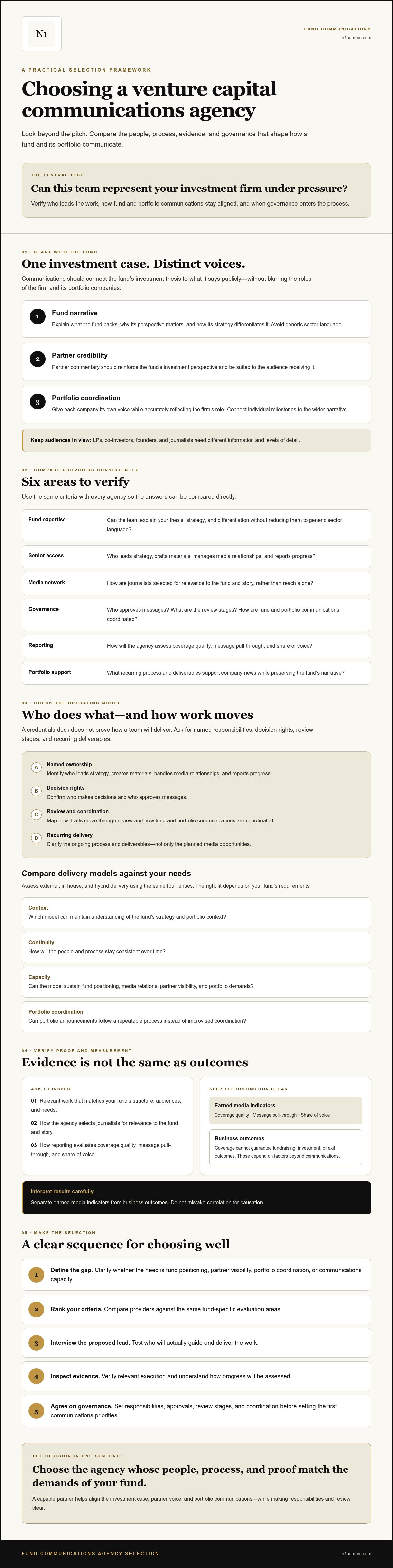
Evaluate the proposed operating model, not just the credentials deck. Ask each venture capital communications agency to show how its experience translates into named responsibilities, decision rights, review stages, and recurring deliverables. A broad record in technology or startup PR doesn’t prove fund-level expertise. Examples should match your investment firm’s structure, audiences, and communications needs.
Use the same criteria for every provider so you can compare their answers directly.
Evaluation areaWhat to verifyFund expertiseCan the team explain your thesis, strategy, and differentiation without reducing them to generic sector language?Senior accessWho leads strategy, drafts materials, manages media relationships, and reports progress?Media networkHow does the agency select journalists for relevance to your fund and story, rather than reach alone?GovernanceWho approves messages, what are the review stages, and how are fund and portfolio communications coordinated?ReportingHow will the agency assess coverage quality, message pull-through, and share of voice?Portfolio supportWhat recurring process and deliverables support portfolio-company news while preserving the fund’s narrative?
Questions that reveal real venture-fund expertise
Ask the agency to explain how it would communicate your investment thesis without flattening what makes the fund distinct. Request relevant examples involving emerging managers, established funds, or multi-strategy platforms, then establish what the agency actually did on each engagement. The client’s sector alone isn’t enough; the work should show an understanding of fund priorities and audiences.
Test whether the proposed approach separates fund announcements from portfolio-company news. Ask how each would be positioned, approved, and connected to the wider narrative. For a stronger strategic baseline, see how to build a fund narrative.
Assess senior access and media capability
Put names beside the work. Confirm who owns strategy, drafting, journalist relationships, approvals, and reporting. Ask which decisions require your team’s sign-off. A senior person in the pitch is only meaningful if their role continues through delivery.
Ask how the agency selects media and measures results. Strong reporting distinguishes a relevant placement from a high-reach mention, checks whether intended messages appear in coverage, and explains the comparison used for share of voice. Ask how often you’ll receive updates and what actions follow the analysis. NarrativeOne describes its investment-firm model as one senior strategist, one journalist network, and one compliance workflow. Review its investment-firm communications model as one point of comparison.
Compare Agency Delivery Models Before You Commit
The right delivery model depends on where accountability needs to sit. A specialist external agency can provide dedicated communications capacity and, when it has relevant experience, investment-firm context. An in-house function stays close to partner decisions and institutional knowledge, but execution capacity depends on the team. A coordinated hybrid model combines internal ownership with external delivery. It can work well, but only when decision rights and handoffs are explicit.
Specialist external agency: Assess how it will learn the fund’s priorities, maintain continuity, and coordinate portfolio-company communications without assuming decision-making authority.
In-house capacity: Consider whether the team can sustain fund positioning, partner visibility, and portfolio support alongside other responsibilities. Internal proximity is useful, but it doesn’t automatically provide execution bandwidth.
Hybrid model: Define who sets priorities, drafts and coordinates materials, manages media relationships, and approves content. Without clear ownership, the model adds handoffs instead of capacity.
In every model, test the narrative architecture. The fund needs a consistent investment case, while each portfolio company needs messaging that reflects its own position and milestones. Ask how the agency will maintain the connection without making every company sound like an extension of the fund.
What ownership and continuity look like in practice
Ask the proposed senior strategist to define their role in strategy, decisions, and communications oversight. Clarify who coordinates materials across the fund and portfolio companies, how information moves between teams, and where approvals sit. Establish escalation routes for sensitive announcements, corrections, or emerging reputational issues. A named lead matters only if the operating model gives that person clear responsibility.
NarrativeOne describes its investment-firm model as one senior strategist, one journalist network, and one compliance workflow shared across the firm and its portfolio companies. The structure is designed to connect strategic direction, media activity, and review without implying that every portfolio company should share the same message.
How to test whether the proposed programme is operational
Request a sample annual planning cadence, then ask how weekly execution is tracked and how decisions are surfaced. NarrativeOne describes a 12-month narrative plan, executed weekly and reported monthly. Check whether reporting distinguishes activity from coverage quality, audience relevance, and the decisions required next. Reporting should inform action, not simply record output.
Where bilingual communications apply, ask whether English and Arabic drafts are written natively. Confirm that compliance rules are embedded before compliance director review, and establish how that review connects to journalist targeting and publication timing. These are workflow questions to resolve before appointment. A venture capital communications agency should be able to show how its model works before the fund depends on it.
Verify Agency Evidence, Measurement, and Compliance Before Appointment
Claims need a verification process. Before appointing a venture capital communications agency, move through four checks: inspect relevant work, validate responsibilities, examine measurement, and review governance. Use the same sequence for every provider. A strong headline or impressive client list isn’t enough to establish fit with your fund’s audiences, announcement types, language needs, or operating context.
Inspect relevant work. Request examples that match your mandate and ask what the agency was responsible for.
Validate responsibilities. Confirm who led the work, what the client contributed, and where decisions and approvals sat.
Examine measurement. Review how the agency defines coverage quality, message accuracy, and audience relevance.
Review governance. Trace how drafts, approvals, and applicable compliance reviews move before publication.
How to assess case studies and performance claims
Ask for the timeframe, the agency’s specific contribution, the client’s role, and the documented result. Judge publication relevance, message accuracy, and audience fit alongside volume. A large number of mentions can still be weak evidence if the coverage misses the intended audience or misstates the fund’s investment case.
NarrativeOne cites Rasmal Ventures’ $45 M Series B announcement, which received Reuters headline placement and coverage in 270+ media outlets. Treat those figures as an attributable example, not a forecast for another client or announcement. Earned coverage indicators can show communications activity and reach, but they don’t prove PR caused fundraising, investment, or exit outcomes. Separate observed results from business outcomes, and don’t treat correlation as causation.
How compliance should fit into the workflow
Ask when applicable rules enter drafting, who reviews the material, and who gives final approval. Requirements depend on the fund’s mandate and operating context. Identify the relevant internal or qualified reviewers rather than assuming one generic framework applies to every communication.
NarrativeOne’s stated process embeds compliance rules before compliance director review. During diligence, map the written approval path for releases, pitches, op-eds, and LP materials. Confirm who can request changes, who resolves conflicting feedback, and what must be approved before publication. If the agency can’t show where governance sits in the workflow, its claims of compliance awareness remain untested.
Use these checks to assess whether an agency’s evidence and process match your mandate. Review NarrativeOne’s investment-firm communications approach.
Select the Agency That Can Become a Fund Communications Function
Selection is only useful if it leads to a workable operating agreement. Before appointing a venture capital communications agency, make five decisions: rank your criteria, interview the person who will lead the work, verify the evidence, agree on governance, and define the first priorities. This turns a persuasive proposal into an accountable mandate.
What to agree before the engagement starts
Document the objectives, audiences, decision-makers, approval authority, and reporting cadence. Specify how fund communications connect with portfolio-company announcements, including who coordinates materials and who approves each company’s messages. Establish a baseline for relevant coverage and define what the monthly report will show, such as activity, quality, audience relevance, and decisions required. Clear terms help prevent different expectations from turning into delivery disputes.
For NarrativeOne, the stated model pairs a 12-month narrative plan with weekly execution and monthly reporting. Its Portfolio announcement service follows the sequence T-14 → T-10 → T-5 → T-2 → Day 0 → +7. The company describes same-day bilingual release capability, with English and Arabic drafted natively rather than translated after drafting. Tier-1 coverage is achievable within 14 days, but placement is not guaranteed. Treat this as a process to examine, not an outcome to assume.
When NarrativeOne’s model may fit
An embedded communications function may suit an investment firm that needs shared infrastructure across its portfolio rather than isolated publicity for individual announcements. Assess whether the required scope aligns with NarrativeOne’s Strategy & narrative, Media relations, Bilingual content, and GP thought leadership. The question is whether these capabilities address the priorities and governance needs you documented before selection.
For more context on establishing credibility before a fund needs visibility, review emerging VC fund communications. Use that perspective to sharpen the engagement’s first priorities, not to substitute general advice for your fund’s objectives.
Before work begins, record the initial priorities, owners, approval path, reporting format, and review points in writing. Then assess progress against the agreed mandate. A communications function earns its place through disciplined execution and clear accountability, not a list of promised placements.
Discuss your fund communications requirements.
Choose for Operating Fit, Not the Pitch
The right venture capital communications agency should understand the fund’s investment case, give senior stakeholders clear access, and coordinate portfolio communications through defined governance. Judge the proposed team by its responsibilities, evidence, review process, and reporting model. Coverage can build market authority, but it can’t guarantee fundraising, investment, or exit outcomes.
Narrative One brings 17 years of operating experience inside recognised investment institutions and $2 B+ AUM across 150+ funds/clients. Its work includes Rasmal Ventures’ $45 M Series B announcement, which received Reuters headline placement and coverage in 270+ media outlets. These are specific credentials to assess against your mandate, not promised results for another fund.
Make the decision methodical: rank your criteria, interview the person who will lead delivery, verify relevant evidence, and agree on governance before setting priorities. The agency’s operating model should fit the fund’s needs, not just its announcement calendar. Discuss your fund communications requirements and take the next step with a clear view of what the engagement must deliver.
Frequently Asked Questions
What does a venture capital communications agency do?
A venture capital communications agency helps investment firms communicate their thesis, partners’ expertise, portfolio activity, and reputation to relevant audiences. Services may include fund positioning, media relations, LP communications, partner thought leadership, and portfolio announcements. The scope should reflect the firm’s mandate. Communications support can strengthen market understanding, but it can’t guarantee fundraising, investment, or exit outcomes.
How do I choose a venture capital communications agency?
Choose by verifying fund-specific experience, delivery ownership, governance, and evidence. Ask the proposed lead to explain your investment thesis in a way that preserves its distinction, then request relevant work and identify each team member’s role. Compare how agencies coordinate fund and portfolio communications, measure coverage quality, and handle approvals. Select the operating model that fits your internal capacity and decision process, not simply the strongest pitch.
What should I ask a VC communications agency before hiring it?
Ask who leads strategy, drafts materials, manages journalist relationships, and reports progress. Clarify decision rights, review stages, recurring deliverables, and escalation routes for sensitive announcements or corrections. Request comparable examples and ask what the agency controlled, what the client contributed, and how results were measured. Also establish how portfolio-company news will be coordinated with the fund narrative without making distinct companies sound interchangeable.
Should a venture capital firm hire an agency or build an in-house communications team?
Choose based on the capacity and context the firm needs. An in-house team can stay close to partner decisions and institutional knowledge, while an agency can add dedicated communications execution and external media capability. A hybrid model combines internal ownership with external support, but requires explicit handoffs and approval authority. Compare continuity, portfolio coordination, and available capacity before deciding. The right model is the one with clear accountability.
How can a VC firm measure communications agency performance?
Agree on measures before work begins. Track relevant coverage, publication quality, message accuracy, audience fit, and whether priority audiences are engaging with the fund’s narrative. Reports should distinguish activity and earned media indicators from business outcomes. A funding announcement followed by coverage doesn’t prove that coverage caused the financing. Use the data to assess progress, identify gaps, and set the next communications priorities.
How does compliance work with a venture capital communications agency?
Compliance should be built into the workflow, with applicable rules identified for the fund’s mandate and qualified reviewers involved where needed. Agree who reviews releases, pitches, opinion pieces, and LP materials, and who has final approval before publication. For Narrative One, compliance rules are embedded before compliance director review. Document the approval path and confirm that it fits the fund’s governance requirements.
Frequently Asked Questions
What does a venture capital communications agency do?
A venture capital communications agency helps investment firms communicate their thesis, partners’ expertise, portfolio activity, and reputation to relevant audiences. Services may include fund positioning, media relations, LP communications, partner thought leadership, and portfolio announcements. The scope should reflect the firm’s mandate. Communications support can strengthen market understanding, but it can’t guarantee fundraising, investment, or exit outcomes.
How do I choose a venture capital communications agency?
Choose by verifying fund-specific experience, delivery ownership, governance, and evidence. Ask the proposed lead to explain your investment thesis in a way that preserves its distinction, then request relevant work and identify each team member’s role. Compare how agencies coordinate fund and portfolio communications, measure coverage quality, and handle approvals. Select the operating model that fits your internal capacity and decision process, not simply the strongest pitch.
What should I ask a VC communications agency before hiring it?
Ask who leads strategy, drafts materials, manages journalist relationships, and reports progress. Clarify decision rights, review stages, recurring deliverables, and escalation routes for sensitive announcements or corrections. Request comparable examples and ask what the agency controlled, what the client contributed, and how results were measured. Also establish how portfolio-company news will be coordinated with the fund narrative without making distinct companies sound interchangeable.
Should a venture capital firm hire an agency or build an in-house communications team?
Choose based on the capacity and context the firm needs. An in-house team can stay close to partner decisions and institutional knowledge, while an agency can add dedicated communications execution and external media capability. A hybrid model combines internal ownership with external support, but requires explicit handoffs and approval authority. Compare continuity, portfolio coordination, and available capacity before deciding. The right model is the one with clear accountability.
How can a VC firm measure communications agency performance?
Agree on measures before work begins. Track relevant coverage, publication quality, message accuracy, audience fit, and whether priority audiences are engaging with the fund’s narrative. Reports should distinguish activity and earned media indicators from business outcomes. A funding announcement followed by coverage doesn’t prove that coverage caused the financing. Use the data to assess progress, identify gaps, and set the next communications priorities.
How does compliance work with a venture capital communications agency?
Compliance should be built into the workflow, with applicable rules identified for the fund’s mandate and qualified reviewers involved where needed. Agree who reviews releases, pitches, opinion pieces, and LP materials, and who has final approval before publication. For Narrative One, compliance rules are embedded before compliance director review. Document the approval path and confirm that it fits the fund’s governance requirements.