
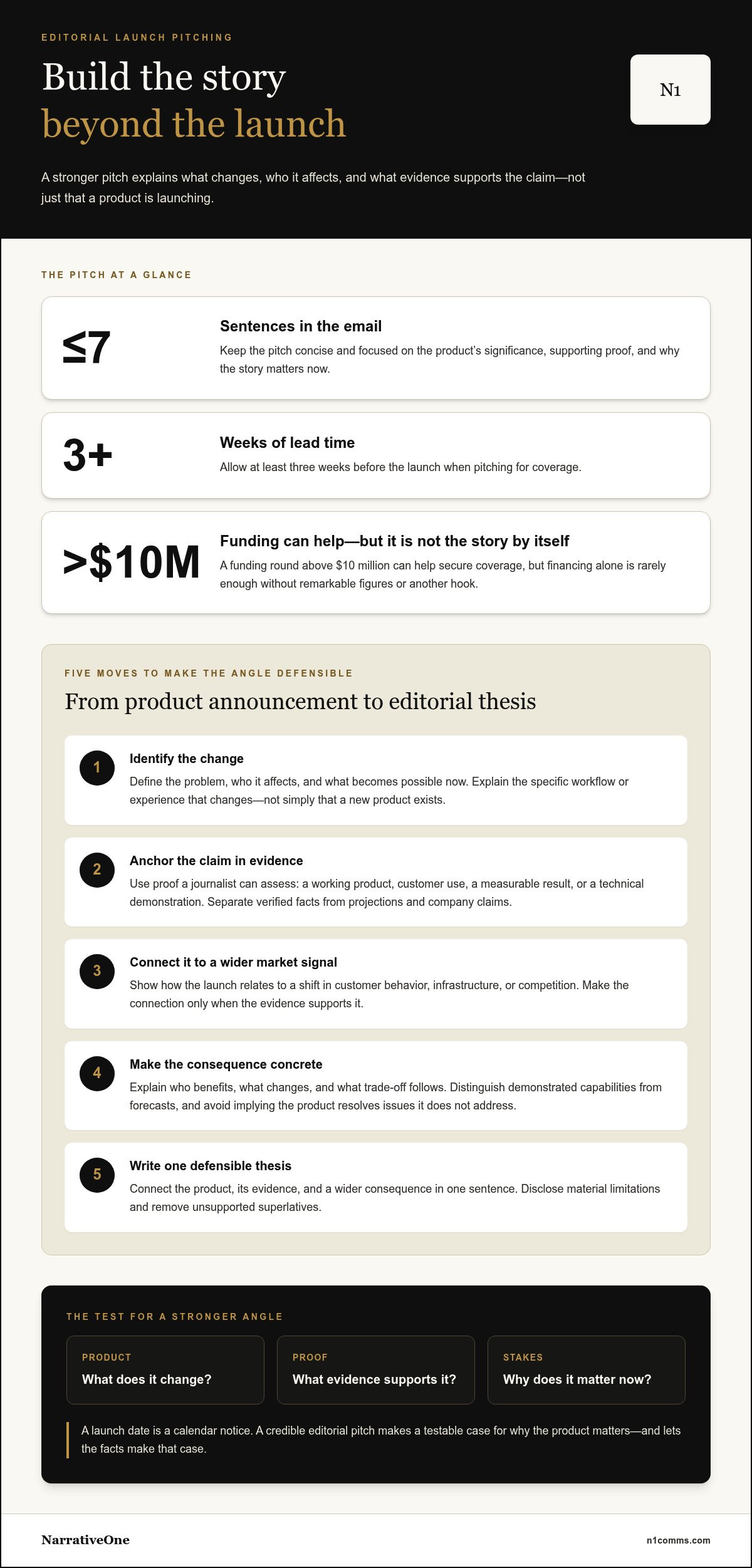
A product launch pitch is stronger when it offers a relevant reporter a story beyond the company announcement. For TechCrunch product launch coverage, keep the email to seven sentences or fewer, match the reporter’s beat, and allow at least three weeks of lead time.
A launch date alone is not a news angle. Explain why the product matters now, who it affects, and what evidence supports your claims. Finding the right reporter is only part of the decision: the same launch may suit another editorial route, while sponsored coverage follows a different model from independent reporting. This guide breaks the work into practical steps. You’ll learn how to shape the angle, identify a relevant journalist, prepare a concise pitch, assess other coverage paths, and distinguish editorial coverage from paid placement. The goal is disciplined targeting, not a wider distribution list.
Key Takeaways
Build the story around what changes for customers or the market, not just the fact that a product is launching.
Match your pitch to a reporter’s recent coverage and demonstrated subject focus, then tailor the evidence and framing accordingly.
Compare editorial outreach with other coverage paths, including sponsored placement, before choosing how to reach your audience.
Use date and category searches to map relevant coverage patterns and sharpen the launch angle.
Keep the pitch focused on the product’s significance, supporting proof, and why the story matters now.
Table of Contents
Developing an editorial angle beyond a company announcement
Identify the change behind the launch. “We released a new platform” reports company activity, not its wider significance. Define the problem the product addresses, who it affects, and what becomes possible now. For example, explain how a new tool changes a specific workflow for small retailers rather than calling it “revolutionary.” The founder’s role matters when it clarifies a technical decision or market insight. Start with the change, then explain why the launch is newsworthy.
Anchor the claim in evidence. Choose proof that a journalist can assess: a working product, customer use, a measurable result, or a technical demonstration. Separate verified facts from projections and company claims. TechCrunch’s startup-PR guide says a funding round above $10 million can help secure coverage, but funding alone is rarely enough without remarkable figures or another hook. Treat financing as context, not a substitute for product evidence. State what supports each claim clearly.
Connect the launch to a larger market signal. A company announcement gains context when it illustrates a shift beyond one business. These examples are not product launches; they show how a discrete event can reveal a broader market movement. For a launch, identify a related shift in customer behavior, infrastructure, or competition, then explain the connection without overstating it.
Make the consequence concrete. Explain who benefits, what changes, and what trade-off follows. For an AI infrastructure launch, relevant context might include opposition that has led to hundreds of proposed and enacted moratoriums across the United States. That context does not prove the product resolves the policy conflict. It helps frame the stakes. Distinguish the product’s demonstrated capabilities from the founder’s forecasts, and explain why that difference matters to users.
Write the angle as a defensible thesis. Reduce the story to one sentence connecting the product, its evidence, and a wider consequence. “The product launches today” is a calendar notice. “This tool helps clinics complete a defined task with fewer manual steps” offers a testable proposition, provided the evidence supports it. A credible case for TechCrunch product launch coverage also explains why the story matters now. Remove unsupported superlatives, disclose material limitations, and let the facts make the case.
A useful angle can also show how a launch relates to capital flows or competitive attention, without suggesting that either proves product value. These events provide context about investment and market appetite, but they do not establish whether a product works or meets a customer need. Make that distinction explicit, and connect the broader signal to the launch only when evidence supports the link.
Visibility can be another part of the story, but it needs careful framing. The Machine Relations Index release dated October 17, 2026, recorded 168 news-driven answer runs citing Forbes, compared with 160 citing TechCrunch. That comparison may prompt questions about where news is being surfaced and which outlets are cited. It does not, by itself, show audience size, influence, or the quality of a launch. A stronger editorial case explains what the measure counts, what it cannot establish, and why that difference matters to the people affected.
Finding the right TechCrunch reporter
Map the product to a reporting beat. Start with the product’s actual function, not the company’s preferred category. A developer tool, for instance, may fit software coverage better than broad startup news. Search TechCrunch for articles about the product’s users, technology, and market. Note which journalists wrote them and whether their work shows ongoing interest in the subject. A reporter covering enterprise software is a stronger candidate for a business platform than one focused on consumer devices.
Study each journalist’s recent work. Read several TechCrunch stories by the same reporter and identify recurring subjects, sources, and questions. A journalist examining AI infrastructure’s effects on local communities may have different interests from one covering AI applications for businesses. Match your pitch to that distinction. Track the reporter’s name, article topic, publication date, and specific connection to your launch. This keeps targeting evidence-based rather than relying on job titles alone.
Build a focused shortlist. Journalists receive hundreds of pitches each week, so a broad distribution list can weaken relevance. Select reporters whose coverage most closely matches the product’s users and strongest evidence. For a cybersecurity startup, that might mean prioritizing a journalist who covers security incidents or products. Record why each person belongs on the list. If the connection takes a long explanation, the fit is probably weak.
Learn each reporter’s stated preferences. Check the journalist’s TechCrunch author page, public profile, and recent posts before reaching out. Look for preferences on topics, formats, and how they want pitches handled. Research relevant TechCrunch journalists on Twitter, then engage substantively with their work. A thoughtful response to a published story can demonstrate familiarity; a generic compliment cannot. Keep interactions professional and focused on the subject.
Make the match explicit in your opening. Name a relevant TechCrunch article and explain how your launch connects to its subject. For example, a founder pitching a developer product could reference the journalist’s reporting on software infrastructure, then state the product’s distinct evidence. Don’t imply the reporter has agreed to cover the company. Editorial decisions remain independent. Help the journalist assess the story quickly without presuming the product will be featured.
Reassess the match before follow-up. Compare your pitch with the reporter’s latest TechCrunch coverage. If their recent work has moved away from your product’s category, revise your shortlist instead of forcing a connection. Keep the subject line specific, name the relevant product area, and lead with the clearest reason for contacting them. This final check protects the founder’s credibility and keeps outreach grounded in demonstrated journalistic interest.
Newsworthy product launches and other coverage paths
Assess whether the release supports independent reporting or calls for another route. Track TechCrunch announcements by category and date, then use those patterns to refine your outreach.
Assess Launch Newsworthiness
Compare the product release with a customer problem, market shift, or technical change. A launch is stronger when it gives a journalist evidence and a reason to report now, not just a company milestone. Check for working product access, credible users, and clear claims. Avoid treating a press release, partner endorsement, or funding announcement as proof of product impact.
Track Launch Coverage and Announcements
Track TechCrunch product announcements by searching its coverage with product category, company name, and publication date. Save relevant articles in a simple log with the headline, author, topic, and launch details. TechCrunch’s tip page, last updated in 2024, says pitches or press releases can be emailed as tips or source material. Use that route to share useful evidence, not demand coverage.
Choose the coverage path that matches the objective. Editorial reporting suits launches with independent news value, accessible evidence, and a clear consequence for the audience. Sponsored coverage is paid placement, not an editorial decision. Keep the distinction clear in planning and internal approvals. If the launch mainly needs a controlled product explanation, owned channels or a partner announcement may work better than an editorial pitch.
Coordinate timing with the release plan. Align product access, spokesperson availability, customer evidence, and partner approvals before outreach. A former TechCrunch contributor recommends roughly two to seven days’ notice for an embargo, depending on complexity. Share the proposed timing and embargo terms clearly. Don’t assume every journalist accepts an embargo, and don’t distribute confidential material without agreed terms.
Maintain a coverage record after publication. Record the article date, category, central claim, and whether the story focused on the product, funding, or market context. Compare the published angle with the original pitch. If a launch receives no editorial response, update the story’s evidence or choose another path rather than repeatedly sending the same press release. A precise record informs the next announcement.
How can I find TechCrunch product launch coverage by date or category?
Search TechCrunch coverage by product category first, then narrow by publication date. Record results that reveal relevant launch patterns and reporting angles.
Define the category before searching. Choose the product’s primary function, such as cybersecurity, enterprise software, or space technology. Add a second term for its user or market, such as “satellite launch” or “developer tools.” This focuses your search on comparable TechCrunch stories. Avoid starting with a broad term like “startup,” which returns coverage from unrelated sectors.
Search the publication’s archive with specific terms. Combine the category with words such as “launch,” “product,” or “release.” Then search the company name, product name, and founder name separately. A search for “satellite launch” may surface different reporting from a company-name search. Compare results rather than assuming one query captures every relevant TechCrunch article.
Narrow results by publication date. Use a defined period that matches your research question, such as a launch window or a year of category coverage. Check each article’s displayed publication date. For historical context, Rocket Lab sent a pair of BlackSky satellites to space on April 1, 2022; SpaceX launched a NASA telescope intended to observe black holes on December 9, 2021. These examples help distinguish adjacent space coverage.
Separate launch stories from related announcements. Label each result by its central event: product release, funding, acquisition, partnership, or company milestone. A date search can surface several announcement types together. For example, SpaceX delivering satellites and landing its first stage onshore on June 30, 2021, is an operational milestone, not a new software product. Classification makes the archive useful for comparison.
Build a repeatable coverage log. Capture the TechCrunch headline, author, publication date, category, company, and central angle. Add the search terms that surfaced each result. A simple table lets you compare coverage over time without relying on memory. Keep product launches distinct from funding news, such as an investment round, so the emerging pattern reflects the right editorial format.
Use the pattern to refine your search. Review the log for recurring categories, launch formats, and story timing. If results for “AI infrastructure” mostly concern policy or investment, add terms related to the product’s users or technical function. Search TechCrunch again with those terms and compare the new results. The aim is a focused reference set, not a count of every article.
How can a company pitch a product launch to TechCrunch?
Set the launch timeline first. Build the outreach plan around the public release date. Allow at least three weeks of lead time when pitching TechCrunch. This gives the journalist time to assess the story, request details, and consider access. It also gives the company time to prepare a spokesperson and supporting materials. Before announcing publicly, decide what information can be shared, when, and who can respond.
Write a short, specific email. Keep the pitch to seven sentences or fewer. Use the subject line to identify the product category and launch, not to call the story groundbreaking. Open by stating what the product does and why the journalist’s readers may care. Follow with the strongest supporting evidence, a clear release date, and a direct offer to provide access or answer questions.
Make every sentence do one job. A compact pitch should establish the news, explain its relevance, and make evaluation easy. Use one sentence for the product, one for the audience’s problem, and one for evidence. Include the founder or technical lead only when their expertise adds useful context. Link claims to a demonstration, documentation, or customer example. Remove slogans, broad market predictions, and background that does not help assess the launch.
Prepare the materials before sending. Gather product screenshots, a concise fact sheet, spokesperson details, and supporting evidence in one accessible package. Ensure each item matches the pitch and public release. If you offer a demonstration, explain what the journalist can see and who will guide it. Keep sensitive information separate from public materials. Preparation reduces avoidable delays when a journalist asks a specific question.
Send one tailored pitch, then manage the exchange. Address the journalist by name and connect your message to their coverage. Don’t send identical emails to a broad list. If the journalist replies, answer directly and meet the agreed timing. If there’s no response, avoid repeated messages that simply restate the announcement. Follow up only to add material evidence or clarify a concrete detail, not to manufacture urgency.
For a launch that needs a disciplined media plan, develop a product launch coverage strategy around the story, evidence, and release timing.
Treat seven sentences as a ceiling, not a target: use fewer whenever the product, evidence, and request are clear. Before sending, check the journalist’s stated preferences and suggestions online, then tailor the subject, angle, and format accordingly. This makes outreach more deliberate without changing the core facts or overstating the claim. Keep the message focused on the launch, not on what the company hopes coverage will achieve.
Use that review as a final quality check. Confirm that the opening explains why the launch fits the journalist’s coverage, that any offered access is ready, and that the supporting material substantiates the central claim. If a preference is unclear, don’t assume; keep the request simple and let the journalist decide whether a conversation, demonstration, or written detail would help. The goal is a pitch that is easy to assess, respects the recipient’s stated approach, and supports an informed reply without unnecessary context.
NarrativeOne: Fund Positioning
NarrativeOne helps investment firms align fund positioning with the stories their portfolio companies take to market. When a launch ties into a portfolio announcement, communications must do more than explain the product: investors, partners, and company leaders need a coherent account of its significance. NarrativeOne provides Portfolio Announcements, LP Communications, and Partner Thought Leadership, alongside Fund Positioning. These services fit when product news intersects with investor communications, portfolio visibility, or a firm’s broader market position. They do not replace TechCrunch’s independent editorial decision; they help create disciplined messaging for the announcement and its stakeholders.
To discuss communications strategy for a fund or portfolio announcement, contact NarrativeOne.
Make the next launch a strategic decision
Before the next release, define what the launch needs to establish beyond visibility. Set an internal standard for supportable claims, consistent information for key audiences, and the business milestone that should guide timing. This gives leadership a durable decision framework, even when the editorial outcome is outside the company’s control. Strong TechCrunch product launch coverage starts with a story that can withstand scrutiny, but communications discipline should extend beyond a single article.
For investment firms, product news can intersect with fund and portfolio priorities. The next step is aligning those priorities before announcements create competing narratives. NarrativeOne works across that communications context. Contact NarrativeOne about your launch to discuss how to position the announcement within your broader strategy. A clear mandate makes the next decision stronger.