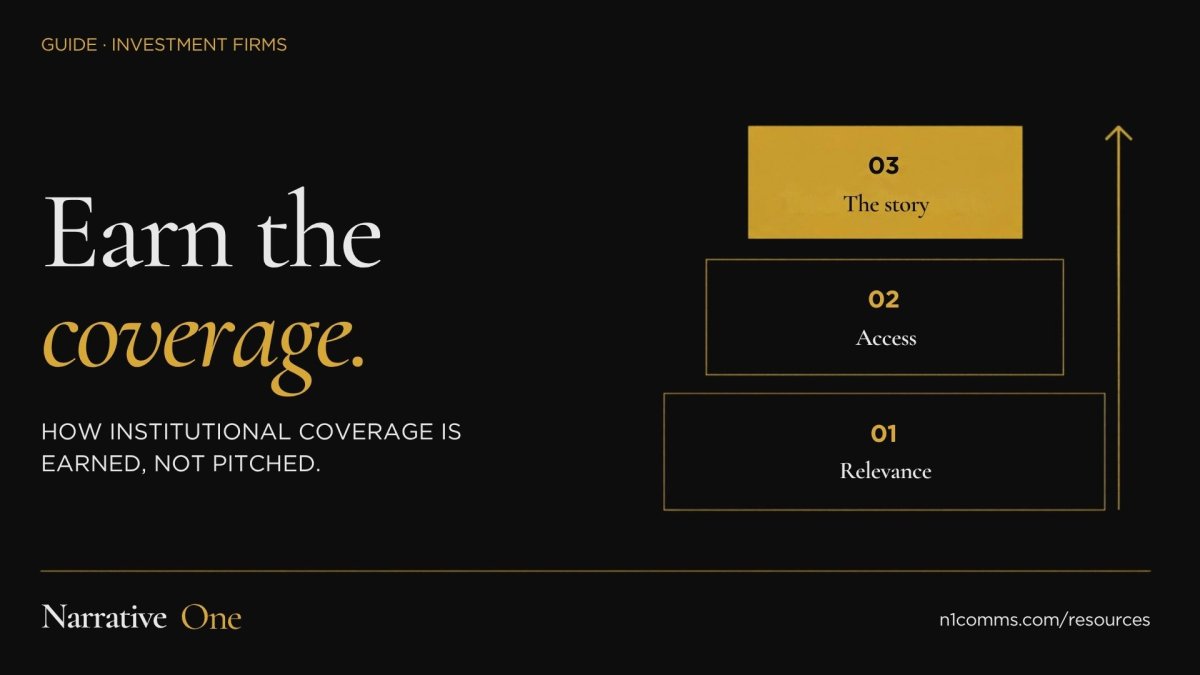
Bloomberg coverage starts with a defensible market story, not a request for a prestigious logo. If you’re asking how to get coverage in Bloomberg, begin by testing whether the development changes how investors understand a market, capital flow, fund, or company. A fund close or transaction may be significant to your firm without being a story for Bloomberg’s audience.
That distinction is where many pitches fail. A milestone can matter internally and still offer little editorial value. A polished press release can’t bridge that gap, and paid placement isn’t independent Bloomberg News coverage. Editorial attention depends on relevance, evidence, timing, and a credible approach to the reporter covering the subject.
This guide explains how to assess an announcement’s editorial angle, build a concise pitch, and prepare the facts and supporting materials journalists need. It also covers how to target a relevant reporter, plan for compliance in financial communications, and distinguish earned editorial coverage from sponsored exposure. The aim is a credible, well-prepared approach, not a promised placement.
Key Takeaways
- Bloomberg editorial coverage is earned through reporting, not secured by paid placement or a press release bearing a prominent name.
- Before pitching, test whether the announcement changes a market, fund, company, or transaction narrative.
- Learn how to get coverage in Bloomberg by shaping one timely angle and supporting it with verifiable evidence.
- Prepare approvals, compliance review, and announcement materials before outreach so the story is ready when a journalist needs it.
- Build a consistent investment-firm narrative across fund, portfolio, LP, and partner communications instead of pursuing a one-off logo.
What Does Getting Coverage in Bloomberg Actually Mean?
“Bloomberg coverage” can refer to several different outcomes. A company announcement distributed through a wire service, a sponsored article, and a Bloomberg News report may all create visibility, but they do not carry the same editorial weight or indicate the same degree of independent scrutiny.
Earned Bloomberg coverage is independent reporting selected by Bloomberg’s editorial team because a story is relevant to its audience and supported by evidence. Your firm can provide information and respond to questions, but it doesn’t control whether the story runs, its headline, or the final editorial treatment. Those decisions belong to the newsroom.
Earned coverage, sponsored content, and distribution are different
In earned reporting, a journalist and editor decide whether a pitch warrants coverage, what additional reporting is needed, and how the story is framed. A source can clarify information or correct factual errors, but that doesn’t make the source the publisher of the story.
Sponsored content follows a different model. An advertiser pays for visibility under commercial terms, and the content should be identified as sponsored or paid. The advertiser may have control over the message within those terms, but paid visibility isn’t independent Bloomberg News reporting. Wire distribution is different again: a company or its representative supplies an announcement for distribution. That can broaden access to the release, but it doesn’t mean Bloomberg journalists independently reported it. For context on the newsroom and its operations, see Bloomberg News.
Before citing a media appearance in investor materials, identify what it was: an editorial report, a labeled sponsored feature, or a distributed release. Check the page format and disclosures. The label defines what the appearance can credibly demonstrate.
Why Bloomberg visibility matters to investment firms
Relevant financial reporting can put an investment firm’s fund, transaction, or portfolio-company story before market participants, including limited partners and co-investors. It can serve as one proof point that a development had broader relevance. On its own, it can’t establish investment performance, validate a strategy, or guarantee commercial outcomes.
That is why the question of how to get coverage in Bloomberg should begin with editorial fit, not the value of the masthead. Does the development change how a market, fund, company, or transaction is understood? Can you substantiate the claim? Is the information ready to report now? Relevance, evidence, timing, and editorial judgment shape whether a pitch advances. Strong preparation improves the quality of the approach, but no communications process can promise an independent editorial decision.
What Makes an Investment Story Relevant to Bloomberg?
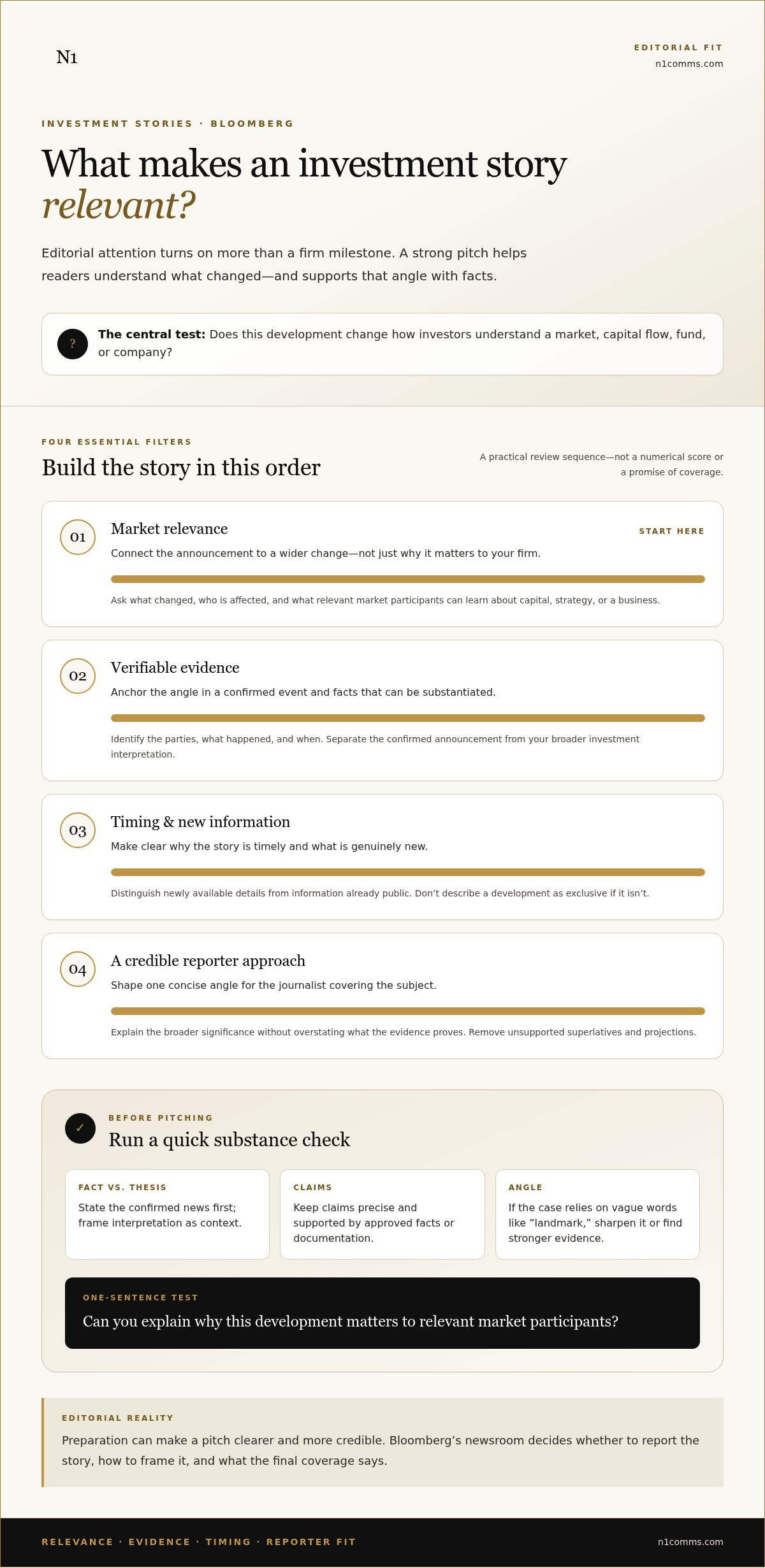
An investment announcement is not automatically a market story. Its relevance depends on what changed, who is affected, and whether the development offers useful insight into capital, strategy, or a business. The test is not whether the news matters to your firm. It’s whether it helps readers understand something beyond the firm itself.
That distinction is central to how to get coverage in Bloomberg. A strong angle connects a specific development to its wider significance without overstating what the evidence proves. Columbia Journalism Review’s discussion of what makes a story compelling offers a useful reminder: a pitch should serve an audience’s understanding, not just an organization’s need for attention.
Test the announcement for substance and relevance
Start with the verifiable event. Identify the parties involved, what happened, when it happened, and what the development changes. Then establish what is genuinely new. A fund close, transaction, or portfolio-company milestone may be newsworthy when it signals a shift in strategy, capital formation, market participation, or a company’s position. A familiar claim repackaged with a fresh headline is not new information.
- Separate fact from thesis. State the confirmed announcement first. Present the broader investment interpretation as context, not as an established outcome.
- Check disclosure status. Distinguish newly available details from information already public. Don’t imply a development is exclusive if it isn’t.
- Substantiate every claim. Remove superlatives and projections that lack approved facts or documentation. Precision strengthens the angle; inflated language weakens it.
Try writing one sentence that explains why the development matters to relevant market participants. For example: “The transaction gives investors a new indication of how the firm is deploying capital in [market or sector].” Use this structure only when the underlying facts support it. If the sentence depends on vague terms such as “landmark” or “transformative,” sharpen the angle or find stronger evidence.
Translate fund and portfolio news into a clear angle
For fund news, explain the strategy, the capital formation milestone, and what the announcement reveals about the fund’s activity. A fund launch alone may be a company update. The angle becomes clearer when verified details show why the strategy or milestone matters to investors. For guidance on framing that announcement, see a guide to announcing a new fund.
For portfolio news, lead with the company’s material business development, then explain the investment firm’s connection. Frame a product launch, expansion, or transaction around its documented significance. Don’t use it as a proxy for claims about investment performance. Fund positioning and portfolio announcements are strongest when every claim is specific, attributable, and aligned with the evidence.
NarrativeOne’s investment-firm communications strategy helps align fund and portfolio narratives with this standard through investment-firm communications.
How to Prepare a Bloomberg Pitch: A Practical Framework
Build a strong pitch in sequence, rather than assembling it from a long press release. Define the news, select one angle, substantiate the claim, prepare the materials, then target the journalist whose reporting matches the subject. Each step makes it easier for the newsroom to assess the story. None guarantees coverage.
For investment firms, this discipline matters because fund, transaction, and portfolio-company announcements can involve sensitive information, multiple stakeholders, and claims that need precise qualification. Before outreach, establish what can be disclosed, who can speak, and which evidence supports the story.
Build the core pitch and evidence package
Keep the first email focused on one development and one reason it matters now. Use a direct subject line that identifies the event. In the opening sentence, state what happened and why a reader might care. Avoid promotional framing. The Bloomberg Way, discussed by Knowledge at Wharton, offers useful context on the standards that shape Bloomberg journalism. A clear account of the facts is a stronger foundation than prestige language.
Prepare a compact evidence package before sending:
- Approved facts: Confirm names, dates, figures, transaction details, and what is newly disclosed.
- Supporting materials: Make relevant documents and market context available, and explain what each item supports.
- Spokesperson readiness: Identify who can respond, what they can address, and when they are available.
- Disclosure boundaries: Separate on-record information from confidential material. State any limits clearly before sharing information instead of assuming a journalist will infer them.
For investment communications, build compliance into preparation. Draft content natively in English and Arabic where needed, embed the applicable compliance rules, then have the compliance director review drafts before outreach. Keep the approved version and supporting materials together so the pitch and any follow-up remain consistent with what has been cleared.
Target the right journalist and follow up with discipline
Bloomberg does not use a general story-pitch inbox. Identify the individual reporter or editor whose coverage aligns with the subject, then read their recent work before making contact. A fund announcement, a transaction, and a portfolio-company development may call for different reporting expertise. Use that fit to guide your outreach rather than sending the same pitch to a broad list.
Shape the pitch around the journalist’s beat and likely information needs. Lead with the news, explain its significance, offer evidence and access, and make clear what remains undisclosed. Keep the first approach concise. If you follow up, add useful context or clarify availability rather than repeating the same request. Respect deadlines and record the outreach and response accurately. An acknowledgment or request for information is not a placement.
That is the operational answer to how to get coverage in Bloomberg: make the story easy to assess, the evidence easy to verify, and the approach relevant to the reporter. The editorial decision remains theirs.
How Timing and Compliance Affect Bloomberg Outreach
A pitch sent before the announcement is cleared creates avoidable risk. A pitch sent after the news has lost relevance may miss the reporting window. Set the outreach date only after the facts, approvals, spokesperson, and disclosure boundaries are aligned. Journalist deadlines matter, but readiness comes first.
For investment firms, assign approval ownership before outreach begins. Identify who validates transaction details, who approves external statements, and who handles legal or compliance review. This is a communications control, not legal advice. The aim is to ensure the pitch and supporting materials match what the firm is authorized to disclose.
Prepare approvals before the announcement window
Use a practical readiness check before contacting journalists:
- Facts and documents: Confirm figures, names, dates, transaction details, and which materials are approved for external use.
- Compliance review: Embed relevant compliance rules in drafts before the compliance director reviews them. Keep approved and unapproved versions distinct.
- Spokesperson: Confirm who can comment, which subjects they can address, and when they can respond.
- Disclosure terms: Align internally on confidentiality boundaries and any proposed embargo before sharing information. State terms clearly and don’t assume they are understood.
For communications drafted in English and Arabic, prepare each version natively and carry the same approved facts and disclosure limits through both. A language difference must not become a message or compliance difference.
Use a defined communications timeline without promising coverage
NarrativeOne’s Portfolio announcement service follows a term-sheet-to-Tier-1-coverage timeline of fourteen days. That describes the service process, not a promise that Bloomberg or any other newsroom will publish. The sequence is T-14, T-10, T-5, T-2, Day 0, then +7:
- T-14: Establish the announcement scope, key facts, owners, and intended timing.
- T-10: Shape the story angle and assemble supporting context and materials.
- T-5: Finalize drafts with compliance rules embedded before compliance-director review.
- T-2: Confirm approvals, spokesperson readiness, disclosure boundaries, and release logistics.
- Day 0: Issue the approved announcement and conduct targeted journalist outreach.
- +7: Follow up appropriately, record responses, and assess next communications steps.
This sequence makes the process accountable, but it cannot control editorial judgment. That distinction is central to how to get coverage in Bloomberg: prepare a timely, approved story, then let the newsroom decide whether it merits reporting.
For disciplined investment-firm announcement planning, strengthen your announcement communications.
Build a Bloomberg Strategy Into Long-Term Investment-Firm Communications
A Bloomberg pitch should sit inside a larger institutional narrative. A one-off announcement may attract attention, but a coherent record of fund activity, portfolio developments, LP communications, and partner commentary gives each new story context. The objective isn’t repeated exposure for its own sake. It’s a consistent account of how the firm invests, where it sees opportunity, and what the evidence supports.
Start with a clear fund thesis. Use it to guide what the firm says about capital formation, investment decisions, and portfolio milestones. Keep messages aligned across channels while tailoring each announcement to its actual news. A portfolio-company PR guide can help structure a company milestone; fund positioning strategy can clarify the underlying investment narrative.
Connect media coverage to the investment-firm narrative
Consistency is not repetition. A fund announcement, LP update, and partner commentary should each contribute distinct information while remaining grounded in the same strategy. Over time, evidence-led communication can help journalists and market participants understand the firm’s point of view and recognize relevant developments. It doesn’t establish investment performance or guarantee future coverage. It builds a more durable communications foundation.
That foundation makes it easier to assess how to get coverage in Bloomberg as a strategic question rather than a search for a logo. The test remains whether a development adds substantiated information to the market’s understanding of the firm or its portfolio.
What a senior, compliance-aware media relations process provides
NarrativeOne works with investment firms, including private equity, venture capital, and multi-strategy platforms. Its delivery model brings together one senior strategist, one journalist network, and one compliance workflow. Content is drafted natively in English and Arabic for senior financial journalists. Compliance rules are embedded before drafts are reviewed by the compliance director.
NarrativeOne brings 17 years of operating experience inside investment institutions and reports $2 B+ AUM across 150+ funds and clients. Its direct journalist relationships include Bloomberg. Shorooq has secured high-profile placements including Bloomberg, Reuters, SkyNews, and Forbes. That is an example of past coverage, not a forecast or promise for another firm.
Editorial outreach works best as one part of sustained fund positioning, portfolio announcements, LP communications, and partner thought leadership. NarrativeOne’s communications strategy and infrastructure help keep each claim aligned with the facts and each announcement connected to the investment story.
Make Editorial Readiness Part of Your Investment Strategy
Knowing how to get coverage in Bloomberg starts with a disciplined distinction: editorial attention follows a relevant, substantiated story, not a request for a prestigious masthead. Build the pitch around one development, support it with approved evidence, and approach the journalist whose reporting fits. Then connect that outreach to a consistent investment-firm narrative across fund, portfolio, LP, and partner communications.
Preparation can improve the quality of the approach, but it can’t determine a newsroom’s decision. NarrativeOne’s investment-firm model brings together one senior strategist, direct journalist relationships that include Bloomberg, Reuters, and the Financial Times, and an embedded compliance workflow. Shorooq’s high-profile placements include Bloomberg, Reuters, SkyNews, and Forbes. These are examples of past coverage, not guarantees of future publication.
For investment firms, credibility compounds through clear positioning, evidence-led announcements, and communications controls established before outreach. Discuss a disciplined media relations strategy for your investment firm with NarrativeOne. A rigorous process gives your story a strong foundation and helps your team engage with journalists credibly.
Frequently Asked Questions
Can you guarantee coverage in Bloomberg?
No. Bloomberg’s journalists and editors make independent decisions about whether to report a story, what to investigate, and how to frame it. A communications team can sharpen the angle, substantiate claims, prepare spokespeople, and target relevant reporters. Those steps improve the pitch’s readiness, not its certainty of publication. Distinguish earned reporting from paid or sponsored exposure, and treat any promise of guaranteed independent editorial coverage with caution.
How do you pitch a story to a Bloomberg journalist?
Contact an individual reporter or editor whose recent work matches the story’s subject. Bloomberg doesn’t use a general pitch inbox for stories. Read the journalist’s relevant reporting, then send a concise, tailored pitch that states the development, why it matters now, and what evidence or spokesperson is available. For investment stories, make the connection to capital, strategy, or a material business development clear. Targeted relevance beats mass distribution.
What kind of investment news is relevant to Bloomberg?
Investment news is more relevant when it helps readers understand a change in a market, fund, company, or transaction. A fund close, investment, or portfolio milestone needs more than prestige language: explain what is new, who is affected, and what the verified facts show. Connect the announcement to its market context without presenting a firm’s investment thesis as proven fact. Relevance depends on the story, its evidence, and editorial judgment.
How long does it take to get coverage in Bloomberg?
There is no fixed Bloomberg newsroom turnaround. NarrativeOne’s Portfolio announcement service describes a term-sheet-to-Tier-1-coverage timeline of fourteen days, organized as T-14, T-10, T-5, T-2, Day 0, then +7. That is a communications preparation and outreach process, not a publication guarantee. Timing depends on announcement readiness and newsroom decisions. A journalist’s interest or request for more information doesn’t confirm that a story will run.
Can a fund announcement get Bloomberg coverage?
Yes, a fund announcement can attract coverage if it offers a relevant, evidence-backed story for Bloomberg’s audience. Explain the fund’s strategy, what the milestone represents, and why it matters to investors or the market. A launch or close alone may not provide enough context. Keep the announcement separate from broader claims about performance or market impact, and support every factual statement with approved information.
Is paid Bloomberg placement the same as editorial coverage?
No. Editorial coverage is independently selected and produced by Bloomberg’s newsroom. Sponsored content is paid visibility and should be identified as such. Wire distribution sends an announcement through a distribution service, but doesn’t mean Bloomberg journalists independently reported it. Before describing a media appearance to investors or partners, identify its format and disclosures accurately. A paid placement can provide exposure; it must not be represented as independent Bloomberg News reporting.
What should a Bloomberg pitch include?
A strong pitch states one development and one reason it matters now. Include the confirmed facts, relevant market context, supporting documents, and a spokesperson who can address the subject. Clarify what is on the record and define confidentiality boundaries before sharing sensitive material. Keep the message concise and tailored to the journalist’s coverage area. To understand how to get coverage in Bloomberg, focus on making the story timely, relevant, and verifiable.
Does a company need a press release to get Bloomberg coverage?
No. A press release can provide a clear record of an announcement, but it isn’t a prerequisite for editorial coverage. A concise pitch supported by approved facts, useful context, and access to an informed spokesperson may be more relevant to a journalist’s needs. If you prepare a release, treat it as a source document rather than a substitute for a news angle. Distribution alone doesn’t ensure reporting.
Frequently Asked Questions
Can you guarantee coverage in Bloomberg?
No. Bloomberg’s journalists and editors make independent decisions about whether to report a story, what to investigate, and how to frame it. A communications team can sharpen the angle, substantiate claims, prepare spokespeople, and target relevant reporters. Those steps improve the pitch’s readiness, not its certainty of publication. Distinguish earned reporting from paid or sponsored exposure, and treat any promise of guaranteed independent editorial coverage with caution.
How do you pitch a story to a Bloomberg journalist?
Contact an individual reporter or editor whose recent work matches the story’s subject. Bloomberg doesn’t use a general pitch inbox for stories. Read the journalist’s relevant reporting, then send a concise, tailored pitch that states the development, why it matters now, and what evidence or spokesperson is available. For investment stories, make the connection to capital, strategy, or a material business development clear. Targeted relevance beats mass distribution.
What kind of investment news is relevant to Bloomberg?
Investment news is more relevant when it helps readers understand a change in a market, fund, company, or transaction. A fund close, investment, or portfolio milestone needs more than prestige language: explain what is new, who is affected, and what the verified facts show. Connect the announcement to its market context without presenting a firm’s investment thesis as proven fact. Relevance depends on the story, its evidence, and editorial judgment.
How long does it take to get coverage in Bloomberg?
There is no fixed Bloomberg newsroom turnaround. NarrativeOne’s Portfolio announcement service describes a term-sheet-to-Tier-1-coverage timeline of fourteen days, organized as T-14, T-10, T-5, T-2, Day 0, then +7. That is a communications preparation and outreach process, not a publication guarantee. Timing depends on announcement readiness and newsroom decisions. A journalist’s interest or request for more information doesn’t confirm that a story will run.
Can a fund announcement get Bloomberg coverage?
Yes, a fund announcement can attract coverage if it offers a relevant, evidence-backed story for Bloomberg’s audience. Explain the fund’s strategy, what the milestone represents, and why it matters to investors or the market. A launch or close alone may not provide enough context. Keep the announcement separate from broader claims about performance or market impact, and support every factual statement with approved information.
Is paid Bloomberg placement the same as editorial coverage?
No. Editorial coverage is independently selected and produced by Bloomberg’s newsroom. Sponsored content is paid visibility and should be identified as such. Wire distribution sends an announcement through a distribution service, but doesn’t mean Bloomberg journalists independently reported it. Before describing a media appearance to investors or partners, identify its format and disclosures accurately. A paid placement can provide exposure; it must not be represented as independent Bloomberg News reporting.
What should a Bloomberg pitch include?
A strong pitch states one development and one reason it matters now. Include the confirmed facts, relevant market context, supporting documents, and a spokesperson who can address the subject. Clarify what is on the record and define confidentiality boundaries before sharing sensitive material. Keep the message concise and tailored to the journalist’s coverage area. To understand how to get coverage in Bloomberg, focus on making the story timely, relevant, and verifiable.
Does a company need a press release to get Bloomberg coverage?
No. A press release can provide a clear record of an announcement, but it isn’t a prerequisite for editorial coverage. A concise pitch supported by approved facts, useful context, and access to an informed spokesperson may be more relevant to a journalist’s needs. If you prepare a release, treat it as a source document rather than a substitute for a news angle. Distribution alone doesn’t ensure reporting.