
Coverage is not ROI. A press mention can expand visibility without proving that a buyer, investor, or candidate acted because of it. If you're asking how to measure PR ROI for tech startups 2026, start by separating evidence of activity from evidence of business impact.
The frustration is familiar: impressions rise, coverage accumulates, and leadership still can't see how communications support company priorities. Attribution makes the problem harder. Buyers encounter multiple touchpoints before they engage, while teams may lack a baseline or a consistent reporting process. Credible measurement doesn't erase that complexity or claim PR caused a funding outcome. It makes the relationship between communications and business outcomes visible, with its limits clearly stated. That distinction matters when budgets face scrutiny and decisions need to rest on more than a headline count.
This article explains how to set objectives before activity begins, establish a practical baseline, and track outputs, audience outcomes, and business indicators without conflating them. It also shows how to use attribution carefully and apply reporting to decide what to continue, change, or stop. The goal isn't a flattering coverage-value equation. It's a measurement system leadership can use.
Key Takeaways
Define PR objectives around a startup priority, audience, intended change, and review period before communications begin.
Build a baseline and assign owners for each metric so reporting stays consistent and decision-ready.
Use direct response, self-reported discovery, and multi-touch records as complementary attribution evidence, not proof of causation.
Apply a clear process to instrument, monitor, review, and adjust communications activity based on the evidence.
Learn how to measure PR ROI for tech startups 2026 by assessing whether a measurement partner separates earned coverage, audience response, and commercial indicators.
Table of Contents
What PR ROI Means for a Tech Startup in 2026
PR ROI is evidence of communications value relative to the investment and the business objectives set before activity begins. It isn't a single coverage score or a claim that a press mention generated revenue. Public relations involves deliberate communication with audiences. Measuring its return means showing what the activity produced, how audiences responded, and whether those responses align with company priorities.
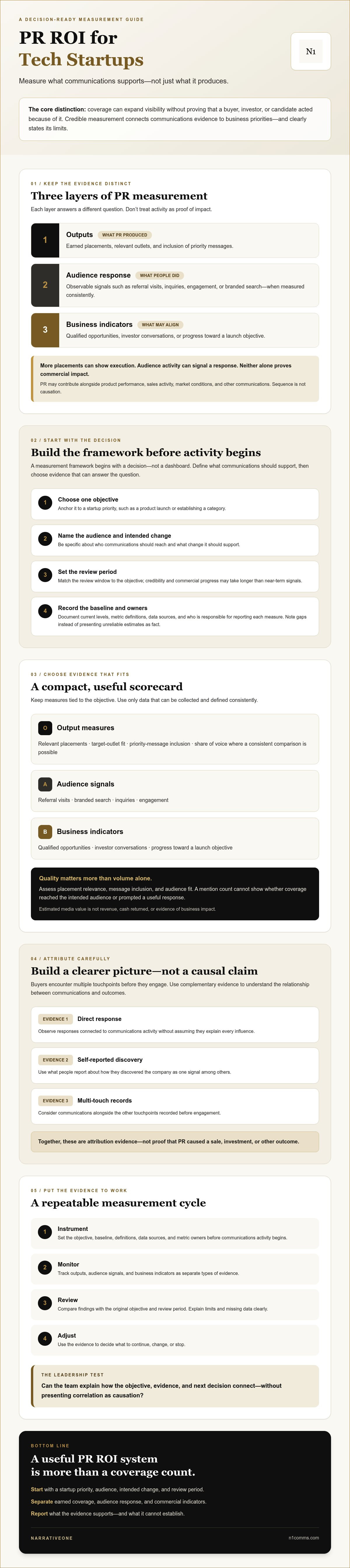
Keep the evidence in three distinct layers:
Outputs: earned placements, inclusion of key messages, and coverage in relevant outlets.
Audience response: referral visits, inquiries, or other observable engagement following exposure.
Business outcomes: indicators such as qualified opportunities, investor conversations, or progress toward a launch objective.
Each layer answers a different question. More placements may indicate execution, but they don't establish audience interest. Audience activity can signal a response, but it doesn't prove commercial impact. PR may contribute to an outcome alongside product performance, sales activity, market conditions, and other communications. Sequence is not causation.
Before choosing metrics, define the measurement question. For example: “Did this launch communication increase relevant awareness among our target buyers?” That question clarifies which audience, evidence, and review period matter. Without it, teams collect numbers first and struggle to explain their relevance later.
Which PR outcomes matter to a technology startup?
The right outcome depends on the company's stage and immediate priority. A startup establishing a category may look for evidence of message adoption and visibility among a defined audience. A company announcing a product milestone may assess relevant coverage and audience response. A startup preparing for fundraising may track investor interest as a signal, not proof that PR secured capital.
Choose an outcome leadership can act on. Near-term signals, such as relevant placements or referral activity, can inform execution quickly. Credibility, investor consideration, and commercial progress may develop over a longer period and involve several influences. Match the review window to the objective rather than demanding an immediate financial return from every activity.
Why coverage volume is not ROI
A mention count records quantity. It can't establish whether coverage reached the intended audience, included the company's key message, or prompted a useful response. One relevant placement may carry more strategic value than several mentions that miss the target audience.
Assess placement quality, message inclusion, and audience fit alongside volume. Treat estimated media value with caution: an estimate of what equivalent advertising might cost is not revenue, cash returned, or evidence of business impact. For leaders asking how to measure PR ROI for tech startups 2026, the standard isn't a bigger number. It's a defensible connection between the objective, the evidence, and the decision that follows.
Build a PR Measurement Framework Around Startup Objectives
A measurement framework starts with a decision, not a dashboard. Choose one objective, name the audience, define the change communications should support, and set a review period. For example, a product launch might aim to increase awareness among a specific buyer group. That objective determines which evidence matters and keeps the scorecard from becoming a collection of unrelated numbers.
Establish the baseline before activity begins. Record the current level, how each metric is defined, its data source, and who owns reporting it. If branded search is part of the plan, document how it will be observed and over what period. If the data isn't available or reliable, note the gap instead of presenting an estimate as fact.
Which tech startup PR metrics belong on the scorecard?
Keep the scorecard compact and separate measures by function. PRSA’s 10 PR Metrics You Should Be Tracking offers a useful reference, but each metric still needs to serve the startup’s own objective.
Outputs: relevant placements, target-outlet fit, inclusion of priority messages, and share of voice where a consistent comparison is possible.
Audience signals: referral visits, branded search, inquiries, or engagement, but only when the data can be collected and defined consistently.
Business indicators: qualified conversations or other objective-linked signals. Report these separately from media outputs; a placement is not a lead.
For every scorecard entry, state what counts, where the data comes from, who supplies it, and how often it is reviewed. For example, define whether a placement must include a priority message to count as relevant. These details make reporting comparable across periods and expose missing inputs before they distort conclusions.
Set baselines and targets without inventing benchmarks
Use the same definitions for the baseline and later reports. Set targets from company priorities and available historical data, not generic industry averages that may not reflect the startup’s stage, audience, or market. If no usable history exists, establish the baseline first and agree on a realistic review point with leadership.
Record changes in analytics setup, CRM practices, campaign scope, or other factors that affect interpretation. Note data gaps and external conditions outside communications’ control. A scorecard should preserve those limits, not hide them.
For teams formalizing measurement within an ongoing communications programme, NarrativeOne’s communications programme approach can provide context for integrating monitoring and reporting into sustained activity. The startup’s framework remains its operating instrument: a clear objective, defined evidence, named owners, and targets grounded in its own data.
How to Attribute PR ROI Without Overclaiming Causation
A press placement followed by an inquiry, investor conversation, or funding milestone doesn't prove the placement caused it. The sequence is evidence of timing, not causation. Buyers and investors encounter several influences, and PR is only one possible input. Credible attribution records what can be observed, identifies what remains uncertain, and uses contribution language when other factors may have shaped the outcome.
For teams working out how to measure PR ROI for tech startups 2026, treat attribution methods as complementary views, not competing claims. PRSA’s PR measurement framework can inform metric selection, but the startup still needs to connect media records to its own inbound and commercial data.
Which attribution methods can a startup use for PR?
First-touch records the earliest known source; last-touch records the source closest to an inquiry or conversion. Both simplify a longer decision journey and can omit other influences. Multi-touch reporting captures several recorded interactions, but it doesn't establish how much causal weight each deserves. Referral links or campaign identifiers can help connect coverage to visits when they're practical and used consistently.
MethodWhat it can showWhat it can’t establishDirect response trackingVisits or inquiries associated with a referral link or campaign identifier.Whether the coverage caused the response or captured every visit.Self-reported discoveryWhether someone says coverage influenced how they found or evaluated the company.How decisive that influence was or whether recall is complete.Multi-touch recordsWhich tracked interactions appeared in a recorded journey.The causal contribution of each interaction or untracked exposure.
How to test whether PR contributed to a result
Build a dated evidence trail. Match media records with referral activity, inbound-source questions, and CRM notes. Ask new contacts how they first heard about the company and what influenced their decision. Compare observed changes with the established baseline, then record other relevant activity, such as a product release, sales initiative, or market shift.
Classify findings precisely:
Association: a tracked change occurred during or after PR activity.
Contribution: multiple evidence sources indicate PR was one influence among others.
Stronger evidence: a consistent pattern across records, responses, and timing supports a more confident assessment, while still not proving PR acted alone.
Report the evidence and its limits together. This makes findings useful for decisions without turning correlation into a causal claim.
How to Measure PR ROI Step by Step and Report It
A useful reporting process turns the framework into an operating cycle. For teams asking how to measure PR ROI for tech startups 2026, consistency matters more than dashboard complexity. Assign clear owners: communications handles media monitoring, analytics or marketing owns web data, sales or business development maintains CRM inputs, and an executive interprets findings against company priorities. In a smaller startup, one person may cover more than one role, but each data source still needs a named owner.
1. Define: Record the objective, audience, intended change, and review period. Keep the question specific enough to guide a decision.
2. Baseline: Capture the pre-activity level for each selected metric, along with its definition and source.
3. Instrument: Confirm tracking access, referral conventions, CRM fields, and reporting responsibilities before outreach begins.
4. Monitor: Log placements and message inclusion, then collect available audience and business signals using the agreed definitions.
5. Review: Compare results with the baseline and objective. Document data gaps, changes in tracking, and other relevant activity.
6. Adjust: Decide whether to maintain the approach, refine it, pause it, or investigate an unexpected result. Define the next test before further activity.
What should a PR ROI dashboard include?
Keep the dashboard decision-ready. For each metric, show the objective it supports, baseline, target, result, reporting period, definition, owner, and data source. Separate earned placements and reach indicators from audience response and business indicators. Include source notes, attribution caveats, and missing-data flags. A blank field is more credible than a number with unclear provenance.
Set a reporting cadence before work starts and keep it consistent across the agreed review period. A concise executive readout should explain what changed, what the evidence supports, and where it stops. If a CRM field or analytics method changes, note the change rather than presenting the resulting figures as directly comparable.
How to turn reporting into better communications decisions
Review performance against the original objective, not a leaderboard of coverage volume. Identify which messages appeared in relevant placements, which audiences engaged where observable, and which journalist beats were associated with useful signals. Then connect each finding to an action: maintain what aligns with the objective, refine what reached the wrong audience, pause activity with no clear strategic role, or investigate when data is incomplete.
Record the next test and its measurement method before launching further activity. That preserves learning across reporting periods and prevents teams from changing the question after seeing the result. To establish a measurement-led communications programme, discuss a communications programme with NarrativeOne.
Choosing a PR Measurement Partner and Acting on the Evidence
A partner’s measurement discipline should be clear before execution, not improvised in the final report. Ask how objectives become metrics, how baselines are established, who owns each data source, and how often findings reach leadership. A credible partner distinguishes earned coverage from audience response and business indicators. It also states what the evidence cannot prove. Unsupported promises of guaranteed ROI or definitive causal attribution are warning signs.
Questions to ask before appointing a PR partner
Request sample metric definitions and a reporting readout. Check whether each measure has a source, owner, and interpretation. Confirm who monitors coverage, who reviews analytics and CRM inputs, and who recommends next actions. Ask how the team describes attribution limits when several factors may influence an outcome. For regulated communications, confirm that compliance sign-off happens before any release reaches a journalist.
How NarrativeOne approaches measurement for tech firms
NarrativeOne offers a twelve-month communications programme that incorporates monitoring and reporting rather than treating measurement as a one-off campaign recap. Its tech-firm services include bilingual content drafted natively in English and Arabic, journalist targeting, and monitoring and reporting on the NarrativeOne platform. Its communications programme also pairs a senior operator with the work, rather than adding junior layers. These capabilities support a consistent process; they don't guarantee a particular business result.
The same distinction applies to track-record figures. NarrativeOne’s tech-firm materials state 200+ startup milestones announced and placed, $1 B+ total valuation impact, and 150+ implied media placements. These are company-reported figures, not proof that PR alone caused funding, valuation, or other outcomes. Before drawing further conclusions, ask what period the valuation figure covers and how the implied placements are defined.
As you assess how to measure PR ROI for tech startups 2026, judge a partner by the quality of its operating system: objective-led planning, consistent records, clear ownership, transparent limitations, and reporting that informs action. The evidence may support continuing an approach, refining its message or audience, or investigating a result that cannot yet be explained. Measurement should improve governance, not manufacture certainty.
Discuss a measurement-led communications programme with NarrativeOne.
Make PR Measurement Part of Your Operating Discipline
Credible PR ROI starts with a defined objective, a baseline, and consistent reporting. Keep coverage, audience response, and business indicators separate. Use attribution as evidence of possible contribution, not proof that PR alone caused a result. Then use what the data supports to maintain, refine, pause, or investigate communications activity.
NarrativeOne’s tech-firm materials state 200+ startup milestones announced and placed, alongside $1 B+ valuation impact. These are company-reported track-record figures, not evidence that PR independently produced valuation outcomes. That distinction is central to how to measure PR ROI for tech startups 2026: report what the evidence shows, including its limits.
Build a system leadership can use throughout the communications programme, not just a one-off recap. Discuss a measurement-led communications programme with NarrativeOne. With clear objectives and disciplined reporting, your team can make better-informed decisions and improve its approach over time.
Frequently Asked Questions
How do you calculate PR ROI for a tech startup?
Start by defining the business objective and the investment being assessed. If reliable financial returns can be linked to communications, compare the attributable return with the programme investment while stating the attribution limits. For broader objectives, assess evidence against the objective rather than forcing a cash formula. To determine how to measure PR ROI for tech startups 2026, track outputs, audience response, and business indicators separately, then use the findings to guide a decision.
What PR metrics should startups track in 2026?
Track metrics that answer a defined business question. A practical scorecard can include relevant placements, target-outlet fit, message inclusion, and share of voice where comparison is consistent. Add referral visits, branded search, inquiries, or engagement only when the data is available and reliable. Keep qualified conversations or other commercial indicators separate from media activity. Each metric needs a definition, data source, owner, and review period to support consistent interpretation.
Can you measure the ROI of earned media?
Yes, but measurement is stronger when it combines several forms of evidence rather than assigning a cash value to coverage alone. Record placements and message inclusion, monitor available audience responses, and compare relevant business indicators with a baseline. Referral data or reported discovery can help connect coverage to audience activity. These signals can support a finding that PR contributed to an outcome, but a placement followed by a result doesn't prove PR caused it.
How do you attribute leads to PR coverage?
Use consistent referral links or campaign identifiers where practical, and record inbound sources in the CRM. Ask new contacts how they discovered the company and what influenced their decision. Compare those responses with media records and timing. First-touch and last-touch views can miss other interactions, while multi-touch records show tracked touchpoints without proving each one’s causal weight. Report a lead as PR-associated or PR-influenced only when the evidence supports that description.
Is media coverage value the same as PR ROI?
No. Coverage-value estimates, including advertising-equivalency measures, don't establish revenue, cash returned, audience relevance, or progress toward a company objective. A placement count is an output, not a financial return. Assess whether coverage reached the intended audience, carried priority messages, and was followed by observable response or relevant business indicators. Keep those findings distinct, and explain what the evidence can and can't support.
How long does it take to see PR results for a startup?
There isn't one reliable timeline for every result. Placements can be observed as activity occurs, while audience response may follow later. Credibility, investor consideration, and commercial progress can take longer and involve influences beyond PR. Set a review period that fits the objective, establish a baseline before activity, and report consistently across that period. Avoid judging a sustained communications effort by a single announcement or short-term coverage spike.
What should a monthly PR ROI report include?
A useful monthly report states the objective, reporting period, baseline, target, result, metric definition, owner, and data source. Separate coverage and reach from audience response and business indicators. Include notable message or outlet patterns, inbound signals, attribution caveats, missing data, and relevant changes in activity or tracking. End with a clear recommendation to maintain, refine, pause, or investigate, and identify what the next reporting period will test.
Frequently Asked Questions
Which PR outcomes matter to a technology startup?
The right outcome depends on the company's stage and immediate priority. A startup establishing a category may look for evidence of message adoption and visibility among a defined audience. A company announcing a product milestone may assess relevant coverage and audience response. A startup preparing for fundraising may track investor interest as a signal, not proof that PR secured capital. Choose an outcome leadership can act on. Near-term signals, such as relevant placements or referral activity, can inform execution quickly. Credibility, investor consideration, and commercial progress may develop over a longer period and involve several influences. Match the review window to the objective rather than demanding an immediate financial return from every activity.
Which tech startup PR metrics belong on the scorecard?
Keep the scorecard compact and separate measures by function. PRSA’s 10 PR Metrics You Should Be Tracking offers a useful reference, but each metric still needs to serve the startup’s own objective. For every scorecard entry, state what counts, where the data comes from, who supplies it, and how often it is reviewed. For example, define whether a placement must include a priority message to count as relevant. These details make reporting comparable across periods and expose missing inputs before they distort conclusions.
Which attribution methods can a startup use for PR?
First-touch records the earliest known source; last-touch records the source closest to an inquiry or conversion. Both simplify a longer decision journey and can omit other influences. Multi-touch reporting captures several recorded interactions, but it doesn't establish how much causal weight each deserves. Referral links or campaign identifiers can help connect coverage to visits when they're practical and used consistently.
What should a PR ROI dashboard include?
Keep the dashboard decision-ready. For each metric, show the objective it supports, baseline, target, result, reporting period, definition, owner, and data source. Separate earned placements and reach indicators from audience response and business indicators. Include source notes, attribution caveats, and missing-data flags. A blank field is more credible than a number with unclear provenance. Set a reporting cadence before work starts and keep it consistent across the agreed review period. A concise executive readout should explain what changed, what the evidence supports, and where it stops. If a CRM field or analytics method changes, note the change rather than presenting the resulting figures as directly comparable.
How do you calculate PR ROI for a tech startup?
Start by defining the business objective and the investment being assessed. If reliable financial returns can be linked to communications, compare the attributable return with the programme investment while stating the attribution limits. For broader objectives, assess evidence against the objective rather than forcing a cash formula. To determine how to measure PR ROI for tech startups 2026, track outputs, audience response, and business indicators separately, then use the findings to guide a decision.
What PR metrics should startups track in 2026?
Track metrics that answer a defined business question. A practical scorecard can include relevant placements, target-outlet fit, message inclusion, and share of voice where comparison is consistent. Add referral visits, branded search, inquiries, or engagement only when the data is available and reliable. Keep qualified conversations or other commercial indicators separate from media activity. Each metric needs a definition, data source, owner, and review period to support consistent interpretation.
Can you measure the ROI of earned media?
Yes, but measurement is stronger when it combines several forms of evidence rather than assigning a cash value to coverage alone. Record placements and message inclusion, monitor available audience responses, and compare relevant business indicators with a baseline. Referral data or reported discovery can help connect coverage to audience activity. These signals can support a finding that PR contributed to an outcome, but a placement followed by a result doesn't prove PR caused it.
How do you attribute leads to PR coverage?
Use consistent referral links or campaign identifiers where practical, and record inbound sources in the CRM. Ask new contacts how they discovered the company and what influenced their decision. Compare those responses with media records and timing. First-touch and last-touch views can miss other interactions, while multi-touch records show tracked touchpoints without proving each one’s causal weight. Report a lead as PR-associated or PR-influenced only when the evidence supports that description.
Is media coverage value the same as PR ROI?
No. Coverage-value estimates, including advertising-equivalency measures, don't establish revenue, cash returned, audience relevance, or progress toward a company objective. A placement count is an output, not a financial return. Assess whether coverage reached the intended audience, carried priority messages, and was followed by observable response or relevant business indicators. Keep those findings distinct, and explain what the evidence can and can't support.
How long does it take to see PR results for a startup?
There isn't one reliable timeline for every result. Placements can be observed as activity occurs, while audience response may follow later. Credibility, investor consideration, and commercial progress can take longer and involve influences beyond PR. Set a review period that fits the objective, establish a baseline before activity, and report consistently across that period. Avoid judging a sustained communications effort by a single announcement or short-term coverage spike.
What should a monthly PR ROI report include?
A useful monthly report states the objective, reporting period, baseline, target, result, metric definition, owner, and data source. Separate coverage and reach from audience response and business indicators. Include notable message or outlet patterns, inbound signals, attribution caveats, missing data, and relevant changes in activity or tracking. End with a clear recommendation to maintain, refine, pause, or investigate, and identify what the next reporting period will test.