
The obvious choice may be the wrong one. In-house communications vs agency for VC isn’t a contest between commitment and convenience. It’s a decision about where the firm needs ownership, expertise and capacity. An internal hire brings proximity to partners and investment priorities, but fund and portfolio communications can quickly exceed one person’s bandwidth.
That pressure is familiar. Senior leaders have limited time to direct communications, while portfolio announcements, media access and compliance review all require coordination. The right model should support the firm’s operating needs without creating a fragile process or leaving important decisions without a clear owner.
This article compares in-house, agency and embedded communications models against the demands of a VC firm and its portfolio. It covers control, specialist expertise, capacity, media relationships and governance, then offers a practical way to assess the staffing and infrastructure each approach requires. The goal is a communications function that serves both the fund and its portfolio, with accountability built into the operating model.
Key Takeaways
Choose communications ownership based on the fund’s operating needs, portfolio demands and governance requirements, not org-chart convention.
Assess in-house communications vs agency for VC by comparing strategic control, senior access, execution capacity and portfolio coordination.
Use a staged decision framework: define the scope, identify capacity gaps, set governance and test whether the model preserves firm context and accountability.
Compare internal, agency and embedded support to determine where institutional knowledge, specialist expertise and execution capacity need to sit.
Evaluate an embedded function as an operating model for coordinating the firm and portfolio, not simply as outsourced media work.
Table of Contents
In-House Communications vs Agency for VC: Why the Operating Model Matters
What In-House VC Communications Delivers, and Where Capacity Can Plateau
VC Agency vs In-House vs Embedded Support: Compare the Operating Models
How to Choose a VC Communications Model for Your Fund’s Needs
How an Embedded Communications Function Supports VC Firms and Portfolios
In-House Communications vs Agency for VC: Why the Operating Model Matters
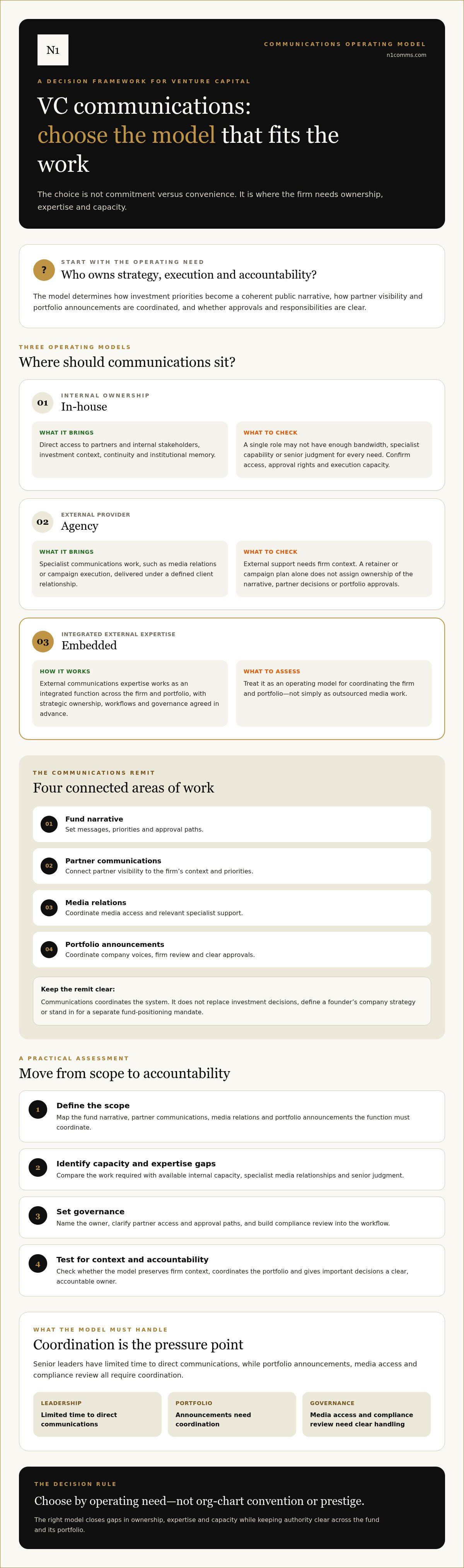
Who owns communications strategy, execution and institutional accountability? That is the decision behind in-house communications vs agency for VC. The choice determines how the firm turns investment priorities into a coherent public narrative, coordinates partner visibility and manages portfolio announcements, while keeping approvals and responsibilities clear.
The models differ in where responsibility sits:
In-house: An internal hire or team owns communications within the firm, with direct access to partners and internal stakeholders.
Agency: An external provider delivers agreed communications work, such as media relations or campaign execution, under a defined client relationship.
Embedded: External communications expertise works as an integrated function across the firm and portfolio, with strategic ownership, workflows and governance agreed in advance.
What does a VC communications function actually own?
Its remit can include the fund narrative, partner communications, media relations and portfolio announcements. These responsibilities connect, but they are not interchangeable. Strategic ownership sets messages, priorities and approval paths. Execution turns them into specific outputs, such as a partner profile or company announcement. The communications function coordinates that system. It doesn’t replace investment decisions, define a founder’s company strategy or stand in for a separate fund-positioning mandate.
Corporate communication spans internal and external stakeholder communication. In a VC firm, the fund and portfolio companies need distinct voices, while announcements involving the firm still require consistent review, clear approvals and accountable owners. Without those controls, activity can multiply while institutional coherence weakens.
Why the in-house-versus-agency choice is not purely about headcount
An internal communications lead may have close access to partners, investment context and decision-makers. That proximity supports institutional memory. It doesn’t automatically provide enough execution capacity, specialist media relationships or senior judgment for every communications need.
An agency may bring specialist execution and media access, but external support needs enough context to act well. A retainer or campaign plan alone doesn’t establish who owns the firm’s narrative, secures partner decisions or coordinates portfolio approvals. An internal title doesn’t guarantee that those responsibilities are covered either.
Prestige is a poor selection criterion. Define the operating requirement instead: how much internal access is needed, what work must be executed, how portfolio activity will be coordinated and who is accountable for approval. The right model is the one that closes those gaps while keeping authority clear.
What In-House VC Communications Delivers, and Where Capacity Can Plateau
An in-house communications lead sits close to the firm’s operating center. They can hear partners’ priorities as they shift, understand the context behind investment decisions and coordinate directly with internal stakeholders. That proximity can help communications reflect the firm’s actual direction, rather than relying on an external team to reconstruct it from periodic briefings.
Where internal ownership gives a VC firm greater control
Internal ownership supports continuity. One person can retain institutional knowledge about the fund’s narrative, partner preferences, approval pathways and previous portfolio announcements. They can connect those priorities to LP communications, partner visibility and the firm’s media activity. But proximity is not authority. The role needs access to decision-makers, defined approval rights and enough capacity to turn context into action.
Control also depends on specialist capability. The communications remit may require senior strategic judgment, media relations, English and Arabic content drafted natively, and a compliance workflow. An internal lead may coordinate these requirements, but the firm should establish which capabilities that person can execute and where support is needed. Build rules and review processes into the work, rather than adding them after materials are drafted.
When an internal team faces structural capacity limits
A single role can become a bottleneck if it owns strategy, daily execution and portfolio support at once. For example, a fund update may land alongside a partner announcement and a portfolio company milestone. Each has different stakeholders, timing and approval needs. If one person manages every deliverable, urgent execution can displace long-range planning and routine coordination.
Internal visibility is also different from specialist access. Knowing the firm’s context does not automatically establish journalist relationships or financial-sector judgment. Assess whether the internal function can maintain those capabilities while serving the firm and portfolio, including during busy periods. The PRSA’s perspective on finding the right fit offers a useful general comparison, but a VC firm should test the model against its own operating demands.
The practical question in in-house communications vs agency for VC is not whether internal ownership is better. It is whether the internal function has the authority, skills and execution capacity to maintain continuity across fund and portfolio needs. If you’re assessing a model designed to connect both, review NarrativeOne’s investment-firm communications approach.
VC Agency vs In-House vs Embedded Support: Compare the Operating Models
Each model places ownership and execution in a different part of the operating system. For a VC firm, the question is who keeps fund communications coherent while coordinating partner visibility and portfolio announcements without confusing the firm’s voice with a company’s own.
Operating factorIn-houseAgencyEmbeddedOwnershipInternal lead owns priorities and workflow.Firm sets the mandate; agency delivers agreed work.Shared operating function, with responsibilities and approvals defined across firm and portfolio.Senior accessDirect proximity to partners and internal stakeholders.Depends on the agency’s team structure and access to firm leadership.One senior strategist works across the communications remit.Execution capacityBounded by internal resources and available specialist skills.External execution capacity and specialist media relationships, shaped by scope.One journalist network supports work across the firm and portfolio.Portfolio coordinationInternal lead coordinates company requests and approvals.Coordination depends on the agreed mandate and company-level arrangements.One shared compliance workflow supports communications across the firm and portfolio companies.
In-house versus agency: the practical trade-offs
Internal teams typically hold more day-to-day institutional context. An agency can bring specialist execution and journalist relationships, but needs reliable access to decision-makers and clear direction. Neither model settles accountability on its own. Identify who sets priorities, coordinates a partner announcement with a portfolio milestone, owns approvals and resolves competing requests. Clear workflows make either structure more effective. Ambiguity turns internal access or external capacity into friction.
When an embedded VC communications model fits
Embedded support is designed as an integrated communications function, not a separate agency assigned to each portfolio company. One senior strategist, one journalist network and one shared compliance workflow serve the firm and portfolio. This structure can fit when the firm needs a consistent operating connection between its own narrative and portfolio communications, while retaining company-level context and approvals.
It also differs from project-by-project agency work. Rather than resetting context for each announcement, an embedded model can connect ongoing priorities with execution and review. Scope still matters: the mandate should state which communications the function owns, how partners and companies participate, and where final approval sits. In-house communications vs agency for VC has no universal winner. The fit depends on scope, governance and execution.
How to Choose a VC Communications Model for Your Fund’s Needs
Select a model based on the work the firm must own, not its headcount or assumptions about prestige. In-house communications vs agency for VC is an operating decision: map the workload, identify capability gaps, establish governance, then test whether the model serves both the fund and its portfolio.
Define the communications workload before choosing a model
Start with a practical inventory. Separate recurring responsibilities from event-driven work, and name an owner for each activity:
Recurring: Fund narrative, LP communications, partner thought leadership and planned media engagement.
Event-driven: Fundraise communications, portfolio announcements, company milestones and response to emerging issues.
Cross-cutting: Monitoring, bilingual content where needed, compliance review and coordination between the firm and portfolio companies.
Then distinguish strategic ownership from execution. The firm may retain decisions about its narrative and partner priorities while relying on specialist support for media relations or announcement execution. Clarify where internal owners need external expertise and where firm context must remain close to the decision-makers.
Test senior access, compliance and portfolio coordination
Before committing, establish who provides senior judgment, who can reach the relevant partners and who approves communications. Confirm how compliance rules enter the drafting and review sequence. In Narrative One’s workflow, compliance rules are embedded before the compliance director reviews drafts. Review belongs in the process, not as a last-minute checkpoint.
Test the model against a real workflow, such as coordinating a fund update alongside a portfolio company announcement. Can the communications owner reach decision-makers, align timing, preserve each organization’s distinct voice and route drafts through the right approvals? If the process works only for the fund or only for individual companies, the operating design is incomplete.
Firm size alone won’t answer these questions. A smaller firm with active portfolio communications may need more coordination capacity than its headcount suggests. A firm with a narrower remit may prefer internal ownership or defined external execution. Assess scope, workload peaks, senior access and governance together.
Finally, set a review point and assess whether the model delivers continuity, clear accountability and reliable execution. A 12-month narrative plan, executed weekly and reported monthly, is one way to make priorities and progress visible. If fund identity and positioning are part of the workload, explore fund positioning strategy as a related area of communications planning.
To assess a communications model against your fund’s requirements, review Narrative One’s investment-firm communications approach.
How an Embedded Communications Function Supports VC Firms and Portfolios
The choice between in-house communications vs agency for VC comes down to the operating connection a fund needs between its own communications and those of its portfolio. An embedded function fits when the firm needs shared strategic direction, specialist execution and consistent governance across both, without treating every announcement as a disconnected project.
What NarrativeOne’s investment-firm model includes
Narrative One supports investment firms through Strategy & narrative, Media relations and Bilingual content, alongside GP thought leadership, Events & speaking, Monitoring & crisis management and Portfolio announcement service. The model is built around one senior strategist, one journalist network and one shared compliance workflow serving the firm and portfolio companies.
That structure connects planning with execution. A 12-month narrative plan is executed weekly and reported monthly, helping the firm maintain priorities while responding to activity as it develops. English and Arabic content is drafted natively for senior financial journalists, not translated after drafting. Compliance rules are embedded before the compliance director reviews drafts, making governance part of the workflow rather than a final add-on.
This is not a separate portfolio agency for every company, nor simply external media work. It is a communications operating model intended to coordinate fund-level priorities with portfolio announcements while preserving clear review and approval responsibilities.
How to assess fit and start a focused conversation
Ask whether fund and portfolio communications genuinely require one integrated function. Consider the recurring coordination burden, the need for senior strategic access, and whether a shared journalist network and compliance process would simplify execution without weakening company-level context. If needs are limited to a specific campaign, a narrower engagement may be more appropriate. Fit depends on the mandate and governance, not a universal ranking of models.
One example of execution is Rasmal Ventures’ $45 M Series B announcement on Reuters, with coverage in 270+ media outlets. It illustrates a specific outcome, not a promise that another announcement will receive the same coverage.
If your firm is assessing whether an embedded model matches its communications requirements, discuss an investment-firm communications model. Bring the fund’s priorities, portfolio coordination needs and approval workflow into the conversation. Clarify the operating design before execution begins.
Build a Communications Model That Scales With the Fund
The right model for a VC firm assigns clear ownership, matches execution capacity to actual demand and connects fund communications with portfolio needs. In-house communications vs agency for VC is not a choice between control and expertise. It is a decision about how to combine them with accountable governance.
Narrative One brings 17 years of operating experience inside recognised investment institutions and $2 B+ AUM across 150+ funds and clients. Its work includes Rasmal Ventures’ $45 M Series B announcement on Reuters, with coverage in 270+ media outlets. That is a documented example, not a promise of equivalent results.
If your firm is assessing how communications strategy, execution and portfolio coordination should work together, discuss an investment-firm communications model. Define the operating need first, then build a structure to meet it with clarity and discipline.
Frequently Asked Questions
Should a VC firm hire an in-house communications lead or use an agency?
Choose based on the work that needs ownership, not a default preference for internal or external support. In-house communications vs agency for VC means weighing institutional access and continuity against specialist execution and media relationships. Map recurring fund and partner communications, portfolio announcements, approval requirements and expected workload. If internal ownership is essential but execution capacity is limited, define which responsibilities an external partner should handle and who remains accountable.
What does an agency provide that an in-house VC communications team may not?
An agency can add specialist media relations, journalist networks and execution capacity that may be difficult to sustain internally. Depending on its expertise and agreed scope, it may also support bilingual content drafted natively in English and Arabic, partner visibility or portfolio announcements. These capabilities aren’t automatic. Ask who will do the work, how much senior attention is involved, and how the agency will learn and retain the firm’s context.
Can one communications function support both a VC fund and its portfolio companies?
Yes, if responsibilities and approval rights are clear. A shared function can align fund-level priorities with portfolio announcements while respecting each company’s context and decision-makers. The operating model should specify who sets priorities, coordinates timing, reviews drafts and approves external communications. A shared workflow can create consistency without making every company sound alike or removing its authority over its own announcements.
When does a hybrid or embedded communications model make sense for a VC?
A hybrid or embedded model can fit when the firm needs internal context and external specialist execution, especially across recurring fund communications and portfolio activity. An embedded function goes beyond isolated campaign assignments by connecting planning, execution and review across the firm and portfolio. Assess whether there is a defined senior owner, a clear scope of work and a governance process that preserves firm accountability while giving portfolio companies appropriate input.
How should a VC firm evaluate an agency’s media relationships and senior involvement?
Ask which senior practitioner will guide the work and who will handle day-to-day execution. Request relevant examples of media engagement, how journalist relationships are maintained and how outlets are selected for a particular announcement. Confirm how often senior decision-makers will engage, what information the agency needs from partners, and how progress will be reported. The proposal should identify accountable people and a working process, not rely on broad claims of access.
How can a VC communications partner support portfolio announcements?
A communications partner can help clarify the announcement’s core message, coordinate timing with the fund and company, prepare materials, manage media relations and route drafts through agreed review. The portfolio company should retain appropriate control over its facts, approvals and voice. Define responsibilities early, including who supplies information, who reviews the draft and who authorizes distribution. This makes the process more coordinated without implying guaranteed coverage or outcomes.
What should be included in a VC communications strategy?
A VC communications strategy should set the fund narrative, priority audiences, partner communications, LP communications, media priorities and approach to portfolio announcements. It should distinguish ongoing narrative work from individual milestones and define owners, approval steps and how activity will be reviewed. Include the relationship between fund and portfolio messaging while preserving each company’s distinct voice. The strategy should guide execution and governance, not serve as a list of disconnected publicity tasks.
Frequently Asked Questions
What does a VC communications function actually own?
Its remit can include the fund narrative, partner communications, media relations and portfolio announcements. These responsibilities connect, but they are not interchangeable. Strategic ownership sets messages, priorities and approval paths. Execution turns them into specific outputs, such as a partner profile or company announcement. The communications function coordinates that system. It doesn’t replace investment decisions, define a founder’s company strategy or stand in for a separate fund-positioning mandate. Corporate communication spans internal and external stakeholder communication. In a VC firm, the fund and portfolio companies need distinct voices, while announcements involving the firm still require consistent review, clear approvals and accountable owners. Without those controls, activity can multiply while institutional coherence weakens.
Should a VC firm hire an in-house communications lead or use an agency?
Choose based on the work that needs ownership, not a default preference for internal or external support. In-house communications vs agency for VC means weighing institutional access and continuity against specialist execution and media relationships. Map recurring fund and partner communications, portfolio announcements, approval requirements and expected workload. If internal ownership is essential but execution capacity is limited, define which responsibilities an external partner should handle and who remains accountable.
What does an agency provide that an in-house VC communications team may not?
An agency can add specialist media relations, journalist networks and execution capacity that may be difficult to sustain internally. Depending on its expertise and agreed scope, it may also support bilingual content drafted natively in English and Arabic, partner visibility or portfolio announcements. These capabilities aren’t automatic. Ask who will do the work, how much senior attention is involved, and how the agency will learn and retain the firm’s context.
Can one communications function support both a VC fund and its portfolio companies?
Yes, if responsibilities and approval rights are clear. A shared function can align fund-level priorities with portfolio announcements while respecting each company’s context and decision-makers. The operating model should specify who sets priorities, coordinates timing, reviews drafts and approves external communications. A shared workflow can create consistency without making every company sound alike or removing its authority over its own announcements.
When does a hybrid or embedded communications model make sense for a VC?
A hybrid or embedded model can fit when the firm needs internal context and external specialist execution, especially across recurring fund communications and portfolio activity. An embedded function goes beyond isolated campaign assignments by connecting planning, execution and review across the firm and portfolio. Assess whether there is a defined senior owner, a clear scope of work and a governance process that preserves firm accountability while giving portfolio companies appropriate input.
How should a VC firm evaluate an agency’s media relationships and senior involvement?
Ask which senior practitioner will guide the work and who will handle day-to-day execution. Request relevant examples of media engagement, how journalist relationships are maintained and how outlets are selected for a particular announcement. Confirm how often senior decision-makers will engage, what information the agency needs from partners, and how progress will be reported. The proposal should identify accountable people and a working process, not rely on broad claims of access.
How can a VC communications partner support portfolio announcements?
A communications partner can help clarify the announcement’s core message, coordinate timing with the fund and company, prepare materials, manage media relations and route drafts through agreed review. The portfolio company should retain appropriate control over its facts, approvals and voice. Define responsibilities early, including who supplies information, who reviews the draft and who authorizes distribution. This makes the process more coordinated without implying guaranteed coverage or outcomes.
What should be included in a VC communications strategy?
A VC communications strategy should set the fund narrative, priority audiences, partner communications, LP communications, media priorities and approach to portfolio announcements. It should distinguish ongoing narrative work from individual milestones and define owners, approval steps and how activity will be reviewed. Include the relationship between fund and portfolio messaging while preserving each company’s distinct voice. The strategy should guide execution and governance, not serve as a list of disconnected publicity tasks.