
Institutional coverage is not won by sending more pitches. It is earned when a firm’s story has material relevance, verifiable evidence and disciplined timing. For investment leaders, the question is not simply how to get institutional media coverage, but whether an announcement can withstand scrutiny from journalists, investors and compliance reviewers. A weak angle or poorly governed disclosure can undermine credibility before a story reaches its audience.
Visibility without institutional relevance creates noise, not positioning. This guide shows how to identify the news in an investment firm’s story, assemble evidence and prepare claims for review before outreach begins. It also sets out a practical process for selecting outlets, coordinating timing and measuring whether coverage supports fund positioning and long-term credibility. That distinction matters when media activity must align with LP communications and compliance review. The standard is not volume. It is a narrative the market can assess and trust.
Key Takeaways
Assess whether a story offers material insight for professional market participants, rather than treating every firm update as news.
To understand how to get institutional media coverage, build a narrative around the fund’s thesis, activity and verifiable evidence.
Prioritize journalists whose coverage aligns with the story’s subject. Broad pitch volume cannot substitute for editorial fit.
Embed compliance rules before the compliance director reviews drafts, then coordinate the release, outreach and follow-through.
Turn individual placements into a governed capability with a 12-month narrative plan, weekly execution and monthly reporting.
Table of Contents
What Institutional Media Coverage Means for an Investment Firm
Target Institutional Media by Editorial Fit, Not Pitch Volume
Execute a Compliant Media Plan from Preparation to Follow-Through
Make Institutional Coverage a Repeatable Communications Capability
What Institutional Media Coverage Means for an Investment Firm
Institutional media coverage is editorial attention earned for a development that matters to professional market participants. It is not the same as general brand awareness. The distinction comes down to audience and information value: coverage should help readers understand a fund, its strategy, its activity or a material change in the market.
For an investment firm, a story needs substance beyond the firm’s wish to be seen. A fund launch, investment, mandate or leadership perspective can provide an entry point, but the editorial question is whether it offers evidence or context readers can use. An outlet’s reputation alone does not establish strategic value. A prominent placement before an audience with little connection to the firm’s objective may matter less than coverage in a publication whose readers follow that investment activity.
Separate editorial coverage from other communications channels:
Earned editorial coverage is produced through an independent editorial decision. The firm can provide information and make its case, but it cannot control whether or how a journalist publishes it.
Paid placement is purchased visibility. It may serve a different communications purpose, but it is not independent editorial coverage.
Wire distribution circulates a release through a distribution service. Distribution can make information available, but it does not mean a journalist has selected the story for coverage.
Owned communications, such as a firm’s website or investor materials, are published through channels the firm controls.
These channels can support a communications plan, but they are not interchangeable. This overview of media relations offers a useful frame for the discipline: provide relevant information and engage with media without treating publication as a guaranteed deliverable.
Which audiences make coverage institutional?
Potential audiences include limited partners, co-investors, counterparties and senior market participants. Their relevance depends on the fund’s strategy, current activity and communication objective. A story about a portfolio investment may matter to one group; a fund strategy or market perspective may be more relevant to another.
Start by identifying who needs to understand the development and why. Institutional coverage is designed to inform market participants, not maximize broad consumer attention. Reach without audience fit is a weak proxy for value.
What makes an investment story editorially relevant?
Editorial relevance starts with a consequential development, not a request for exposure. Evidence supports the claim, context explains why it matters, timing gives the development meaning, and a prepared spokesperson can address the subject with authority.
A pitch connects those elements and explains the story’s significance. It cannot dictate an editorial decision. The disciplined approach to how to get institutional media coverage is to make the case clearly, substantiate it and leave the decision with the newsroom.
Build an Investment-Firm Narrative Journalists Can Assess
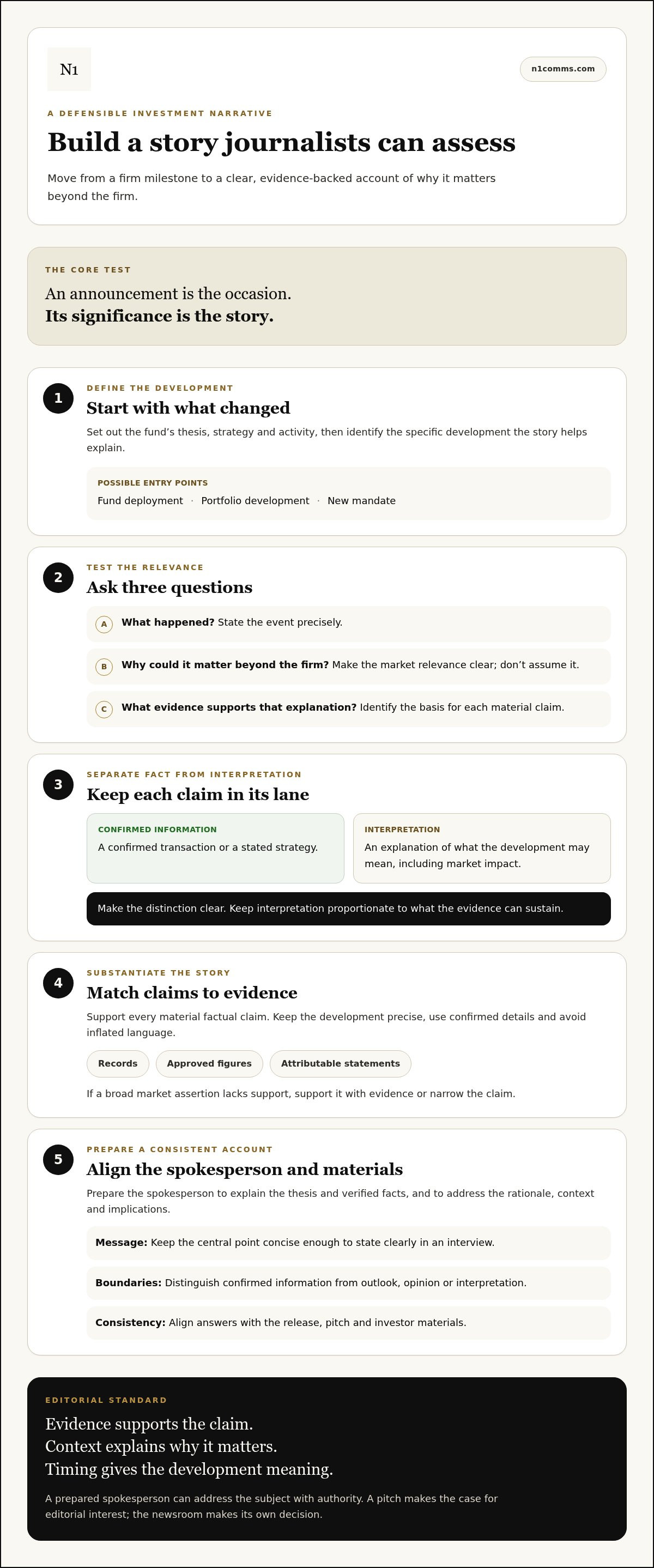
A credible investment-firm narrative begins with the fund, not the headline. Define the investment thesis, strategy and activity, then identify the specific change the story helps explain. That change might involve fund deployment, a portfolio development or a new mandate. The announcement is the occasion; its significance is the story.
Next, distinguish what can be verified from what the firm believes it means. A confirmed transaction or stated strategy is different from an interpretation about market impact. Make that distinction clear. Support every material factual claim with evidence, and keep interpretations proportionate to what the evidence can sustain.
Institutional coverage depends on a narrative that is evidentially sound and consistent wherever the story appears.
Turn a fund milestone into a defensible story
Before drafting, test the milestone against three questions: What happened? Why could it matter beyond the firm? What evidence supports that explanation? A fundraise, mandate or portfolio event may be important to the firm without automatically becoming news for a broader market. Make the relevance clear rather than assuming it.
Development: State the event precisely, using confirmed details and no inflated language.
Significance: Explain the connection to the fund’s thesis or activity, and distinguish interpretation from fact.
Support: Identify the records, approved figures or attributable statements that substantiate each claim.
This structure keeps the story useful under scrutiny. If its significance depends on a broad market assertion, support that assertion with evidence or narrow the claim. A pitch can make a case for editorial interest, but it cannot guarantee it.
Prepare the spokesperson and supporting material
The spokesperson should be able to explain the fund thesis and the announcement’s verified facts without drifting into claims the materials cannot support. Prepare concise answers on the rationale, context and implications. Align those answers with the release, pitch and investor materials so each channel reinforces the same core account.
Keep the central message short enough to state clearly in an interview.
Separate confirmed information from outlook, opinion or interpretation.
Anticipate questions that test assumptions, definitions and the basis for claims.
Use one controlled source of approved facts to keep versions aligned. For bilingual communications, draft natively in English and Arabic so the core meaning and evidence are consistent in both versions. Embed compliance rules before the compliance director reviews drafts. Review is more effective when claims have already been structured for scrutiny.
A focused institutional fund narrative connects strategy, evidence and spokesperson readiness. That discipline is central to how to get institutional media coverage without letting an announcement outrun the facts. Firms strengthening their fund positioning can build the narrative architecture before the next milestone arrives.
Target Institutional Media by Editorial Fit, Not Pitch Volume
A distribution list is not a media strategy. For an investment firm, targeting starts with the story’s subject, then tests whether an outlet’s audience and a journalist’s beat make the story useful. A funding announcement, portfolio development and fund strategy analysis may each need a different editorial route. Sending the same pitch to every contact ignores those differences and can weaken the message’s relevance.
Broad distribution and beat-specific outreach serve different functions. Distribution can make a release available across many channels, but availability is not editorial attention. Targeted outreach puts the story before journalists whose coverage areas align with it. That takes more research and may reach fewer contacts, but gives the pitch a clear reason to exist. Neither approach guarantees coverage.
Broad distribution: Fit is wide but less tailored. It can provide consistent circulation of an approved announcement, but circulation does not establish a journalist’s interest or audience relevance.
Beat-specific outreach: Fit is assessed against the outlet’s remit, the journalist’s coverage and the story’s subject. It supports a more tailored pitch, but requires research and preparation and does not assure publication.
Use four checks to assess each target: approach, how the story reaches the journalist; fit, whether the journalist covers this subject; strength, what the outlet contributes to the communication objective; and limitation, what the channel cannot deliver. This comparison keeps prestige from taking the place of relevance.
Match the story to the right journalist and outlet
Build the list from the angle outward. For a portfolio development, identify journalists who cover that sector or type of transaction. For a fund strategy story, look for coverage of investment strategy or capital markets. Then assess the outlet’s audience and editorial remit against the communication objective. A journalist relationship can inform how to approach a story, but it is context, not a promise of placement.
Record the fit in practical terms: the journalist’s relevant coverage, the audience the outlet serves and why this specific development belongs in that conversation. Remove contacts whose beat only loosely overlaps. A short, defensible list is stronger than an indiscriminate pitch roster.
Make the pitch useful to an editor
Lead with the development, the evidence supporting it and why it matters now. Avoid opening with a generic firm biography or unsubstantiated claims of leadership. Include a prepared spokesperson and the facts supporting the proposed angle, so the journalist can quickly assess both the story and the available source.
This is the operational answer to how to get institutional media coverage: make each approach specific enough to be useful, accurate enough to withstand scrutiny and disciplined enough to protect the news window. Pitch volume is easy to count. Editorial fit is the more meaningful control.
Execute a Compliant Media Plan from Preparation to Follow-Through
A media plan should control the work, not manufacture certainty. For an investment-firm announcement, set a sequence for preparation, review, release, outreach and monitoring before the news window opens. Tier-1 coverage is achievable within 14 days, but no timeline guarantees an editorial decision for every announcement. Readiness improves execution; it does not override newsroom judgment.
Use a governed announcement sequence
Use the 14-day sequence to coordinate preparation and review. Each milestone should keep the narrative, evidence, approvals and outreach aligned without treating the calendar as a promise of publication.
T-14: Begin the preparation sequence and establish the announcement’s working plan.
T-10: Continue preparation and review against the planned release.
T-5: Advance the review process and maintain alignment across announcement materials.
T-2: Complete the final preparation and review milestone before release.
Day 0: Issue the release and conduct planned media outreach.
+7: Monitor coverage and follow through after release.
The timeline provides structure, not a shortcut around readiness. A delay in review or a change to the announcement may affect the sequence. Keep the approved version clear, and coordinate outreach with the release rather than allowing multiple versions to circulate without control.
For bilingual announcements, prepare English and Arabic content natively so both versions can be released on the same day. The goal is aligned meaning and timing, not a translation produced after the original draft. This helps keep the announcement coherent across audiences and channels.
Build compliance into the communications workflow
Compliance belongs in the drafting process, not as a final filter applied after the story is fixed. Embed the relevant rules before the compliance director reviews drafts. The workflow includes FSRA, ADGM, DIFC, SAMA and CMA rules. This gives the reviewer a defined narrative and evidence base to assess, rather than asking them to repair avoidable issues at the end.
Maintain a controlled version of the release and supporting materials throughout review. Changes to a material claim should be reflected consistently across the release, pitch and spokesperson materials. This is communications governance in practice: clear ownership, consistent content and review built into the process. A structured approach also supports Communications Infrastructure for Funds: Build a System That Compounds, where communications operate as a repeatable capability rather than an isolated announcement.
For firms planning how to get institutional media coverage, the sequence is clear: prepare deliberately, embed compliance before review, coordinate release and outreach, then monitor the result. The governed media plan for an investment firm connects narrative preparation with coordinated outreach and follow-through.
Make Institutional Coverage a Repeatable Communications Capability
A single placement is an output. Durable credibility comes from a governed pattern of communication that gives the market a coherent view of the firm over time. One announcement cannot carry the full burden of fund positioning, investor confidence and institutional reputation. The work is cumulative: each story should reinforce an accurate account of the firm’s strategy and activity.
NarrativeOne structures this work through a 12-month narrative plan, executed weekly and reported monthly. The operating model is integrated: one senior strategist, one journalist network and one shared compliance workflow across the firm and its portfolio. This creates continuity between planned announcements, ongoing media engagement and review. It is a system for disciplined execution, not a promise of coverage.
Measure coverage against the communication objective
Measurement should distinguish activity from outcomes. A release issued or a pitch sent records work completed. Relevant mentions and share of voice help assess whether the firm appears in conversations that matter to its positioning. Interpret either measure in context: the outlet, audience, story angle and objective all affect what a result means.
NarrativeOne reports $50 M+ earned media value across 200+ mentions. It also reports $1 B+ total earned media value for clients as an aggregate. These are reported outcomes, not forecasts, guarantees or universal benchmarks. They do not establish what another firm will achieve. For a specific programme, reporting should connect coverage to the stated communication objective rather than treating every mention as equally valuable.
A useful monthly review asks whether coverage reached relevant audiences, reflected the intended positioning and informed the next communications decision. This turns reporting into an operating feedback loop, not a retrospective list of links.
Apply the framework to an investment-firm programme
One example is Rasmal Ventures’ $45 M Series B announcement, which appeared on Reuters with headline placement and received coverage in 270+ media outlets, supported by a bilingual release. These figures describe a specific outcome, not a typical result or a forecast for future announcements. The example shows how a defined fund milestone can connect to a prepared narrative and coordinated media execution.
NarrativeOne provides Strategy & narrative and Media relations for investment firms. The related resource, Fundraise Communications Strategy for Investment Firms, addresses the positioning work that supports a fundraise story. More broadly, how to get institutional media coverage comes down to relevance, evidence, audience fit and a repeatable process that does not overstate what any single placement proves.
Learn more about NarrativeOne’s approach to institutional media relations.
Make Your Next Media Decision Deliberate
The next step is not to pitch more widely. Decide what the market needs to understand about your firm, then build communications that can support that position over time. That is the practical answer to how to get institutional media coverage: make each story evidence-led, relevant to its intended audience and governed before it reaches the press.
NarrativeOne brings 17 years of operating experience inside investment institutions. Its founder was named among Forbes Middle East’s Most Influential CMOs, 2026. These credentials reflect experience in the communications environment investment firms operate within, not a guarantee of editorial outcomes.
Use your next announcement as a test of readiness. Is the story material to institutional audiences? Can every claim withstand scrutiny? Do the narrative, spokesperson and review process align? Clear answers create a stronger foundation for media relations and long-term credibility.
Explore NarrativeOne’s institutional media relations approach to see how a disciplined communications capability can support your firm’s positioning. The next story can begin with a stronger system behind it.
Frequently Asked Questions
What qualifies as institutional media coverage?
Institutional media coverage is independent editorial reporting that reaches professional market participants and addresses a development relevant to their decisions or understanding. A story about a fund’s strategy, a portfolio company or an investment milestone may qualify if it serves that audience. A firm’s own website post or a paid article can support communications, but neither represents independent editorial judgment.
Can an investment firm guarantee Tier-1 media coverage?
No. An investment firm can prepare a strong, well-supported story and approach relevant journalists, but the newsroom controls whether it publishes and how it frames the story. No placement should be treated as certain. A sound plan sets objectives around preparation, outreach and follow-through, then evaluates the result without presenting editorial decisions as a deliverable the firm can guarantee.
How should an investment firm prepare a spokesperson for media outreach?
Prepare the spokesperson to explain the announcement in plain, precise terms and distinguish confirmed facts from forecasts or opinion. Rehearse likely questions about the investment rationale, decision process and implications for the fund or portfolio. Agree on which topics the spokesperson can address and where a response requires further review. This keeps interviews useful without improvising beyond approved information.
Is a press release enough to secure institutional coverage?
No. A release can serve as the authoritative record of an announcement, but it cannot make the story relevant to a specific editor by itself. Pair it with a tailored pitch that identifies the news angle and why it matters to that journalist’s audience. Keep supporting material consistent with the release, and make a knowledgeable spokesperson available to add context.
Does an investment announcement need an event to attract media attention?
No. An event is one possible communications format, not a prerequisite for editorial interest. The announcement should have a clear reason to matter even without a stage, panel or launch gathering. Consider an event when participation or discussion adds substantive context; otherwise, a direct announcement and prepared spokesperson may communicate the development more clearly. The format should serve the story, not substitute for one.
What should an investment firm measure after media outreach?
Measure results against the objective set before outreach. Track which outlets covered the story, whether the intended facts and positioning appeared accurately, and whether relevant audiences engaged with the coverage through appropriate firm channels. Record corrections or material omissions as well. These observations help distinguish a placement from useful communication and inform what to adjust in the next programme. That discipline is central to how to get institutional media coverage over time.
Frequently Asked Questions
Which audiences make coverage institutional?
Potential audiences include limited partners, co-investors, counterparties and senior market participants. Their relevance depends on the fund’s strategy, current activity and communication objective. A story about a portfolio investment may matter to one group; a fund strategy or market perspective may be more relevant to another. Start by identifying who needs to understand the development and why. Institutional coverage is designed to inform market participants, not maximize broad consumer attention. Reach without audience fit is a weak proxy for value.
What makes an investment story editorially relevant?
Editorial relevance starts with a consequential development, not a request for exposure. Evidence supports the claim, context explains why it matters, timing gives the development meaning, and a prepared spokesperson can address the subject with authority. A pitch connects those elements and explains the story’s significance. It cannot dictate an editorial decision. The disciplined approach to how to get institutional media coverage is to make the case clearly, substantiate it and leave the decision with the newsroom. A credible investment-firm narrative begins with the fund, not the headline. Define the investment thesis, strategy and activity, then identify the specific change the story helps explain. That change might involve fund deployment, a portfolio development or a new mandate. The announcement is the occasion; its significance is the story. Next, distinguish what can be verified from what the firm believes it means. A confirmed transaction or stated strategy is different from an interpretation about market impact. Make that distinction clear. Support every material factual claim with evidence, and keep interpretations proportionate to what the evidence can sustain. Institutional coverage depends on a narrative that is evidentially sound and consistent wherever the story appears.
What qualifies as institutional media coverage?
Institutional media coverage is independent editorial reporting that reaches professional market participants and addresses a development relevant to their decisions or understanding. A story about a fund’s strategy, a portfolio company or an investment milestone may qualify if it serves that audience. A firm’s own website post or a paid article can support communications, but neither represents independent editorial judgment.
Can an investment firm guarantee Tier-1 media coverage?
No. An investment firm can prepare a strong, well-supported story and approach relevant journalists, but the newsroom controls whether it publishes and how it frames the story. No placement should be treated as certain. A sound plan sets objectives around preparation, outreach and follow-through, then evaluates the result without presenting editorial decisions as a deliverable the firm can guarantee.
How should an investment firm prepare a spokesperson for media outreach?
Prepare the spokesperson to explain the announcement in plain, precise terms and distinguish confirmed facts from forecasts or opinion. Rehearse likely questions about the investment rationale, decision process and implications for the fund or portfolio. Agree on which topics the spokesperson can address and where a response requires further review. This keeps interviews useful without improvising beyond approved information.
Is a press release enough to secure institutional coverage?
No. A release can serve as the authoritative record of an announcement, but it cannot make the story relevant to a specific editor by itself. Pair it with a tailored pitch that identifies the news angle and why it matters to that journalist’s audience. Keep supporting material consistent with the release, and make a knowledgeable spokesperson available to add context.
Does an investment announcement need an event to attract media attention?
No. An event is one possible communications format, not a prerequisite for editorial interest. The announcement should have a clear reason to matter even without a stage, panel or launch gathering. Consider an event when participation or discussion adds substantive context; otherwise, a direct announcement and prepared spokesperson may communicate the development more clearly. The format should serve the story, not substitute for one.
What should an investment firm measure after media outreach?
Measure results against the objective set before outreach. Track which outlets covered the story, whether the intended facts and positioning appeared accurately, and whether relevant audiences engaged with the coverage through appropriate firm channels. Record corrections or material omissions as well. These observations help distinguish a placement from useful communication and inform what to adjust in the next programme. That discipline is central to how to get institutional media coverage over time.