
Market entry is not just a communications exercise. It is a decision about where to compete, how to reach buyers, and what it will take to earn their trust. A market entry messaging strategy should be grounded in evidence about demand, buyer behavior, competitors, and local expectations. Validate the opportunity, choose an operating approach, then adapt the offer and its message to the market.
Expansion takes more than translating existing copy or repeating a successful launch elsewhere. Assumptions about buyers, purchasing roles, competitive alternatives, and proof may not hold in a new market.
This article explains how to assess a potential market, shape messaging around buyer needs, and avoid cross-border communication errors. It also shows how to prepare consistent, credible communications before entry, so leaders can make a disciplined decision instead of mistaking visibility for traction.
Key Takeaways
Assess demand, competitive positioning, operational fit, and risk before committing resources to a new market.
Build buyer personas around local purchasing roles, pain points, decision processes, and preferred content.
Adapt language and claims to local expectations; translation alone won’t resolve cultural or compliance mismatches.
Align leadership, sales, and public communications around consistent evidence and a clear market narrative.
Define market entry as a broader operating decision, then connect communications to the chosen route to market.
Table of Contents
1. How do you enter a new potential market?
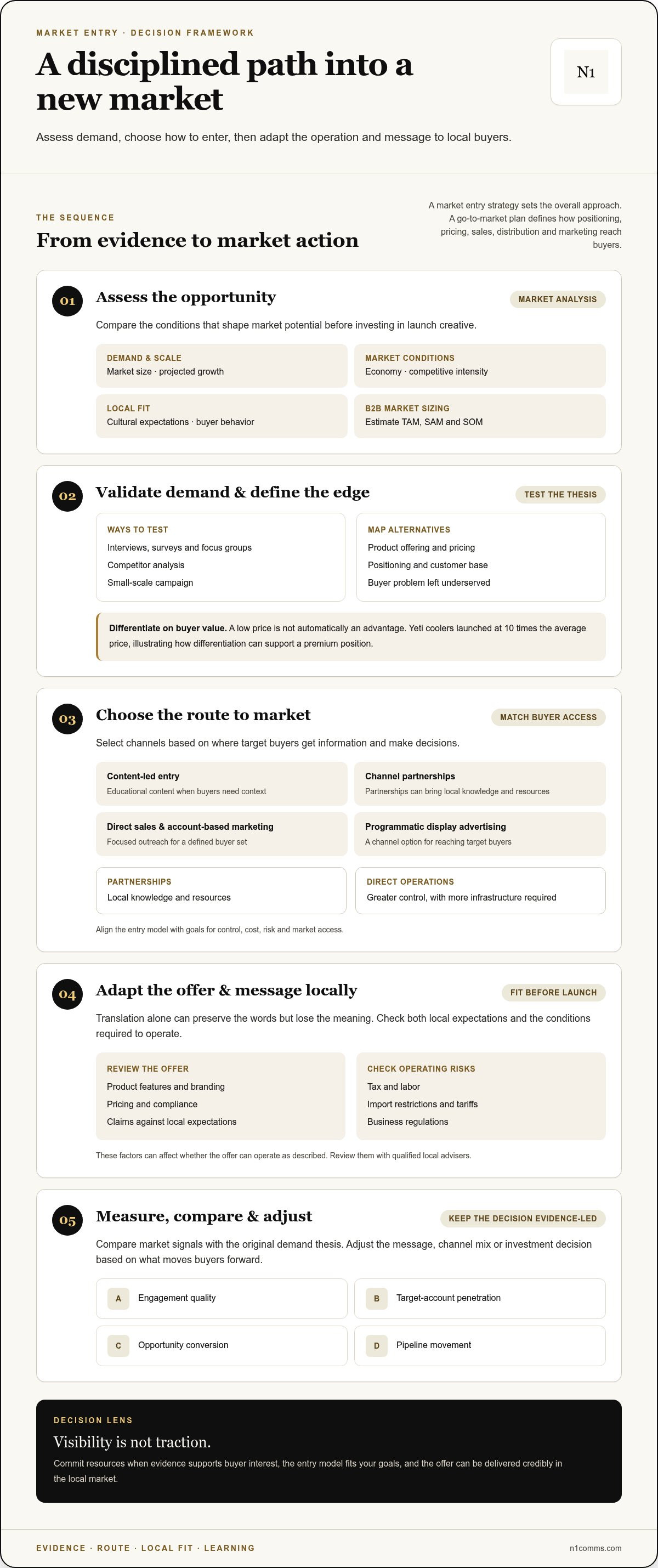
Enter a potential market through a deliberate sequence: assess demand, select an entry model, then adapt operations and messaging. Market entry means introducing products, services, or business operations into an untapped geography, customer segment, or industry vertical. A market entry strategy defines the overall approach; a go-to-market plan details how positioning, pricing, sales, distribution, and marketing will reach buyers.
Start with market analysis, not launch creative. Compare market size, projected growth, economic conditions, competitive intensity, cultural fit, and regulatory barriers. B2B teams should estimate total addressable market, serviceable available market, and serviceable obtainable market. Then test demand through interviews, surveys, focus groups, competitor analysis, or a small-scale campaign. Validation reduces the risk of committing substantial resources before buyer interest is demonstrated.
Map competitors by product offering, pricing, positioning, and customer base. Identify which buyer problem remains underserved, then state why your offer is a credible alternative. A low price is not automatically an advantage. Yeti coolers launched at 10 times the average price, showing how a differentiated position can support a premium rather than compete on cost alone. The distinction must connect to buyer value, not merely internal preference.
Choose launch channels by where target buyers consume information and make decisions. B2B options include content-led entry, channel partnerships, direct sales, account-based marketing, and programmatic display advertising. Match the tactic to the sales model: use focused account outreach for a defined buyer set, or educational content when buyers need context before engaging. Digital campaigns can also test demand and reveal buying behavior before a larger commitment.
Assess cultural, legal, and competitive risks before setting claims or launch timing. Local expectations shape communication and purchasing behavior, so direct translation can preserve the words but lose the meaning. Review product features, branding, pricing, and compliance against local and industry standards. Examine tax, labor, import restrictions, tariffs, and business regulations with qualified local advisers, since these factors affect whether the offer can operate as described.
Test your competitive advantage against local alternatives. Compare how buyers value your performance, service model, expertise, distribution, or proof. A market entry messaging strategy should express that advantage in terms buyers recognize and support it with evidence. If local competitors already own the category language, define a sharper use case or buyer segment rather than repeating their claims.
Align the entry model with your goals for control, cost, risk, and market access. Partnerships can bring local knowledge and resources; direct operations offer greater control but require more infrastructure. Set launch measures around engagement quality, target-account penetration, opportunity conversion, and pipeline movement. Compare those signals with the original demand thesis, then adjust the message, channel mix, or investment decision.
2. Go-to-market messaging tailored to buyer personas and pain points
Define target segments by industry, company scale, use case, purchasing role, and urgency. Then compare each segment’s unmet need with your product’s strongest evidence. For a U.S. B2B launch, separate the executive sponsor focused on business outcomes from technical evaluators focused on integration and security. Position the offer around the problem each role must resolve, not a broad claim that could fit any audience.
Refine your ideal customer profile using local buyer evidence rather than assumptions imported from an existing market. Interviews, surveys, and focus groups can reveal differences in priorities, terminology, and purchasing processes. A useful persona captures purchasing responsibilities, pain points, objections, preferred content, sales-cycle dynamics, and technology context. A finance leader, for example, may need a credible business case, while an operations lead needs confidence that the solution fits current workflows.
Structure messages around the questions buyers ask before committing: What changes for my team? What evidence supports the claim? What implementation demands follow? Who carries the risk? Answer each with a specific proof point, clear qualification, or relevant example. U.S. buyers evaluating enterprise software, for instance, may need a concise value case for leadership and technical detail for implementation teams. Address objections directly; vague superlatives create more friction than confidence.
Language is part of audience relevance, not a finishing touch. In a 2014 CSA Research survey of more than 3,000 consumers across 10 non-English-speaking countries, 75% preferred buying in their own language, while 60% rarely or never bought from English-only websites. The figures reinforce a practical step: adapt terminology, examples, and calls to action for the market and buyer, rather than translating existing copy word for word.
A useful example is Coca-Cola’s Share a Coke campaign. In Australia, the 2011 pilot used the country’s 150 most popular names and sold more than 250 million named bottles and cans during that summer; Coca-Cola later expanded the campaign to more than 70 countries. The transferable lesson is disciplined localization: retain a recognizable core idea, then adapt its execution to local audience cues.
Measure effectiveness by connecting message exposure to commercial movement. Track engagement quality, target-account penetration, content consumption, buyer intent, conversion to opportunities, pipeline velocity, and MQL-to-SQL conversion. Compare results by segment and channel, then revise the message where attention fails to progress into qualified conversations. For teams formalizing that narrative across markets, Market Entry Messaging in English and Arabic can align positioning with local buyer context.
3. Common cross-border messaging mistakes
Cross-border messaging fails when teams treat a new country as a translation task. The deeper mistake is carrying over assumptions about humor, proof, status, urgency, or trust. A phrase that sounds confident at home may seem boastful elsewhere. A benefit that resonates with buyers in one market may miss the priority driving decisions in another. Before launch, review every claim, example, and call to action against local buyer expectations.
Research local language, cultural cues, and applicable rules before publishing brand messaging. Ask native-language reviewers to assess meaning and tone, and have qualified local advisers review regulated claims and market-specific requirements. Replace idioms with direct language, for example, and support environmental or performance claims with evidence that applies to the market.
Keurig’s experience in Canada shows the exposure created by unsupported claims. In 2022, Keurig faced a CAD $3m penalty over claims that its pods were recyclable where local programs did not accept them. The operational lesson is precise: substantiate each claim in the places where buyers will encounter it. A statement can be technically familiar to headquarters and still mislead local customers.
Another common mistake is treating translation as localization. Translation transfers words; localization tests whether the message fits local decision-making. Review preferred terminology, formality, purchasing concerns, and expected evidence. A software company, for instance, should test whether a translated term describes a workflow buyers actually recognize. Local interviews can reveal wording that sounds correct but obscures the offer.
Teams also create risk when they adapt claims inconsistently across channels. A website may describe a product as low-risk while a sales deck implies a guaranteed outcome. Build a shared claim register with approved wording, evidence, market scope, and accountable owners. Before release, compare website copy, sales materials, product pages, and launch announcements. Consistency is governance, not cosmetic polish.
Centralized messaging can create the opposite problem: every market gets the same examples and proof. Keep the core positioning stable, but adapt supporting evidence to local buyer priorities. A case study from another region may demonstrate technical capability without proving local relevance. Pair it with market-specific use cases, partner context, or customer language gathered through research.
Avoid launching before internal teams can explain the offer consistently. Sales teams, executives, and customer-facing staff need the same approved narrative and clear boundaries for claims. Before launch, review the message for comprehension, cultural risks, supporting evidence, and consistency across channels. That discipline protects expansion opportunities and revenue from preventable credibility failures.
Credibility signals and communications preparedness
Credibility depends on alignment between the proposition, evidence, and delivery. Before market launch, establish a communications framework that defines the product or service, the buyer problem it addresses, the proof behind each claim, and who is authorized to speak. A growth-stage company, for example, should link its expansion narrative to operational evidence, not ambition alone.
Inconsistency creates a measurable trust problem. Gartner research found that 69% of B2B buyers report inconsistencies between company website information and what sellers tell them. Compare sales decks, executive talking points, product pages, and customer materials before launch. If each asset describes a different outcome, buyers must reconcile the gap themselves.
Consistency matters across touchpoints, not just within a single channel. Storyblok consumer research found that 87% of respondents say brand consistency matters between touchpoints, while 73% are less likely to buy from a brand that feels inconsistent. Build one approved message architecture, then adapt its examples and language without changing the underlying claims.
The evidence should match the strength of the proposition. A product demonstration can support a capability claim; a customer case can illustrate a realized outcome; a forecast needs clear qualification. Create a claim-to-proof matrix recording the wording, supporting evidence, relevant market, and accountable owner. It gives communications and sales teams a shared basis for credible answers.
TOMS reports giving more than $200 million through grants and shoe donations since 2006. The example shows how a specific record can make a purpose statement more concrete. For any organization, distinguish verified results from commitments and plans. Buyers assess not only what a brand says, but whether its evidence supports the scale and certainty of its language.
Prepare internal stakeholders before external announcements. Employees, investors, and board members may all need support during market entry, but the information should suit each group’s role. Give leaders the strategic rationale, equip sales teams with buyer-facing proof, and provide employees with a consistent explanation of the change. A shared brief helps prevent competing narratives.
Communications preparedness also requires a clear escalation structure. Assign owners to review claims, respond to media inquiries, and correct inaccurate information. A product launch involving a disputed performance claim, for example, needs a designated decision-maker and an evidence trail. Clear governance reduces delays and keeps public statements aligned with operational facts.
Before expanding, review the core proposition, proof points, spokesperson preparation, and channel materials. Test whether a buyer can understand the offer, see its relevance, and find evidence without encountering conflicting explanations. This discipline makes communications part of the infrastructure for growth, rather than a launch-day exercise assembled after decisions are already public.
5. Definition of market entry and market entry strategy
Market entry means introducing a product, service, or business operation into a previously untapped market. That market may be a new geographic region, customer segment, or adjacent industry vertical. A software company selling to a new industry, for example, enters a distinct market even without crossing a national border. The central question is whether the opportunity justifies building a presence there.
A market entry strategy defines the organization’s overall approach. It guides market selection, competitive position, resource allocation, and operational implementation. A go-to-market strategy is narrower: it sets out how the business will reach buyers through positioning, pricing, sales, distribution, and marketing. A company might choose Canada as a target market, for example, then develop a channel plan for reaching enterprise accounts there.
Entry also means choosing an operating model, not just announcing a launch. Indirect exporting uses an intermediary, reducing the company’s resource demands but limiting customer access, marketing control, and profit. Direct exporting gives the business greater control over operations, pricing, and payments, while making it directly responsible for those activities. Licensing lets another company use a trademark or technology; franchising also gives the original company control over how that business operates.
Other models allocate control and exposure differently. A joint venture or partnership can combine local knowledge, expertise, and resources. Direct investment may involve establishing a wholly owned subsidiary or acquiring a local company. Each model involves a different commitment. The right structure depends on desired control, operational capacity, risk tolerance, and the access required to reach buyers.
Define the entry decision with a clear sequence. First, specify the market boundary: country, customer segment, or vertical. Next, establish the demand thesis and the buyer problem. Then choose an operating model, determine required capabilities, and set evidence-based launch measures. For a B2B company, account engagement and conversion into qualified opportunities can show whether the route reaches the intended buyers.
A market entry messaging strategy sits within this operating architecture. It explains why the business is entering, which buyers it serves, and what supports its position. It cannot replace a market decision or fix an operational mismatch. Instead, it connects the chosen model with buyer understanding. If a company enters through a local partner, for instance, its messaging should explain the partner’s role and the company’s own value.
The practical takeaway is to define “entry” before defining the campaign. Expansion requires coordinated decisions about market selection, resources, operations, and buyer communication. A launch is one visible event; entry is the system that makes the offer available, credible, and commercially reachable in the new market.
NarrativeOne: Fund Positioning
NarrativeOne helps investment firms establish a clear fund position for a defined market and investor audience. Turn to Fund Positioning when the investment thesis, differentiation, or expansion narrative needs a disciplined communications foundation. The goal is a coherent account of what the fund does, why its mandate matters, and how its position connects to the market opportunity.
As the narrative moves into execution, Portfolio Announcements, LP Communications, and Partner Thought Leadership can address distinct stakeholder needs. Each communication should reinforce the same strategic position while speaking directly to its audience. That alignment matters when entering a new market, where investors and partners need clarity before engaging.
To discuss fund positioning for your market, contact NarrativeOne.
Make the Next Market Decision Deliberate
Expansion is more credible when communications are built into the decision, not added after the operating plan is fixed. Treat the market entry messaging strategy as part of your governance architecture: it should explain the strategic rationale, equip stakeholders to describe the move, and preserve consistency as the business engages new buyers. The next step is to turn the market thesis into a narrative your leadership, investors, and commercial teams can use.
NarrativeOne’s Fund Positioning, Portfolio Announcements, and LP Communications support distinct stages of this work. Fund Positioning establishes the central investment narrative; portfolio and LP communications carry it to relevant audiences with discipline. The right starting point depends on where your expansion plan needs greater definition and alignment.
Contact NarrativeOne to plan your messaging. A clear narrative gives your next market move a stronger foundation.
Frequently Asked Questions
How do you enter a new potential market?
Enter a potential market by identifying reachable buyers and assigning clear ownership for the decision. A software firm considering healthcare, for example, can map which institutions control procurement, who evaluates the product, and what evidence each needs. Document operational dependencies, launch milestones, and criteria for continuing or stopping. This turns expansion from a geographic ambition into a governed commercial decision.
What is a messaging strategy?
A messaging strategy defines what an organization communicates, to whom, and with what supporting proof. It connects business objectives to audience needs, approved claims, and communication channels. A company introducing a data platform, for example, might use one core proposition, then explain its operational value to department leaders and its financial rationale to executives.
Can a company have different messaging for different products?
Yes. A company can give each product a distinct message for its buyer problem while staying consistent with its broader identity. A software company selling analytics and workflow tools might emphasize decision quality for one product and process coordination for the other. Define each product’s audience, proposition, evidence, and objections, while keeping shared company claims aligned across materials.
How should you test and refine your messaging?
Test messaging with the people expected to act on it, then revise based on comprehension and behavior. In buyer interviews, ask participants to explain the offer in their own words and identify anything unclear. Compare alternative headlines or value propositions in a controlled campaign, then assess qualified responses and sales conversations. Record each change and the evidence behind it.
Should your messaging appeal to everyone?
No. Messaging should prioritize the buyers most likely to need the offer and influence its purchase. A cybersecurity company, for example, may address security leaders first, while providing separate evidence for finance and technology stakeholders. Trying to speak equally to every audience blurs the problem being solved. Define whom the message serves, then make secondary audiences clear without diluting its central point.
What is the difference between positioning and messaging?
Positioning defines the place a company or product aims to occupy in buyers’ minds relative to alternatives. Messaging translates that position into language buyers can understand and use. A logistics platform might position itself around shipment visibility, then explain how that capability helps operations teams respond to delays and executives assess performance.
Why is messaging difficult?
Messaging is difficult because different teams bring different evidence, priorities, and assumptions about buyers. Product leaders may emphasize features, sales teams may focus on objections, and executives may speak about strategic growth. Establish shared ownership of claims and review core materials together. For instance, compare the website’s product description with the language used in sales calls.
Why move to a new market?
A company may enter a new market when its current customer base has limited room to grow or another segment offers a stronger fit. Expansion can also diversify revenue sources and reduce reliance on a single market’s conditions. The decision should follow a specific growth thesis: identify the buyer need, explain why the company can serve it, and define what evidence would validate the opportunity.