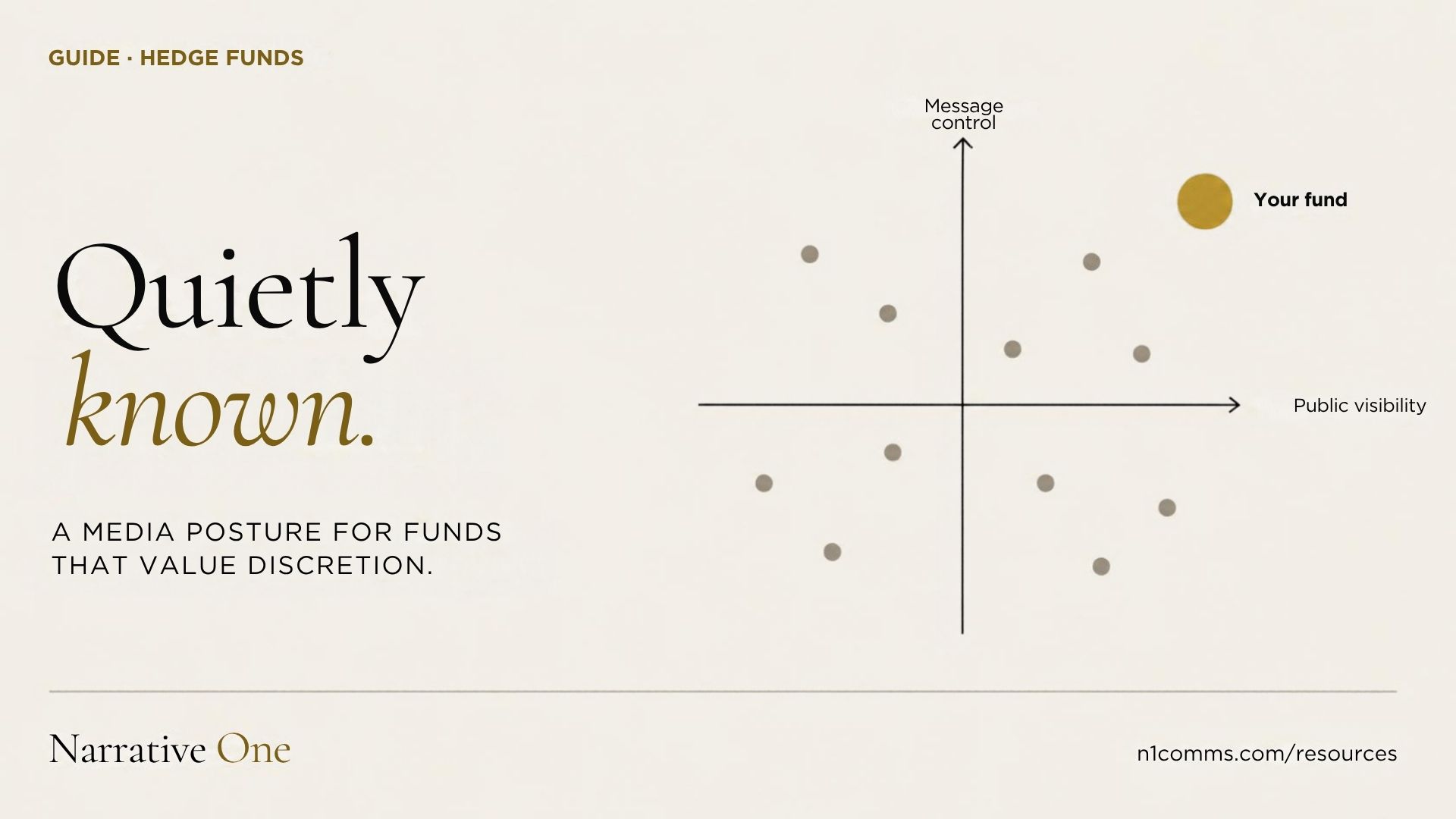
Visibility is not a strategy. For a hedge fund, unmanaged visibility can create risk. Media relations for hedge funds should serve a defined market objective, not produce headlines for their own sake. Coverage can sharpen credibility, but an imprecise claim or poorly timed comment can create governance and reputational exposure.
That tension is familiar to investment leaders. Public communication can support a fund’s positioning and investor narrative, yet it must not pull portfolio managers into a constant content cycle or outpace compliance review. Silence isn’t always the answer. Discipline is.
This guide explains when media relations can advance a hedge fund’s objectives, what expertise and operating model a communications partner should bring, and how to govern narrative, approvals, timing, and measurement. It also shows how a joined-up workflow can connect communications across a firm and its portfolio without adding unnecessary demands on investment teams. The standard is clear: media activity should strengthen market credibility while remaining accountable to the fund’s governance framework.
Key Takeaways
Set a clear communications objective before selecting press targets, and anchor the narrative in the fund’s investment context.
Distinguish earned editorial coverage from paid promotion, investor relations, and routine LP reporting.
Compare internal, ad hoc, and embedded specialist models by senior access, investment-sector fluency, continuity, targeting, and reporting.
Build governance into the workflow from the start: embed compliance rules before drafts reach the compliance director, then review timing and results.
Assess media relations for hedge funds as a governed market function, with a clear operating model linking strategy, journalist relationships, and approvals.
Table of Contents
What Media Relations for Hedge Funds Is, and What It Is Not
Media relations is the strategic engagement of journalists to communicate relevant perspectives from a fund or its senior leaders. For hedge funds, it starts with a reason to enter the public conversation: clarify the firm’s position on a market issue, establish an executive’s authority in a defined area, or support a broader positioning priority. Media relations describes the journalist-facing discipline. Its value lies in the quality and relevance of the engagement, not the number of mentions it generates.
That distinction sets clear boundaries. Earned editorial coverage is produced through a publication’s independent editorial process. It is not paid promotion, a placement that can be purchased or guaranteed, or a substitute for investor communications. A media strategy should give journalists accurate, relevant information while preserving the fund’s control over what it says and who is authorised to speak.
Visibility is a means, not an end. A mention has little strategic value if it reaches the wrong audience, dilutes the fund’s positioning, or creates an avoidable governance issue. Ask whether the communication advances a defined priority and whether the fund can stand behind the message, timing, and context. Volume alone is a weak measure.
How media relations differs from investor relations
Journalist engagement reaches a public audience through an independent editorial intermediary. Investor relations communicates directly with current or prospective investors, while LP reporting serves existing limited partners with information relevant to their relationship with the fund. These audiences need different levels of detail, timing, and context, as well as distinct approval routes. A public comment must not become a shortcut for investor disclosure, and an LP update should not be repurposed as a press statement without review. A considered LP communications strategy keeps investor communication aligned with its audience and purpose.
When visibility can support a hedge fund’s objectives
Media activity can contribute when it is tied to a specific investment-firm priority. For example, a partner may offer informed context on a market theme that aligns with the fund’s positioning, or explain the firm’s perspective in a way that strengthens executive authority with relevant audiences. The goal is not simply to appear in a publication. It is to make a precise contribution that supports a broader narrative without overstating the fund’s role or views.
Before outreach, define the intended audience, the message the fund is prepared to stand behind, and the conditions under which a spokesperson can participate. Then assess whether the opportunity advances the objective enough to justify the exposure and internal attention. If the rationale is only “more coverage,” the case is incomplete. No media appearance or placement should be treated as guaranteed.
Public communications must follow governance appropriate to the fund and its circumstances. Identify who can speak, what requires review, and how timing will be coordinated before engagement begins. Media relations for hedge funds is disciplined when editorial visibility serves the fund’s strategy and approvals and boundaries remain clear.
How a Hedge Fund Media Relations Strategy Is Built
A working strategy starts inside the fund, not inside a media database. Before identifying journalists, establish the investment context, the communications priority, and the evidence the fund can stand behind. A market view, a leadership perspective, and a portfolio announcement each have different purposes. Treating them as interchangeable creates noise and makes approval harder.
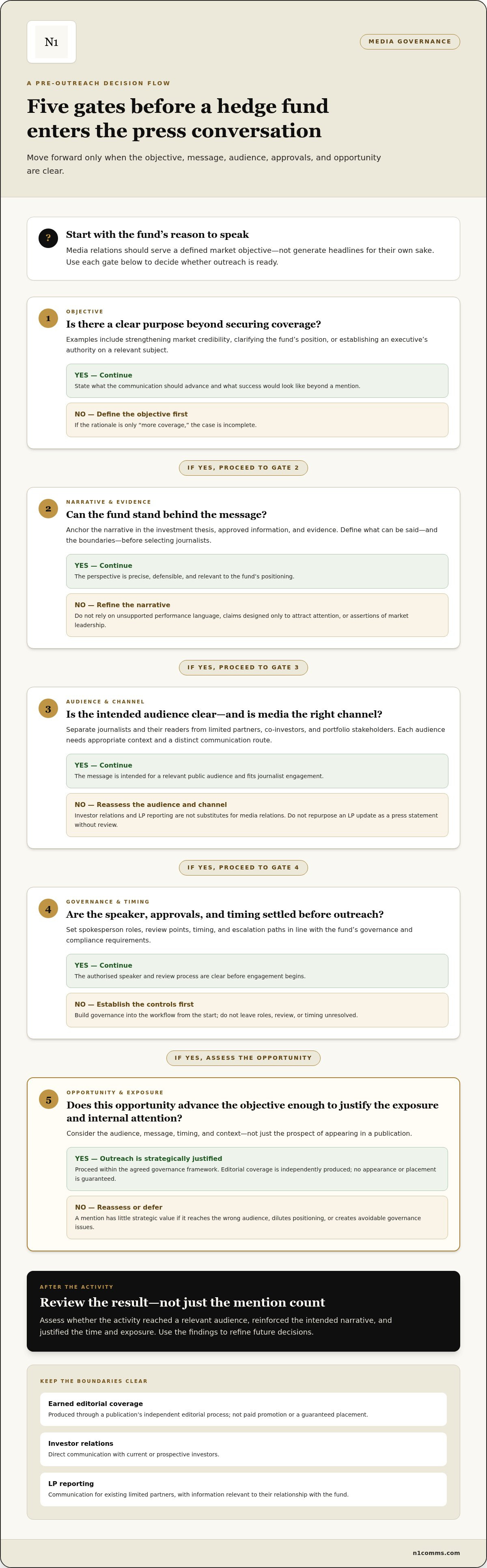
Build the strategy in sequence. Each decision should guide the next:
Set the objective. Define what communication should advance, such as market credibility, a clearer fund position, or an executive’s authority on a relevant subject. State what success would look like beyond securing coverage.
Define the narrative. Identify the fund’s defensible perspective, supporting evidence, and boundaries for what can be said. The narrative should reflect the fund’s investment thesis and approved information, not a claim designed to attract attention.
Identify audiences. Separate journalists and their readers from LPs, co-investors, and portfolio stakeholders. Determine who needs to hear the message, what context they require, and which channels are appropriate.
Govern the communication. Set spokesperson roles, review points, timing, and escalation paths before outreach. Account for the fund’s governance and compliance requirements.
Review the result. Assess whether the activity reached a relevant audience, reinforced the intended narrative, and justified the time and exposure. Use the findings to refine future decisions, not just to count mentions.
Set the narrative before selecting media targets
A fund’s narrative should answer a practical question: what can its leaders credibly add to a market conversation? Ground the answer in the fund’s thesis, strategy, and approved evidence. For example, a partner discussing a sector trend should distinguish the firm’s considered view from a forecast or a claim about future returns. Avoid unsupported performance language and assertions of market leadership. Precision protects credibility.
Match the message to the audience and moment
Proactive commentary, fund announcements, portfolio news, and leadership profiles call for different messages and timing. A journalist’s relevance depends on the subject, the spokesperson’s expertise, and whether the perspective is useful at that moment. Communications for LPs, co-investors, or portfolio stakeholders may need different context and approval. For English and Arabic audiences, draft content natively in both languages rather than translating after the message is settled.
Apply the sequence consistently, then adapt execution to the fund’s priorities and audience. That is the discipline behind media relations for hedge funds: a clear objective, a credible narrative, controlled distribution, and a review tied to strategic value. Firms seeking an investment-firm communications model can explore NarrativeOne’s investment-firm communications approach.
How to Compare Hedge Fund Media Relations Operating Models
The right operating model depends on the fund’s communications workload, internal expertise, and governance requirements. Compare the system, not the sales pitch. The table below highlights practical differences across three common models. Actual capability varies by firm and arrangement.
Assessment areaInternal capabilityAd hoc outreachEmbedded specialist supportSenior accessDepends on internal team structure and leadership capacity.May be limited to the scope of a specific assignment.Can provide direct access to senior strategic judgment.Investment-sector fluencyMay be strong if the team has relevant capital-markets experience.Can vary with the individual engagement.Can integrate investment-firm context into ongoing communications.ContinuityRelies on retained knowledge and available internal capacity.Often centred on a discrete announcement or need.Supports a consistent narrative and ongoing execution.Journalist targetingDepends on established relationships and research capacity.Typically focused on the immediate opportunity.Can align journalist relevance with the firm’s priorities over time.Reporting and governanceCan be closely integrated with internal processes.May focus on delivery of the assignment.Can connect review, activity, and reporting to agreed objectives.
These are operating tendencies, not guarantees. An internal team may have deep expertise, while an external specialist may have limited senior access. The useful question is where responsibility sits at each point: narrative development, journalist selection, drafting, review, and measurement. For media relations for hedge funds, compliance should shape the workflow from the start. Rules should be embedded before drafts reach the compliance director, not introduced as a final-stage filter.
What a hedge fund should assess in a communications partner
Assess experience with investment firms and fluency in capital-markets context. Confirm that senior strategic judgment is directly available, rather than mediated through layers of account management. Then examine how reporting works. A useful review connects activity to the fund’s agreed objectives: which audience was reached, whether the narrative advanced, and what should change next. Output counts alone cannot establish strategic value.
Why operating infrastructure matters beyond a single announcement
A project-only engagement can address a specific event, but it does not by itself create continuity between that event and the fund’s wider narrative. Narrative One’s model includes a 12-month narrative plan, executed weekly and reported monthly. That cadence gives the firm a structure for planned communications while leaving room to respond to relevant developments.
Media activity is only one channel in a fund’s communications system. Direct updates can sustain LP engagement between formal reporting periods. A between-quarter LP communications checklist can help structure that owned channel without confusing it with journalist outreach.
How Governance, Timing, and Measurement Shape Fund Media Relations
Governance is part of the communications system, not a final checkpoint. The fund’s own policies, approval authorities, and circumstances should shape every external statement before drafting begins. That discipline supports consistency and reduces the risk of releasing language that exceeds approved evidence or falls outside the intended message.
Build approvals into the communications workflow
Map accountability before a journalist is approached. Identify who owns the message, who reviews it, and who authorises release. Compliance rules should be embedded in the workflow before the compliance director reviews drafts, not added after the copy is written. This lets the review test a structured, evidence-based message rather than repair one created without governance in mind.
For communications that touch multiple markets, assess relevant requirements with qualified compliance counsel. Frameworks and regulator requirements associated with FSRA, ADGM, DIFC, SAMA, and CMA may matter depending on the fund’s activities and audience. Their relevance is jurisdiction-specific and can change. This is an operational reminder, not legal advice; verify current requirements before publication.
Keep claims within the fund’s approved evidence and wording. That includes statements about performance, clients, transactions, and portfolio activity. A useful review asks whether each factual assertion is substantiated, whether the spokesperson is authorised to make it, and whether the context could alter its meaning. If evidence or approval is missing, revise or withhold the claim.
Use a defined announcement timeline and useful reporting
A planned announcement needs clear decision points, not a last-minute scramble. Narrative One’s stated sequence is T-14, T-10, T-5, T-2, Day 0, then +7. The stages create space to align the message, prepare and review materials, coordinate outreach, manage release, and assess follow-up. Tier-1 coverage is achievable within 14 days under this process, but no placement is guaranteed.
Reporting should separate activity from strategic indicators. Activity measures include outreach completed, responses received, and placements secured. Strategic indicators ask whether the right audiences encountered the message and whether coverage advanced the agreed objective. Depending on the purpose, review relevant Tier-1 mentions, share of voice, relevance, sentiment, and progress against the fund’s stated priorities. Share of voice is meaningful only when the comparison set and topic are clearly defined.
Track delivery: Record outreach, responses, and confirmed placements.
Assess quality: Review publication relevance, message accuracy, and sentiment.
Test strategic contribution: Compare results with the objective set before launch and identify what should change next.
Strong media relations for hedge funds links approvals, timing, and measurement in one accountable process. Build a compliance-aware media relations workflow that reflects the fund’s governance and communications priorities.
What an Investment-Firm Communications Partner Can Bring
A communications partner should add operating capacity and senior judgment, not simply increase the volume of activity. For an investment firm, that means understanding how firm positioning, partner perspectives, portfolio announcements, and governance fit together. Narrative One brings 17 years of operating experience inside recognised investment institutions. That experience informs its work with investment firms, including private equity, venture capital, and multi-strategy platforms.
What an embedded communications function changes
Embedded support connects communications across the investment firm and its portfolio companies through shared infrastructure. Narrative One’s model uses one senior strategist, one journalist network, and one compliance workflow. This creates continuity: the same strategic perspective can inform firm-level messaging and portfolio communications, while the workflow accounts for review and approval requirements. It is a joined-up model, not separate teams working from disconnected briefs.
A 12-month narrative plan gives that work a clear operating rhythm, with execution weekly and reporting monthly. The plan helps align activity over time rather than treating every announcement as an isolated assignment. Weekly execution advances agreed priorities; monthly reporting provides a structured point to assess progress and adjust. Investment teams can retain focus on investment work while communications follow a defined plan.
How Narrative One supports investment-firm communications
The work combines Strategy & narrative and Media relations with investment-firm communications capabilities such as Bilingual content, GP thought leadership, Events & speaking, Monitoring & crisis management, and Portfolio announcement service. The purpose is to connect narrative, spokesperson expertise, journalist engagement, and communications oversight rather than handle each as an unrelated task.
For English and Arabic audiences, content is drafted natively in both languages to senior financial-journalist standards, not translated after drafting. Media engagement is targeted to the subject and the relevant journalist’s coverage. Compliance rules are embedded before drafts reach the compliance director, keeping review within the operating workflow rather than leaving governance to a final-stage check.
For a fund assessing a communications model, the practical question is whether strategy, execution, and oversight work as one system. Narrative One’s investment-firm experience provides a basis for that work without implying guaranteed results. Tier-1 coverage is achievable within 14 days, but no media placement is guaranteed.
Discuss a communications approach for your investment firm grounded in its priorities, operating context, and governance requirements.
Set the Standard Before the Next Market Moment
The next step is not to increase visibility. It is to decide in advance what would make public engagement worthwhile. Identify a market moment where the firm has a credible contribution to make, define the audience that matters, and agree on the conditions that would make outreach pause. That decision framework turns media relations for hedge funds into a deliberate operating choice rather than a reaction to incoming press requests.
Set the threshold before the opportunity arrives. Who can speak? What evidence supports the message? Which internal stakeholders need to approve it? What would make the fund decline? Clear answers give leadership room to respond with judgment, not urgency. They also make it easier to distinguish a strategically useful opportunity from attention that carries no durable value.
If your firm is ready to establish that standard, discuss a communications approach for your investment firm. A disciplined framework gives your team greater control over when it speaks and why. Start with the decision, then build the system around it.
Frequently Asked Questions
Is media relations appropriate for every hedge fund?
No. Media engagement makes sense when a fund has a clear reason to speak publicly, an authorised spokesperson, and the capacity to manage review and follow-up. A fund with no approved public perspective or material communications priority may gain little from proactive outreach. Start by asking whether a defined audience needs to hear the fund’s view. If not, restraint is a sound strategic choice.
Can hedge fund media relations support investor confidence without replacing LP communications?
Yes. Public commentary can help investors understand a firm’s perspective, but it cannot provide the tailored context or relationship-specific information LPs need. For example, a partner’s published view on a market theme may reinforce the fund’s expertise, while portfolio updates and fund-specific matters remain within established investor channels. Coordinate communications so public statements don’t become substitutes for direct updates or create confusion about where investors should seek relevant information.
How should a hedge fund prepare a spokesperson for a journalist interview?
Prepare the spokesperson around the interview’s purpose, likely questions, approved evidence, and boundaries. Identify which points they can substantiate, which subjects require a referral, and how to correct an inaccurate premise. Rehearse concise answers without scripting every word. The spokesperson should also know the publication, the journalist’s subject focus, the interview format, and who to contact internally if the conversation moves into unapproved territory.
What should a hedge fund do when a journalist requests comment on a sensitive issue?
Route the request through the designated communications and compliance contacts before responding. Confirm the subject, deadline, requested format, and whether the fund has verified facts it can share. Don’t speculate, disclose confidential information, or assume a conversation is off the record. If a response is appropriate, use approved language and an authorised spokesperson. If facts are uncertain, communicate that internally and seek qualified advice before making a statement.
Can a hedge fund discuss performance or portfolio holdings with the media?
Only if the information is approved for external use and the wording has been reviewed against the fund’s policies and applicable requirements. Performance claims need particular care: ensure figures, context, and any required qualifications are substantiated and authorised. Portfolio holdings may be confidential or subject to restrictions. Before commenting, involve the relevant compliance and legal reviewers. This is a communications safeguard, not legal advice; requirements depend on the fund and circumstances.
How can a fund assess whether media coverage reached the right audience?
Assess fit, not just reach. Review whether the outlet covers the relevant market or investor audience, whether the story accurately conveyed the fund’s intended perspective, and whether the spokesperson’s expertise came through. Track relevant placements and the quality of resulting engagement, such as follow-up questions from appropriate stakeholders. Treat those signals as evidence to examine, not proof that coverage caused an allocation or investment decision.
Does a hedge fund need an ongoing media relations programme or only announcement support?
It depends on the fund’s communications priorities and how often it has a useful public contribution to make. Announcement support can suit a discrete, approved milestone with a clear audience. An ongoing programme is more appropriate when leaders have recurring perspectives to communicate or the firm needs consistency across multiple moments. Avoid maintaining activity for its own sake. Set review points so the programme can be adjusted when priorities, evidence, or circumstances change.
Frequently Asked Questions
Is media relations appropriate for every hedge fund?
No. Media engagement makes sense when a fund has a clear reason to speak publicly, an authorised spokesperson, and the capacity to manage review and follow-up. A fund with no approved public perspective or material communications priority may gain little from proactive outreach. Start by asking whether a defined audience needs to hear the fund’s view. If not, restraint is a sound strategic choice.
Can hedge fund media relations support investor confidence without replacing LP communications?
Yes. Public commentary can help investors understand a firm’s perspective, but it cannot provide the tailored context or relationship-specific information LPs need. For example, a partner’s published view on a market theme may reinforce the fund’s expertise, while portfolio updates and fund-specific matters remain within established investor channels. Coordinate communications so public statements don’t become substitutes for direct updates or create confusion about where investors should seek relevant information.
How should a hedge fund prepare a spokesperson for a journalist interview?
Prepare the spokesperson around the interview’s purpose, likely questions, approved evidence, and boundaries. Identify which points they can substantiate, which subjects require a referral, and how to correct an inaccurate premise. Rehearse concise answers without scripting every word. The spokesperson should also know the publication, the journalist’s subject focus, the interview format, and who to contact internally if the conversation moves into unapproved territory.
What should a hedge fund do when a journalist requests comment on a sensitive issue?
Route the request through the designated communications and compliance contacts before responding. Confirm the subject, deadline, requested format, and whether the fund has verified facts it can share. Don’t speculate, disclose confidential information, or assume a conversation is off the record. If a response is appropriate, use approved language and an authorised spokesperson. If facts are uncertain, communicate that internally and seek qualified advice before making a statement.
Can a hedge fund discuss performance or portfolio holdings with the media?
Only if the information is approved for external use and the wording has been reviewed against the fund’s policies and applicable requirements. Performance claims need particular care: ensure figures, context, and any required qualifications are substantiated and authorised. Portfolio holdings may be confidential or subject to restrictions. Before commenting, involve the relevant compliance and legal reviewers. This is a communications safeguard, not legal advice; requirements depend on the fund and circumstances.
How can a fund assess whether media coverage reached the right audience?
Assess fit, not just reach. Review whether the outlet covers the relevant market or investor audience, whether the story accurately conveyed the fund’s intended perspective, and whether the spokesperson’s expertise came through. Track relevant placements and the quality of resulting engagement, such as follow-up questions from appropriate stakeholders. Treat those signals as evidence to examine, not proof that coverage caused an allocation or investment decision.
Does a hedge fund need an ongoing media relations programme or only announcement support?
It depends on the fund’s communications priorities and how often it has a useful public contribution to make. Announcement support can suit a discrete, approved milestone with a clear audience. An ongoing programme is more appropriate when leaders have recurring perspectives to communicate or the firm needs consistency across multiple moments. Avoid maintaining activity for its own sake. Set review points so the programme can be adjusted when priorities, evidence, or circumstances change.