
The investor’s first impression is rarely made in a meeting. A media strategy for investment managers should connect executive-led thought leadership with investor-focused storytelling, social media, audience insight and plain-language education. Institutional decision-makers consume upwards of 8-10 information sources before engaging with an asset manager, so each communication must reinforce a coherent point of view.
Visibility alone is not the objective of a media strategy for investment managers. Investors need to understand how a firm thinks, what distinguishes its approach, and why its perspective matters. That takes more than publishing market commentary. It calls for a disciplined narrative tailored to distinct audiences and communicated consistently by senior leaders. This article sets out a practical framework for building that system, from shaping educational stories and choosing channels to segmenting audiences, clarifying complex ideas, and developing executive thought leadership. The aim is to earn attention through substance, not volume.
Key Takeaways
Build investor stories around a clear thesis, evidence and implications, then use educational content to make complex investment ideas easier to assess.
Use social platforms with intent: choose channels that fit your audience and measure whether content earns attention and meaningful engagement.
Segment investors by their priorities and information needs so each message addresses a relevant decision, not a generic audience.
Replace jargon with direct language that explains the strategy, its rationale and its relevance to investors.
Give executives a defined role in thought leadership, with consistent perspectives that reinforce the firm’s positioning across media and investor communications.
Table of Contents
1. Investor-focused storytelling and educational content
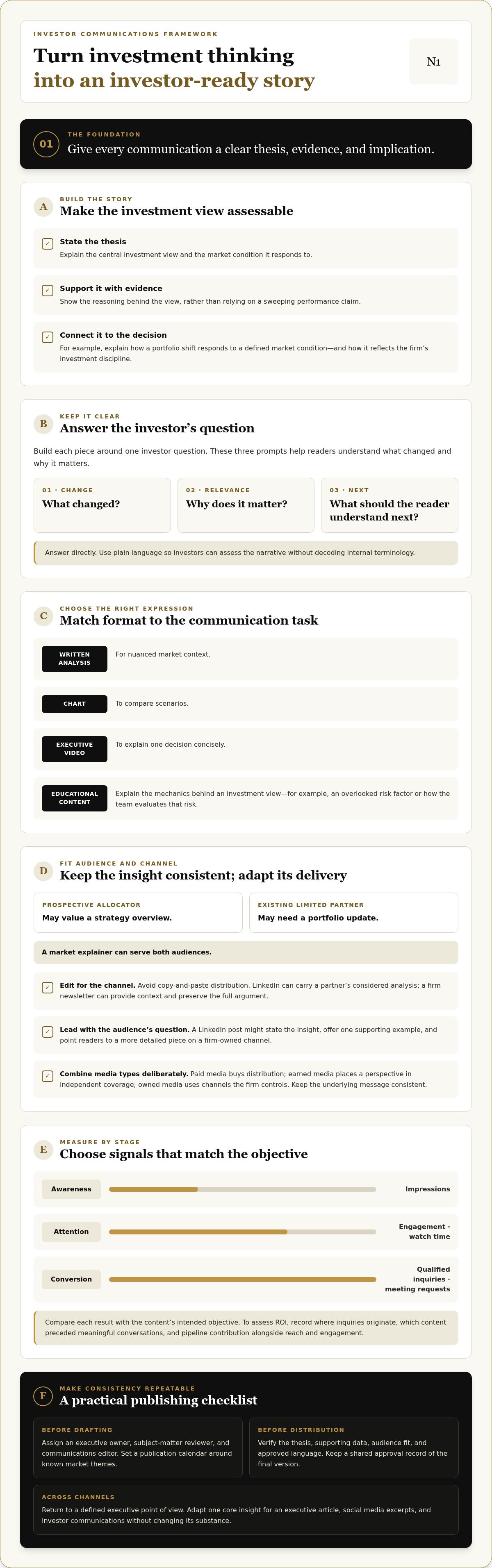
Investor communications need a thesis, supporting evidence, and a clear implication for decision-makers. For example, explain how a portfolio shift responds to a defined market condition, then connect the action to the firm’s investment discipline rather than making a sweeping performance claim.
Build each piece around one investor question: What changed? Why does it matter? What should the reader understand next? A direct answer gives investors a narrative they can assess without decoding internal terminology.
Educational content earns attention by explaining the mechanics behind an investment view. A short article might clarify an overlooked risk factor, while a portfolio note shows how the team evaluates that risk.
Choose a format that suits the task: written analysis for nuanced market context, a chart to compare scenarios, or an executive video to explain one decision concisely.
Social media needs channel-specific editing, not copy-and-paste distribution. LinkedIn can carry a partner’s considered analysis; a firm newsletter can add context and preserve the full argument.
Lead with the audience’s question on every channel. A LinkedIn post might state the insight, offer one supporting example, and direct readers to a more detailed piece on a firm-owned channel.
Paid media buys distribution, earned media places a firm’s perspective in independent coverage, and owned media uses channels the firm controls. Investment managers can combine all three while keeping the underlying message consistent.
In the United States, a media strategy for investment managers can combine executive commentary, useful owned content, and selective media outreach. LinkedIn supports professional thought leadership, while relevant earned coverage can extend an investment perspective.
Match each format to investor needs. A prospective allocator may value a strategy overview; an existing limited partner may need a portfolio update. A market explainer can serve both.
Measure results by stage. Track impressions for awareness, engagement and watch time for attention, and qualified inquiries or meeting requests for conversion. Compare each result with the content’s intended objective.
To assess ROI, define the connection between communication and investor action. Record where inquiries originate, note which content preceded meaningful conversations, and review pipeline contribution alongside reach and engagement.
Consistency comes from a repeatable workflow. Before drafting, assign an executive owner, a subject-matter reviewer, and a communications editor. Then set a publication calendar around known market themes.
Before distribution, verify the thesis, supporting data, audience fit, and approved language. A shared approval record makes it easier to identify the final version and keep the firm’s messaging consistent across channels.
Thought leadership builds when leaders return to a defined point of view. Distribute one core insight through an executive article, social media excerpts, and investor communications, adapting each format without changing the substance.
2. Social media’s role in investment-manager branding and investor engagement
Social platforms shape how investors assess an investment manager’s public identity. A 2018 figure reports that 68% of institutional investors use social media to research asset management firms before investment decisions. Greenwich Associates found that 63% consumed social media in 2019. Treat each post as part of the firm’s visible record, not a disposable update.
LinkedIn is the primary platform for professional thought leadership. Twitter/X and niche outlets can extend visibility when their audiences fit the firm’s investor base. Start by choosing 1-2 platforms where target audiences are active. Set a purpose for each channel, such as explaining a strategy, sharing market insight or directing readers to a detailed firm publication.
For the SEC marketing rule question, social posts are subject to the same compliance requirements as webpages or printed ads; they are not exempt as real-time promotions. In the United States, maintain social-media posts for three years for audit purposes, under requirements attributed to FINRA, SEC, FTC, FFIEC, and ABA.
FINRA and state requirements depend on the firm and its regulatory status. Apply the relevant securities rules to each communication and route posts through compliance review before publication. A post about investment services remains public communication, even on an executive’s personal profile.
In the UAE, social media is treated as public communication. Financial-services posts must align with advertising standards and financial regulations, including requirements set by authorities such as the Securities and Commodities Authority and the Central Bank of the UAE. A market insight or trend can inform content, but the firm still needs a review process for its claims and presentation.
Social media is an ongoing operating commitment, not a scheduled batch of posts. Assign owners for drafting, approvals, publishing, and comment monitoring. Use a shared calendar to map market themes, fund milestones, and executive availability. Leave room for timely responses, but do not publish an unreviewed claim to meet a posting deadline.
Investment brands also need a clear approach to customer questions. Assign someone to monitor direct messages and comments, acknowledge substantive questions, and move sensitive account matters to established private channels. Never discuss an individual’s holdings or account details in public. Record recurring questions and use them to shape future educational posts.
Use analytics to connect activity with business objectives. Review impressions for reach, engagement for audience response, and qualified inquiries for investor interest. Keep the scorecard focused on decisions: if a post attracts views but little relevant engagement, revise its topic, format, or distribution. Regular review turns platform data into an operating signal.
3. Audience segmentation and personalisation
A single investor profile can hide competing mandates, time horizons, and evidence needs. Segment audiences by investment role, decision stage, strategy interest, and geography. For example, a pension allocator assessing risk needs different material from a family office exploring alternatives. Tie each segment to a specific communication objective.
Start with business goals, then build audience profiles from actual investor questions. A fundraising campaign may prioritize qualified allocator conversations, while an existing-client programme may focus on explaining portfolio decisions. Record each profile’s mandate, concerns, preferred evidence, and next decision. Avoid demographic labels that do not change what the firm communicates.
Understanding audiences requires more than internal assumptions. Review meeting notes, investor questions, event feedback and campaign engagement. A 2019 Greenwich Associates study found that less than 50% of institutional investors consumed finance-specific trade publications. That finding reinforces the need to learn where each audience actually seeks information.
Use a practical research loop. First, group recurring questions from investor relations and investment teams. Next, compare them with website visits, email responses, and event attendance. Finally, validate the patterns in investor conversations. Repeated questions about liquidity, for example, may point to the need for a focused explainer for allocators.
Personalisation means adjusting relevance, not changing the firm’s investment thesis. A prospective allocator may need a concise strategy overview; an existing limited partner may need context on a portfolio development. Keep the core facts consistent, then adapt the emphasis, format, and detail to each audience’s decision.
Map each audience segment to a content pathway. An awareness-stage reader might encounter a market perspective; an engaged prospect may need a strategy note before a meeting. Coordinate these steps on the campaign calendar so each communication advances a defined business goal rather than arriving as an isolated update.
Measure success against the intended audience action. For a fundraising campaign, track qualified inquiries and progression into investor conversations. For LP communications, assess engagement with relevant updates and recurring questions. Firms have claimed that personalised content boosted revenue by 10 to 15 percent, but the useful test is whether targeted material supports a measurable business objective.
Retention also provides a reason to tailor communications. Professional service firms providing personalised content have historically reported an 84% client retention rate, compared with an average of 55 to 75% in other industries. Treat this as context, not a forecast. Review segment performance regularly and revise personas when investor priorities or business goals change.
4. Personalization and plain-language communication
Personalisation fails when it changes substance instead of relevance. Keep the investment thesis intact and adapt the explanation to the reader’s decision. An investment committee may need risk drivers and portfolio implications; a prospective partner may first need to understand the strategy’s purpose and structure.
Plain language improves precision without reducing rigor. Replace “duration exposure” with “how bond prices may respond when interest rates change” when that is what you mean. Define necessary technical terms once, then use them consistently across presentations, investor letters, and media commentary.
Use a three-step edit before publication: identify the main claim, remove language that obscures it, and test whether the evidence supports it. Instead of saying “our approach is positioned to capitalize on volatility,” specify the market condition and investment decision behind the statement.
Make each communication answer a practical investor question. An LP update can explain what changed in a portfolio, why the team acted, and what risks remain. A media interview can translate the same insight into a concise explanation for a broader audience without introducing claims that conflict with investor materials.
Targeted language improves visibility when it meets the audience’s information needs. A partner speaking with allocators can explain a strategy through mandate fit and implementation. Public market commentary can focus on the event, its potential implications, and the firm’s analytical framework.
Personalisation also depends on format. Use a short executive summary for time-constrained readers, followed by detailed analysis for investment professionals. Put the material update first in an LP letter. In a presentation, label charts clearly and explain what each comparison shows.
Professional service firms providing personalized content have historically had an 84% client retention rate, compared with an average of 55 to 75% in other industries. Treat that finding as a reason to make communications useful and relevant, not as a forecast for any individual firm.
Create a language standard that editors and investment teams can apply. Define approved terms for strategy, risk, and performance; flag ambiguous claims; and assign a subject-matter reviewer. For example, require every chart caption to state the period and comparison it represents.
AI is expected to enable hyper-personalized content experiences for asset management by 2030. Until then, use existing investor questions and communication preferences to tailor materials. Track which explanations prompt informed conversations, then refine the language while preserving the approved investment rationale.
5. Executive-led media and thought leadership
Executive visibility works when a leader contributes distinct investment judgment. It falls flat when every post repeats approved boilerplate. First define the executive’s territory: a portfolio manager might explain risk interpretation, while a managing partner addresses capital allocation. That boundary gives thought leadership a clear point of view.
Build the platform around three components: a core thesis, evidence, and implications. An executive discussing market volatility, for example, can explain which signal changed, how the team interprets it, and what investors should watch. The insight should stand on its own, not disguise a product pitch.
LinkedIn suits professional analysis and executive commentary. Use a short post to state one position, then support it with a specific observation or chart. Longer articles can examine the reasoning in depth. Each format should reinforce the same central idea without repeating identical wording.
An executive’s role is not limited to interviews or keynote appearances. A disciplined programme can include authored commentary, media briefings, and responses to relevant market developments. Assign an editor to preserve the leader’s voice, check facts, and ensure the final message matches approved firm positions.
Prepare for media by anticipating questions from investors and journalists. Draft a message map with the central claim, supporting evidence, and boundaries. If asked about a market shock, for instance, the executive can distinguish immediate portfolio implications from longer-term uncertainty.
Turn thought leadership into action with a distribution sequence. Publish the executive’s full argument on an owned channel, adapt its key insight for LinkedIn, then offer relevant context to journalists. Track which ideas lead to substantive investor conversations, not just broad visibility.
Consistency depends on governance. Set an editorial calendar around investment themes, assign a senior subject-matter reviewer, and establish approval steps before publication. After an interview or article appears, compare the coverage with the intended message. Capture useful questions for the next briefing.
For investment firms building a more defined executive voice, develop an executive thought leadership program around a clear thesis and disciplined media activity. The objective is not more commentary. It is a recognizable perspective investors can evaluate.
NarrativeOne: Fund Positioning
NarrativeOne helps investment firms establish a clear fund position and communicate it consistently to investors. Turn to Fund Positioning when a strategy needs a sharper market narrative or fundraising communications need to connect the investment thesis with investor priorities.
As the narrative reaches the market, Portfolio Announcements and LP Communications support distinct audiences with relevant updates. Partner Thought Leadership gives senior executives a defined role in expressing the firm’s investment perspective. This is strategic communications infrastructure, not a substitute for the firm’s investment process or compliance oversight.
For a fund narrative, portfolio update or executive perspective that needs disciplined communication, contact NarrativeOne or visit n1comms.com.
Make communication part of the investment system
A media strategy for investment managers should work as operating infrastructure, not a campaign that ends after publication. Start by assigning ownership: decide who sets the firm’s position, who translates it for investors, and how leaders keep communications aligned as priorities shift.
That discipline matters when a fund enters the market, communicates a portfolio development, or strengthens limited-partner relationships. NarrativeOne supports this work through Fund Positioning, Portfolio Announcements, and LP Communications. Each offering addresses a distinct communication need while keeping the firm’s investment perspective central.
Set the next decision before adding another channel or format. Identify the audience, the message they need, and the action the communication should support. Then build a process that executives and investment teams can sustain.
Contact NarrativeOne to discuss your media strategy and define a clear next step for your firm. Strong communication starts with deliberate choices, and your team can put those choices to work.
Frequently Asked Questions
What is a media strategy for investment managers?
A media strategy for investment managers is a coordinated plan for communicating a firm’s investment perspective to defined audiences. It sets the messages, spokespeople, channels, approval process, and measures of success. For example, a fund preparing to raise capital can align its investment thesis, partner commentary, and public announcements around one clear narrative. The strategy guides communication choices; it does not replace investment judgment or compliance oversight.
Which media channels are most effective for investment management firms?
The right channels depend on the audience and objective. LinkedIn supports professional visibility and executive commentary; firm-owned articles and investor materials allow more context. Earned media can put a firm’s analysis before readers of business and financial publications. For a fund announcement, coordinate an approved owned statement with relevant journalist outreach, then use executive channels to explain its significance.
How can investment managers define their target audiences and media objectives?
Begin with the decision the communication should support, then identify who makes or influences it. A prospective institutional allocator, an existing limited partner, and a portfolio-company executive have different information needs. Use meeting questions, investor-relations feedback, and campaign responses to document those needs. Set an objective for each audience, such as clarifying strategy, supporting fundraising conversations, or strengthening understanding of a portfolio development.
What steps are involved in building a media strategy for an investment management firm?
First, define the business objective and priority audience. Establish the firm’s core message and choose a credible executive spokesperson. Select suitable channels and formats, then create a publication and approval process with clear ownership. Before launch, agree on measures tied to the objective. After distribution, assess audience response and investor conversations, then use those signals to shape the next communication.
What reputational and compliance risks should investment managers consider in media campaigns?
Key risks include unsupported performance statements, inconsistent descriptions of a strategy, selective disclosure, and inaccurate claims repeated across channels. A public post can reach beyond its intended audience and remain visible after market conditions change. In the United States, firms should review public communications for compliance, preserve an approval record, and ensure executives use current approved language. Route sensitive market or portfolio matters through established internal review before publication.
What are the SEC marketing rule requirements for investment manager advertising?
Social media posts are subject to the same compliance requirements as webpages and printed ads; they are not exempt as real-time promotions. Route posts through compliance review before publication and maintain U.S. social-media posts for three years for audit purposes.
What FINRA and state regulations apply to investment adviser media and social media?
FINRA and state requirements depend on the firm and its regulatory status. Apply the relevant securities rules to each communication, route posts through compliance review before publication, and maintain U.S. social-media posts for three years for audit purposes.