A placement count can make a busy PR quarter look successful while telling a founder little about whether credibility is growing. The metrics for successful tech founder PR should show more than where a story appeared. They should clarify who it reached, how audiences responded, and whether that response supported a business priority.
Coverage reports often tally headlines without assessing relevance. Founder visibility is hard to interpret without a baseline, and an investor conversation or inbound lead rarely has a single cause. Treating correlation as proof weakens the case for communications rather than strengthening it.
This article sets out a practical measurement framework that separates activity, media outputs, audience response, and strategic outcomes. It explains how to select indicators for a company’s stage and communications objective, establish a consistent baseline, and report progress without claiming more attribution than the evidence supports. The result is a clearer view of whether founder PR is building authority and creating strategic leverage, not simply generating coverage.
Key Takeaways
- Use metrics for successful tech founder PR to distinguish communications activity, media outputs, audience response, and strategic signals.
- Choose measures based on the founder’s stage and objective, whether the priority is visibility, message delivery, authority, or audience action.
- Assess each metric in context: a large reach figure may indicate exposure, but it cannot establish credibility or business impact on its own.
- Set a baseline and document metric definitions, data sources, owners, and review cadence before measuring progress.
- Connect narrative, media relations, bilingual content, monitoring, and reporting as sustained communications infrastructure, not just a count of placements after a campaign.
What Do Metrics for Successful Tech Founder PR Actually Measure?
Visibility is evidence that a founder appeared in public. Business impact is evidence that communications contributed to a priority such as investor confidence, category understanding, or qualified interest. Those are different claims. A sound measurement model tracks the path between them without treating one as proof of the other.
Successful founder PR measurement tracks what the team did, what media published, how audiences responded, and which strategic signals followed. Each measure should answer a stated communications objective. If a figure cannot inform a decision or explain progress, it is report inventory, not a useful performance indicator. The distinction matters because Key Performance Indicators (KPIs) assess progress against defined goals. They are not simply figures collected because a platform makes them available.
Why coverage volume alone is an incomplete measure
A placement count records an output. It does not establish whether the outlet reaches the founder’s intended audience, whether the story presents the intended message, or whether readers noticed it. One article may explain a founder’s technical position to a relevant audience; another may mention the company without conveying what differentiates it. Both count as placements, but their strategic weight differs.
Keep coverage volume in the framework because it shows whether media activity produced published coverage. Then assess each placement’s relevance, message presence, and audience response. The count answers “how much was published?” It cannot answer “what did this achieve?” on its own.
The four levels of a founder PR measurement model
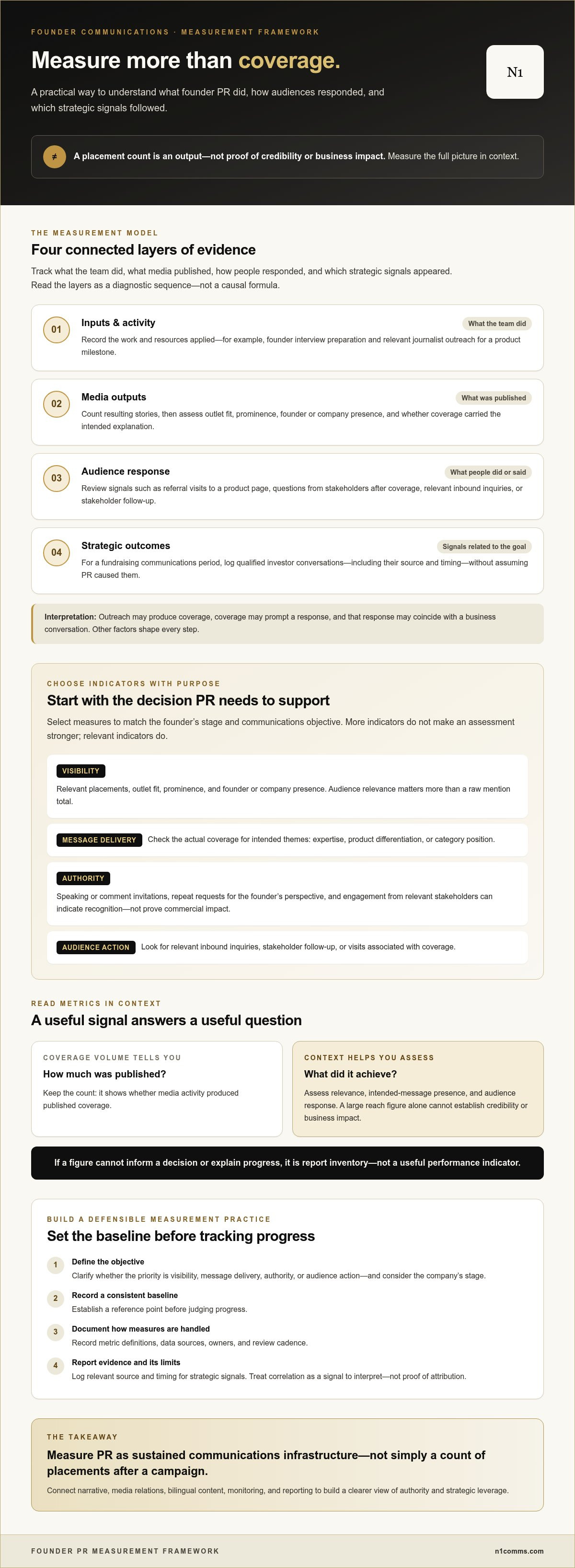
Organize metrics for successful tech founder PR across four connected levels. Each provides a different kind of evidence:
- Inputs and activity: The resources and work applied. For example, track founder interview preparation and relevant journalist outreach for a product milestone.
- Media outputs: What was published. Record the number of resulting stories and whether they included the founder’s core explanation of the milestone.
- Audience response: What people did or said after exposure. Review referral visits to the company’s product page or questions raised by stakeholders after coverage.
- Strategic outcomes: Signals related to the objective. For example, log qualified investor conversations during a fundraising communications period, including their source and timing.
Read the levels as a diagnostic sequence, not a causal formula. Outreach may produce coverage; coverage may prompt audience response; that response may coincide with relevant business conversations. Other factors shape each step. Record the evidence and its limits, then use the pattern to decide what to adjust. That is more defensible than attributing every subsequent inquiry or commercial outcome to PR.
Which Tech Founder PR Metrics Belong in a Useful Measurement Framework?
A useful framework starts with the decision the founder needs communications to support. A company preparing for fundraising may prioritize accurate investor-facing messages and relevant investor inquiries. A founder entering a new category may focus on visibility among the audiences that shape that market. The metrics for successful tech founder PR should reflect the objective and company stage. More indicators do not make an assessment stronger. Relevant indicators do.
Metrics are meaningful only when tied to a defined objective and a recorded baseline. Use four measurement groups, then select only the indicators that help assess the chosen goal:
- Visibility: Relevant placements, outlet fit, prominence, and the founder’s or company’s presence in the story. Audience relevance is more informative than a raw mention total.
- Message delivery: Whether coverage includes the intended themes, such as the founder’s expertise, product differentiation, or category position. Review the actual content rather than assuming a mention conveyed the message.
- Authority: Invitations to speak or comment, repeat requests for the founder’s perspective, and engagement from relevant stakeholders. These can indicate growing recognition, but do not prove commercial impact.
- Audience action: Relevant inbound inquiries, stakeholder follow-up, or visits associated with coverage where tracking is available. Record the source and context before interpreting an action as business-related.
Visibility and media-quality indicators
Assess a placement by asking who it reaches, how prominently the founder appears, and whether the story supports the communications objective. A Forbes Middle East mention, for example, is not automatically more valuable than coverage in another outlet. Its relevance depends on the intended audience and the quality of the story. Separate total placements from qualified placements, and document how “relevant” is defined so comparisons stay consistent.
Authority, response, and business signals
Match indicators to founder priorities such as investor interest, hiring, partnerships, or market leadership. A speaking invitation is an authority signal. A message from a prospective investor is an inbound signal. A completed investor meeting is a business activity. These are distinct measures, not interchangeable evidence of an outcome. PRSA’s discussion of PR metrics to prove ROI is a useful reference for connecting communications indicators to organizational goals without reducing evaluation to a single number.
Founders assessing founder positioning and profile building can apply the same discipline: define the objective, establish the baseline, and label each signal accurately.
How Can Founders Separate Meaningful PR Progress from Vanity Metrics?
A large number is not automatically evidence of strategic value. It may describe output, estimated exposure, or audience reaction, but it cannot establish that PR produced investor interest, customer demand, or hiring results. The metrics for successful tech founder PR need context: a baseline, a defined reporting period, audience relevance, and evidence that coverage carried the intended message.
Use this comparison to test what each figure supports and where its limits begin:
Metric: Coverage volume. Indicates: The number of published placements during a stated period. Cannot prove: Relevance, message quality, or business impact. Caveat: Compare like periods and distinguish qualified coverage from every mention.
Metric: Estimated reach. Indicates: Potential exposure based on the provider’s method. Cannot prove: That the audience saw, read, or acted on the story. Caveat: State the source and definition. Do not treat estimates as confirmed readership.
Metric: Sentiment. Indicates: How coverage is classified under a stated method. Cannot prove: Audience trust or a change in reputation by itself. Caveat: Verify the classification approach, sample, and reporting period before making a trend claim.
Metric: Message inclusion. Indicates: Whether coverage carried a selected founder or company point. Cannot prove: That readers understood or accepted it. Caveat: Define the messages in advance and review the coverage consistently.
What media volume, reach, and sentiment can and cannot show
Volume is an output, not proof of investor, customer, or hiring impact. Reach estimates are not verified attention, and sentiment scores are only interpretable when their definitions and methodology stay consistent. Before comparing periods, check whether the audience, source set, classification rules, and reporting window match. Otherwise, apparent improvement may reflect a changed measurement system rather than progress.
How to interpret attribution without overclaiming
Choose reporting language that matches the evidence. “Occurred alongside” describes correlation. “May have contributed” indicates a plausible role among other influences. “Directly generated” requires a documented method that supports the claim. Fundraising, hiring, and partnerships typically involve multiple inputs, so timing alone does not establish causation.
NarrativeOne’s technology materials state 200+ startup milestones announced and placed, $1 B+ valuation impact, and 150+ implied media placements. These are company-stated track-record figures, not benchmarks for an individual founder or evidence that PR alone caused valuation impact. Confirm definitions and reporting periods before publication. For a client programme, report its own baseline and results separately, with the limits of attribution made explicit.
How Should a Tech Founder Set PR Baselines and Review Results?
Measurement becomes useful before the first campaign activity, not after a report arrives. A baseline records the starting position; agreed definitions make later changes interpretable. Without both, a founder may mistake normal fluctuation for progress or compare figures built on different rules.
Consistent definitions turn month-to-month reporting into a valid comparison rather than a change in counting. Document each metric’s meaning, data source, owner, and review cadence before the programme begins. Then use this five-step process:
- Set the objective. State the communications priority in decision-ready terms, such as strengthening the founder’s authority in a defined category or supporting a fundraising narrative.
- Record the baseline. Capture the current position for relevant coverage, presence of key messages, and available audience responses. Use historical records where available. If data is missing, disclose the gap rather than reconstructing a figure.
- Select indicators. Choose a small set that can test the objective. Include leading indicators, such as relevant media interest or message inclusion, alongside longer-term signals, such as qualified stakeholder inquiries. Neither should be mistaken for the other.
- Review consistently. Keep the sources, definitions, audience criteria, and comparison periods stable. Note any change in method so it does not appear as a performance shift.
- Adjust deliberately. Review the evidence, identify what appears to be working or missing, and revise the communications approach. Record the reason for each change so later reviews retain context.
Choose a baseline that matches the communications objective
A baseline should reflect the goal, not whichever figures are easiest to retrieve. For a visibility objective, record relevant coverage and how prominently the founder appears. For a message objective, review whether selected themes appear in existing coverage. For audience response, use available, attributable inquiry or engagement records. Keep the timeframe and definitions consistent. If past coverage was not classified for message presence, mark that measure as unavailable rather than implying a complete historical comparison.
Turn reporting into a decision-making routine
Review activity and outcomes together. If media interest increases but the intended message is absent from coverage, the next step may be to refine the narrative. If relevant coverage appears but no stakeholder response is recorded, check whether the audience and response measure match the objective. Treat these as diagnostic signals, not automatic proof of cause.
Narrative One’s technology communications programme includes monitoring and reporting. Use the reporting process to maintain a record of results, methodological changes, and decisions. To explore a structured technology founder communications programme, consider how sustained communications support can connect narrative, media activity, monitoring, and reporting.
What Does a Measurement-Led Tech Founder PR Programme Look Like?
Measurement belongs inside the communications operating model, not in a report assembled after the work is done. The objective shapes the founder’s narrative; the narrative guides media relations and content; monitoring tests what reached the audience and how it was received. Reporting then informs the next strategic decision. Each stage should connect to the founder’s market-authority priorities while keeping evidence of activity distinct from evidence of outcomes.
Build measurement into the communications operating model
Narrative One’s technology-firm programme is structured as a twelve-month programme, not a one-off project. It brings together narrative development, media relations, bilingual content, thought leadership, monitoring, and reporting. The work starts by clarifying the narrative, then moves to drafting and review, with English and Arabic releases prepared simultaneously. Content is drafted natively in both languages, not translated after drafting.
For releases, the compliance-officer workflow includes mandatory legal sign-off before material reaches journalists. That review is part of the operating process, not a retrospective check. Monitoring and reporting provide evidence for decisions: whether the message is appearing as intended, whether the targeted media activity is relevant, and what should be refined. The programme uses a single senior operator model, not separate teams or multiple senior strategists. Its structure supports disciplined measurement, but does not guarantee a particular result for an individual founder.
Assess whether external communications support fits
Judge a provider by the operating discipline behind its claims. Ask how senior-level judgement informs the narrative, how journalist targeting reflects the objective, how English and Arabic drafting is coordinated, and how compliance review is handled. Then examine reporting: are metric definitions, sources, and limitations clear enough to guide decisions? A related strategic lens appears in Fund Brand Positioning Strategy: Build a Distinctive Investment Case, which can help frame the importance of a clear position before communications activity scales.
The right measure is not the most impressive number. It is the evidence that helps a founder decide what to reinforce, refine, or stop. A sustained programme should connect communications objectives to monitoring and reporting, while distinguishing observed signals from outcomes that cannot be attributed to PR alone.
To put a measurement-led approach in place, discuss a founder communications programme with Narrative One. Define the objective first, establish the baseline, and build the reporting discipline around both.
Make Founder PR Accountable to Strategic Progress
The metrics for successful tech founder PR do more than count activity. They connect communications objectives to media quality, audience response, and strategic signals. A clear baseline and consistent definitions make progress assessable; careful attribution keeps reporting credible.
Each founder’s measurement framework should reflect their own stage, objectives, and available evidence. Track company-reported results separately from programme-specific performance, and make clear what the figures can and cannot establish.
Measurement works best as sustained communications infrastructure, with monitoring and reporting informing what to reinforce or refine. Explore a measurement-led communications programme for technology founders and define the indicators that matter to your priorities.
With a disciplined framework, PR becomes easier to evaluate and improve. Build the evidence carefully, and let it guide the next move.
Frequently Asked Questions
Which metrics are most important for measuring tech founder PR?
The most important metrics are the ones tied to the founder’s communications objective. Track visibility through relevant coverage and prominence, message delivery through inclusion of agreed themes, authority through invitations or stakeholder engagement, and audience action through relevant inquiries or follow-up. The metrics for successful tech founder PR will differ by company stage and priority. A fundraising narrative, for example, calls for different indicators than a campaign focused on category leadership.
Is media coverage volume a reliable measure of PR success?
Coverage volume is useful for counting published placements, but it is not a reliable stand-alone measure of PR success. It cannot show whether outlets reached the intended audience, whether stories conveyed the founder’s message, or whether readers took action. Pair the placement count with outlet relevance, prominence, and message inclusion. Treat reach estimates as potential exposure, not verified readership, and explain the method behind any estimate you report.
How do you measure PR ROI for a technology startup?
Start by defining the business objective and recording a baseline. Track communications outputs and audience signals alongside relevant business activity, such as qualified investor inquiries during a fundraising period. Record timing, source, and context, then assess whether communications may have contributed. Do not attribute a funding or sales result to PR based only on timing. A credible ROI assessment states what was observed, what can be linked, and what remains uncertain.
What is the difference between PR outputs and PR outcomes?
PR outputs are the direct products of communications activity, such as a published article, an interview, or the number of relevant placements. Outcomes are the responses or strategic signals that follow, such as stakeholder engagement or a qualified inquiry. A placement is evidence that coverage appeared; it is not proof that the story changed reputation or generated business. Report outputs and outcomes separately, then describe any relationship without overstating causation.
How often should a startup review its PR metrics?
Review metrics on a consistent cadence that gives activity and response enough time to develop. Monthly reporting can help a startup monitor coverage, message delivery, and audience signals, while periodic strategic reviews assess progress against longer-term objectives. Narrative One’s technology programme includes monitoring and reporting. Keep metric definitions, sources, and comparison periods stable between reviews, and document any methodology changes so a shift in measurement is not mistaken for a shift in performance.
Can PR metrics prove that communications caused a funding round?
Usually, PR metrics alone cannot prove that communications caused a funding round. Fundraising depends on multiple factors, and a media placement occurring before an investment does not establish causation. A founder can document investor inquiries that referenced coverage, track the timing of relevant conversations, and report PR as a possible contributing factor when the evidence supports it. Use stronger causal language only when a documented measurement method can substantiate the claim.
Frequently Asked Questions
Which metrics are most important for measuring tech founder PR?
The most important metrics are the ones tied to the founder’s communications objective. Track visibility through relevant coverage and prominence, message delivery through inclusion of agreed themes, authority through invitations or stakeholder engagement, and audience action through relevant inquiries or follow-up. The metrics for successful tech founder PR will differ by company stage and priority. A fundraising narrative, for example, calls for different indicators than a campaign focused on category leadership.
Is media coverage volume a reliable measure of PR success?
Coverage volume is useful for counting published placements, but it is not a reliable stand-alone measure of PR success. It cannot show whether outlets reached the intended audience, whether stories conveyed the founder’s message, or whether readers took action. Pair the placement count with outlet relevance, prominence, and message inclusion. Treat reach estimates as potential exposure, not verified readership, and explain the method behind any estimate you report.
How do you measure PR ROI for a technology startup?
Start by defining the business objective and recording a baseline. Track communications outputs and audience signals alongside relevant business activity, such as qualified investor inquiries during a fundraising period. Record timing, source, and context, then assess whether communications may have contributed. Do not attribute a funding or sales result to PR based only on timing. A credible ROI assessment states what was observed, what can be linked, and what remains uncertain.
What is the difference between PR outputs and PR outcomes?
PR outputs are the direct products of communications activity, such as a published article, an interview, or the number of relevant placements. Outcomes are the responses or strategic signals that follow, such as stakeholder engagement or a qualified inquiry. A placement is evidence that coverage appeared; it is not proof that the story changed reputation or generated business. Report outputs and outcomes separately, then describe any relationship without overstating causation.
How often should a startup review its PR metrics?
Review metrics on a consistent cadence that gives activity and response enough time to develop. Monthly reporting can help a startup monitor coverage, message delivery, and audience signals, while periodic strategic reviews assess progress against longer-term objectives. Narrative One’s technology programme includes monitoring and reporting. Keep metric definitions, sources, and comparison periods stable between reviews, and document any methodology changes so a shift in measurement is not mistaken for a shift in performance.
Can PR metrics prove that communications caused a funding round?
Usually, PR metrics alone cannot prove that communications caused a funding round. Fundraising depends on multiple factors, and a media placement occurring before an investment does not establish causation. A founder can document investor inquiries that referenced coverage, track the timing of relevant conversations, and report PR as a possible contributing factor when the evidence supports it. Use stronger causal language only when a documented measurement method can substantiate the claim.