
A portfolio company announcement is an investment-platform capability, not a standalone press release. Yet portfolio company announcement PR is often handled differently at every company: teams improvise the message, approvals arrive late, and broad distribution creates visibility without reaching the investors or co-investors who matter. The problem isn’t a shortage of news. It’s a lack of shared operating discipline.
Fund and company teams know that timing, accuracy, and control matter. The challenge is aligning them without flattening each company’s story. This guide shows how to build a repeatable announcement process that serves the company and its investors, with relevant coverage as the objective rather than reach for its own sake. It covers ownership across the fund and portfolio, message development, approval gates, and a practical T-14, T-10, T-5, T-2, Day 0, then +7 cadence. It also explains how native English and Arabic drafting, journalist relationships, and compliance rules embedded before the compliance director reviews drafts can work as shared communications infrastructure. The result is a coordinated capability, not another ad hoc release.
Key Takeaways
Structure portfolio company announcement PR as a coordinated capability for the company and its investors, not an isolated release.
Separate the company’s core milestone from the fund’s investment thesis to keep the story clear and relevant to each audience.
Choose between targeted journalist relations, wire distribution, and owned channels based on audience relevance, editorial control, and reporting needs.
Use the T-14, T-10, T-5, T-2, Day 0, then +7 sequence to give the announcement process clear stages.
Align messaging, approvals, and compliance through shared communications infrastructure across the firm and its portfolio companies.
Table of Contents
Why portfolio company announcement PR needs an investment-firm operating model
How portfolio company announcement PR moves from thesis to coverage
Targeted media relations or wire distribution: what should the announcement use?
How to plan a compliant portfolio announcement across the 14-day sequence
What an embedded portfolio announcement service changes for an investment firm
Why portfolio company announcement PR needs an investment-firm operating model
A portfolio announcement has more than one stakeholder. A funding round, new mandate, market entry, or operating milestone can shape the company’s reputation while also informing how investors and co-investors understand the fund’s strategy. The message should serve the company first, while giving the fund accurate context for its own communications.
That is why portfolio company announcement PR means more than drafting a release. It coordinates the narrative, approvals, media relations, publication, and follow-up. A distribution channel can deliver a statement, but it can’t determine which facts establish the milestone, align the company and fund, or make the story relevant to an editor. Those decisions require an operating model.
What makes a portfolio announcement different from a standard press release?
The interests are linked, but not interchangeable. The company owns its milestone and operating story. The investment firm may explain why the investment fits its thesis. Investors and co-investors need clear, consistent facts, not competing versions of the announcement.
Frame the announcement around the underlying event. A funding announcement should clarify what the capital enables; a market-entry milestone should explain the company’s move and its relevance. In either case, editorial relevance depends on a specific, supportable story, not simply the existence of an investment relationship. For context on how private equity firms relate to portfolio companies, the fund model helps explain why company news can also carry implications for the investor.
A release is one asset in the process, and a media list or wire distribution is one route to an audience. Neither replaces a strategy that defines the story, verifies the facts, and plans what happens after publication.
Where fund and company communications need to align
Alignment starts with a shared record of facts: the milestone, approved descriptions of the company and fund, supportable claims, designated spokespeople, and timing approved by each party. Set ownership before drafting. Otherwise, conflicting edits and late approvals can dilute the message or delay the announcement.
Consistency across portfolio companies does not mean forcing every company into the same narrative. It means applying a reliable communications framework while preserving each company’s distinct story. The fund can connect an announcement to its broader investment thesis without taking focus away from the company or adding claims the company cannot substantiate.
This is also where a deliberate fund brand positioning strategy supports execution: it gives the fund a coherent point of view while keeping the portfolio company’s achievement at the centre. Shared facts, clear approval ownership, and coordinated timing turn individual announcements into communications infrastructure rather than isolated campaigns.
How portfolio company announcement PR moves from thesis to coverage
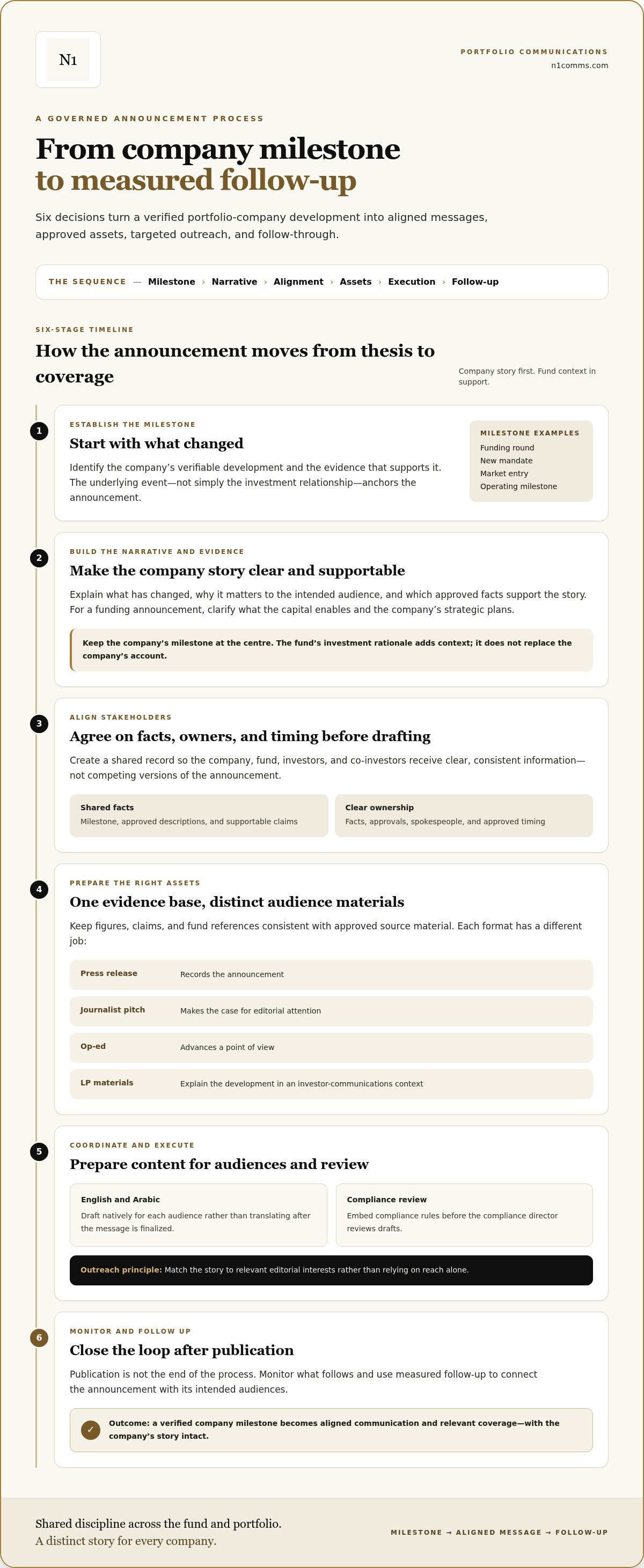
A disciplined announcement moves through six decisions: establish the company milestone, build the narrative, align stakeholders, prepare assets, execute, and monitor. Each stage has a distinct purpose. Skip one and the process can produce a polished release that lacks evidence, approval, audience fit, or follow-through.
A coordinated portfolio announcement is a governed sequence that turns a verified company milestone into aligned messages, approved assets, targeted outreach, and measured follow-up. The sequence protects the company’s story while giving the fund a clear role in explaining its investment thesis.
Build the announcement narrative and evidence base
Start with the company’s verifiable development. Identify what has changed, which evidence supports it, and why it matters to the intended audiences. A funding announcement, for example, should explain the company’s milestone and strategic plans using approved facts. The fund’s investment rationale can add context, but it shouldn’t replace the company’s account or blur the distinction between company claims and investor perspective.
Next, prepare executive messaging around the company’s strategy. A release records the announcement; a journalist pitch makes the case for editorial attention; an op-ed advances a point of view; LP materials explain the development in an investor-communications context. These assets share an evidence base, but they serve different audiences and shouldn’t be treated as interchangeable. Keep figures, claims, and fund references consistent with approved source material.
Coordinate stakeholders, bilingual content, and media relations
Assign ownership for facts, approvals, spokespeople, and timing before drafting begins. English and Arabic content should be drafted natively for each audience, not translated after the message is finalized. Compliance rules are embedded before the compliance director reviews drafts. For relevant US public-company disclosures, the SEC’s overview of Regulation FD (Fair Disclosure) explains the principle of broad, non-selective disclosure; applicability depends on the company and context.
One senior strategist can align the company’s announcement with the fund’s investment thesis without allowing either narrative to overwhelm the other. One journalist network can support targeted media relations by matching the story to relevant editorial interests rather than relying on reach alone. The same compliance workflow applies across the firm and its portfolio, creating consistent controls without forcing identical messaging.
On Day 0, execution is not the finish line. Monitor coverage and responses, follow up with stakeholders, and assess whether the announcement reached its intended audiences. Use that feedback to inform the next announcement. To see how this operating approach connects to portfolio announcements and investment-firm communications, explore NarrativeOne’s portfolio announcement approach.
Targeted media relations or wire distribution: what should the announcement use?
Choose channels according to the announcement objective. Targeted journalist relations pursue editorial interest; wire distribution makes an approved release available through distribution channels; owned communications give the company and fund a direct place to share context. These approaches can work together, but they do different jobs. Distribution can extend availability, but it cannot establish that an editor or journalist sees a story as relevant.
Distribution circulates the release; journalist-led earned coverage depends on an independent editorial decision. That distinction should shape every portfolio company announcement PR plan.
ConsiderationTargeted journalist relationsWire distributionOwned channelsAudience relevanceBuilt around a journalist’s beat and outlet audienceBroad availability, with relevance varying by pickupReaches existing company or fund audiencesEditorial controlJournalists determine whether and how to cover the storyRelease text remains the approved source, but pickup is not controlledCompany or fund controls the published messageDiscoverabilityCan surface a story to relevant editorial contactsCan make the release accessible across distribution channelsDepends on the organization’s channels and audienceMessage depthA pitch can add tailored context beyond the headlineTypically centred on the release itselfCan support further explanation and updatesReporting needsTrack relevant responses and resulting coverageReview distribution and pickup dataAssess engagement on owned channels
When targeted journalist relations fit the announcement
Use targeted outreach when the milestone has a clear connection to an outlet’s audience and a journalist’s reporting beat. A tailored pitch explains why the development matters, adds useful context, and points to the evidence behind the claim. The release provides the facts; the pitch makes the editorial case. Bloomberg, Reuters, and Financial Times are examples of outlets whose coverage may be relevant, not promised destinations.
When distribution and owned channels add value
A release gives spokespeople, investors, and media a consistent reference point. Distribution can extend its availability, while owned channels can add company perspective, fund context, or follow-up information. Neither substitutes for targeted media relations when the objective is relevant earned coverage. Investment advisers assessing their communications can consult the SEC’s SEC Marketing Rule compliance guide; applicability depends on the communication and circumstances.
Rasmal Ventures’ $45 M Series B announcement received Reuters headline placement and coverage in 270+ media outlets. It is a specific example of an announcement achieving both a named editorial placement and wider coverage, not a guarantee of the same outcome for another company. Select channels based on the milestone, audience, and available evidence. Then report on the results that matter, not distribution volume alone.
How to plan a compliant portfolio announcement across the 14-day sequence
A fixed sequence gives the fund and company a shared operating cadence. It also makes ownership visible: teams know when the narrative takes shape, when drafts move through review, and when the announcement shifts from publication to follow-up. Use the sequence as a control framework, not as a reason to invent extra deadlines or promise an editorial outcome.
What each announcement milestone should control
Keep the sequence consistent in planning documents, approval records, and timelines shared with stakeholders:
T-14: Open the preparation phase and establish the announcement’s working narrative.
T-10: Align the fund and company around the facts, messaging, and approval path.
T-5: Advance the announcement materials through preparation and review.
T-2: Confirm readiness across the approved materials and stakeholders.
Day 0: Release the announcement using the agreed timing and assets.
+7: Follow up and review the announcement’s progress.
These checkpoints create structure without implying that every announcement needs the same level of activity at each stage. The milestone, audience, and approval requirements determine the work within the framework. The sequence itself remains fixed: T-14, T-10, T-5, T-2, Day 0, then +7.
How compliance and bilingual drafting fit before publication
Compliance belongs in the workflow before a draft reaches the compliance director. Embed the applicable rules into the drafting process first, then route drafts for the director’s review. This makes review part of message development, not a late-stage check after the narrative and assets have already been set.
English and Arabic materials should be drafted natively as parallel content, rather than writing one version and translating it afterward. That allows each version to carry the same approved facts while reading naturally for its audience. A same-day bilingual release is supported within the portfolio announcement service.
Review and approval precede journalist distribution. This principle protects message control and gives the media-relations process a clear handoff. Tier-1 coverage within 14 days is achievable, not assured; editorial decisions remain independent of the workflow.
For investment firms seeking a disciplined process for portfolio company announcement PR, NarrativeOne’s Portfolio announcement service brings the sequence, native bilingual drafting, and shared compliance workflow into one operating model.
What an embedded portfolio announcement service changes for an investment firm
An embedded model replaces disconnected, one-off execution with shared communications infrastructure. One senior strategist, one journalist network, and one compliance workflow support the investment firm and every portfolio company. The system is shared; the story remains specific to each company.
That distinction matters. A repeatable process can connect portfolio announcements to the fund’s wider narrative while preserving clear ownership of company facts, approvals, and spokespeople. It also gives the firm a consistent governance framework for communications, rather than requiring each portfolio team to rebuild the process from scratch.
What investment firms gain from shared communications infrastructure
Portfolio company announcement PR works best as part of an ongoing communications architecture. A practical operating rhythm can pair a 12-month narrative plan with weekly execution and monthly reporting. The plan establishes priorities; weekly execution advances active communications; monthly reporting gives the firm a regular view of progress and follow-up. This cadence supports consistency without imposing a single message on every company.
NarrativeOne brings 17 years of operating experience inside recognised investment institutions. Its firm-level experience includes $2 B+ AUM across 150+ funds/clients. These figures provide context for the investment-firm focus; they are not a promise of results for an individual announcement.
How to assess fit and take the next step
Assess the requirement before choosing the operating model. If the need is one isolated release, the immediate priorities are a defined milestone, approved facts, and a clear publication path. If announcements recur across the portfolio, consider whether the firm needs shared narrative oversight, repeatable approvals, coordinated media relations, bilingual content, and consistent follow-up.
A Portfolio announcement service brings those elements together through a shared strategist, journalist network, and compliance workflow. English and Arabic content is drafted natively, and compliance rules are embedded before the compliance director reviews drafts. The model supports both the fund’s communications priorities and each company’s distinct announcement.
Use the decision to clarify ownership: who develops the narrative, who approves the facts, and who coordinates outreach? If those responsibilities vary from company to company, a repeatable capability can establish a stronger operating baseline. Explore NarrativeOne’s portfolio announcement service.
Make every portfolio announcement part of the operating model
Effective portfolio company announcement PR depends on coordination, not distribution alone. A clear narrative separates the company’s milestone from the fund’s investment thesis, while defined approvals, relevant media relations, and planned follow-up keep execution aligned. A repeatable process lets the firm support each company without making every announcement sound the same.
NarrativeOne brings 17 years of operating experience inside investment institutions, with $2 B+ AUM across 150+ funds/clients. Rasmal Ventures’ $45 M Series B announcement received Reuters headline placement and coverage in 270+ media outlets. These are proof points, not promises of future coverage.
If announcements are handled differently across your portfolio, assess where shared ownership and workflow could improve control. Explore NarrativeOne’s portfolio announcement service to see how one senior strategist, one journalist network, and one compliance workflow support the firm and its companies.
With the right communications infrastructure, each announcement can serve its company and contribute to a coherent fund narrative. Build the process once, then apply it with discipline.
Frequently Asked Questions
What is portfolio company announcement PR?
Portfolio company announcement PR is coordinated communications around a portfolio company’s milestone. It includes the narrative, approval process, media relations, release, and follow-up, with clear roles for the company and investment firm. A funding round, new mandate, or market-entry development may matter to both: the company owns the operating story, while the fund can explain its investment context. The purpose is relevant communication, not merely issuing a release.
How do you announce a portfolio company funding round to the media?
Start by confirming the funding details and other claims against approved source material. Build the announcement around what the company has achieved and what the funding enables, then align the company and fund on spokespeople, language, and timing. Prepare a release as the factual reference point and tailored pitches for journalists whose audiences fit the story. Coordinate distribution and follow-up; sending a release alone is not proof of media interest.
Can a portfolio announcement generate earned media coverage without relying only on a wire?
Yes. Targeted journalist relations can seek earned coverage without relying solely on wire distribution. Identify journalists whose reporting interests and audiences align with the milestone, then pitch the story with relevant context beyond the release headline. A wire can extend the release’s availability, while owned channels provide a direct place for company and fund updates. Editorial coverage remains an independent decision, so no channel or outreach approach guarantees placement.
How long does a portfolio company announcement PR campaign take?
The announcement workflow uses the sequence T-14, T-10, T-5, T-2, Day 0, then +7. This provides a preparation and alignment cadence leading to publication, followed by a defined follow-up point. A same-day bilingual release is supported, and Tier-1 coverage within 14 days is achievable, not assured. The schedule structures the work; it doesn’t control editorial decisions or guarantee that a journalist will publish a story.
What should a portfolio company press release include?
A press release should state the company’s verified milestone clearly, with supporting facts and approved figures. For a funding announcement, explain the round and the company’s stated plans for the capital, using language the company and fund have aligned on. Identify the relevant company spokesperson and include accurate context about the fund where it helps readers understand the investment. Keep claims supportable and consistent across the release and related materials.
How should an investment firm coordinate its messaging with a portfolio company?
Agree on shared facts, approved descriptions, spokespeople, approval ownership, and announcement timing before publication. Keep the company’s milestone and operating narrative at the centre; use the fund’s investment thesis as supporting context rather than a substitute for the company story. A shared process can maintain consistency across portfolio announcements while allowing each company’s message to reflect its own development. Native English and Arabic drafting can keep both versions aligned in substance.
How can firms manage compliance in portfolio company announcements?
Build relevant compliance rules into the drafting workflow before the compliance director reviews drafts. Align claims, figures, and fund references with approved source material, and complete the required review and approvals before journalist distribution. Keep the final release consistent with any related pitches and owned-channel messages. Requirements depend on the entities and communication involved, so assign clear review ownership rather than assuming one generic approval process fits every announcement.
Frequently Asked Questions
What makes a portfolio announcement different from a standard press release?
The interests are linked, but not interchangeable. The company owns its milestone and operating story. The investment firm may explain why the investment fits its thesis. Investors and co-investors need clear, consistent facts, not competing versions of the announcement. Frame the announcement around the underlying event. A funding announcement should clarify what the capital enables; a market-entry milestone should explain the company’s move and its relevance. In either case, editorial relevance depends on a specific, supportable story, not simply the existence of an investment relationship. For context on how private equity firms relate to portfolio companies, the fund model helps explain why company news can also carry implications for the investor. A release is one asset in the process, and a media list or wire distribution is one route to an audience. Neither replaces a strategy that defines the story, verifies the facts, and plans what happens after publication.
What is portfolio company announcement PR?
Portfolio company announcement PR is coordinated communications around a portfolio company’s milestone. It includes the narrative, approval process, media relations, release, and follow-up, with clear roles for the company and investment firm. A funding round, new mandate, or market-entry development may matter to both: the company owns the operating story, while the fund can explain its investment context. The purpose is relevant communication, not merely issuing a release.
How do you announce a portfolio company funding round to the media?
Start by confirming the funding details and other claims against approved source material. Build the announcement around what the company has achieved and what the funding enables, then align the company and fund on spokespeople, language, and timing. Prepare a release as the factual reference point and tailored pitches for journalists whose audiences fit the story. Coordinate distribution and follow-up; sending a release alone is not proof of media interest.
Can a portfolio announcement generate earned media coverage without relying only on a wire?
Yes. Targeted journalist relations can seek earned coverage without relying solely on wire distribution. Identify journalists whose reporting interests and audiences align with the milestone, then pitch the story with relevant context beyond the release headline. A wire can extend the release’s availability, while owned channels provide a direct place for company and fund updates. Editorial coverage remains an independent decision, so no channel or outreach approach guarantees placement.
How long does a portfolio company announcement PR campaign take?
The announcement workflow uses the sequence T-14, T-10, T-5, T-2, Day 0, then +7. This provides a preparation and alignment cadence leading to publication, followed by a defined follow-up point. A same-day bilingual release is supported, and Tier-1 coverage within 14 days is achievable, not assured. The schedule structures the work; it doesn’t control editorial decisions or guarantee that a journalist will publish a story.
What should a portfolio company press release include?
A press release should state the company’s verified milestone clearly, with supporting facts and approved figures. For a funding announcement, explain the round and the company’s stated plans for the capital, using language the company and fund have aligned on. Identify the relevant company spokesperson and include accurate context about the fund where it helps readers understand the investment. Keep claims supportable and consistent across the release and related materials.
How should an investment firm coordinate its messaging with a portfolio company?
Agree on shared facts, approved descriptions, spokespeople, approval ownership, and announcement timing before publication. Keep the company’s milestone and operating narrative at the centre; use the fund’s investment thesis as supporting context rather than a substitute for the company story. A shared process can maintain consistency across portfolio announcements while allowing each company’s message to reflect its own development. Native English and Arabic drafting can keep both versions aligned in substance.
How can firms manage compliance in portfolio company announcements?
Build relevant compliance rules into the drafting workflow before the compliance director reviews drafts. Align claims, figures, and fund references with approved source material, and complete the required review and approvals before journalist distribution. Keep the final release consistent with any related pitches and owned-channel messages. Requirements depend on the entities and communication involved, so assign clear review ownership rather than assuming one generic approval process fits every announcement.