A fund of funds can have a rigorous investment thesis and still appear incoherent to institutional investors. PR for fund of funds must make manager-selection logic visible while preserving the identity of each underlying strategy. The platform needs a shared narrative, not a single voice imposed across every manager.
That distinction is difficult to communicate. Investors need to understand how managers are selected, what role they play in the portfolio, and how their developments connect to the fund’s broader strategy. When those messages are uncoordinated, portfolio announcements can feel fragmented. When they’re over-standardised, distinct strategies disappear.
This article explains how to use PR to describe the investment model, build institutional credibility, and coordinate platform and portfolio communications without flattening manager voices. It covers narrative structure, announcement coordination, and a compliance-aware workflow. The objective is not more visibility for its own sake. It’s a clear, accurate account of how the platform creates value.
Key Takeaways
PR for fund of funds should explain the platform’s investment approach and manager-selection logic without turning distinct strategies into one generic story.
Connect platform messaging, manager narratives, and portfolio announcements through shared terminology while preserving each voice.
Prioritise communications by their substance, audience relevance, timing, and approved information, not by activity alone.
Build a practical governance sequence: define the narrative, assign owners, plan channels, review drafts, and monitor outcomes.
Coordinate communications through one operating model that aligns strategy, media relations, bilingual content, and GP thought leadership.
Table of Contents
What PR for a Fund of Funds Must Explain
PR for fund of funds is the coordinated communication of a platform’s investment approach, its role in selecting managers, and the distinct strategies represented across its underlying portfolio. It must make the whole legible without making its parts interchangeable. A Fund of funds (FOF) overview provides useful background on the structure. Communications must go further by explaining how this particular platform operates and how its narratives relate.
Platform credibility explains why the fund exists and how it approaches manager selection. Individual manager visibility explains each manager’s own strategy, expertise, and developments. These are connected responsibilities, not competing ones. A shared communications framework aligns the account of the platform while leaving each manager’s investment identity intact.
The purpose is not simply to generate attention. Communications should help institutional audiences understand the platform’s role, clarify what a portfolio development means, or provide relevant context about a manager. Before announcing a development, ask what has changed, who needs to know, and which approved facts support the message. Visibility without substance adds noise. Useful communication gives audiences a clear reason to understand the information and how it fits the broader investment model.
Why the multi-manager model needs a distinct narrative
A fund of funds sits between a platform-level strategy and multiple underlying managers. Without explanation, audiences may struggle to distinguish the platform’s function from the work of the managers it selects. The narrative must show how the platform creates coherence across those relationships without implying that every manager shares one approach.
That requires clear language about selection logic: what the platform evaluates, how managers fit within its approach, and what role each strategy plays. The explanations should reflect the actual investment process, not substitute generic claims for evidence. Consistency comes from precise terminology and a stable account of the platform’s role. It does not require identical descriptions of different managers.
Who fund-of-funds communications need to serve
External communications may serve LPs and co-investors who need an accurate account of the platform, its managers, or a relevant portfolio development. Their information needs vary by context. An LP communication may need to explain the platform’s mandate, while a portfolio announcement should make the company’s development clear. Address the subject directly rather than assuming every audience shares the same priorities or decision criteria.
Internal stakeholders shape the accuracy and coherence of that account. Leadership establishes the platform narrative; investment teams provide context on selection and portfolio developments; portfolio managers contribute detail and perspective specific to their strategies. Assign each stakeholder a clear role in supplying or approving information. This helps prevent conflicting messages while preserving appropriate differences in voice, resulting in an institutional narrative that informs without overclaiming.
How Fund-of-Funds PR Connects Platform, Managers, and Portfolio
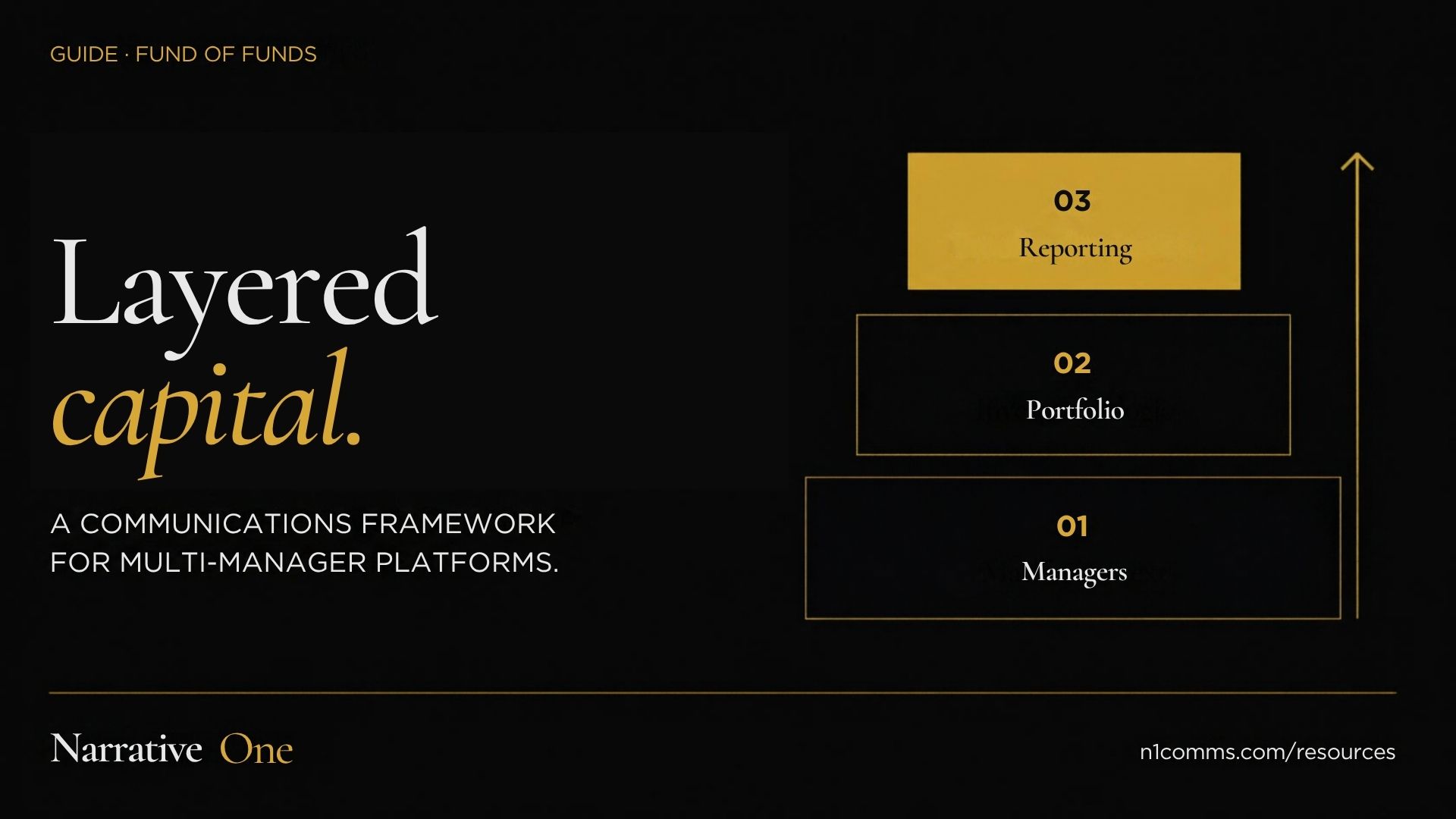
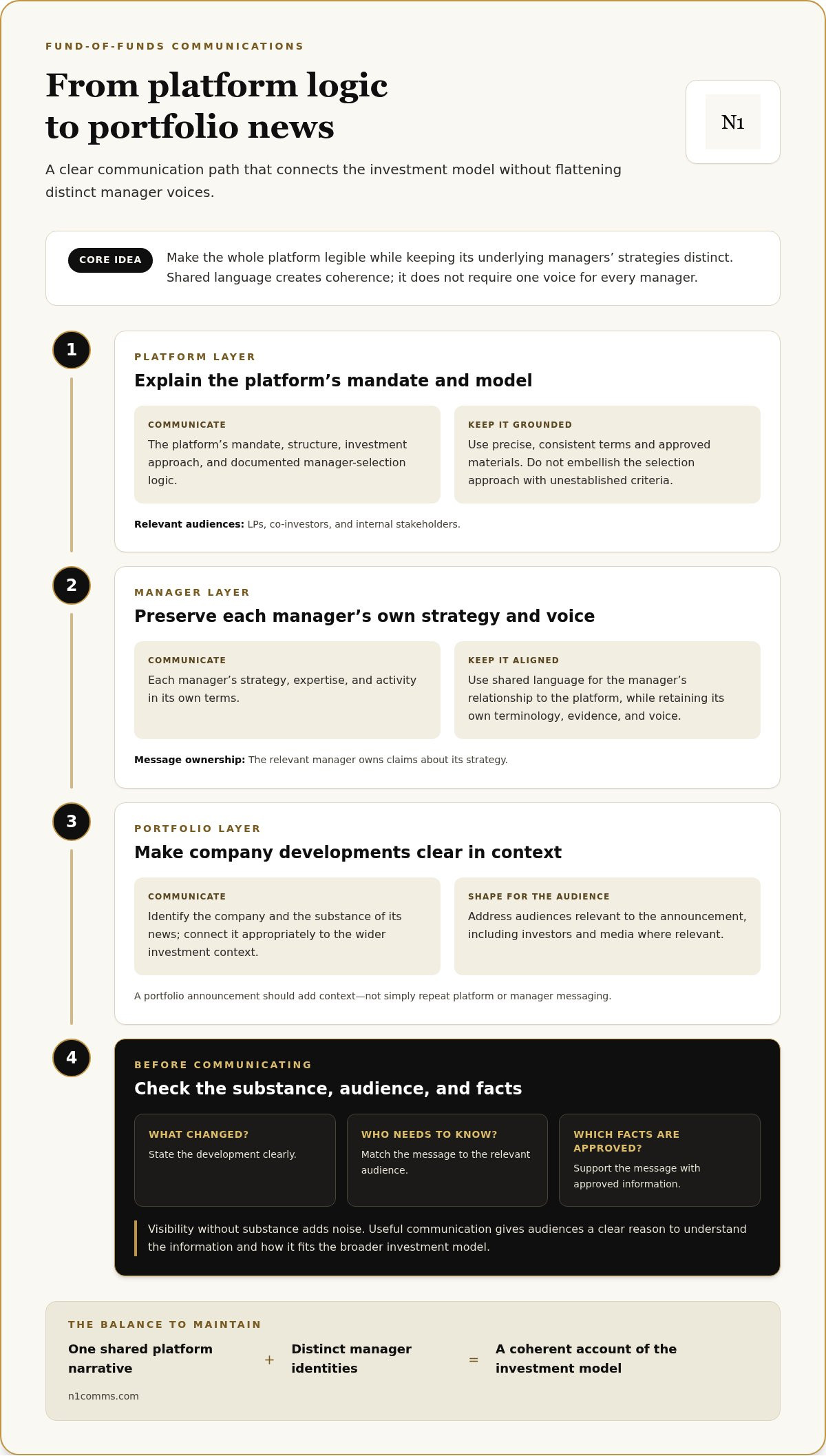
Fund-of-funds communications work as a layered system. The platform explains its mandate and investment approach. Each underlying manager communicates its own strategy and expertise. Portfolio-company announcements report developments at company level, with relevant context about the manager or platform relationship. PR for fund of funds connects these messages without collapsing them into one voice.
Platform layer
Audience: LPs, co-investors, and internal stakeholders.
Purpose: Explain the platform’s mandate, structure, and documented approach to manager selection.
Manager layer
Audience: LPs, co-investors, and relevant industry audiences.
Purpose: Communicate each manager’s strategy, expertise, and activity in its own terms.
Portfolio layer
Audience: Audiences relevant to the company announcement, including investors and media.
Purpose: Share a company development accurately and show its appropriate connection to the wider investment context.
The platform narrative: mandate, model, and selection logic
The platform narrative should state what the fund is designed to do, how its multi-manager structure works, and how its selection approach is described in approved materials. Communications should not embellish that approach with criteria the investment team has not established. Use consistent terms for the platform, its underlying managers, and their relationship. Repeating precise language builds recognition; broad claims create ambiguity.
Message ownership matters. Platform leadership and the investment team should validate statements about the mandate and selection logic. The relevant manager should own claims about its strategy. This division keeps each message accountable and limits duplicated announcements that repeat the same information without adding context.
Manager and portfolio narratives: distinct voices, shared context
Managers need room to describe their own strategies and expertise. A common framework can set shared language for the relationship to the platform while leaving each manager’s terminology, evidence, and voice intact. Alignment is not uniformity.
Portfolio announcements should identify the company and the substance of its news, then connect it to the relevant manager or platform only where that relationship is accurate and appropriate. Avoid wording that implies the platform controls a company or speaks on its behalf unless that is factually supported. For practical guidance on company-level communications, see the portfolio company PR guide for investment firms.
This architecture gives each layer a clear owner and purpose. A shared investment communications framework can help maintain that coordination as platform, manager, and portfolio messages move across channels.
Which Fund-of-Funds Communications Deserve Attention?
Not every development warrants the same communication or the same channel. A fund launch, a manager’s new investment, a portfolio company milestone, and a partner’s market commentary each serve a different purpose. Strong PR for fund of funds prioritises developments by substance, audience relevance, timing, and the information approved for use. Before planning an announcement, identify what is genuinely new, who it matters to, and what the audience needs to understand. Activity alone is not a reason to announce.
Platform news versus manager and portfolio developments
A platform milestone should explain a meaningful change or development at the fund level. A manager announcement should reflect that manager’s own activity. Portfolio news should lead with the company’s development, not use it as a substitute for explaining the platform. A fund launch is its own communications moment; the new fund announcement guide offers a focused reference.
CommunicationNarrative ownerPrimary audiencePurpose and suitable channelPlatform milestone or fund launchPlatform leadershipLPs, co-investors, and relevant mediaExplain the fund-level development through approved LP materials, an owned announcement, or a targeted media pitch.Manager activityRelevant managerAudiences connected to that manager’s strategyProvide manager-specific context through its own channels or a focused pitch.Portfolio announcementPortfolio company, with relevant investment stakeholdersAudiences interested in the company’s newsReport the company development and its accurate investment context through an announcement or relevant media outreach.Partner commentaryPartner or designated executiveLPs, co-investors, and relevant industry audiencesContribute informed perspective through an op-ed, interview, or other thought leadership.
The table is a routing tool, not a ranking. A development earns attention when it offers material information, matters to a defined audience, is well-timed, and can be communicated using approved facts. Portfolio news can illustrate activity across the platform, but repeated portfolio announcements cannot carry the platform’s full narrative.
Editorial coverage and owned communications serve different roles
An owned release, pitch, op-ed, and LP communication are not interchangeable. A release states approved information in the organisation’s own channel. A pitch presents a relevant story to journalists. An op-ed advances a partner’s perspective. LP materials address their intended institutional audience. Earned media is editorial coverage, not paid placement or guaranteed distribution. Publications decide what they cover, when, and how.
Media planning should begin with the story’s substance and audience, not a target publication name alone. The Bloomberg coverage strategy guide provides context for planning around a specific outlet. A disciplined investment communications strategy keeps announcements, sustained media relations, and executive commentary distinct.
How to Build a Compliance-Aware Fund-of-Funds PR Framework
A compliance-aware communications framework is a governance process, not a substitute for legal advice. It determines who owns each message, how facts are verified, which channels are appropriate, and when a communication receives review. PR for fund of funds needs this discipline because platform, manager, and portfolio messages can involve different owners and audiences.
Define the narrative. Set out the platform’s mandate, investment approach, and manager-selection logic using approved facts. Identify which claims belong to the platform and which must come from an underlying manager or portfolio company.
Assign message owners. Name an accountable owner for platform communications, manager statements, and company announcements. Confirm who supplies source information and who approves the final draft.
Plan channels. Match the communication to its audience and purpose. An LP update, an owned announcement, a media pitch, and partner commentary serve different functions. Choose deliberately.
Review drafts before release. Build the appropriate compliance review into the drafting workflow, not into a last-minute approval step. Each communication requires review suited to its content and intended use.
Monitor outcomes. Track whether messages remain consistent across channels and record relevant coverage against an agreed baseline. Report observations without treating coverage or attention as guaranteed results.
Set narrative ownership and a repeatable communications cadence
NarrativeOne’s model uses a 12-month narrative plan, executed weekly and reported monthly. The annual plan establishes priorities and key themes; weekly execution turns those priorities into communications activity; monthly reporting reviews progress and informs adjustments. Measure consistency and relevant coverage against an agreed baseline. Don’t manufacture targets or results where evidence isn’t available.
This cadence makes ownership operational. Leadership validates the platform account. Investment teams confirm fund and manager context. The relevant manager or portfolio company owns its statements. A shared calendar can flag overlapping announcements, gaps, and moments that require coordination before drafts circulate.
Embed compliance before communication reaches the media
Compliance rules are embedded before the compliance director reviews drafts. The sequence matters: establish boundaries during message development, check claims and approved information as the draft takes shape, then route it for the appropriate review. FSRA, ADGM, DIFC, SAMA, and CMA are included in the compliance workflow. Their mention does not determine which rules apply to a specific communication.
This is communications governance. It supports controlled drafting and review; it doesn’t replace legal advice or the organisation’s own approval requirements. To explore this approach, review NarrativeOne’s investment-firm communications approach.
What a Fund-of-Funds PR Operating Model Looks Like
For a multi-manager platform, communications need shared infrastructure and clear ownership. The operating model is compact: one senior strategist aligns the platform and portfolio narratives; one journalist network connects relevant stories with publications read by LPs and co-investors; one compliance workflow governs drafts across the communications process. This structure coordinates activity without making managers sound alike or implying that editorial coverage is assured.
Each capability has a defined role. Strategy & narrative sets the central messages and how they relate across the firm and its portfolio. Media relations identifies appropriate stories and develops journalist engagement. Bilingual content and GP thought leadership extend that work across languages and executive perspectives. English and Arabic content is drafted natively to senior financial-journalist standards, not translated after drafting. Compliance rules are embedded before the compliance director reviews drafts.
A shared communications function across firm and portfolio
An embedded function gives the platform and portfolio companies a coordinated communications structure while preserving the right owner for each message. The Portfolio announcement service uses a defined sequence: T-14 → T-10 → T-5 → T-2 → Day 0 → +7. A planned cadence creates time to coordinate information, approvals, messaging, publication, and follow-up. Media outreach can target publications relevant to LPs and co-investors, but coverage remains an editorial decision.
This operating model also helps prevent a portfolio announcement from carrying claims about the wider platform that it cannot support. Each message stays grounded in its source, while shared terminology makes the relationship between firm and portfolio easier to understand.
Evidence, operating discipline, and next steps
NarrativeOne was built by a former investment-firm chief communications officer with 17 years of direct fundraising, exit, and term-sheet experience. A practical example is Rasmal Ventures’ $45 M Series B announcement, which received Reuters headline placement and coverage in 270+ media outlets, using a bilingual release. The example demonstrates coordinated execution; it does not promise the same coverage for another announcement.
For fund leaders, the value is operational: a consistent narrative, distinct manager voices, disciplined review, and communications planned across the platform and portfolio. Discuss a communications framework for your fund.
Build Communications That Match the Fund’s Structure
Effective PR for fund of funds makes the platform’s investment approach clear, gives each underlying manager room to communicate its distinct strategy, and connects portfolio developments to the wider narrative without overstating relationships. A defined owner for each message, disciplined channel planning, and compliance-aware review turn that clarity into repeatable practice.
NarrativeOne brings 17 years of operating experience inside investment institutions, with $2 B+ AUM across 150+ funds/clients. Its work includes Rasmal Ventures’ $45 M Series B announcement, which received Reuters headline placement and coverage in 270+ media outlets. These are examples of communications execution, not promises of future coverage.
For a fund whose platform and managers need to speak with distinct but aligned voices, discuss a communications framework for your fund. The right foundation makes every message clearer, more disciplined, and more credible.
Frequently Asked Questions
What does PR for a fund of funds include?
PR for a fund of funds coordinates communications about the platform, its underlying managers, and relevant portfolio developments. Strategy & narrative defines the messages; Media relations connects suitable stories with journalists; Bilingual content supports communication in English and Arabic; GP thought leadership develops partner perspectives; and Monitoring & crisis tracks coverage and issues. The mix should reflect the fund’s structure, audiences, and approved information, not default to announcements.
How is fund-of-funds PR different from PR for a single investment fund?
Fund-of-funds PR must explain both the platform’s role and the distinct strategies of its underlying managers. A single-fund narrative may involve fewer communication layers, but structures differ. Coordinated message ownership helps clarify who speaks for the platform, each manager, and portfolio developments. Consistent context connects those messages without suggesting that every platform or manager shares the same strategy or communications model.
Can a fund of funds communicate portfolio-company news without confusing its own narrative?
Yes, if the announcement has a clear owner and accurately explains its relationship to the platform. Keep the portfolio company’s facts and voice distinct; don’t imply a stronger connection or degree of control than exists. A shared message framework can supply context without taking over the company’s story. Before external distribution, confirm the information, approvals, spokesperson, and wording appropriate to the announcement.
How should a fund of funds approach media relations?
Start with the story’s substance, intended audience, and appropriate spokesperson. Then match the message to relevant publications and formats, such as a release, journalist pitch, or partner op-ed. Media relations involves editorial engagement, not guaranteed coverage or paid placement. Follow-up and monitoring should be consistent, with results assessed against an agreed baseline. The objective is relevant communication, not coverage volume for its own sake.
How can fund-of-funds PR remain compliance-aware?
Establish message ownership and review responsibilities before drafting begins. Embed applicable compliance rules into the workflow, then route drafts through the appropriate compliance director review before media distribution. The review should inform drafting, not appear as a last-minute step. Requirements depend on the fund and the communication’s circumstances. Communications guidance supports governance, but it isn’t legal advice or a substitute for formal review.
How often should a fund of funds communicate with LPs and the media?
There’s no single cadence for every platform. Set a rhythm around the fund’s narrative, material developments, audience needs, and internal review process. NarrativeOne’s model uses a 12-month narrative plan, executed weekly and reported monthly. This is the firm’s delivery model, not a universal industry standard. Regular planning helps coordinate communications while leaving room for relevant developments and appropriate review.
Frequently Asked Questions
What does PR for a fund of funds include?
PR for a fund of funds coordinates communications about the platform, its underlying managers, and relevant portfolio developments. Strategy & narrative defines the messages; Media relations connects suitable stories with journalists; Bilingual content supports communication in English and Arabic; GP thought leadership develops partner perspectives; and Monitoring & crisis tracks coverage and issues. The mix should reflect the fund’s structure, audiences, and approved information, not default to announcements.
How is fund-of-funds PR different from PR for a single investment fund?
Fund-of-funds PR must explain both the platform’s role and the distinct strategies of its underlying managers. A single-fund narrative may involve fewer communication layers, but structures differ. Coordinated message ownership helps clarify who speaks for the platform, each manager, and portfolio developments. Consistent context connects those messages without suggesting that every platform or manager shares the same strategy or communications model.
Can a fund of funds communicate portfolio-company news without confusing its own narrative?
Yes, if the announcement has a clear owner and accurately explains its relationship to the platform. Keep the portfolio company’s facts and voice distinct; don’t imply a stronger connection or degree of control than exists. A shared message framework can supply context without taking over the company’s story. Before external distribution, confirm the information, approvals, spokesperson, and wording appropriate to the announcement.
How should a fund of funds approach media relations?
Start with the story’s substance, intended audience, and appropriate spokesperson. Then match the message to relevant publications and formats, such as a release, journalist pitch, or partner op-ed. Media relations involves editorial engagement, not guaranteed coverage or paid placement. Follow-up and monitoring should be consistent, with results assessed against an agreed baseline. The objective is relevant communication, not coverage volume for its own sake.
How can fund-of-funds PR remain compliance-aware?
Establish message ownership and review responsibilities before drafting begins. Embed applicable compliance rules into the workflow, then route drafts through the appropriate compliance director review before media distribution. The review should inform drafting, not appear as a last-minute step. Requirements depend on the fund and the communication’s circumstances. Communications guidance supports governance, but it isn’t legal advice or a substitute for formal review.
How often should a fund of funds communicate with LPs and the media?
There’s no single cadence for every platform. Set a rhythm around the fund’s narrative, material developments, audience needs, and internal review process. NarrativeOne’s model uses a 12-month narrative plan, executed weekly and reported monthly. This is the firm’s delivery model, not a universal industry standard. Regular planning helps coordinate communications while leaving room for relevant developments and appropriate review.