
Investment-firm communications support capital formation, not just press releases. A PR firm for investment firms connects media relations, reputation, fundraising credibility, and executive thought leadership to strengthen the firm’s public position. The goal is not simply to generate coverage, but to make the investment strategy clear to the audiences whose confidence matters.
That distinction matters because investors and journalists assess more than an announcement. They look for a coherent thesis, credible leadership, and messages that hold up across market cycles and public scrutiny. This article explains how a financial services PR firm supports investment-focused media relations, reputation, fundraising communications, and executive positioning. It also considers what a disciplined engagement involves. The central question is alignment: every public statement should reinforce the firm’s strategic narrative without going beyond its facts.
Key Takeaways
Investment-focused media relations works best when announcements, market commentary, and leadership messages reinforce one coherent position.
Private equity, venture capital, and alternative managers need communications shaped around their fund strategy, portfolio, and investor audiences.
Fundraising credibility depends on a clear narrative that makes the investment thesis and its evidence understandable to limited partners.
Executive thought leadership builds authority when leaders contribute a distinct, informed perspective rather than repeat generic market commentary.
Assess specialist agencies by how well their media strategy, investor communications, and executive positioning align with your firm’s priorities.
Table of Contents
PR for private equity, venture capital, and alternative investment managers
Which PR agencies specialize in investment firms and asset managers in the US?
Asset management and hedge fund media relations
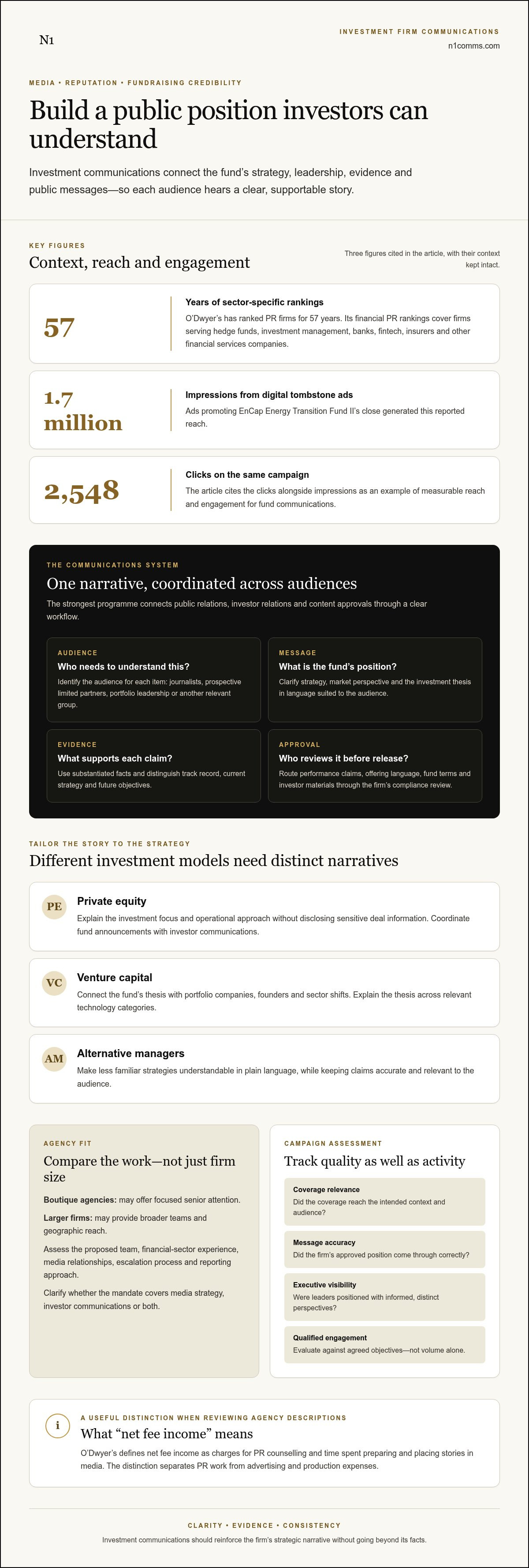
For asset managers and hedge funds, media relations must protect the investment thesis while making it understandable to journalists and investors. A strong communications programme links public relations, investor relations, and content approvals through a clear workflow.
Media Relations and Content Creation
Media relations starts with a usable message architecture: the fund’s strategy, market perspective, and evidence for each claim. Content may include executive commentary, portfolio announcements, market analysis, and prepared responses to likely questions. Identify the audience and approval owner for each item. A market note for journalists, for example, may need different detail from an LP update.
Ask how the agency develops story angles, prepares spokespeople, and verifies facts before pitching. A PR firm for investment firms should distinguish explaining a strategy from implying an investment outcome. Effective media relations prioritizes accurate, relevant coverage over volume.
Agency Selection and Comparison
Choose an agency by testing its financial-sector experience, senior-level involvement, and capacity to coordinate with compliance and investor relations. O’Dwyer’s financial PR rankings cover firms serving hedge funds, investment management services, banks, fintech providers, insurers, and other financial services companies. O’Dwyer’s has ranked PR firms for 57 years, offering a sector-specific reference point for comparison.
Boutique agencies may offer focused senior attention, while larger firms may provide broader teams and geographic reach. Compare the proposed account team, relevant media relationships, escalation process, and reporting approach rather than firm size alone. Investor relations and public relations may overlap, so clarify whether the mandate covers media strategy, investor communications, or both.
Credibility and Media Coverage
Credibility grows through consistent, supportable communication. An agency should match a spokesperson’s expertise to the story, provide useful context for journalists, and prepare clear answers before interviews. For a global manager, core messages should also align across markets, with examples and terminology adapted for each audience.
How should investment firms compare agencies? Look at the proposed team, sector knowledge, deliverables, and approval workflow. What services might an agency cover? Common needs include media strategy, content, spokesperson preparation, investor relations coordination, and issue response. How can firms assess a campaign? Track coverage relevance, message accuracy, executive visibility, and qualified engagement against agreed objectives.
For US-facing communications, route performance claims, offering language, fund terms, and investor materials through the firm’s compliance review before release. The PR team should follow that process rather than interpret SEC requirements independently. Coordinate media announcements with LP communications so timing, language, and approved facts remain consistent.
How do firms build media credibility? Offer informed commentary, substantiate claims, and respond promptly to journalists with relevant context. O’Dwyer’s defines net fee income as charges for PR counselling and time spent preparing and placing stories in media. This distinction can help when reviewing agency descriptions that separate PR work from advertising and production expenses.
Digital tombstone ads promoting EnCap Energy Transition Fund II’s close generated 1.7 million impressions and received 2,548 clicks, illustrating measurable reach and engagement for fund communications.
PR for private equity, venture capital, and alternative investment managers
Private equity, venture capital, and alternative managers need communications shaped around their capital strategies. The narrative should connect fund objectives, investment approach, portfolio activity, and leadership expertise.
Private Equity and Emerging Manager PR
A private equity firm’s public messaging should explain its investment focus without disclosing sensitive deal information. An emerging manager can build its narrative around partner experience, sector expertise, and investment thesis. Start by mapping each audience, such as prospective limited partners, portfolio leadership, and business media, to approved evidence and messages.
Coordinate fund announcements with investor communications. A first-time fundraise, for example, calls for consistent descriptions of strategy and leadership across media materials and LP updates. Assess whether the agency can explain private-market terms clearly while preserving the distinctions between track record, current strategy, and future objectives.
Private equity and venture capital have different investment models, so their communications should not rely on a generic script. A private equity firm may emphasize its operational approach and portfolio developments; a venture capital firm may explain its thesis across technology categories. In both cases, integrated planning aligns partner commentary, company announcements, and investor-facing messages.
Venture Capital and Alternative Manager PR
Venture capital communications often connect a fund’s thesis with portfolio companies, founders, and shifts in the sector. Alternative managers may need to explain less familiar strategies in plain language. A practical sequence is to define the audience, choose a substantiated point of view, prepare a spokesperson, and match the message to the right media context.
Fintech, digital assets, and other evolving categories call for precise explanations. When commenting on a market development, distinguish observable facts from opinion and avoid implying performance outcomes. Review each proposed story angle against the fund’s strategy, approved information, and investor communications before publication.
Portfolio announcements also require coordination between the manager and the company involved. Agree on timing, approved descriptions, spokesperson roles, and the facts each party can share. This helps ensure an announcement does not present an investment as a forecast or substitute publicity for evidence.
Investment Firm Agency Specialization
In the US, O’Dwyer’s directory covers PR agencies specializing in financial public relations and investor relations. Its categories include hedge funds, investment management services, fintech providers, banks, insurers, and industry trade associations. O’Dwyer’s has ranked PR firms for 57 years, making sector coverage a useful starting point for agency research.
Use directory listings to identify potential areas of specialization, then assess the proposed team’s understanding of your strategy and audiences. Ask to see a sample workflow covering message development, internal review, media outreach, and investor relations coordination. The key is whether the agency can connect these steps without blurring their distinct responsibilities.
Compare agency proposals by strategic fit, senior involvement, financial-sector knowledge, and the quality of their content process. For firms refining a fund narrative or coordinating investor-facing communications, investment communications strategy can provide a useful next step.
Fundraising and deal-flow credibility
Fundraising communications should make a firm’s investment case clear without treating visibility as proof. Investors assess the strategy, team, and supporting evidence; public relations can bring those elements together in a consistent narrative. Start by identifying the fund’s audience, the decision it faces, and the substantiated information that supports the firm’s position. This gives financial services communications a defined purpose: build credibility through clarity, not claims about likely performance.
EnCap Energy Transition Fund II closed at $1.5 billion. That figure is a concrete example of a fund close, not evidence that publicity caused the result. For a manager communicating a close, the work is to present the fund’s strategy and milestone accurately, then align approved language across media materials, investor updates, and executive remarks. The distinction matters. Communications can explain a fundraising milestone; they cannot substitute for the investment case behind it.
Build the fundraising narrative
Use a clear sequence. First, define the fund’s thesis and target market. Next, connect the partners’ relevant experience to that thesis. Then identify portfolio or market evidence that supports the narrative. Finally, prepare distinct versions for limited partners, journalists, and prospective co-investors. Each should preserve the same core facts while addressing its audience’s specific questions.
An emerging manager approaching institutional investors needs more than an announcement. The firm must explain its differentiation, investment discipline, and decision-making in language that can withstand scrutiny. Equity-focused firms should distinguish realized results from current holdings and forward-looking objectives. That separation keeps a persuasive narrative from becoming an unsupported performance claim.
Connect visibility to deal flow
Deal-flow credibility grows when external visibility reflects a genuine investment focus. A venture firm focused on fintech, for instance, can explain the market forces it evaluates and the questions it asks founders. A private equity manager can describe its sector perspective without disclosing confidential transaction details. These examples help journalists, founders, and referral sources understand the firm’s approach.
Social media can extend an approved point of view, but distribution alone does not produce a fundraising outcome. Select a specific insight, assign an accountable spokesperson, and adapt it for the platform. Coordinate timing with investor relations and relevant portfolio communications. A public post should not introduce a claim that differs from the firm’s formal materials.
Measure communications against defined objectives: qualified media attention, accurate use of key messages, relevant investor engagement, and consistency across channels. Keep these indicators separate from commitments, capital raised, and investment performance. A communications team can report on coverage and message alignment; fundraising decisions depend on the fund’s terms, strategy, and evidence. This boundary keeps visibility useful and the narrative credible.
Thought leadership and executive positioning
Executive visibility is valuable when it makes a firm’s investment judgment easier to understand. Financial PR should develop a distinct point of view for each leader and connect it to the firm’s strategy. A partner discussing infrastructure, for example, needs a clear argument about market structure, not a generic prediction about growth.
Build a point of view leaders can own
Map each executive’s expertise to a defined audience. A chief investment officer might explain how the firm evaluates risk, while a portfolio partner can discuss operating priorities in a specific sector. This focus prevents leaders from competing for the same talking points and gives journalists, investors, and founders a reason to seek each person’s perspective.
Develop a message brief with three parts: the leader’s position, the evidence or experience behind it, and the questions it may raise. A venture partner focused on fintech, for example, could explain how changing customer behaviour affects product adoption. The brief should distinguish observed conditions from opinion and avoid implying investment results.
Match formats to audiences
Choose formats that suit the idea. A detailed interview can unpack a complex market thesis; a bylined article can present a structured argument; a short commentary can clarify a timely development. Decide on the format after identifying the audience and the understanding or decision the communication should support.
Consistency matters more than repetition. A fund leader can carry one central thesis across an interview, conference remarks, and approved social media posts, while adjusting the detail for each audience. The substance should remain recognizable, while wording, examples, and technical detail change with the context.
Put governance around visibility
Executive positioning needs a clear operating process. Assign an internal owner to coordinate drafts, verify facts, and route materials through the firm’s established review. Before an interview, prepare likely questions, approved examples, and clear boundaries around confidential portfolio or fund information. This lets a spokesperson speak precisely without going beyond authorized facts.
For a global investment firm, align the central narrative across regions before adapting local examples. A partner discussing a market trend in one country should not contradict the firm’s approved position elsewhere. Regional teams can adjust terminology and context while preserving the same core claims.
Measure the platform by relevance and quality, not raw exposure. Track whether coverage reaches the intended audience, represents the leader’s argument accurately, and prompts useful follow-up conversations. Review these outcomes against the original objective, such as clarifying a strategy or establishing expertise in a specialty. Executive thought leadership compounds when each contribution strengthens a coherent institutional position.
Which PR agencies specialize in investment firms and asset managers in the US?
In the US, specialization means more than a financial-services label on an agency profile. Look for experience communicating investment strategies, fund milestones, portfolio activity, and executive perspectives. O’Dwyer’s directory can help identify firms working in financial public relations and investor relations. Treat a listing as a starting point, then assess the work and team proposed for your mandate.
Start with the communications challenge. A new manager preparing a fundraise needs a different narrative from an established asset manager responding to a market event. Define the objective, audience, and internal approval process before reviewing proposals. This lets you compare agencies against the same operating need rather than broad claims about reach.
Assess investment-sector fluency
Assess whether an agency can explain your strategy accurately and distinguish your fund type, audience, and investment approach. A venture manager’s portfolio-company announcement, for example, differs from a private credit manager’s market commentary. Ask how the proposed team would adapt each message to its audience without flattening the underlying strategy.
Examine who will do the work. Identify who will develop messaging, manage media relations, and coordinate with investor relations. A senior presentation means little if the day-to-day workflow lacks clear ownership. Request a sample process covering drafting, review, spokesperson preparation, and post-publication assessment.
Compare evidence, not agency labels
Assess relevant work for strategic fit, not headline visibility alone. Did the agency clarify a fund thesis, support a portfolio announcement, or position an executive around a defined specialty? Look for clear descriptions of the communications challenge, the agency’s role, and the resulting coverage or content. Separate that evidence from fundraising outcomes, which depend on the fund and its investors.
Test the agency’s approach to sensitive information. A useful proposal should show how the team handles confidential deal details, changing timelines, and approval changes. Consider a scenario: a portfolio company is ready to announce, but the investment team changes the approved language. The agency’s response will reveal its process discipline.
Finally, compare the proposed scope and reporting with your objective. A firm seeking investor narrative development needs a different work plan from one focused on media relations or executive visibility. Define the audiences, deliverables, approval responsibilities, and progress measures before engagement. This creates a clear basis for evaluating the work without equating press volume with strategic value.
For a focused discussion of fundraise messaging and investor narrative, discuss investment communications strategy.
NarrativeOne: Fund Positioning
NarrativeOne supports investment firms with fund narratives, coordinated investor communications, and executive positioning. Fund Positioning connects the strategy, investment thesis, and leadership perspective in a coherent public narrative. Portfolio Announcements and LP Communications help align portfolio milestones with investor-facing messages, while Partner Thought Leadership gives firm leaders a structured way to communicate their expertise.
This work is most relevant when a firm is preparing for a fundraise, clarifying its market position, or coordinating communications around portfolio activity. The objective is consistency across audiences, not publicity for its own sake. If your firm is ready to sharpen its investment narrative, contact NarrativeOne or visit n1comms.com.
Make communications part of the firm’s operating discipline
Decide where communications can strengthen your firm’s position with investors, media, and portfolio stakeholders. Choosing a PR firm for investment firms should start with that strategic need, not a publicity target. Define the business priority, identify the audiences whose understanding matters, and establish who owns internal message approval.
NarrativeOne’s Fund Positioning helps clarify how a fund presents its investment thesis. Portfolio Announcements and LP Communications support consistent messaging around portfolio developments and investor updates. Together, these services connect external visibility with the firm’s broader communications strategy. The objective is not more noise, but a coherent position leaders can sustain as the firm evolves.
Bring your priorities, audience considerations, and current narrative into a focused discussion. Contact NarrativeOne about investment firm PR to define a communications approach aligned with your firm’s next strategic move.
Frequently Asked Questions
What Is a Financial Services PR Firm?
A financial services PR firm manages communications for organizations in fields such as investment management, banking, and fintech. Its work may include preparing executives for media inquiries, shaping messages for different stakeholder groups, and coordinating responses to sensitive developments. If a firm changes its leadership structure, for example, communications planning can help employees, investors, and journalists receive accurate information suited to their concerns.
What does a PR firm do for investment firms?
A PR firm for investment firms builds and manages communications around a firm’s strategic priorities. Beyond media outreach, this can include preparing leaders for difficult questions, organizing message approvals, and maintaining consistent language during organizational changes. Before announcing a new investment strategy, for example, the firm can map likely questions from existing investors, prospective partners, employees, and journalists, then prepare separate responses based on the same approved facts.
What financial communications and SEC compliance rules apply to investment firm PR?
Route performance claims, offering language, fund terms, and investor materials through the firm’s compliance review before release. The PR team should follow that process rather than interpret SEC requirements independently.