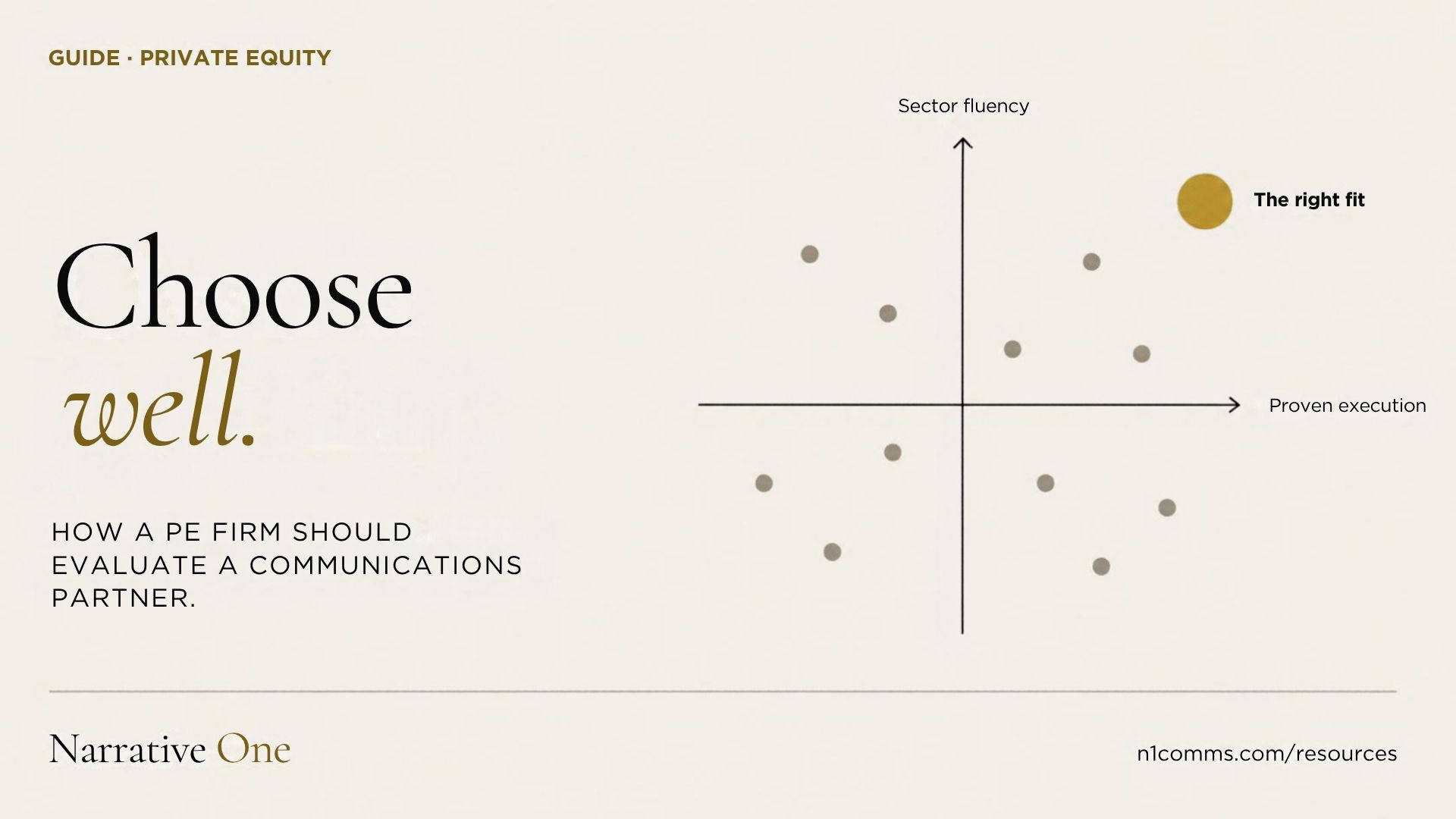
A private equity communications agency that only secures coverage can still leave a firm exposed. The real test is whether communications hold together across the fund, its partners, and its portfolio companies, especially when an announcement must move quickly without bypassing compliance oversight.
That distinction matters. A generic agency model can miss investment-firm realities; disconnected teams can produce conflicting narratives; and a rushed approval process can create avoidable risk. Communications need to operate as portfolio infrastructure, not as a sequence of isolated campaigns.
This buyer’s guide explains how to assess agency models, investment-firm experience, operating discipline, and fit across a portfolio. It covers how firm positioning connects with portfolio announcements, media activity, and partner thought leadership, then considers how approvals and compliance workflows should function under pressure. The objective is clear: choose a communications partner that can build a coherent narrative and execute it with control.
Key Takeaways
Assess whether a private equity communications agency can support both firm-level priorities and portfolio-company needs across the investment lifecycle.
Look beyond press coverage to a connected operating model for strategy, execution, governance, and reporting.
Compare agency models against practical criteria: investment experience, senior access, integration, approval controls, and reporting discipline.
Use due diligence to test how objectives, stakeholders, approvals, execution, and evidence connect in real work.
See how NarrativeOne’s model brings one senior strategist, one journalist network, and one compliance workflow to communications across firms and portfolios.
Table of Contents
Why a Private Equity Communications Agency Must Understand the Investment Lifecycle
What a Private Equity Communications Agency Should Build Beyond Press Coverage
A Private Equity Communications Agency Due-Diligence Checklist
Why a Private Equity Communications Agency Must Understand the Investment Lifecycle
Communications pressure doesn't sit in one department or arrive on a predictable schedule. A fund may be shaping its investment case for limited partners while a portfolio company prepares a leadership announcement, product milestone, or financing update. Each message has a different audience, purpose, and approval path. Treating them as separate publicity tasks risks weakening the larger story: why the firm invests, how it supports companies, and what each development signals.
A private equity communications agency must understand the operating context behind a message, not just its news value. The Private Equity Overview provides a foundation for understanding how private equity firms invest and operate; communications execution then depends on the specific fund, stakeholders, and event.
Where communications pressure appears across a fund’s lifecycle
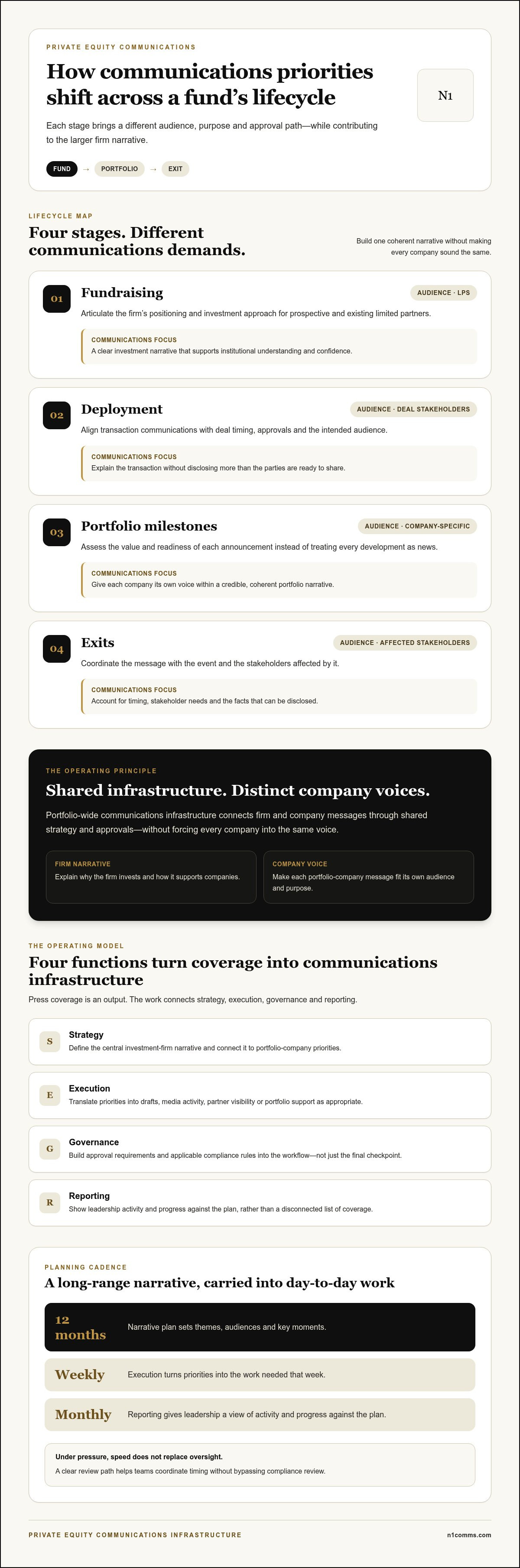
Communications needs shift as a fund moves from raising capital to deploying it, supporting portfolio companies, and preparing for exits. Fundraising calls for a clear investment narrative for LPs. Deployment may bring announcements that explain a transaction without disclosing more than the parties are ready to share. Portfolio milestones require judgment about whether a public announcement serves a strategic purpose, while exit communications must account for timing, stakeholders, and the facts that can be disclosed.
Fundraising: articulate the firm’s positioning and investment approach for prospective and existing LPs.
Deployment: align transaction communications with deal timing, approvals, and the intended audience.
Portfolio milestones: assess the value and readiness of each announcement rather than treating every development as news.
Exits: coordinate the message with the event and the stakeholders affected by it.
Fund-level positioning also shapes how portfolio-company news is interpreted. A milestone carries more weight when it fits a credible account of the firm’s investment thesis and approach to value creation. Consistency matters; uniformity does not. Each company needs its own voice within a coherent portfolio narrative.
Portfolio-wide communications infrastructure is the shared strategy and approval process that keeps a fund’s and its companies’ messages coherent without making them sound identical.
Why private equity communications differs from general publicity
General publicity often begins with a headline. Investment-firm communications must begin with context: the thesis, the transaction stage, the term sheet, the intended audience, and the relevant decision-makers. Those details shape what can be said, when it can be said, and whether public coverage is the right outcome at all. LP communications, executive visibility, and portfolio announcements require different judgments, even when they draw on the same underlying narrative.
Governance is part of the work, not a final checkpoint. Drafts need to reflect approval requirements and applicable compliance rules before they reach the compliance director for review. That discipline helps teams coordinate timing without treating speed as a reason to bypass oversight. For broader context on how institutional positioning supports asset managers, see strategic communications for asset managers.
What a Private Equity Communications Agency Should Build Beyond Press Coverage
Press coverage is an output, not an operating model. A private equity communications agency should connect four functions: strategy, execution, governance, and reporting. Without that architecture, a strong announcement can sit apart from the fund’s positioning, LP communications, and portfolio-company narrative.
The working structure should translate a 12-month narrative plan into weekly priorities and monthly reporting. The annual view sets themes, audiences, and key moments. Weekly execution turns those priorities into drafts, media activity, partner visibility, or portfolio support as appropriate. Monthly reporting gives leadership a view of activity and progress against the plan, rather than a disconnected list of coverage.
For a firm with portfolio companies, consistency depends on clear ownership and a shared process. One senior strategist can maintain the through-line across firm and portfolio; one journalist network can support relevant media engagement; and one compliance workflow can provide a consistent review path. This model connects the work without forcing every company into the same voice.
LP communications have their own purpose and cadence. They build institutional understanding and confidence through investor-facing material, not through media coverage alone. A disciplined LP communications strategy should therefore sit within the broader narrative architecture while serving the distinct needs of existing and prospective investors.
The operating components behind an embedded communications function
The operating stack brings together Strategy & narrative, Media relations, Bilingual content, and GP thought leadership. Strategy defines the central investment-firm narrative. Media relations connects that narrative to appropriate coverage. English and Arabic content is natively drafted for its intended audience, while GP thought leadership gives partners a considered role in relevant sector conversations.
Events & speaking supports partner visibility in settings where direct engagement matters. Monitoring & crisis management helps the firm track developing issues and prepare a measured response. Choose the format for the audience and purpose: releases communicate an approved development; pitches frame a relevant story for journalists; op-eds advance a point of view; LP materials address investor information needs. These tools are not interchangeable.
How portfolio announcements move from term-sheet to coverage
The Portfolio announcement service is structured to move from term-sheet to Tier-1 coverage in fourteen days. That requires more than writing a release at the last minute. The sequence sets decision points for preparation, review, coordination, publication, and follow-through:
T-14: establish the announcement plan and gather required inputs.
T-10: develop the narrative and draft materials.
T-5: advance review and media preparation.
T-2: finalize approved materials and timing.
Day 0: coordinate release and media activity.
+7: review follow-through and coverage.
Compliance rules are embedded in drafts before the compliance director reviews them. Disciplined sequencing creates speed by preparing decisions early, not by bypassing review. Firms assessing an embedded communications model can examine how Narrative One supports investment firms across strategy, media, and portfolio announcements.
How to Compare Private Equity Communications Agency Models
Agency models differ in how they assign judgment, integrate with the firm, and control execution. A campaign-led engagement can suit a defined announcement or time-bound objective. An embedded function connects ongoing priorities across the fund and portfolio. Neither label proves capability. Compare the operating evidence behind it.
Investment experience
Campaign-led: expertise may focus on delivering a specific brief. Embedded: investment context informs narrative choices across fundraising, transactions, portfolio milestones, and exits.
Senior access
Campaign-led: senior input may centre on planning or review. Embedded: a senior strategist shapes the work and advises decision-makers directly.
Integration
Campaign-led: activity is organized around a defined assignment. Embedded: firm and portfolio communications connect through shared strategy and coordinated execution.
Governance
Campaign-led: approvals are established for the individual deliverable. Embedded: a consistent workflow carries governance into recurring communications.
Reporting
Campaign-led: reporting records delivery against the assignment. Embedded: reporting connects activity to ongoing narrative priorities and institutional communications capability.
Use this comparison to test fit, not to assume one model is universally superior. External support must preserve the firm’s control over sensitive information. Look for clear ownership of approvals, disciplined handling of drafts and inputs, and a defined path for escalation. The agency should strengthen execution without displacing the firm’s decision rights.
Media activity measures what was published; institutional communications capability measures whether the firm can communicate with coherence, control, and purpose over time. Coverage can matter, but it cannot, by itself, demonstrate that the underlying operating system is sound.
Assess investment-firm judgment and senior accountability
Ask how direct experience with fundraising, exits, and term sheets shapes strategic advice. Who develops the narrative, and who advises senior stakeholders when timing or disclosure is sensitive? Narrative One brings 17 years of operating experience inside investment institutions. Its founder’s background offers relevant evidence of investment-firm context, not just communications delivery.
That distinction matters in practice. A term-sheet-stage announcement calls for different judgment from a fundraise narrative or an exit communication. Senior accountability means the person responsible understands those differences and can connect the advice to the firm’s priorities.
Assess compliance, bilingual drafting, and media access
Examine whether compliance rules are embedded in drafts before the compliance director reviews them. For English and Arabic communications, assess whether each version is natively drafted for its audience, including senior financial journalists, rather than translated after the message is set. Media relations for hedge funds offers adjacent context on financial-media judgment.
These criteria reflect Narrative One’s approach to investment-firm communications. Explore Narrative One’s communications model to see how the approach connects strategy, media relations, and portfolio announcements.
A Private Equity Communications Agency Due-Diligence Checklist
A private equity communications agency should be assessed against the fund’s operating realities, not a generic vendor scorecard. Run diligence in sequence: define the mandate, map stakeholders, examine the operating model, then test the evidence. The aim is to establish whether strategy, approvals, execution, and reporting work as one system across the firm and portfolio companies.
Define the mandate before comparing agency proposals
Start with the business priorities and the audiences communications must serve. Identify portfolio needs, approval owners, and the communications risks that could affect timing or message control. Then separate the mandate into distinct workstreams: fund positioning for the firm’s investment narrative, LP communications for investors, GP visibility for partner expertise, and portfolio announcements for company developments.
These priorities can connect, but they are not interchangeable. An LP update serves a different purpose from a media release. If the mandate includes communication between formal reporting periods, a practical between-quarter LP communication checklist can help clarify what investor updates need to accomplish.
Test the operating model across firm and portfolio
Ask the agency to show how one senior strategist, one journalist network, and one compliance workflow can support both the investment firm and portfolio companies. Establish who shapes the narrative, who coordinates delivery, and how compliance rules are embedded in drafts before the compliance director reviews them. Confirm how the process adapts to different company voices without fragmenting the fund’s wider positioning.
Request a worked example that traces a communications priority from planning through approval, execution, and reporting. The example should make responsibilities and decision points visible. A polished press release alone is not evidence of an operating model.
Test evidence, process, and reporting discipline
Review work relevant to investment firms, and preserve the context behind each result. For Shorooq, three institutional mandates of USD 50 M, 100 M, and 100 M had placements including Bloomberg, Reuters, SkyNews, and Forbes. Rasmal Ventures’ $45 M Series B announcement received Reuters headline placement and coverage in 270+ media outlets. These are examples of outcomes, not promises that another announcement will produce the same coverage.
Then ask how weekly execution connects to the 12-month narrative plan and monthly reporting. Reporting should show what was delivered, how activity relates to priorities, and what decisions or adjustments follow. Examine the baseline and scope behind each case study: the announcement, intended audience, work performed, and reported result. That context separates useful evidence from a headline number without an operating explanation.
Use this diligence sequence to test fit, control, and accountability before selecting a partner. Assess your communications architecture with Narrative One.
How Narrative One Supports Private Equity Communications
Narrative One structures communications as an embedded function serving investment firms and their portfolio companies. The model connects firm-wide positioning with company announcements and media activity, rather than treating each brief as an isolated campaign. It is built around one senior strategist, one journalist network, and one compliance workflow.
The work spans Strategy & narrative, Media relations, LP Communications, Fund Positioning, and the Portfolio announcement service. Related capabilities include Bilingual content, GP thought leadership, Events & speaking, and Monitoring & crisis management. Together, these functions support investor, media, partner, and portfolio-company communications within a connected operating model.
One senior strategist, one journalist network, one compliance workflow
The shared model keeps strategic direction connected across the firm and its portfolio, while allowing each company’s message to reflect its own facts and priorities. One senior strategist provides continuity; one journalist network supports media engagement; one workflow carries compliance discipline through the work. Compliance rules are embedded in drafts before the compliance director reviews them.
English and Arabic content is natively drafted for its intended audience, not translated after drafting. That distinction helps preserve clarity and context across languages. Releases, investor materials, partner visibility, and media outreach each serve different audiences, but can still align with the investment firm’s wider narrative. The private equity communications agency model is designed around that coordination.
Evidence and next steps for an investment firm
Narrative One reports $2 B+ AUM across 150+ funds and clients, alongside 17 years of operating experience inside investment institutions. Its case examples show different forms of execution. Rasmal Ventures’ $45 M Series B announcement received Reuters headline placement and coverage in 270+ media outlets. Shorooq’s USD 50 M, 100 M, and 100 M institutional mandates had placements including Bloomberg, Reuters, SkyNews, and Forbes. These are stated client results, not a guarantee of future coverage.
The Portfolio announcement service is structured from term-sheet to Tier-1 coverage in fourteen days. Its stated sequence is T-14, T-10, T-5, T-2, Day 0, then +7. Separately, Forbes Middle East named Narrative One’s founder among the Middle East’s Most Influential CMOs, 2026. That recognition applies to the founder, not to client campaign outcomes.
For an investment firm, the next step is to define the priorities the communications function must support, from fund positioning and LP Communications to portfolio announcements and media relations. Discuss your private equity communications priorities.
Make Communications Part of the Firm’s Operating Plan
Decide what communications must enable for your firm in its next planning cycle. Set the priorities, identify who owns decisions, and define how the work should adapt as fund and portfolio needs change. That turns the search for a private equity communications agency into an operating decision, not a procurement exercise driven by a single announcement or coverage target.
Bring the relevant stakeholders into that decision early. Align investment, investor relations, portfolio leadership, and compliance around the outcomes and approval discipline the function must support. A clear mandate gives a communications partner the context to act with focus while keeping control with the firm.
Narrative One works with investment firms on communications priorities across fund positioning, LP communications, partner visibility, and portfolio announcements. Discuss your private equity communications priorities and define the communications architecture your firm needs to move forward with clarity and control.
Frequently Asked Questions
What does a private equity communications agency do?
A private equity communications agency can connect fund positioning, media relations, LP materials, GP thought leadership, portfolio announcements, and monitoring within a strategic communications function. The goal is more than securing isolated publicity: communications should support the investment firm’s priorities and relationships over time. The mandate depends on the firm’s objectives, audiences, governance, and portfolio needs. A firm focused on LP updates may need a different scope from one preparing a portfolio-company announcement.
When should a private equity firm hire a communications agency?
A firm can bring in communications support when it needs to sharpen a fundraise narrative, plan a portfolio announcement, increase executive visibility, or establish a consistent communications function. The useful trigger is a clear priority, not simply a desire for more publicity. For example, a firm preparing to speak with prospective LPs may need to align its investment narrative before outreach begins. Timing depends on the firm’s priorities and readiness; support cannot guarantee fundraising, investment outcomes, or media coverage.
How can a private equity communications agency protect confidential information?
Protecting sensitive information depends on controlled access, clearly defined approvals, careful announcement timing, and compliance-aware drafting. Before work begins, the firm should identify who can provide inputs and who has authority to approve disclosure. Drafts should reflect communications rules before the compliance director reviews them. This workflow supports disciplined review, but it is not a guarantee of confidentiality or a substitute for the firm’s own governance and information-handling requirements.
Can one communications agency support both a fund and its portfolio companies?
Yes. A shared senior strategist, journalist network, and compliance workflow can connect communications across an investment firm and its portfolio companies. Shared infrastructure supports coordination; it does not mean using identical messaging. A company announcing a product milestone, for example, needs a narrative suited to its facts and audience, while the fund’s broader positioning remains consistent. Each communication still requires appropriate timing, review, and alignment with the relevant stakeholders.
How should a private equity firm measure communications agency performance?
Measure performance against agreed objectives and an established baseline. Relevant indicators can include Tier-1 mentions, share of voice, sentiment, speed, and the quality of monthly reporting. Interpret each metric in context: a high volume of coverage may matter less than reaching the audience tied to a specific fund priority. Separate activity delivered from outcomes influenced by other factors. Case studies can inform expectations, but they cannot guarantee future results.
What does bilingual communications support involve for investment firms?
Narrative One drafts content natively in English and Arabic for senior financial journalists, rather than translating a completed draft afterward. Depending on the mandate, materials may include releases, journalist pitches, op-eds, or LP materials. Each format has a different purpose: a pitch proposes a story, while an LP document addresses investor communication needs. Bilingual support does not mean every communication must be published in both languages; the audience and objective should guide the choice.
How long can a private equity portfolio announcement take from term-sheet to Tier-1 coverage?
Narrative One’s Portfolio announcement service has a stated timeline of fourteen days from term-sheet to Tier-1 coverage. Its sequence is T-14, T-10, T-5, T-2, Day 0, then +7. This schedule structures preparation, review, announcement activity, and follow-through. It describes the service timeline, not a guaranteed media result. Coverage depends on the announcement, its relevance to journalists, and the decisions made through the communications and approval process.
Frequently Asked Questions
What does a private equity communications agency do?
A private equity communications agency can connect fund positioning, media relations, LP materials, GP thought leadership, portfolio announcements, and monitoring within a strategic communications function. The goal is more than securing isolated publicity: communications should support the investment firm’s priorities and relationships over time. The mandate depends on the firm’s objectives, audiences, governance, and portfolio needs. A firm focused on LP updates may need a different scope from one preparing a portfolio-company announcement.
When should a private equity firm hire a communications agency?
A firm can bring in communications support when it needs to sharpen a fundraise narrative, plan a portfolio announcement, increase executive visibility, or establish a consistent communications function. The useful trigger is a clear priority, not simply a desire for more publicity. For example, a firm preparing to speak with prospective LPs may need to align its investment narrative before outreach begins. Timing depends on the firm’s priorities and readiness; support cannot guarantee fundraising, investment outcomes, or media coverage.
How can a private equity communications agency protect confidential information?
Protecting sensitive information depends on controlled access, clearly defined approvals, careful announcement timing, and compliance-aware drafting. Before work begins, the firm should identify who can provide inputs and who has authority to approve disclosure. Drafts should reflect communications rules before the compliance director reviews them. This workflow supports disciplined review, but it is not a guarantee of confidentiality or a substitute for the firm’s own governance and information-handling requirements.
Can one communications agency support both a fund and its portfolio companies?
Yes. A shared senior strategist, journalist network, and compliance workflow can connect communications across an investment firm and its portfolio companies. Shared infrastructure supports coordination; it does not mean using identical messaging. A company announcing a product milestone, for example, needs a narrative suited to its facts and audience, while the fund’s broader positioning remains consistent. Each communication still requires appropriate timing, review, and alignment with the relevant stakeholders.
How should a private equity firm measure communications agency performance?
Measure performance against agreed objectives and an established baseline. Relevant indicators can include Tier-1 mentions, share of voice, sentiment, speed, and the quality of monthly reporting. Interpret each metric in context: a high volume of coverage may matter less than reaching the audience tied to a specific fund priority. Separate activity delivered from outcomes influenced by other factors. Case studies can inform expectations, but they cannot guarantee future results.
What does bilingual communications support involve for investment firms?
Narrative One drafts content natively in English and Arabic for senior financial journalists, rather than translating a completed draft afterward. Depending on the mandate, materials may include releases, journalist pitches, op-eds, or LP materials. Each format has a different purpose: a pitch proposes a story, while an LP document addresses investor communication needs. Bilingual support does not mean every communication must be published in both languages; the audience and objective should guide the choice.
How long can a private equity portfolio announcement take from term-sheet to Tier-1 coverage?
Narrative One’s Portfolio announcement service has a stated timeline of fourteen days from term-sheet to Tier-1 coverage. Its sequence is T-14, T-10, T-5, T-2, Day 0, then +7. This schedule structures preparation, review, announcement activity, and follow-through. It describes the service timeline, not a guaranteed media result. Coverage depends on the announcement, its relevance to journalists, and the decisions made through the communications and approval process.