A fund’s narrative is not an institutional asset if it changes with every audience. Strategic communications for asset managers connects investor updates, media engagement, and portfolio announcements to one governed position. Without that connection, activity can create noise instead of building recognition and trust.
An investment strategy can be difficult to explain consistently to LPs, journalists, and portfolio stakeholders. Communications often happen in bursts, and unclear ownership or review steps can slow an announcement when timing matters. Visibility alone is not enough: communications must reach relevant audiences with a message that reflects the firm’s priorities.
A fit-for-purpose model aligns the narrative, assigns senior ownership, plans communications over time, and builds compliance review into execution. The aim is a durable operating system, not a collection of disconnected campaigns. This article explains what that system includes and how to assess whether it supports the firm’s institutional position.
Key Takeaways
Assess strategic communications for asset managers as an operating system, not a series of visibility tactics.
Connect the investment thesis, firm positioning, and executive messages through a controlled narrative architecture.
Compare in-house, project-based, and embedded models against continuity, senior access, stakeholder coverage, compliance integration, and measurement.
Use five practical steps to define objectives, map stakeholders, audit messaging, assign governance, and establish reporting evidence.
A 12-month narrative plan, weekly execution, and monthly reporting can create a durable communications cadence across a firm and its portfolio.
Table of Contents
Why strategic communications matter to asset managers beyond visibility
The strategic communications system: narrative, stakeholders, and governance
How to compare strategic communications models for asset managers
A practical evaluation framework for asset-manager communications
How NarrativeOne embeds strategic communications for asset managers
Why strategic communications matter to asset managers beyond visibility
A sound investment case can lose coherence as it moves from an LP discussion to a co-investor conversation, a media interview, or a portfolio announcement. Each audience needs a different level of detail, but the institutional position should remain recognisable. Without coordination, changes in language and emphasis can obscure what the firm stands for and what its strategy is designed to do.
Strategic communications governs the alignment of narrative, stakeholders, channels, timing, and review. It builds on the broader principles of Strategic Communication, then applies them to the demands of an investment firm. A useful definition: Strategic communications for asset managers is the operating system that keeps every stakeholder interaction aligned with the firm’s institutional position. It is not simply a publicity tactic.
Where disconnected communications create institutional friction
Inconsistent language creates avoidable friction. LPs may hear one account of the investment thesis, co-investors another, while media coverage or portfolio messaging introduces a third emphasis. These differences don’t automatically indicate a substantive problem, but they can make the firm harder to understand and weaken confidence in how it explains its priorities.
This is communications risk, not investment-performance risk. A coordinated narrative cannot control returns or remove commercial uncertainty. It can reduce confusion about the firm’s strategy, responsibilities, and decisions. That requires recurring touchpoints to have clear owners, appropriate review, and a shared source of truth. Otherwise, each update is rebuilt from memory, and consistency depends on whoever happens to be communicating.
In practice, the source of truth should distinguish approved firm-level messages from information that requires review or should remain audience-specific. For example, an LP update and a public portfolio announcement can share the same core positioning while using different detail and disclosure boundaries. This discipline helps teams prepare for routine communications and time-sensitive news without treating every announcement as an isolated event.
What asset-manager communications must accomplish
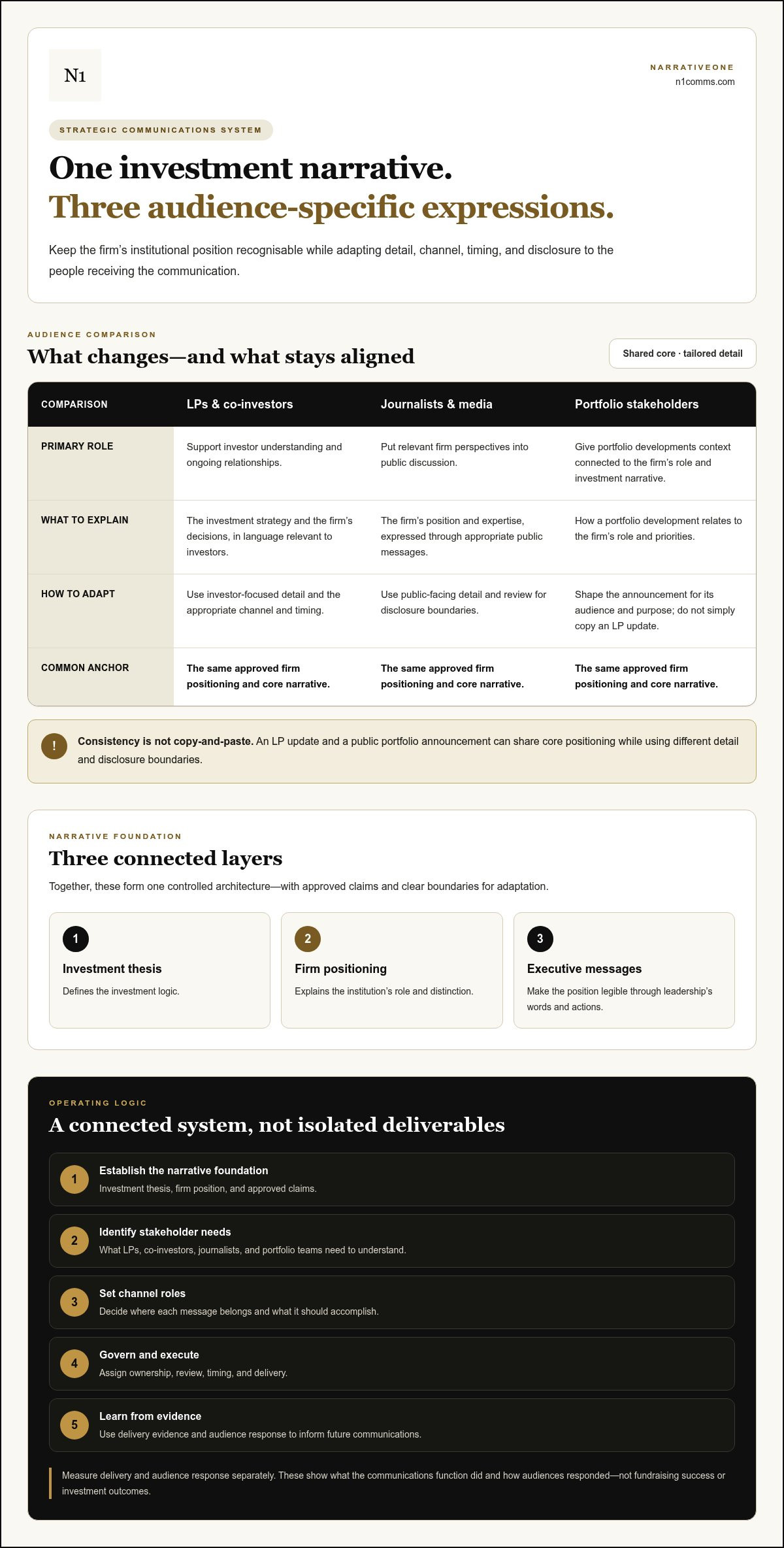
Every communication should have a defined audience, institutional objective, and appropriate level of disclosure. The same message shouldn’t be copied unchanged across an LP letter, a public statement, and a portfolio announcement. Keep the core narrative coherent, then adapt the detail, channel, and timing to the audience and purpose.
Reputation: establish a credible, consistent account of the firm’s position and expertise.
Investor understanding: explain strategy and decisions in language relevant to LPs and co-investors.
Portfolio visibility: give portfolio developments context that connects them to the firm’s role and investment narrative.
Crisis readiness: clarify ownership, review, and response pathways before pressure arrives.
Measure these outcomes separately. Execution evidence can show whether priority communications were delivered, reviewed, and adapted for their intended audiences. Audience response can indicate whether the message reached or engaged those stakeholders. Neither measure proves fundraising success. The purpose is to understand what the communications function did and how audiences responded, not to promise investment or capital-raising results.
The strategic communications system: narrative, stakeholders, and governance
A communications system has linked components, not a stack of unrelated deliverables. Its operating logic is straightforward: establish the narrative foundation, identify stakeholder needs, assign channel roles, set governance, execute, then learn from evidence. Each part informs the next. A media opportunity, for example, should express the approved investment narrative, but it shouldn’t replace an LP update or disclose information intended for another audience.
The narrative foundation connects three levels: the investment thesis, the firm’s market position, and the messages its executives use to explain both. The thesis defines the investment logic. Firm positioning explains the institution’s role and distinction. Executive messages make that position legible through leadership’s words and actions. Together, these elements form one controlled architecture, with approved claims and clear boundaries for adaptation.
Narrative foundation: investment thesis, firm position, approved claims.
Stakeholder needs: what LPs, co-investors, journalists, and portfolio teams need to understand.
Channel roles: where each message belongs and what it should accomplish.
Governance and execution: ownership, review, timing, and delivery.
Learning: evidence of delivery and audience response that informs future communications.
LP communications support investor understanding and ongoing relationships. Media relations puts relevant firm perspectives into public discussion. GP thought leadership gives investment leaders a disciplined way to articulate their expertise. Each serves a different purpose, but all should draw from one narrative source. Consistency supports institutional trust because audiences encounter a coherent account of the firm, not because communication can guarantee capital commitments or investment outcomes.
Build one narrative architecture for distinct audiences
Audience adaptation should change emphasis and detail, not the underlying investment strategy or approved claims. LPs may need context on the firm’s approach; co-investors may focus on areas of alignment; journalists need clear, attributable explanations; portfolio-company stakeholders need to understand how an announcement relates to the firm. A strong LP communications strategy makes investor updates useful beyond routine reporting while preserving that common narrative.
Make governance and compliance part of the system
Governance assigns an owner to each message, defines approval paths, and maintains version control so teams don’t circulate outdated claims. Compliance belongs in the workflow design, not as a last-minute obstacle. NarrativeOne embeds compliance rules before the compliance director reviews drafts. FSRA, ADGM, DIFC, SAMA, and CMA are documented compliance references, not a substitute for legal advice.
That operating model requires disciplined coordination: one senior strategist, one journalist network, and one compliance workflow shared across the firm and portfolio companies. It creates a clear line from strategy to execution. When assessing an embedded communications model, look for continuity across investor, media, and portfolio touchpoints.
How to compare strategic communications models for asset managers
The right model depends on the work communications must perform, not the label attached to the arrangement. Compare strategic communications for asset managers by asking who maintains the narrative, who delivers recurring work, how stakeholders are covered, where compliance sits, and what evidence leadership receives. Activity without governance or a clear institutional purpose is overhead. A governed, relevant function can support consistency and accountability, but it cannot control fundraising results or investment performance.
DimensionIn-house ownershipProject-based external supportEmbedded communications infrastructureContinuityCan retain institutional knowledge through internal ownership.Typically organized around defined assignments or announcements.Connects recurring work to an ongoing narrative plan.Senior accessDepends on the team’s structure and leadership remit.Usually concentrated around the project and its decision-makers.Builds senior strategic judgment into planning and execution.Stakeholder coverageCan be tailored to internal priorities and capacity.Focused on the audiences specified for each assignment.Coordinates firm and portfolio touchpoints across audiences.Compliance integrationDepends on internal processes and ownership.Must be coordinated within the project workflow.Designed as a shared part of communications execution.MeasurementCan report against internal objectives and activity.Often tied to the agreed deliverable or campaign.Can connect recurring execution and audience response over time.
Assess continuity, seniority, and accountability
Start by naming three responsibilities: who owns the narrative, who executes recurring communications, and who reports progress to leadership? A one-off announcement can meet an immediate need, but it doesn’t establish continuity across investor materials, media engagement, and portfolio news. A 12-month narrative plan creates a longer operating horizon, while weekly execution and monthly reporting make ownership and progress visible.
NarrativeOne’s model combines one senior strategist, one journalist network, and one compliance workflow shared across the firm and portfolio companies. That structure connects judgment, media relationships, and review without implying separate teams or guaranteed coverage.
Assess audience reach, compliance, and evidence
Check whether the model connects investor-facing materials for LPs and co-investors with media outreach to publications relevant to the firm’s objectives. Media coverage is an input and an outcome measure: it records activity and visibility, not investor trust or performance. A media relations strategy for hedge funds can help clarify the role of that channel within the broader system.
Then examine how compliance review is built into execution and what leadership sees in reporting. Earned-media value, mentions, and share of voice measure communications activity or audience presence; they are not promises of commercial results. The fit test is whether reporting ties evidence to institutional priorities. To understand how an embedded communications model is structured, assess its ownership, cadence, and reporting together.
A practical evaluation framework for asset-manager communications
Evaluate strategic communications for asset managers through decisions and evidence, not a list of activities. Leadership should be able to identify the objective, accountable owner, and record of progress for each part of the system. Use this five-step assessment to expose gaps and set priorities.
Define objectives. Decide whether the priority is institutional credibility, investor understanding, media visibility, or portfolio support. The executive sponsor owns the priority; approved firm objectives and communications plans provide evidence that it is explicit.
Map stakeholders. Identify which LPs, co-investors, journalists, and portfolio stakeholders each communication must reach. The communications lead owns the map; investor materials, stakeholder records, and publication context show whether channels fit the intended audience.
Audit the narrative. Decide which investment-thesis messages and claims should remain consistent, and where audience-specific detail is needed. The strategy owner leads the audit; current presentations, announcements, interviews, and approved messaging reveal gaps or drift.
Assign governance. Name the drafter, decision-maker, compliance reviewer, and escalation owner for routine and sensitive communications. The designated senior owner is accountable; approval records, version histories, and escalation paths show whether the process works in practice.
Set reporting. Choose measures that correspond to the objective and define the review cadence. The communications owner reports progress; monthly dashboards, coverage records, investor-facing materials, and audience-response evidence support assessment.
Set objectives, audience priorities, and reporting measures
Keep objectives distinct. Reputation is not investor understanding, and media visibility is not portfolio support. For a media objective, a firm might track relevant Tier-1 mentions per quarter against a pre-engagement baseline, using consistent criteria for what counts as relevant coverage. Assess publication context and audience fit, not placement volume alone. Monthly reporting can show what was delivered, where responses emerged, and what to adjust in the next cycle. It cannot establish that communications caused fundraising results.
For investor cadence and touchpoints between formal reporting periods, use this between-quarter LP communication checklist to assess whether updates serve a clear investor need.
Test readiness for announcements and sensitive issues
Before a time-sensitive announcement, confirm the owner, approval route, monitoring responsibility, and escalation path. Where bilingual communications are needed, content should be drafted natively in English and Arabic for senior financial journalists, not translated after drafting. NarrativeOne’s portfolio announcement service can move from term-sheet to Tier-1 coverage in fourteen days, with a same-day bilingual release.
For the Portfolio announcement service, the sequence is T-14 → T-10 → T-5 → T-2 → Day 0 → +7. Assess each point for a defined action, accountable reviewer, and evidence of completion. Use the framework to identify where communications governance needs strengthening, then discuss an evaluation of your communications model.
How NarrativeOne embeds strategic communications for asset managers
NarrativeOne structures strategic communications for asset managers as an embedded function serving the investment firm and its portfolio, not a sequence of isolated announcements. The operating cadence starts with a 12-month narrative plan, moves into weekly execution, and is reviewed through monthly reporting. Leadership can see what is planned, what has been delivered, and what the next cycle should address.
The work spans Strategy & narrative, Media relations, Bilingual content, GP thought leadership, Events & speaking, and Monitoring & crisis management. These are connected functions, not independent outputs. For example, a portfolio milestone can be assessed against the firm’s narrative, the relevant audience, the appropriate channel, and the review process before execution.
Connect senior judgment with execution infrastructure
The firm was built by a former investment-firm CCO with 17 years of direct fundraising, exit, and term-sheet experience. Its model pairs one senior strategist with one journalist network and one shared compliance workflow serving the investment firm and portfolio companies. Compliance rules are embedded before the compliance director reviews drafts. This links senior judgment to delivery and review, rather than leaving each announcement to operate on its own.
For relevant media work, content is drafted natively in English and Arabic to the standards of senior financial journalists, not translated after drafting. Language, audience, and editorial context are part of the message architecture. This helps maintain a coherent institutional position across communications while allowing emphasis and detail to fit the intended audience.
Use evidence without turning outcomes into guarantees
Documented examples show the kind of execution the model supports. Rasmal Ventures’ $45 M Series B announcement reached 270+ media outlets. That is a specific announcement outcome, not a forecast for another campaign or a promise of investor response.
Other documented measures include $50 M+ earned media value across 200+ mentions and $1 B+ in total client earned media value. These figures describe distinct reported scopes and should be interpreted as communications evidence, not equivalent measures or proof of fundraising impact. Coverage and earned-media measures can help assess visibility. They don’t establish investor trust, capital raised, or investment performance.
A credible mandate makes the operating criteria visible: a senior owner, shared workflow, defined cadence, audience-specific execution, and reporting that records activity and response. These criteria help assess whether communications can function as institutional infrastructure across the firm and its portfolio.
Discuss a strategic communications mandate grounded in your firm’s priorities, stakeholder needs, and governance requirements.
Make communications part of the institution’s operating discipline
The next step is not to add another channel or produce more content. Decide which institutional priorities communications must advance, where ownership sits, and how leadership will know the system is working. That turns strategic communications for asset managers from an intermittent activity into an accountable function.
Start with one practical question: which stakeholder conversation becomes harder when the firm’s narrative is unclear? Use the answer to set a priority, assign an owner, and establish the evidence that will guide the next review. The framework should evolve as the firm’s strategy and stakeholder needs change without losing control of its core position.
Narrative One works with investment firms to structure communications around those priorities and the realities of execution. Discuss a strategic communications mandate to identify the operating model that fits your institution and set a clear basis for more deliberate communications.
Frequently Asked Questions
What does strategic communications for asset managers include?
It includes the coordinated work needed to explain a firm’s investment case to different audiences without losing message discipline. In practice, that can mean preparing an LP update around a portfolio milestone, aligning an executive’s public remarks with approved firm positioning, and planning how the same development is presented to journalists. Strategic communications also defines who owns each message, how it is reviewed, and what evidence will show whether it reached its intended audience.
How is strategic communications different from investor relations?
Investor relations focuses on the firm’s direct relationship and communications with investors. Strategic communications has a wider stakeholder and channel remit, which can include media, executive visibility, portfolio announcements, and crisis readiness alongside investor-facing messaging. The functions should coordinate, not compete. For example, a new fund milestone may require an investor update and a public announcement, each with distinct detail but consistent positioning and review.
How should an asset manager measure communications effectiveness?
Measure against the objective, using a baseline and evidence that can be reviewed over time. For investor understanding, examine recurring questions, feedback, and whether materials address the information needs they were designed for. For reputation or media visibility, assess relevant coverage and message accuracy, not just volume. Reporting should distinguish outputs from audience response and business outcomes. Communications measures can inform decisions, but they don’t establish that communications caused investment or fundraising results.
When should an investment firm begin building its communications strategy?
Begin before a major external event creates pressure to explain the firm. Fund formation, a fundraising process, a market entry, a new strategy, or a portfolio milestone can all expose gaps in positioning and approval ownership. Starting early gives leadership time to agree on core claims, identify audiences, prepare spokespeople, and define review responsibilities. Revisit the strategy as the firm’s objectives, portfolio, or stakeholder priorities change.
How can an asset manager coordinate English and Arabic communications?
Use a shared message framework, then develop each language version for its audience rather than treating one as a literal copy of the other. Align key claims, terminology, figures, and disclosure boundaries across drafts, while allowing phrasing and context to read naturally in each language. Assign clear review ownership for both versions and compare them before release. This reduces the risk of inconsistent emphasis or meaning across parallel communications.
How can communications teams prepare for a sensitive announcement or crisis?
Prepare the decision path before an issue emerges. Identify who verifies facts, who approves messages, who speaks for the firm, and who monitors stakeholder response. Draft a holding statement structure that can be updated with confirmed information, and define how changes are recorded and escalated. Keep communications aligned with the relevant internal review process. Preparation supports a controlled response, but it cannot remove the underlying issue or guarantee public reaction.
What should an asset manager look for in a communications partner?
Look for senior accountability, investment-sector understanding, and an approach that connects communications to defined institutional priorities. The partner should explain who shapes the narrative, how recurring execution is managed, how compliance review fits into drafts, and what reporting will show. Assess evidence against specific objectives, not just a list of placements. A sound model makes responsibilities and limitations clear without presenting coverage as a proxy for investor trust.
Frequently Asked Questions
What does strategic communications for asset managers include?
It includes the coordinated work needed to explain a firm’s investment case to different audiences without losing message discipline. In practice, that can mean preparing an LP update around a portfolio milestone, aligning an executive’s public remarks with approved firm positioning, and planning how the same development is presented to journalists. Strategic communications also defines who owns each message, how it is reviewed, and what evidence will show whether it reached its intended audience.
How is strategic communications different from investor relations?
Investor relations focuses on the firm’s direct relationship and communications with investors. Strategic communications has a wider stakeholder and channel remit, which can include media, executive visibility, portfolio announcements, and crisis readiness alongside investor-facing messaging. The functions should coordinate, not compete. For example, a new fund milestone may require an investor update and a public announcement, each with distinct detail but consistent positioning and review.
How should an asset manager measure communications effectiveness?
Measure against the objective, using a baseline and evidence that can be reviewed over time. For investor understanding, examine recurring questions, feedback, and whether materials address the information needs they were designed for. For reputation or media visibility, assess relevant coverage and message accuracy, not just volume. Reporting should distinguish outputs from audience response and business outcomes. Communications measures can inform decisions, but they don’t establish that communications caused investment or fundraising results.
When should an investment firm begin building its communications strategy?
Begin before a major external event creates pressure to explain the firm. Fund formation, a fundraising process, a market entry, a new strategy, or a portfolio milestone can all expose gaps in positioning and approval ownership. Starting early gives leadership time to agree on core claims, identify audiences, prepare spokespeople, and define review responsibilities. Revisit the strategy as the firm’s objectives, portfolio, or stakeholder priorities change.
How can an asset manager coordinate English and Arabic communications?
Use a shared message framework, then develop each language version for its audience rather than treating one as a literal copy of the other. Align key claims, terminology, figures, and disclosure boundaries across drafts, while allowing phrasing and context to read naturally in each language. Assign clear review ownership for both versions and compare them before release. This reduces the risk of inconsistent emphasis or meaning across parallel communications.
How can communications teams prepare for a sensitive announcement or crisis?
Prepare the decision path before an issue emerges. Identify who verifies facts, who approves messages, who speaks for the firm, and who monitors stakeholder response. Draft a holding statement structure that can be updated with confirmed information, and define how changes are recorded and escalated. Keep communications aligned with the relevant internal review process. Preparation supports a controlled response, but it cannot remove the underlying issue or guarantee public reaction.
What should an asset manager look for in a communications partner?
Look for senior accountability, investment-sector understanding, and an approach that connects communications to defined institutional priorities. The partner should explain who shapes the narrative, how recurring execution is managed, how compliance review fits into drafts, and what reporting will show. Assess evidence against specific objectives, not just a list of placements. A sound model makes responsibilities and limitations clear without presenting coverage as a proxy for investor trust.