
A funding round is more than a financing update. Fundraising announcements for tech companies can explain what the capital enables, reinforce investor confidence and shape how customers, recruits and the market understand the business. Bring in communications support when the narrative and media outreach need deliberate coordination. If the announcement is only an internal update, a public campaign may add little.
That hesitation is understandable. A poorly framed release can reduce a strategic milestone to a number, while untargeted outreach can leave the story without a clear audience or purpose. Announcing a round is not valuable by default. Its value comes from connecting the news to the company’s position and next stage of growth.
This article explains how to decide whether to bring in PR support, build a press release around a credible company and investor narrative, and approach journalists with discipline. It also covers common mistakes and how a well-planned announcement can improve market understanding beyond the moment the capital closes.
Key Takeaways
Decide whether PR support fits the announcement by weighing its strategic value, audience and need for coordinated media outreach.
Shape the release around what the funding enables, not just the amount raised or the names of investors.
Make media outreach targeted and disciplined, with a clear pitch and measured follow-up.
Avoid weak claims, inconsistent details and announcements that disclose funding without explaining its significance.
Use the round to strengthen market understanding, then align the announcement with the company’s broader positioning.
Table of Contents
Should you engage a PR agency for a fundraising announcement?
Choose PR support when a round needs more than a transaction notice. Consider the audience, the complexity of the narrative and the risk of inconsistent communication.
Assess announcement benefits
Set a business objective before drafting. A funding release can explain what the capital enables, build credibility with prospective hires and give customers context for planned expansion. For example, a product company can link its financing to a defined investment in product development. Don’t make investor names or the amount raised the whole story.
Compare round announcement needs
Shape the announcement around the capital source and audience. A venture capital round can foreground the lead investor and growth thesis; an angel round can explain the strategic value of individual backers. A debt announcement should clarify the financing’s role without presenting it as equity, while crowdfunding can address the participating community. Ensure each description reflects the signed financing structure.
Bring in PR support when founders, investors and external audiences need one consistent account. A communications partner can shape the narrative, coordinate approvals and target relevant journalists. Internal teams may handle a straightforward update with limited media needs. Consider whether your team has time to prepare accurate materials, answer reporter questions and keep messages consistent across channels. A press release alone doesn’t provide that discipline.
For U.S. private companies, the U.S. Securities and Exchange Commission says many startups must file a Form D shortly after completing an equity raise. Treat the announcement and filing as separate workstreams, and align public statements with the financing’s actual terms and applicable disclosure obligations.
Verify the announcement against statements from named investors and other primary company communications. Check the amount, currency and financing type, and whether the figure represents closed capital or a broader target. If accounts differ, don’t present the disputed figure as established fact. Clarify what each statement actually says.
Use these checks before deciding whether to announce:
Define the audience, such as customers, recruits, investors or journalists.
State what the round makes possible, using a specific business example.
Confirm investor names and financing descriptions with the parties involved.
Choose agency support when narrative coordination and media outreach exceed internal capacity.
Press releases and media outreach
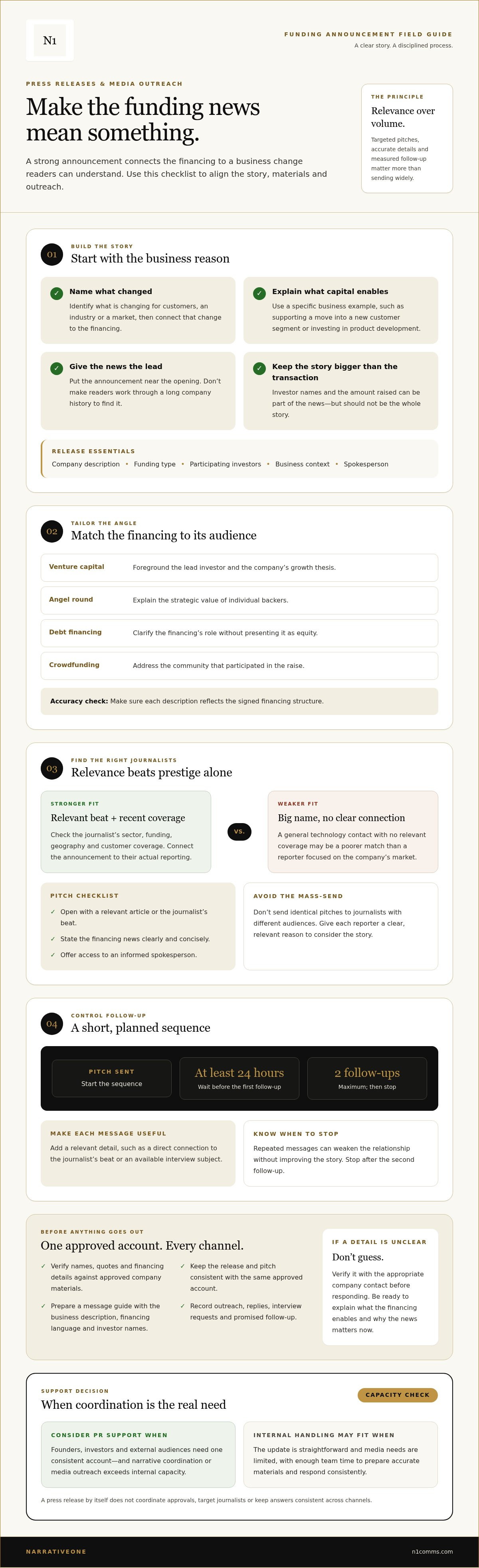
Plan the release and outreach together. Even a clear announcement needs relevant journalists, a precise pitch and disciplined follow-up.
Start with the editorial reason for the announcement. Identify what changed for customers, an industry or a market, then link that change to the financing. For example, a software company entering a new customer segment can explain how the round supports that move. Effective fundraising announcements for tech companies give readers this business context, not just transaction details.
Draft a release with the core facts: company description, funding type, participating investors, business context and spokesperson. Put the announcement in the opening, not behind a long company history. Verify every name, quote and financing description against approved company materials. Fundraising announcements for tech companies should give journalists a precise account they can assess quickly.
Build a journalist list around relevant coverage, not publication prestige alone. Review reporting on the company’s sector, funding activity, geography and customers. Note each journalist’s beat and recent work, then connect it to the announcement. A reporter covering enterprise software financing is a stronger fit than a general technology contact with no relevant coverage.
Send each journalist a concise, targeted pitch. Open with a relevant article or beat, then state the financing news and offer access to an informed spokesperson. Avoid mass emails and identical pitches to reporters with different audiences. A targeted approach gives journalists a clear reason to consider the story.
Plan follow-up before sending the pitch. Wait at least 24 hours before the first follow-up, then limit the sequence to 2 follow-ups. Each message should add a useful detail, such as a direct connection to the journalist’s beat or an available interview subject. Stop after the second follow-up; repeated messages weaken the relationship without improving the story.
For a company that needs coordinated execution, consider fundraising announcement media relations as part of the communications plan. The priority is not volume. It is a relevant pitch, accurate materials and a controlled process.
Use the release and pitch to support the same account of the announcement. Keep a short message guide with the approved business description, financing language, investor names and spokesperson details, so anyone answering questions can stay consistent. Prepare for likely questions about what the financing enables and why the news matters now. If a detail is unconfirmed, don’t guess; verify it with the appropriate company contact before responding. This keeps the announcement useful without overstating the round’s significance.
A contributor says he has helped dozens of companies announce funding news. That experience underscores the value of preparation as well as distribution: the team should know who can speak, what they can discuss and how to handle requests for clarification. Record outreach, replies, interview requests and promised follow-up, and share the record with those responsible for communications. After the announcement, review what prompted questions and what materials reporters requested. Use those observations to improve the next outreach effort, while keeping the focus on relevance, accuracy and respectful relationships with journalists.
Common announcement mistakes
Before publication, check the announcement against six potential failure points. Each can weaken accuracy, credibility or usefulness to investors and customers.
Distinguish closed capital from planned or potential financing. If a company has secured equity but is still discussing a credit facility, don’t combine them into one headline amount. Label each component accurately and use the same figures in the release, founder statements and investor communications. Inconsistent amounts create avoidable questions about the transaction.
Describe the financing structure precisely. Calling debt an equity round, or presenting a crowdfunding campaign as venture backing, misrepresents the company’s capital base. Match the announcement’s terminology to the actual transaction. If several financing sources participated, name each category rather than grouping them under “investors.”
Replace generic growth claims with operational specifics. “The funding will accelerate innovation” tells readers little. Explain the priority, such as expanding a product team, entering a defined market or extending a platform’s capabilities. Don’t claim a plan is underway if the company has only identified it as a future use of funds.
Substantiate every market-positioning claim. Calling a startup “the leading platform” requires evidence and a defined basis for comparison. Otherwise, describe the product, customer or problem in verifiable terms. Review the headline, founder quote and boilerplate together: an unsupported superlative in any one can undermine otherwise careful messaging.
Review quotes and investor references before release. A founder’s statement should add strategic perspective, not repeat the funding amount. Verify each named investor’s role and secure approval for quoted language. Don’t imply endorsement from a customer, partner or investor whose role in the announcement is different.
Keep confidential details out of the public narrative. Review draft text, images and attachments for customer names, product plans or transaction terms not intended for release. A slide in a press kit, for example, might reveal an unannounced launch. Assign one final reviewer to inspect every asset before publication.
Check consistency across the release, company newsroom and social posts. One approved source document helps the team publish the same names, financing description and strategic rationale. Correct errors before distribution, rather than issuing conflicting follow-up statements.
Fundraising press release structure
Structure the release to serve readers and journalists. Each part should clarify the transaction, its significance and the company’s next move.
Write a headline that identifies the company and financing event. Use direct wording, such as “Northstar Analytics raises new funding to expand its forecasting platform.” Avoid clever headlines that obscure the news. Journalists scanning an inbox should understand the announcement before opening the release.
Lead with the transaction’s essential facts. State the company name, financing type, participating investors and relevant business context. If the amount is public, include it accurately; if it isn’t, don’t imply a figure. The opening should say what happened and who participated before introducing product history or founder biography.
Explain the company’s work in one concrete sentence. Identify the customer, problem and product, such as software that helps logistics teams plan delivery routes. Avoid broad labels like “next-generation technology” without a useful description. Clear context helps readers outside the sector assess the funding announcement.
Link the financing to a specific strategic priority. Describe a planned action, such as expanding engineering capacity or entering a new customer segment. Distinguish plans from completed work. “The company plans to develop its analytics product” communicates intent; “the funding has already transformed the platform” claims an outcome.
Use quotes to add perspective, not repeat the headline. A founder can explain why the company is pursuing a defined priority; an investor can describe the investment thesis. For example, a founder might explain how customer demand shaped product development. Confirm every quote and named role before distribution.
Close with company context and a useful media contact. Keep the company description factual, consistent with public materials and focused on its current business. Give journalists a named spokesperson or communications contact and a clear way to request an interview. Check names, titles and contact details throughout the release before publishing.
Read the final release from a reporter’s perspective. Check that the headline, opening, financing description and strategic rationale tell one coherent story. Remove repeated claims, unexplained acronyms and promotional language. Journalists should be able to identify the news, understand the company and find the relevant spokesperson without wading through unrelated detail.
Why startups should announce fundraising rounds
Publish a round announcement when it serves a defined strategic purpose. Treat public visibility as something to manage, not an automatic reward for closing financing.
Use the announcement to establish a clear market record. A public statement gives customers, candidates and potential partners one consistent account of the round and its purpose. For example, a startup entering a new market can explain how financing supports that move. This context helps readers understand the company’s direction beyond its funding status.
Make the market context part of the decision. Global venture funding fell by 35% in 2022 compared with 2021, while African tech funding increased by 8% year over year in 2022. African tech companies raised $6.5 billion through 764 equity and debt deals in 2022. These figures show why a round can signal company-level momentum within a changing funding environment.
Decide what the announcement should help achieve next. A company recruiting engineers can link the financing to its hiring priorities. A startup pursuing enterprise customers can explain how capital supports product development or market expansion. Identify the intended audience first, then make the relevance clear. Without a defined audience, a release risks becoming a record of the transaction alone.
Weigh transparency against the company’s communication priorities. Fully and partially publicly disclosed equity fundraises accounted for 87% of African tech equity transactions in 2022, compared with 77% in 2021. They accounted for 600 of 693 equity transactions in African tech in 2022. Disclosure is a visible market practice, but each company still needs a coherent rationale and accurate account.
Align the announcement with the next stage of company building. A funding story can introduce the strategic priorities that investors, customers and prospective employees should understand. Keep the connection concrete: explain the problem the company will address, the capability it will build or the market it will serve. Avoid implying that financing alone proves execution. To shape that narrative, develop a disciplined fundraising narrative around the round’s purpose.
An announcement can clarify a company’s place in its funding journey without implying that every later stage is assured. The article describes early-stage investing as a bright spot for startups until they reach Series B rounds. That makes it useful to explain not only the capital secured, but also what the company aims to prove before its next financing step. Tie expectations to planned work, such as improving a product, reaching customers or building the team, rather than presenting the round as a guarantee of future growth.
The contributor says he has 20+ years of marketing experience at startups, venture capital firms, and large tech companies. He says he has helped companies announce fundraising rounds ranging from $1 million pre-seed rounds to $50 million raises. That range underscores why an announcement should fit the company’s particular stage and purpose, rather than follow a generic formula. For any round, make the account specific enough to explain what the financing enables, while avoiding promises that the company cannot yet support. A well-framed statement can give readers a useful basis for understanding the company’s priorities and progress, and leave room for later updates to show what those plans deliver.
NarrativeOne: Fund Positioning
NarrativeOne helps venture firms define how founders, investors and the market understand their fund. Its Fund Positioning work shapes a coherent narrative. Portfolio Announcements add strategic context to investments, while LP Communications and Partner Thought Leadership address distinct stakeholder needs.
Turn to NarrativeOne when a funding announcement needs to reinforce more than the transaction, or when the fund’s positioning needs clearer alignment across communications. NarrativeOne connects the round, the portfolio and the fund’s investment thesis without treating each announcement as an isolated event.
For a focused approach to fund positioning and announcements, contact NarrativeOne.
Make the next announcement part of the strategy
A financing milestone changes a company’s position, but communication shapes how that change is understood. Treat fundraising announcements for tech companies as part of the operating plan, not a standalone publicity event. Define what stakeholders should understand, what the capital enables and how the announcement supports the company’s direction.
That discipline matters beyond one round. A consistent narrative can connect company priorities with how investors, customers and the market interpret future milestones. NarrativeOne’s work spans fund positioning, portfolio announcements and LP communications, bringing distinct stakeholder narratives into focus without reducing them to one generic message.
When the announcement needs sharper strategic alignment, contact NarrativeOne about your announcement. Give the next milestone a clear purpose and a narrative built to carry beyond publication.
Frequently Asked Questions
How do tech companies write effective fundraising announcement press releases?
Write for readers unfamiliar with the company, product and investors. Open with the completed financing and explain the business in plain language before using sector terms. Separate confirmed transaction details from plans, and label future priorities as intentions. For example, say the company plans to expand its engineering team, not that the round has already driven product growth. Keep one approved version for every channel.
What details should a fundraising announcement include, such as valuation, use of funds, and investors?
Include the company, financing type, closed amount if public, participating investors and a clear explanation of the intended use of funds. Valuation is optional: include it only if the company and relevant parties have approved public disclosure. For example, a company can say the proceeds support product development without publishing its valuation. Ensure every named investor and stated use of funds matches the approved transaction details.
Where do tech companies publish fundraising announcements: press releases, company blogs, or news outlets?
Use the company newsroom or blog as the controlled source, then distribute a release to relevant media contacts. A newsroom post gives customers, candidates and partners a stable reference. Earned coverage reaches a news outlet’s audience if a journalist chooses to report the story. Keep core facts consistent across both channels, while adapting the framing to each outlet’s readership.
What are the risks of announcing a funding round before closing or disclosing valuation?
Announcing before a round closes can misstate the transaction if terms, participants or timing change. It can also cause confusion if public claims conflict with the final agreement or investor communications. Publishing a valuation may invite scrutiny of a figure the company need not disclose. Set an approval gate: confirm the round’s status, align named parties, and obtain appropriate internal and legal review before releasing sensitive terms.