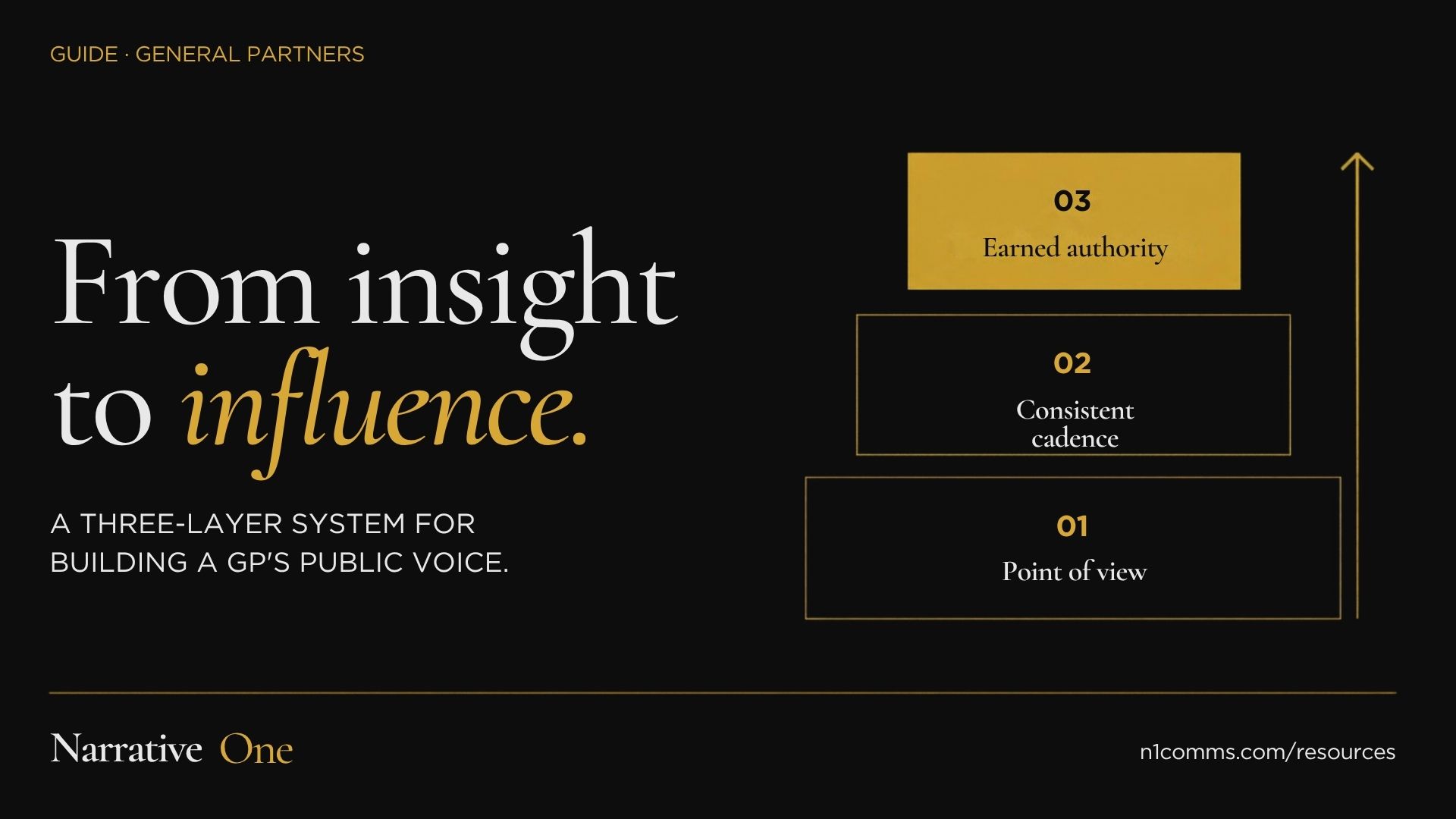
A partner’s strongest insight isn’t an authority asset until it’s distinctive, governed, and connected to the fund’s investment strategy. That’s the discipline behind thought leadership for VC partners. Yet public commentary often repeats familiar market convictions, while isolated posts leave no durable record of how a firm thinks. A credible point of view starts with what partners have learned through investment decisions, not generic takes on the latest trend.
Partners need to share a clear perspective without exposing confidential information or creating communications risk. Visibility alone won’t solve that problem. This article shows how to define a credible investment view, turn it into a repeatable publishing practice, and connect partner expertise to fund authority without overstating the firm’s role or outcomes. It also explains how a 12-month narrative plan, weekly execution, and a shared compliance workflow can keep insight aligned across the firm and its portfolio. The objective isn’t a campaign built around occasional commentary. It’s a sustained communications discipline that lets judgment accumulate into recognition over time.
Key Takeaways
Thought leadership for VC partners builds fund authority when public insight reflects investment judgment, not just visibility.
Shape a distinctive point of view by interpreting market evidence through the fund’s thesis and the partner’s expertise.
Assess each idea for relevance, substantiation, distinctiveness, and alignment before it becomes public commentary.
Build a repeatable workflow from insight capture through review and publication, with a cadence tied to meaningful investment questions.
Connect GP thought leadership to a broader communications system, including a shared strategist, journalist network, and compliance workflow.
Table of Contents
Why Thought Leadership for VC Partners Is More Than Visibility
How VC Partner Insight Becomes a Distinctive Investment Point of View
What Makes VC Partner Commentary Credible, Useful, and Distinctive?
How to Build a Repeatable Thought Leadership Practice for VC Partners
How NarrativeOne Supports Thought Leadership for VC Partners
Why Thought Leadership for VC Partners Is More Than Visibility
A public profile is not an investment point of view. Thought leadership is the evidence-led expression of expertise that helps an audience understand how a partner interprets markets, evaluates risk, and makes capital allocation decisions. What is thought leadership? The useful distinction isn’t how often a partner publishes, but whether their analysis gives readers a reason to trust their judgment.
Thought leadership is investment judgment made legible to the market. It differs from ordinary commentary because it connects evidence to a coherent perspective. It also differs from promotion: claims about a fund or portfolio company may attract attention, but attention alone doesn’t explain why the partner’s judgment matters.
Fund announcements have a defined purpose: to communicate a transaction, milestone, or change. They can support a firm’s visibility, but they aren’t a substitute for analysis. Durable authority develops when a partner repeatedly explains what an investment signal means, what it doesn’t mean, and how it informs a broader thesis. No single post can do that work alone.
Useful commentary serves more than one audience. Founders can learn how an investor thinks about company-building decisions. LPs can see the reasoning behind a strategy. Co-investors can assess how a partner approaches a market or risk. The wider market gets interpretation rather than another forecast detached from its assumptions. Strong thought leadership for VC partners makes expertise accessible without turning every insight into a pitch.
What thought leadership means for a venture capital partner
A partner’s point of view should grow from investment experience and connect a market observation to a clear interpretation. Noting that a sector is attracting attention is an observation; explaining which underlying shift could make a particular business model more durable is analysis. Credibility comes from showing the reasoning and its limits, not from publishing frequently or presenting conviction as certainty.
Visibility is an output. Credibility and relevance are the objectives. A useful test: could a founder or LP apply the insight to a decision, even if they never invest with the fund? If so, the commentary offers value beyond the partner’s profile.
How partner authority relates to fund positioning
A partner’s expertise can reinforce the fund’s investment case without replacing it. The firm defines its shared positioning: where it invests, what it believes, and why its approach is distinct. The partner brings a specific lens shaped by experience, sector focus, or investment practice. That lens should add depth to the firm’s case, not create a competing promise or imply that one partner’s view represents every investor at the firm.
This distinction keeps public insight coherent. A partner can examine one investment question in depth while the firm maintains a consistent account of its strategy. A fund brand positioning strategy provides that broader frame, so individual expertise strengthens the investment case instead of fragmenting it.
Authority compounds through alignment: each contribution demonstrates judgment, serves a defined audience, and adds another piece to a consistent public record. The measure isn’t attention in isolation. It’s whether the partner’s insight helps the market understand how the fund thinks.
How VC Partner Insight Becomes a Distinctive Investment Point of View
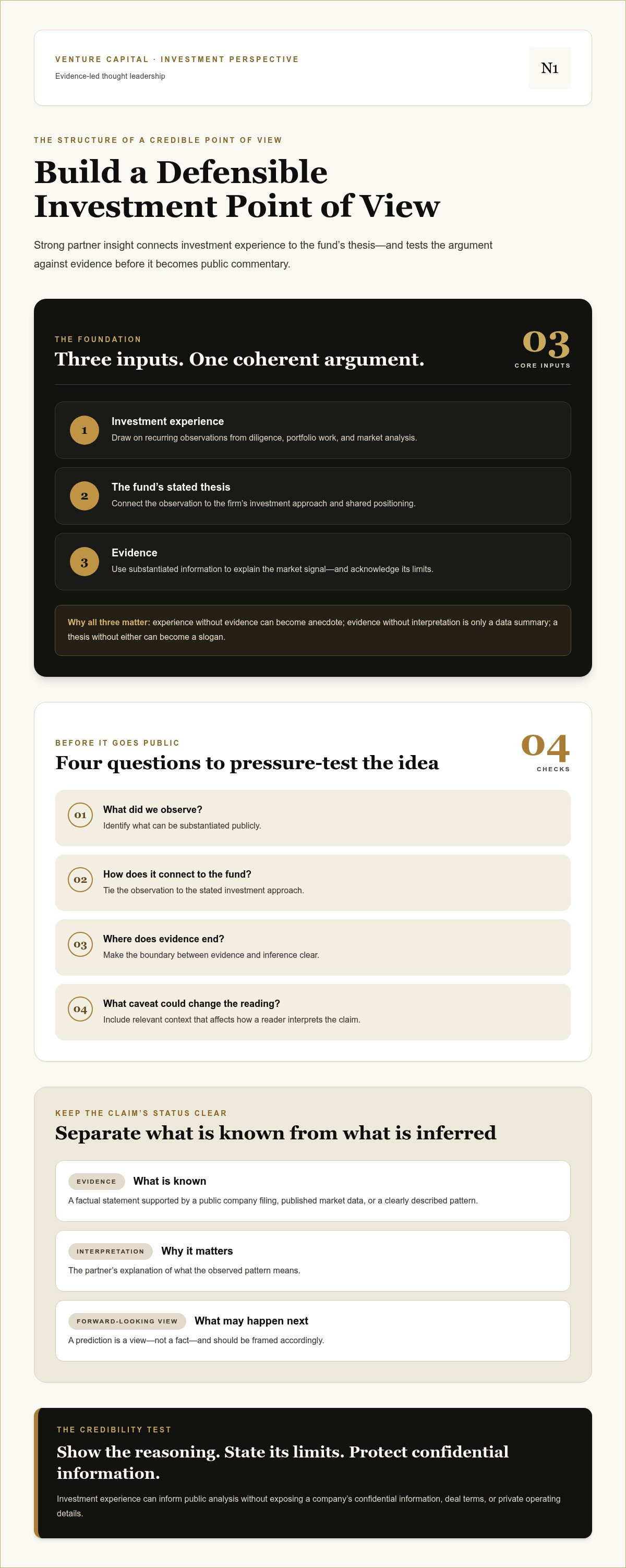
A distinctive point of view draws on three inputs: a partner’s investment experience, the fund’s stated thesis, and evidence that helps explain a market signal. Remove any one of them and the argument weakens. Experience without evidence becomes anecdote. Evidence without interpretation becomes a data summary. A thesis without either becomes a slogan.
A credible investment point of view connects verifiable evidence to a clear interpretation, while stating what the evidence cannot prove.
From investment experience to a defensible thesis
Start with recurring observations from diligence, portfolio work, and market analysis. Look for a question that has surfaced more than once: what makes a customer adopt a product, where does a business model encounter friction, or which capabilities appear to support durable growth? Recurrence can point to a useful subject, but it doesn’t prove a broad market claim. Test the observation against evidence and the fund’s investment approach.
Then separate what is known from what is inferred. A public company filing, published market data, or a clearly described pattern can support a factual statement. Explaining why that pattern matters is interpretation. Predicting what happens next is a further step and should be framed as a view, not a fact. Investment experience can inform the analysis without exposing a company’s confidential information, deal terms, or private operating details.
For each potential argument, ask:
What did we observe, and what can be substantiated publicly?
How does this observation connect to the fund’s stated investment approach?
Where does the evidence end and our inference begin?
What relevant caveat would change how a reader interprets the claim?
Build differentiation through specificity and proof
Specificity makes an insight testable. Consider a hypothetical partner who hears founders discussing customer acquisition costs. “Efficiency matters” is a slogan. A more useful argument might examine how the timing of customer payback affects a company’s ability to scale, then distinguish the available evidence from the partner’s judgment about its investment significance. The example doesn’t need confidential portfolio data; it needs a clear question, a defensible basis, and an explicit boundary.
That boundary protects the argument from false certainty. Evidence of a pattern in one segment doesn’t establish that it applies across an entire sector. A plausible forecast doesn’t become a fact because an investor states it confidently. Contrarianism isn’t differentiation either. Disagreeing with consensus has value only when the partner can show what the consensus misses and why the alternative interpretation holds.
Before developing a draft, name its intended reader and the decision the insight could inform. Founders may need to understand a market trade-off; LPs may want insight into how the fund evaluates a thesis; co-investors may benefit from a sharper account of a risk. If the argument serves no identifiable question, it’s not ready for publication. A disciplined GP thought leadership approach can make that test a repeatable part of developing and refining partner insight.
What Makes VC Partner Commentary Credible, Useful, and Distinctive?
A strong idea can still fail in public. It may rely on a prediction no evidence supports, read like fund promotion, or address no clear audience. Credibility comes from disciplined claims: what the partner knows, how they reached their view, and where its limits lie. Provocation can attract attention, but it cannot substitute for substantiation.
Use four tests before advancing an idea: Is it relevant to a real audience question? Can its factual claims be supported? Does it offer a perspective beyond borrowed consensus? Does it reinforce the fund’s strategy? An idea that fails one test needs revision. If it fails several, keep it internal.
Signals of credible VC partner thought leadership
Evidence-led analysis distinguishes observation from inference and prediction. It explains the reasoning without disguising uncertainty and makes the core point accessible without flattening the investment complexity behind it. This is the editorial standard for thought leadership for VC partners: clarity with intellectual restraint. The partner’s perspective should also fit the fund’s strategic position. A compelling post that contradicts the firm’s stated approach creates confusion, not differentiation.
Credible signalCommon weaknessSpecific claims tied to observable evidenceBroad forecasts presented as established factReasoning that separates evidence from interpretationConfident assertions without a visible basisA defined audience and useful decision contextCommentary aimed at everyone, and therefore useful to no oneA perspective consistent with fund strategyPromotional language or a position that conflicts with the firm’s investment caseMeasured language that states relevant limitsAbsolute certainty used to manufacture authority
Precision is not timidity. A partner can make a firm argument while acknowledging what a data point cannot establish. Evidence of a pattern in one market segment, for example, may support a focused observation but not a sweeping claim about an entire sector. That distinction makes the insight more useful to founders, LPs, and co-investors. It also gives readers a way to assess the partner’s judgment rather than simply react to their tone.
How to address confidentiality and communications risk
Public commentary should not disclose confidential deal details, unannounced portfolio information, or performance claims that lack substantiation. Use a controlled review process rather than a last-minute search for risky wording. Compliance rules are embedded before the compliance director reviews drafts, so boundaries shape the material from the outset rather than being bolted on at publication.
Depending on the firm, audience, and relevant markets, compliance considerations may involve the FSRA, ADGM, DIFC, SAMA, or CMA. Naming these bodies does not establish which rules apply to a particular communication. Route drafts through the firm’s compliance workflow and keep claims within its approved boundaries. Credibility is built by saying exactly what the evidence supports, then stopping there.
How to Build a Repeatable Thought Leadership Practice for VC Partners
A durable editorial practice runs on a process, not a posting target. It captures partner insight as investment work happens, then gives each idea a clear route through selection, drafting, review, publication, and learning. That structure protects partner time and keeps thought leadership for VC partners connected to the fund’s strategy rather than just the content calendar.
A useful editorial test is simple: does this idea serve an audience, rest on evidence, and fit the fund’s strategy?
A five-step editorial workflow for partner insight
Capture. Record recurring questions from diligence, portfolio work, and market analysis. Use a secure internal note or discussion to preserve the underlying insight, not sensitive company details. Remove confidential information before an idea enters the public-content process.
Select. Assess each idea for audience relevance, available evidence, distinctiveness, and fit with the fund’s investment strategy. If it depends on private information or makes a claim the partner can’t substantiate, reshape it or hold it back.
Develop. Define the intended reader, the question the piece answers, and the evidence that supports it. A strategist or editor can help structure the argument, while the partner checks that the analysis reflects their judgment and doesn’t overstate what the evidence shows.
Review and approve. Set clear responsibility for factual checks, strategic alignment, confidentiality, and compliance review. Embed communication rules before the compliance director reviews drafts. A defined approval path prevents late-stage edits from changing the meaning of a carefully qualified point.
Publish and learn. Place the contribution in a suitable channel, then assess whether it reached the intended audience and generated useful questions or follow-up. Record what resonated and what needs clarification. Use those signals to inform future topics, not to chase reactions with more volume.
Choose formats and cadence for the audience
Match the format to the argument. An op-ed can carry a developed thesis; an interview can surface a partner’s reasoning through questions; an event contribution can put insight into discussion; concise commentary can address a timely issue when the partner has something substantive to add. Repurposing works when each format has a distinct job. A core analysis might inform an event answer and a shorter written viewpoint, but adapt each for its audience rather than copying it with boilerplate.
Set a manageable rhythm around investment questions the firm can address with evidence. A 12-month narrative plan can map priority themes, while weekly execution and monthly reporting keep the practice moving and give the team a basis for review. Consistency comes from maintaining the process, not forcing a partner to publish on an arbitrary schedule.
LPs also need communication that builds context beyond routine reporting. A thoughtful partner perspective can contribute to that broader relationship when it complements a clear LP communications strategy.
NarrativeOne’s GP thought leadership support brings a governed, repeatable process to partner insight.
How NarrativeOne Supports Thought Leadership for VC Partners
Partner commentary is strongest when it sits inside a broader communications system. A well-formed idea needs to align with the fund’s narrative, reach an appropriate audience, and pass through a disciplined review process. NarrativeOne’s GP thought leadership connects these requirements to the wider communications infrastructure investment firms use to express their strategy and expertise.
A senior-led operating model for investment communications
NarrativeOne brings 17 years of operating experience inside investment institutions to its work with investment firms. Its model pairs one senior strategist with one journalist network, creating a consistent line between the fund’s priorities, the partner’s insight, and how that insight is developed for external audiences. The journalist network supports targeted media coverage; it doesn’t replace the partner’s investment judgment.
GP thought leadership works alongside Strategy & narrative, Media relations, and Bilingual content. Together, these services connect an individual partner’s expertise to the firm’s investment case and communications priorities. Content is drafted natively in English and Arabic for senior financial journalists, not translated after drafting. One shared compliance workflow supports communications across the firm and its portfolio companies, helping maintain consistency while accounting for the different contexts in which each communicates.
This structure matters because partner insight rarely operates in isolation. A point of view may inform an article, contribute to an interview, or support the firm’s wider narrative. The senior-led model provides a strategic through-line across those formats while leaving room for each partner’s distinct perspective.
Governance and continuity built into the programme
Review begins before a draft reaches the compliance director. Compliance rules are embedded into the workflow first, so they shape how ideas are developed and expressed. The compliance director then reviews drafts within that established framework. This sequence treats governance as part of the editorial architecture, not a final-stage obstacle.
Execution follows a 12-month narrative plan, carried out weekly and reported monthly. The plan gives partner insight continuity across the year; weekly execution advances the work, while monthly reporting provides a structured view of activity. It does not make outcomes automatic. The discipline lies in sustaining alignment between the firm’s priorities and the insight it shares publicly.
NarrativeOne’s stated client-base metric is $2 B+ AUM across 150+ funds/clients. That figure describes the scale of the client base, not a performance claim or a promised result for any individual firm. For investment teams, the value of an integrated approach is its structure: one strategic lead, a journalist network, and a compliance workflow shared across the firm and its portfolio.
Learn more about NarrativeOne’s GP thought leadership approach.
Put the Next Investment Insight to Work
The next step is not to publish more. It’s to identify the investment question your partners are best placed to interpret, then give that insight a clear path from internal discussion to governed public communication. That choice sets the standard for what follows: a point of view grounded in judgment, useful to its audience, and consistent with the fund’s position.
For thought leadership for VC partners, authority is built through decisions repeated over time: what to examine, what to substantiate, what to hold back, and where to contribute. A sustained practice gives each new contribution a foundation in the fund’s strategy and the insight that came before it.
If your firm is ready to turn partner insight into a sustained practice, explore NarrativeOne’s GP thought leadership approach. Start with one investment question worth explaining clearly, then build a disciplined process to develop and share the answer.
Frequently Asked Questions
Can VC partners build thought leadership without becoming full-time content creators?
Yes. Partners can contribute expertise without managing a publishing operation. Set aside focused time to discuss an investment question, review the resulting argument, and approve the final version. An editorial lead can coordinate scheduling and drafting. For example, a focused interview can surface a partner’s reasoning on a sector shift, then become one carefully developed piece. The partner’s contribution is judgment, not daily posting. That makes thought leadership for VC partners compatible with investment responsibilities.
How is VC partner thought leadership different from fund marketing?
Fund marketing communicates the firm’s offer, strategy, and fundraising narrative. Thought leadership examines an investment question and gives readers a reasoned perspective they can assess, even if they never become investors. A partner explaining the trade-offs behind a market thesis is offering analysis; a post focused only on fund credentials is promotional. The two can support each other, but they serve different purposes and should be planned accordingly.
What topics can a VC partner discuss without revealing confidential information?
Partners can discuss public market signals, general investment principles, sector dynamics, and lessons framed without identifying a company or transaction. For example, they might explain how customer concentration can affect diligence, using a hypothetical rather than details from a live deal. Before publication, review examples for clues that could identify a company, reveal non-public developments, or imply performance claims. Generalize or remove any detail that creates avoidable exposure.
Does a VC partner need to publish under a personal profile or the fund’s name?
Neither format is mandatory. A personal byline can make an individual partner’s expertise clear; a fund channel can emphasize the firm’s shared position. Decide based on who owns the argument, who needs to reach the audience, and how the firm governs public commentary. If a personal post represents only one partner’s view, make that distinction clear. The fund should still align on messaging that could be read as an institutional position.
How should a venture capital partner respond when market evidence challenges their thesis?
Address the evidence directly, then examine what it changes. A new data point may weaken one assumption, affect timing, or challenge the thesis more fundamentally. Explain which interpretation now holds, what remains uncertain, and whether the partner’s view has changed. Updating a position is a sign of analytical discipline, not a loss of authority. Avoid dismissing inconvenient evidence or quietly repeating an older claim as if nothing has shifted.
Can VC partners use events and speaking engagements as thought leadership?
Yes. A panel, interview, or conference contribution can develop a point of view through live questions and disagreement. Prepare a short set of core arguments, relevant public evidence, and boundaries around topics that should stay private. Afterward, review which questions exposed a useful gap in the argument. That learning can inform a separate article or follow-up commentary, provided the new format adds substance rather than reproducing the talk verbatim.
How can a fund maintain consistent partner commentary when investment priorities change?
Distinguish the fund’s enduring principles from its current areas of focus. When priorities shift, explain what changed, why the firm’s attention moved, and which earlier assumptions still hold. Review existing public material so new commentary doesn’t leave outdated claims unexplained. Partners can then speak to current opportunities without suggesting the fund has abandoned its underlying discipline. Consistency comes from transparent reasoning, not from pretending strategy never evolves.
Frequently Asked Questions
Can VC partners build thought leadership without becoming full-time content creators?
Yes. Partners can contribute expertise without managing a publishing operation. Set aside focused time to discuss an investment question, review the resulting argument, and approve the final version. An editorial lead can coordinate scheduling and drafting. For example, a focused interview can surface a partner’s reasoning on a sector shift, then become one carefully developed piece. The partner’s contribution is judgment, not daily posting. That makes thought leadership for VC partners compatible with investment responsibilities.
How is VC partner thought leadership different from fund marketing?
Fund marketing communicates the firm’s offer, strategy, and fundraising narrative. Thought leadership examines an investment question and gives readers a reasoned perspective they can assess, even if they never become investors. A partner explaining the trade-offs behind a market thesis is offering analysis; a post focused only on fund credentials is promotional. The two can support each other, but they serve different purposes and should be planned accordingly.
What topics can a VC partner discuss without revealing confidential information?
Partners can discuss public market signals, general investment principles, sector dynamics, and lessons framed without identifying a company or transaction. For example, they might explain how customer concentration can affect diligence, using a hypothetical rather than details from a live deal. Before publication, review examples for clues that could identify a company, reveal non-public developments, or imply performance claims. Generalize or remove any detail that creates avoidable exposure.
Does a VC partner need to publish under a personal profile or the fund’s name?
Neither format is mandatory. A personal byline can make an individual partner’s expertise clear; a fund channel can emphasize the firm’s shared position. Decide based on who owns the argument, who needs to reach the audience, and how the firm governs public commentary. If a personal post represents only one partner’s view, make that distinction clear. The fund should still align on messaging that could be read as an institutional position.
How should a venture capital partner respond when market evidence challenges their thesis?
Address the evidence directly, then examine what it changes. A new data point may weaken one assumption, affect timing, or challenge the thesis more fundamentally. Explain which interpretation now holds, what remains uncertain, and whether the partner’s view has changed. Updating a position is a sign of analytical discipline, not a loss of authority. Avoid dismissing inconvenient evidence or quietly repeating an older claim as if nothing has shifted.
Can VC partners use events and speaking engagements as thought leadership?
Yes. A panel, interview, or conference contribution can develop a point of view through live questions and disagreement. Prepare a short set of core arguments, relevant public evidence, and boundaries around topics that should stay private. Afterward, review which questions exposed a useful gap in the argument. That learning can inform a separate article or follow-up commentary, provided the new format adds substance rather than reproducing the talk verbatim.
How can a fund maintain consistent partner commentary when investment priorities change?
Distinguish the fund’s enduring principles from its current areas of focus. When priorities shift, explain what changed, why the firm’s attention moved, and which earlier assumptions still hold. Review existing public material so new commentary doesn’t leave outdated claims unexplained. Partners can then speak to current opportunities without suggesting the fund has abandoned its underlying discipline. Consistency comes from transparent reasoning, not from pretending strategy never evolves.