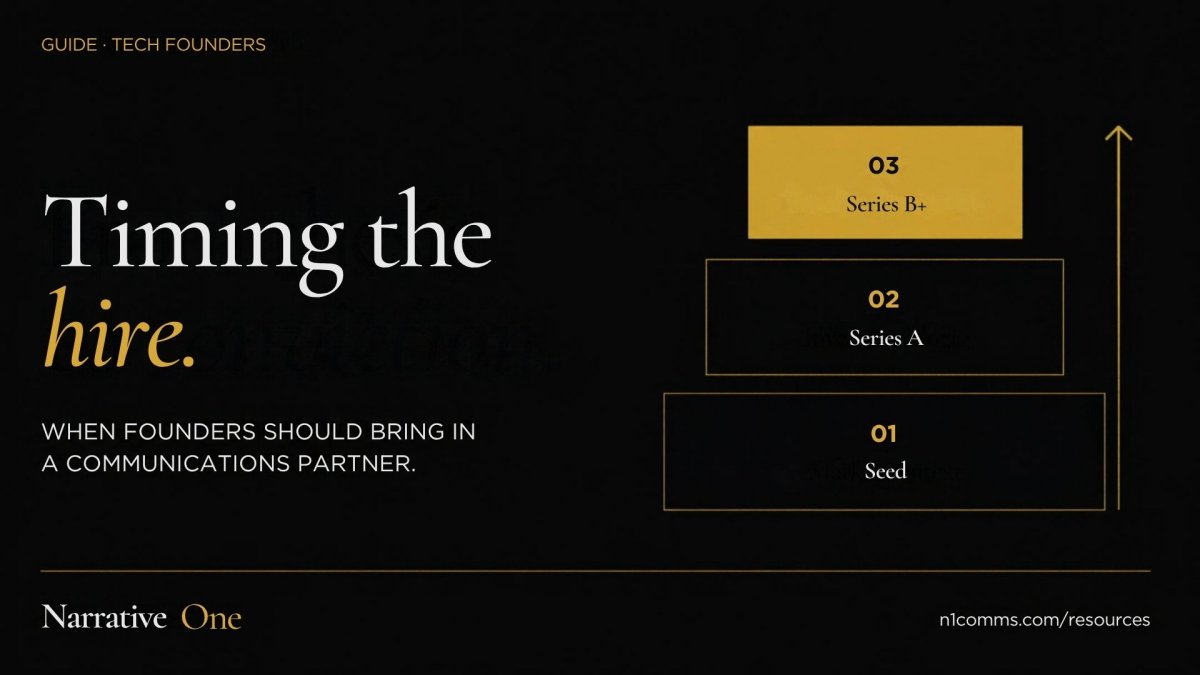
A PR agency cannot manufacture readiness. If your company’s story is still shifting, publicity can amplify confusion instead of building confidence. The question of when to hire a PR agency for a startup comes down to whether a meaningful business milestone, a credible narrative, and the capacity to support communications have converged.
It’s reasonable to ask whether agency work will advance a business objective or simply consume founder time. A funding announcement or product launch can create a reason to act, but one news moment is not the same as a communications strategy. PR has greater value when each announcement reinforces a clear position with investors, customers, and the market.
This guide gives you a practical readiness test based on milestones, narrative strength, and operating capacity. It explains what an agency should own, what founders need to contribute, and how to distinguish sustained strategic communications from one-off publicity. You’ll leave with a clear next step: strengthen your story first, handle outreach founder-led, or engage an agency for a structured programme.
Key Takeaways
- Decide when to hire a PR agency for a startup by testing whether a credible narrative, a meaningful business trigger, and the capacity to support communications align.
- Assess fundraising, product launches, market entry, category positioning, and material milestones as potential reasons to engage, rather than relying on company age or funding stage alone.
- Identify readiness gaps that could weaken a PR engagement, then decide whether to address them first or defer publicity.
- Evaluate communications support by its strategic judgment, senior involvement, journalist targeting, reporting, and compliance workflow, not by placement promises alone.
- See how a twelve-month communications programme can connect narrative development, drafting, review, media relations, and reporting into sustained infrastructure.
When to hire a PR agency for a startup: readiness comes before publicity
Startup PR is not simply a request to make the company better known. It is strategic communication in service of a defined business objective, such as supporting a fundraise, clarifying a market position, or giving a product launch a credible public context. Public relations (PR) can shape how an organization communicates with its audiences, but visibility alone is not a business outcome.
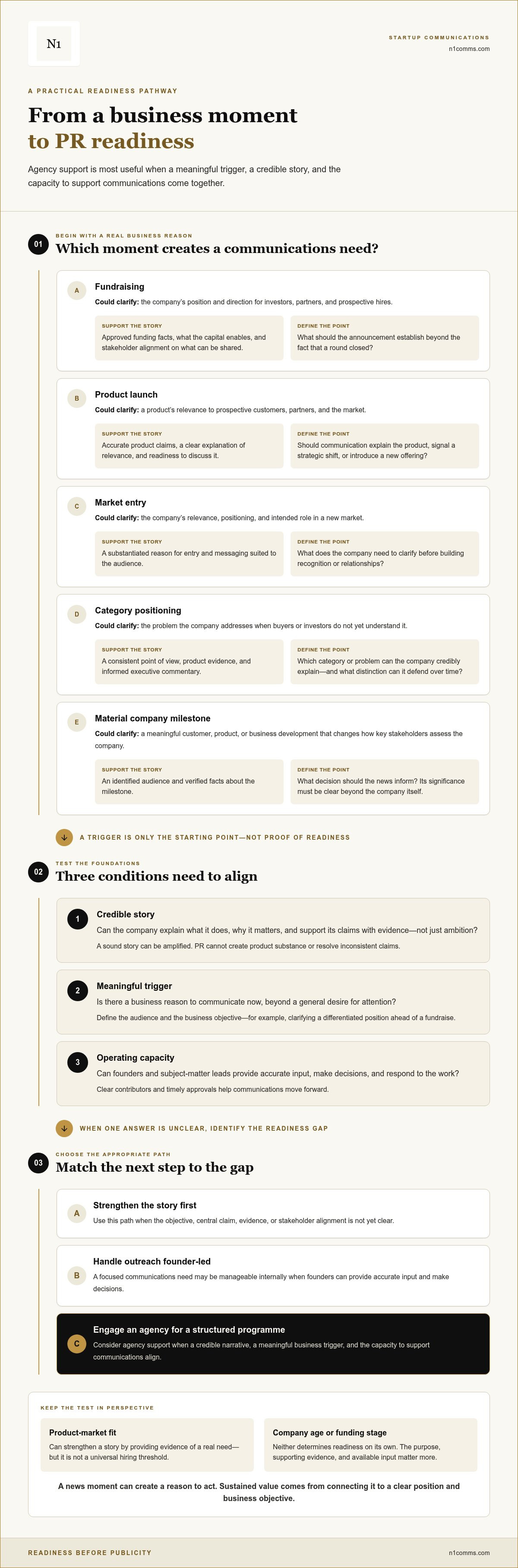
Agency support becomes useful when a credible story, a meaningful business trigger, and the capacity to support communication align. This is a more useful test than company age or funding stage. A young company may have a substantiated launch and a clear reason to communicate. A later-stage company may still lack a coherent story or the internal capacity to act on one.
- Credible story: The company can support its claims with evidence, not just ambition.
- Meaningful trigger: There is a business reason to communicate now, beyond a general desire for attention.
- Operating capacity: Founders and subject-matter leads can provide accurate input, make decisions, and respond to the work communications requires.
What does PR readiness mean for a startup?
Readiness means the company can explain what it does, why it matters, and what supports its claims. It also means defining the intended result. “Become better known” is too broad to guide strategy. “Help prospective investors understand our differentiated position ahead of a fundraise” gives communication a purpose. PR can amplify a sound strategy. It cannot create product substance, resolve inconsistent claims, or substitute for a business plan.
Use a simple diagnostic: can your team state the objective, substantiate the central claim, and identify who must contribute for communication to move forward? If one answer is unclear, you have a readiness gap to address before publicity. It may be fixable, and it is not automatically a reason to abandon PR.
Why product-market fit is a signal, not a universal rule
Product-market fit can strengthen a company’s story because it may provide evidence that a product is meeting a real need. But it is not an automatic hiring threshold. A specific product launch or material company milestone can create a valid communications trigger earlier, provided the claims are supportable and the objective is clear.
The reverse is also true: reaching a funding stage or reporting traction does not, by itself, justify an agency engagement. Ask what the moment needs to accomplish, what evidence can support the story, and who will supply timely input and approvals. That answer, not a stage label, determines whether the company is ready to proceed.
Five startup moments that can justify hiring a PR agency
The useful question isn’t whether your startup has reached a certain age or funding stage. It’s whether a specific company event creates a communications need that internal effort can’t adequately support. To assess when to hire a PR agency for a startup, identify the audience, evidence, and business decision attached to the moment. A trigger without those elements is just activity.
- Fundraising. A funding announcement may help investors, partners, and prospective hires understand the company’s position and direction. The proof points are approved funding facts, a clear account of what the capital enables, and stakeholder alignment on what can be shared. The communications decision: what should this announcement establish beyond the fact that a round closed?
- Product launch. A launch can matter to prospective customers, partners, and the market when the product addresses a defined need. Support the story with accurate product claims, a clear explanation of its relevance, and evidence that the company is prepared to discuss it. Decide whether communication should drive understanding, signal a strategic shift, or introduce a new offering.
- Market entry. Entering a new market can require more than announcing availability. The audience may need context on the company’s relevance, positioning, and intended role. Useful proof includes a substantiated reason for entry and messaging that fits the audience. Decide what the company needs to clarify before it can build recognition or relationships.
- Category positioning. If buyers or investors don’t understand the problem your company addresses, a single announcement won’t resolve the gap. This trigger calls for a consistent point of view, supported by product evidence and informed executive commentary. Decide which category or problem the company can credibly explain, and what distinction it can defend over time.
- A material company milestone. A meaningful customer, product, or business development may warrant communication if it changes how key stakeholders assess the company. Identify the audience, verify the facts, and determine what decision the news should inform. A milestone is not automatically newsworthy; its significance must be clear beyond the company itself.
From an announcement to sustained positioning
Fundraising and launch moments often have a defined communications window. They also require coordination: approved facts, stakeholder expectations, and a consistent account of what the event means. Category positioning is different. It depends on repeated, credible commentary connected to a stable company narrative. Coverage alone does not establish category leadership; the company must earn that position through substance and consistency.
NarrativeOne supports startup milestones and product launches through strategic communications. For founders weighing a one-time announcement against ongoing support, explore startup communications and PR as a sustained programme tied to business objectives.
When a startup should wait: the readiness gaps that make PR premature
Hiring an agency too early can give an unclear story a louder distribution. If the company’s positioning changes from conversation to conversation, or its strongest claims can’t be substantiated, publicity exposes the gap rather than closing it. That doesn’t mean PR is permanently off the table. The next step may be preparation, not a full engagement.
Signs your startup needs PR, and signs it is not ready
A substantiated milestone and a defined audience create a communications rationale. A vague ambition to “raise awareness” does not. Before moving forward, test whether the company can explain what it wants an audience to understand and support its claims with evidence. Shifting positioning, unverified performance statements, or uncertainty about who can approve public statements all weaken execution.
PR is not a substitute for product progress, commercial traction, or a viable fundraising case. If those fundamentals are the real concern, publicity won’t repair them. It can help communicate a credible development once the company is ready to stand behind it.
Prepare the story before you fund its distribution. That preparation may be enough to close a fixable gap. A deeper strategic or operational issue calls for deferring the engagement.
Founder capacity, approvals, and evidence
Agency work still depends on company-side decisions. Founders or designated spokespeople need to provide context, review drafts, verify claims, and be available for relevant conversations. If nobody owns those responsibilities, even a sound narrative can stall. Agree on spokespersons and approval authority before external outreach begins.
Build a practical readiness file before deciding when to hire a PR agency for a startup. It should make the story easier to validate and execute:
- Narrative: Write a concise description of the company, the problem it addresses, and its distinct perspective. Flag claims that still need clarification.
- Evidence: Gather approved facts, supporting materials, and the person responsible for verifying each claim.
- Approvals: Set a clear review path, including who can approve public statements and resolve conflicting feedback.
- Spokesperson access: Identify who can speak credibly about the company and make time for preparation and follow-up.
If these elements are incomplete but can be assembled, close the gaps and reassess against the business objective. If the company cannot yet substantiate its central story, or the underlying business case remains unsettled, defer the agency decision. Communications preparation sharpens the foundation. An agency engagement puts that foundation into an active programme.
How to assess a startup PR agency before you commit
An agency’s value is determined by its operating model, not its promise of attention. Assess who will shape the narrative, how the work connects to company priorities, and what happens between a founder’s input and a journalist receiving a release. A single press release may serve a defined moment. It is not the same as a communications programme that builds a consistent position over time.
Questions that reveal the agency’s operating model
Ask for a clear account of ownership and workflow. Who develops the narrative? Who drafts and approves materials? Who selects and pitches journalists? Who monitors activity and reports what it means for the communications objective? These questions reveal whether strategy and execution are connected or divided across layers without clear accountability.
Also establish how company milestones fit into a broader plan. A fundraising announcement, product launch, and founder commentary should reinforce a coherent position rather than read as unrelated bursts. Clarify what the agency needs from founders, who has approval authority, and how monitoring and reporting will inform future decisions. Reporting should make activity and outcomes legible, not simply produce a list of mentions.
Why bilingual drafting and compliance workflow can affect fit
For startups addressing audiences in English and Arabic, native drafting in both languages can help ensure each version communicates with clarity and intent. Arabic should not be treated as a mechanical afterthought to an English draft. Ask how the agency develops and reviews each version, and how the language choices fit the company’s narrative and audiences.
Workflow matters just as much as wording. NarrativeOne’s compliance workflow includes mandatory legal sign-off before a journalist receives a release. That sequence puts review in place before distribution. Combined with deliberate journalist targeting, monitoring, and reporting, it supports a more considered approach than sending the same release broadly and counting distribution as strategy.
NarrativeOne delivers startup communications through a twelve-month programme led by one senior operator, connecting narrative development, drafting, media relations, and founder decisions without junior layers. This model is designed for sustained communications, not a one-off announcement or a promise of placements. The right fit depends on whether your startup needs that ongoing structure or narrower support around a specific milestone.
If your evaluation points to a sustained programme, explore NarrativeOne’s startup communications programme.
What happens after you hire: build a startup communications programme
Hiring an agency should begin a disciplined sequence, not trigger an immediate rush to publish. The work starts with narrative definition, then moves into planning, drafting, review, distribution, and reporting. Each stage gives the next one a stronger foundation. A release sent before the story and facts are settled is activity without adequate control.
From narrative foundation to execution
NarrativeOne’s twelve-month communications programme treats communications as ongoing infrastructure, not a one-off project. The programme allocates 6-8 weeks to define the narrative, then 3 weeks for drafting, review, and distribution. These stages connect the company’s core position to its milestones, audiences, and media activity.
Once the narrative is established, it informs messaging, journalist targeting, and the communications plan. English and Arabic materials are drafted natively and released simultaneously, rather than treating one language as a later translation. Before a release reaches a journalist, mandatory legal sign-off is completed. Distribution is followed by monitoring and reporting, so the company can assess activity and refine its communications over time.
This sequence makes founder involvement purposeful. Founders provide context, evidence, and decisions; the programme turns those inputs into consistent communications. A senior operator connects narrative, media targeting, drafting, and founder decisions without junior layers between strategy and execution.
The next step for a founder ready to engage
Before starting, identify the next material company milestone, the audience that matters, and the evidence that supports the story. Be specific. A funding event may matter to investors and partners; a product milestone may call for a different audience and proof. That clarity gives the programme a business objective to serve.
NarrativeOne’s record includes 200+ startup milestones announced and placed, $1 B+ valuation impact, and 150+ media placements. These figures describe reported outcomes, not a guarantee of future coverage or valuation impact. They provide context for the programme’s experience, while each startup’s results depend on its own story, evidence, and circumstances.
If your milestone, audience, and supporting facts are clear, take the next step: Discuss a startup communications programme.
Make your next communications decision with discipline
The decision about when to hire a PR agency for a startup should rest on alignment, not a company-age milestone. A meaningful trigger creates a reason to communicate. A substantiated narrative gives that communication credibility. Founder access, clear approvals, and timely input make execution possible.
If those conditions aren’t in place, strengthen the story and operating process before investing in publicity. If they are, assess whether you need support for a defined announcement or a sustained programme that connects company milestones to a consistent market position. The distinction matters. Communications should serve a business objective, not become an end in itself.
NarrativeOne’s record includes 200+ startup milestones announced and placed, $1 B+ valuation impact, and 150+ media placements. These figures describe reported outcomes, not guaranteed results. The relevant question is how a structured communications programme can support your company’s objectives and evidence.
If your next milestone, audience, and proof points are clear, discuss a startup communications programme. Build from a credible foundation, then move forward with purpose.
Frequently Asked Questions
When should a startup hire a PR agency?
The question of when to hire a PR agency for a startup comes down to readiness, not company age. Consider engaging support when you have a clear, supportable story, a defined communications objective, and a meaningful trigger, such as a launch or fundraising milestone. Your team must also be able to provide accurate facts, timely approvals, and spokesperson access. If those conditions are missing, strengthen the foundation before prioritizing media outreach.
Should a startup wait until it has product-market fit to hire PR?
No. Product-market fit is a useful readiness signal, but it isn’t a universal prerequisite for every communications objective. A substantiated product launch, funding milestone, or category explanation may justify earlier support. The test is whether the startup can support its claims and whether PR serves a defined business objective. Communications shouldn’t be used to compensate for an unclear proposition or a business case the company can’t yet substantiate.
What are the signs a startup needs PR?
A material milestone, a need to explain a differentiated product, or a requirement for consistent communication with external audiences can signal a need for PR. Readiness also depends on having verified proof points, an identified spokesperson, and a workable approval process. A general desire for more attention is not enough. Define what the audience needs to understand and what decision the communication should support before choosing the next step.
Is it too early to hire a PR agency before a funding round?
Not necessarily. A funding round is one possible trigger, not the only one. A product launch, category-positioning need, or other substantiated company development may warrant communications support earlier. If the startup’s positioning is still shifting, or it lacks evidence and clear approvals, preparation may be more useful than immediate outreach. The right timing depends on the strength of the story and the work required, not simply the fundraising calendar.
What should a startup look for in a PR agency?
Assess who leads the work, how the agency develops the narrative, selects journalists, and reports on activity. Clarify how founder input, approvals, monitoring, and compliance review fit into execution. The operating model should connect communications to company milestones, rather than treat each release as an isolated task. If your audiences need English and Arabic materials, establish whether drafts are developed natively in both languages, not translated after the fact.
How long does it take to prepare startup PR?
Timing depends on the company’s readiness and the scope of work. NarrativeOne’s technology-firm programme allocates 6-8 weeks to define the narrative, followed by 3 weeks for drafting, review, and distribution. These are the programme timelines, not a universal timetable or a guarantee of coverage. The clarity of company messaging, availability of verified facts, and pace of approvals all shape the work.
Should a founder handle PR before hiring an agency?
Founder-led communication can help clarify the company’s point of view and identify the audiences that matter. It still requires accurate claims, a coherent narrative, and consistent follow-through. An agency can add strategic planning, journalist targeting, drafting, monitoring, and reporting when those needs exceed the founder’s capacity. Decide based on the work required and the team’s ability to execute it, rather than assuming a particular stage automatically calls for outside support.
Can a PR agency guarantee startup media coverage?
No responsible communications plan should treat editorial coverage as guaranteed. Outcomes depend on the story, its relevance to journalists and readers, timing, and editorial judgment. An agency can strengthen positioning, prepare materials, target appropriate journalists, and manage communications activity, but those actions don’t control whether an outlet publishes. Evaluate the quality and discipline of the process, along with documented past outcomes, rather than relying on promises of placements.
Frequently Asked Questions
What does PR readiness mean for a startup?
Readiness means the company can explain what it does, why it matters, and what supports its claims. It also means defining the intended result. “Become better known” is too broad to guide strategy. “Help prospective investors understand our differentiated position ahead of a fundraise” gives communication a purpose. PR can amplify a sound strategy. It cannot create product substance, resolve inconsistent claims, or substitute for a business plan. Use a simple diagnostic: can your team state the objective, substantiate the central claim, and identify who must contribute for communication to move forward? If one answer is unclear, you have a readiness gap to address before publicity. It may be fixable, and it is not automatically a reason to abandon PR.
When should a startup hire a PR agency?
The question of when to hire a PR agency for a startup comes down to readiness, not company age. Consider engaging support when you have a clear, supportable story, a defined communications objective, and a meaningful trigger, such as a launch or fundraising milestone. Your team must also be able to provide accurate facts, timely approvals, and spokesperson access. If those conditions are missing, strengthen the foundation before prioritizing media outreach.
Should a startup wait until it has product-market fit to hire PR?
No. Product-market fit is a useful readiness signal, but it isn’t a universal prerequisite for every communications objective. A substantiated product launch, funding milestone, or category explanation may justify earlier support. The test is whether the startup can support its claims and whether PR serves a defined business objective. Communications shouldn’t be used to compensate for an unclear proposition or a business case the company can’t yet substantiate.
What are the signs a startup needs PR?
A material milestone, a need to explain a differentiated product, or a requirement for consistent communication with external audiences can signal a need for PR. Readiness also depends on having verified proof points, an identified spokesperson, and a workable approval process. A general desire for more attention is not enough. Define what the audience needs to understand and what decision the communication should support before choosing the next step.
Is it too early to hire a PR agency before a funding round?
Not necessarily. A funding round is one possible trigger, not the only one. A product launch, category-positioning need, or other substantiated company development may warrant communications support earlier. If the startup’s positioning is still shifting, or it lacks evidence and clear approvals, preparation may be more useful than immediate outreach. The right timing depends on the strength of the story and the work required, not simply the fundraising calendar.
What should a startup look for in a PR agency?
Assess who leads the work, how the agency develops the narrative, selects journalists, and reports on activity. Clarify how founder input, approvals, monitoring, and compliance review fit into execution. The operating model should connect communications to company milestones, rather than treat each release as an isolated task. If your audiences need English and Arabic materials, establish whether drafts are developed natively in both languages, not translated after the fact.
How long does it take to prepare startup PR?
Timing depends on the company’s readiness and the scope of work. NarrativeOne’s technology-firm programme allocates 6–8 weeks to define the narrative, followed by 3 weeks for drafting, review, and distribution. These are the programme timelines, not a universal timetable or a guarantee of coverage. The clarity of company messaging, availability of verified facts, and pace of approvals all shape the work.
Should a founder handle PR before hiring an agency?
Founder-led communication can help clarify the company’s point of view and identify the audiences that matter. It still requires accurate claims, a coherent narrative, and consistent follow-through. An agency can add strategic planning, journalist targeting, drafting, monitoring, and reporting when those needs exceed the founder’s capacity. Decide based on the work required and the team’s ability to execute it, rather than assuming a particular stage automatically calls for outside support.
Can a PR agency guarantee startup media coverage?
No responsible communications plan should treat editorial coverage as guaranteed. Outcomes depend on the story, its relevance to journalists and readers, timing, and editorial judgment. An agency can strengthen positioning, prepare materials, target appropriate journalists, and manage communications activity, but those actions don’t control whether an outlet publishes. Evaluate the quality and discipline of the process, along with documented past outcomes, rather than relying on promises of placements.