Consistency matters more than volume in communications during conflicts for MENA-based investment firms and tech companies. Fund managers should keep investor updates consistent, whatever cadence they use, distinguish verified facts from assessments, and protect confidential information. The standard is disciplined communication, not constant commentary.
That discipline is difficult when facts shift, stakeholders face different risks, and silence creates uncertainty. A sound strategy must serve investors, employees, portfolio companies, and the public without compromising regulatory, fiduciary, or confidentiality duties.
This article explains how to structure updates, communicate positive and negative developments, and handle sensitive information during conflict. It also examines how investment firms and technology companies can align messages across audiences, prepare spokespeople, and decide when an update is ready to share. The objective is clear: preserve trust through accurate, consistent communication, even when conditions remain unsettled.
Key Takeaways
- Separate verified facts, operational assessments, and forward-looking statements so stakeholders can distinguish what has happened from what may follow.
- Communicate material portfolio and transaction developments consistently, while tailoring the detail to each audience and protecting confidential information.
- Prepare for disrupted networks with agreed backup channels, named spokespersons, and clear internal escalation protocols.
- Verify conflict-related claims against independent evidence before publication, and correct errors promptly rather than amplifying unverified material.
- Use a disciplined message framework to share positive and negative updates without overstating progress or obscuring material risks.
Regulatory, fiduciary, and confidentiality considerations
Conflict communication must balance investor duties, operational facts, confidentiality, and employee safety. The right approach depends on the firm’s obligations, audience, and exposure in each market.
Confidentiality in Crisis Messaging
Confidentiality in crisis messaging means sharing decision-relevant facts without exposing protected business, personal, or security information. This matters because a useful update can also reveal sensitive portfolio details or create risks for people and operations.
Separate confirmed developments from internal analysis before drafting. For example, an investor update can describe a transaction’s effect on portfolio operations without disclosing employee locations, access credentials, or commercially sensitive terms. Companies operating during conflict should assess heightened human rights due diligence and strengthen infrastructure and services against unlawful access. Restrict sensitive details to those who need them, and record what was approved for release.
Stakeholder Messages and Approval Processes
Stakeholder messaging is the controlled distribution of accurate, audience-specific information through named spokespeople and documented approvals. This matters because customers need practical service information, while investors need material context and partners need clear operating expectations.
Private equity firms should inform existing limited partners about transaction-related changes in investment strategy or management. Explain how a transaction may affect portfolio operations, ownership, governance, and business trajectory. Give investor relations teams approved FAQs and talking points, then route drafts through the relevant investment, legal, and communications reviewers before release.
A crisis plan should identify the decision owner, spokesperson, approval path, audience list, and update cadence. Prepare spokespeople with a concise fact sheet, likely questions, and clear boundaries around confidential information. Tailor the message: executives need strategic implications, while front-line employees need practical operational guidance and a channel for questions.
Regional Practices and Communication Risks
Regional communication practice means adapting messages to local context, operating conditions, and stakeholder expectations. This matters because a statement that is clear in one market may be misunderstood or create avoidable exposure in another.
Build a country-by-country review around the relevant entity, audience, language, and conflict conditions. Do not assume one regional message fits every market. Public statements and social posts can expose staff, disclose sensitive locations, or appear to take a position the organization did not intend. Employee messages need the same discipline, with practical instructions kept separate from public commentary.
Russia’s invasion of Ukraine in 2022 renewed attention to corporate conduct during conflict. Companies across sectors voluntarily withdrew from Russia and Belarus without sanctions pressure. Online platforms responded promptly to the Ukraine escalation but did not act swiftly in Syria and Myanmar. These contrasting examples show why consistent criteria, clear ownership, and documented decisions matter for a successful response. During ownership changes, employee town halls and regular cultural-alignment updates can also address uncertainty directly.
Sharing both positive and negative investment updates
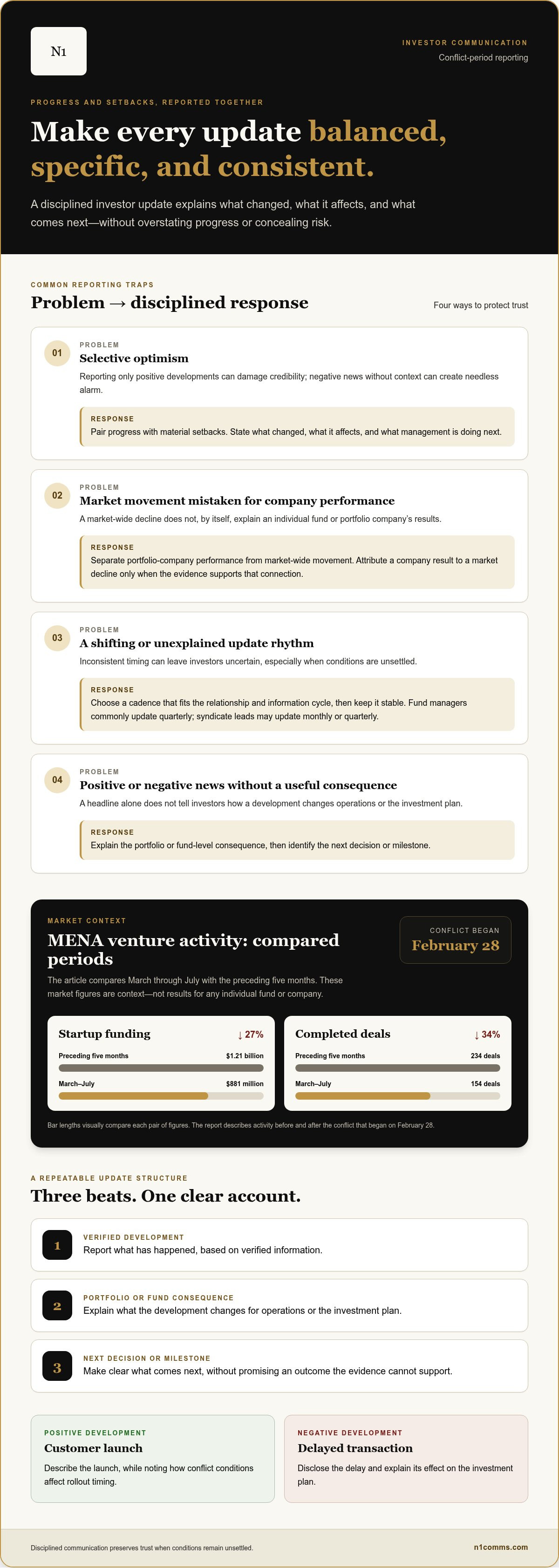
Investor updates should pair progress with material setbacks, applying the same reporting discipline to both. During conflict, selective optimism damages credibility, while bad news without context creates needless alarm. Separate portfolio-company performance from market-wide movement, then state what changed, what it affects, and what management is doing next. This gives limited partners a useful account rather than a polished narrative that conceals risk.
The MENA venture market illustrates why context matters. Startup funding declined by 27% from the five months preceding March through July to March through July. Transactions declined by 34% over those compared periods. Startups raised $881 million and completed 154 deals from March through July, compared with $1.21 billion and 234 deals in the preceding five months. The report compares conditions before and after the conflict that began on February 28. These figures describe market activity, not the results of any individual fund or company.
Build each update around a consistent sequence: report the verified development, explain its portfolio or fund-level consequence, then identify the next decision or milestone. A positive update might describe a customer launch while noting how conflict conditions affect rollout timing. A negative update might disclose a delayed transaction and explain its effect on the investment plan. Do not attribute a specific company result to a market decline unless the evidence supports that connection.
Keep the reporting cadence even when the news is difficult. Fund managers commonly send investor updates quarterly, while syndicate leads may update investors monthly or quarterly. Choose a cadence that fits the relationship and information cycle, then keep it stable. If a material development warrants an update between scheduled reports, explain the event and its implications without replacing the regular reporting rhythm.
- For positive news: state the achievement, its relevance to the investment thesis, and the evidence behind it.
- For negative news: describe the impact, mitigation underway, and the decision or information still outstanding.
- For market context: label external data clearly and separate it from company-specific performance.
Consistency matters more than a uniformly positive tone. A stable format lets investors compare progress, setbacks, and actions across reporting periods. Fundraise communications and investor narrative can help structure that account when a firm needs to explain performance and market conditions without blurring the distinction between them.
Before an update becomes public, align investor messaging with approved facts and the intended audience. This supports candor without turning a portfolio update into speculation or an unsupported fundraising claim.
What are best practices for crisis communications during armed conflicts for MENA investment firms and tech companies?
Effective crisis communication connects operational decisions to clear, consistent messages. For MENA firms, the system must cover employees, investors, portfolio companies, customers, and partners without treating them as one audience. Managers should communicate with investors consistently, regardless of how frequently they send updates. A reliable cadence reduces gaps between internal decisions and external understanding. Strong communications during conflicts for MENA-based investment firms and tech companies start with clear ownership.
Start with governance, not a press statement. Assign an executive decision owner, a communications lead, and operational contacts for affected portfolio companies. Define which developments trigger an update, who drafts it, and who approves its release. Keep a decision log recording the evidence considered, the message issued, and the next review point. This creates an accountable record as conditions change.
Conflict preparation should include thorough human rights due diligence and consultation with civil society. These activities help companies assess how operations, services, and business relationships affect people in conflict-affected settings. Translate findings into communication decisions: identify affected groups, explain relevant operational changes, and avoid claims that exceed the evidence. Consultation should inform the response, not substitute for action.
Technology and investment firms should test the operational systems behind their messages. Companies operating during conflict should assess whether they have conducted heightened human rights due diligence and take steps to strengthen infrastructure and services against unlawful access. If operations move to a new service provider, plan how contract terms will be monitored for compliance and enforced. A supplier change can affect service continuity and the accuracy of public statements.
Use a common factual core, then adapt the detail for each audience. Employees need direct operational guidance; investors need implications for strategy and portfolio exposure; customers need service information; partners need changes to responsibilities or delivery. Market entry also requires understanding customers and consumer behaviour in each market, then tailoring communication to local consumers. Translation alone does not create local relevance. Effective communications during conflicts for MENA-based investment firms and tech companies address these distinct audience needs.
- Before escalation: map stakeholders, decision owners, approval paths, and essential operating dependencies.
- During disruption: issue consistent investor updates and distinguish verified facts from operational assessments.
- After a decision: record its rationale, communicate affected changes, and set a review point.
Strong crisis communications are an operating discipline, not a single announcement. Firms that connect due diligence, stakeholder input, service resilience, and consistent investor communication can respond with greater control. Review the system after each material event, including supplier transitions and changes to portfolio operations. Update the message framework when facts, affected audiences, or operational decisions change.
What crisis communication channels and protocols work best when internet and mobile networks are disrupted?
No single channel is dependable during a network outage. Build a communication stack with a primary digital channel, a separate fallback, and an offline procedure. For example, an investment firm might use its secure messaging platform for routine updates, voice calls when data fails, and a printed contact tree for prolonged outages. Assign each channel a purpose before disruption begins.
Map who needs each message. Fund leadership may need decision-critical updates, while portfolio-company teams need operational instructions and investors need a clear status summary. Record approved contact details and message owners in an offline-accessible document. Keep a controlled copy with designated leaders, and establish a process for replacing outdated copies when personnel or responsibilities change.
Choose fallback channels based on the operating environment and the message’s sensitivity. Landlines may remain usable when mobile data fails; satellite phones or radios may serve as alternatives where available and appropriate. Establish who holds each device, how to reach them, and what information can be transmitted through that channel. Do not assume a channel is secure or available simply because it worked during a previous outage.
Define a simple protocol for every outage. The first message should identify the sender, intended recipients, time sent, and next expected contact point. Ask recipients to acknowledge receipt through a pre-agreed method. If they cannot, use the next channel in the sequence rather than sending repeated messages across every platform. This reduces confusion and helps prevent outdated instructions from circulating.
- Primary: use the organization’s established secure channel for routine internal coordination.
- Fallback: use an agreed voice or text method when the primary service fails.
- Offline: use printed contact trees and message templates when digital access is unavailable.
- Escalation: assign a decision owner to activate the next channel and record the transition.
Test the protocol with a tabletop outage exercise. For example, simulate a portfolio company losing mobile data during a scheduled investor update. Ask teams to retrieve offline contacts, send a concise status message, confirm receipt, and identify the authorized spokesperson. Record where delays or conflicting versions occur, then revise the contact tree and message sequence.
Keep messages brief and timestamped. State what is known, what action recipients should take, and when the next update will follow. If a communication cannot be verified or delivered safely, pause distribution until the appropriate channel and approval path are restored. The objective is controlled continuity, not maximum message volume.
How should companies verify conflict information and avoid spreading misinformation or propaganda?
Build a verification process before a conflict-related claim reaches investors, staff, or the public. Record the exact claim, its origin, when it was received, and which decision depends on it. For example, a message saying a portfolio site has closed must be distinguished from a report that the surrounding area is unsafe. Those claims require different evidence and responses.
Trace information to its original source. A screenshot of a social post is not the same as a direct statement from the organization involved. Check whether the source has direct access, whether the material is current, and whether its account has changed. For images or video, examine visible landmarks, dates, captions, and signs of editing. Old footage recirculated with a new location can distort an operational assessment.
Seek independent corroboration where possible. Compare the claim with direct communication from the affected company, on-the-ground staff, or other reliable records. Two accounts repeating the same unattributed post do not provide independent confirmation. Record what supports the claim, what conflicts with it, and what remains unresolved. Keep this evidence trail with the approval record.
- Origin: identify who first made the claim and how they know.
- Time and place: confirm when and where the reported event occurred.
- Corroboration: compare independent evidence and flag contradictions.
- Decision: state whether the claim is usable, needs qualification, or should not be shared.
Translation adds another verification layer. A translated statement can change certainty, attribution, or tone, especially when a phrase has no direct equivalent. Have a fluent reviewer compare the translated version with the original, then preserve the source text. Avoid compressing a nuanced statement into a headline that implies a stronger claim.
Match the evidence standard to the communication. Internal operational guidance can identify a report as unverified and limit distribution to decision-makers. A public statement needs a clear basis and careful wording. If the evidence supports only a limited fact, publish that fact without adding motive, blame, or a broader conclusion. Correct errors directly and preserve the correction alongside the original record.
For communications support, develop a disciplined crisis message grounded in verified facts, clear attribution, and controlled approvals.
Once a claim has been assessed, shape any communication around the people who must act on it. Private equity firms should tailor communications to portfolio-company stakeholders, giving executives detailed strategic insights and front-line employees practical operational information. Distinguishing these audiences makes verified information relevant to their needs, rather than giving everyone the same level of detail.
When a transaction is involved, private equity firms should explain how it may affect portfolio companies’ operations, ownership structure, governance, and business trajectory. During a merger, they should also communicate shared values and goals to address cultural-alignment concerns. Clear communication helps stakeholders understand the implications without presenting an uncertain report as settled fact. Keep messages grounded in verified information and avoid promising outcomes the evidence does not establish.
NarrativeOne: Fund Positioning
NarrativeOne helps investment firms align fund positioning with communications decisions after a conflict or market shock. When the investment thesis, portfolio conditions, or investor expectations shift, a coherent narrative gives stakeholders a consistent frame without obscuring material developments.
Fund positioning can clarify how a firm explains its strategy and role in the market. Portfolio announcements and LP communications support updates for companies and limited partners, while partner thought leadership gives senior leaders a disciplined way to address relevant market issues. Every message should reflect approved facts, audience needs, and confidentiality boundaries.
When the communication challenge extends beyond an isolated update, NarrativeOne can help structure the narrative across these touchpoints. To discuss fund positioning for your firm, visit n1comms.com.
Build the Communications System Before the Next Decision
Make communications during conflicts for MENA-based investment firms and technology companies part of operating governance, not an improvised response. Set ownership, approval authority, and escalation triggers before a difficult decision reaches the market. Then align each message with the firm’s investment thesis and the information stakeholders need to act.
NarrativeOne supports this work through Fund Positioning, Portfolio Announcements, and LP Communications. These offerings help firms maintain a coherent institutional narrative as portfolio conditions and investor expectations evolve. The objective is not to control every interpretation. It is to communicate precisely, preserve trust, and keep decisions grounded in an agreed account of the facts.
Use the next planning cycle to identify where messaging ownership or stakeholder alignment remains unclear. A defined framework gives leaders a stronger basis for responding under pressure and maintaining continuity across the fund and its portfolio.
Discuss your communications with NarrativeOne, and build a more deliberate foundation for the decisions ahead.
Frequently Asked Questions
What should an investor communication strategy look like?
Connect the fund’s investment thesis, portfolio developments, and investor expectations through a repeatable reporting framework. Set a regular reporting rhythm, then define which material events justify an additional update. For example, a portfolio company’s change in leadership may affect the investment case differently from a temporary operational interruption. Explain the relevance to the fund, distinguish fact from analysis, and make each update comparable with earlier reports.
Who should managers be communicating with?
Managers should identify everyone affected by a decision, not only limited partners. Relevant groups can include portfolio-company boards and executives, employees, customers, suppliers, co-investors, lenders, and public authorities. Prioritize recipients by the action or decision they need to make. For example, a supplier facing a changed delivery schedule needs practical instructions, while a co-investor may need the implications for shared governance. Keep audiences distinct so confidential details reach only appropriate recipients.
How do sanctions, export controls, and local regulations affect conflict-related communications in MENA?
They can shape what a company may disclose, which transactions it can discuss, and how it describes affected operations. The impact depends on the relevant jurisdictions, entities, counterparties, goods, technology, and communication audience. Before describing a transaction or service change publicly, map those factors with the organization’s compliance and legal reviewers. Keep operational facts distinct from legal conclusions, and avoid language that implies approval, permission, or a breach unless that characterization has been reviewed.