
Capital is not raised by product merit alone. Understanding how communications affect fundraising for tech companies starts with a clear principle: investors need to grasp the opportunity, the evidence behind it, and why the timing matters. Strategic communications make that case coherent across investor conversations, company announcements, and stakeholder updates.
Founders know that product strength, market timing, and execution shape investor decisions. But when the narrative is vague, inconsistent, or disconnected from the audience, those fundamentals become harder to assess. Communication cannot replace performance. It makes performance easier to understand.
This article explains how audience insight, timely messaging, digital storytelling, and stakeholder communications can support tech fundraising. It shows how to align the narrative with investor priorities, communicate milestones with purpose, and maintain credibility throughout the fundraising process. The distinction is simple: visibility is not the objective. Clearer conviction is.
Key Takeaways
- Map investor priorities before shaping the narrative, so messaging addresses the questions that influence confidence and capital decisions.
- Connect each update to a meaningful milestone or fundraising moment; consistency builds credibility, while untimely communication creates noise.
- Use digital storytelling to make the company’s opportunity, evidence, and progress clear across investor touchpoints.
- Align communication with the needs of founders, investors, limited partners, and other stakeholders while keeping the core narrative consistent.
- Choose channels based on audience behavior and the purpose of the message, then assess which touchpoints support stronger investor engagement.
1. Audience understanding and timely messaging
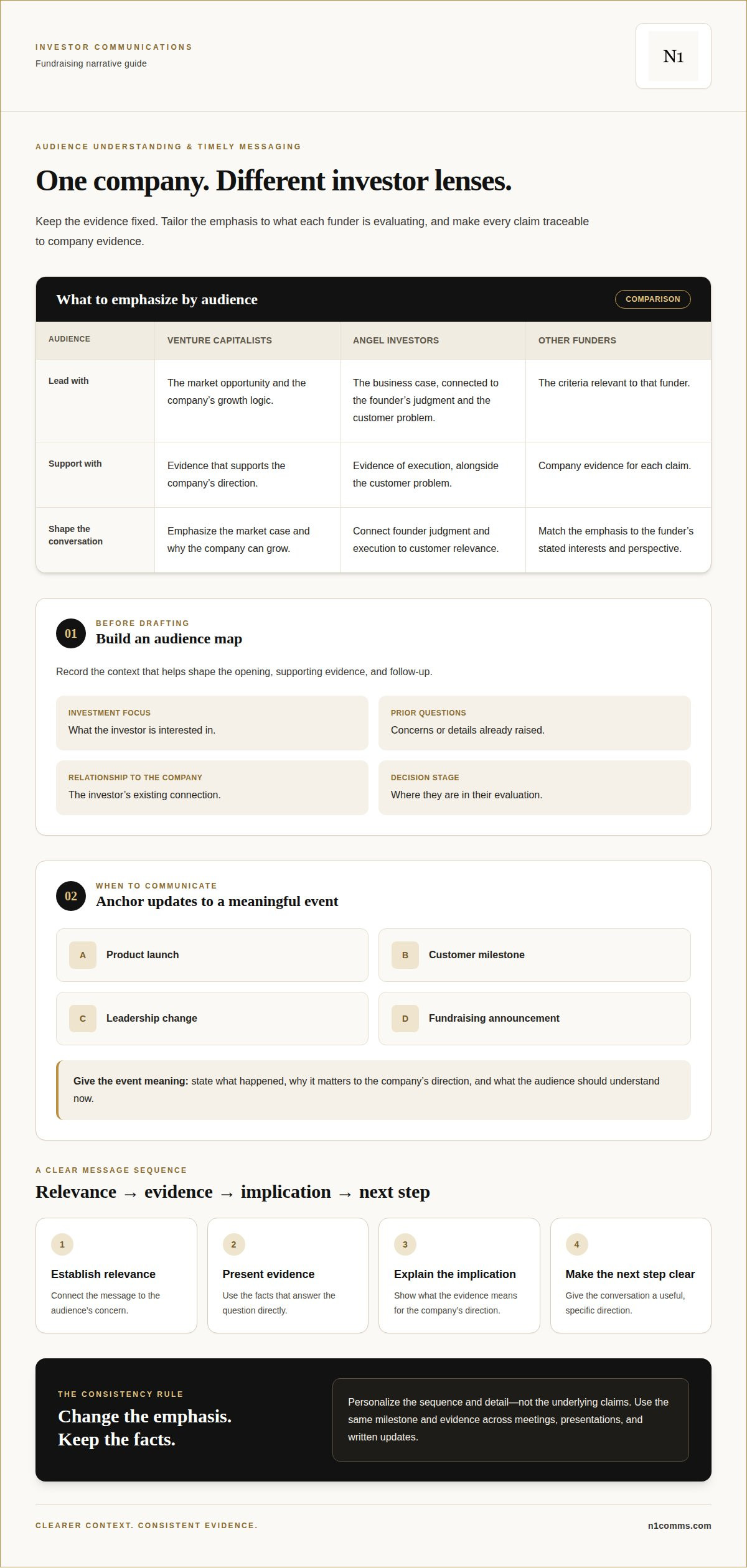
Understanding how communications affect fundraising for tech companies begins with a question: whose confidence must the next message earn? Venture capitalists, angel investors, strategic funders, and existing backers may assess the same company through different lenses. Keep the evidence fixed, but tailor the emphasis to each audience’s priorities.
Startups should tailor fundraising pitches by matching evidence to each funder’s stated interests and investment perspective. For venture capitalists, foreground the market opportunity, growth logic, and evidence supporting the company’s direction. For angel investors, connect the business case to the founder’s judgment, customer problem, and execution. For other funders, lead with their relevant criteria and support each claim with company evidence.
Build an audience map before drafting. Record each investor’s investment focus, prior questions, relationship to the company, and decision stage. Then identify the concern behind each conversation. One investor may need a clearer product use case; another may focus on the route to market. These differences should shape the opening, supporting evidence, and follow-up.
Personalization is not a license to create separate versions of reality. Keep core facts consistent across meetings, presentations, and written updates. Adjust the sequence and detail, not the underlying claims. A founder might explain a product milestone through customer relevance to one audience and market positioning to another, using the same milestone and evidence.
Timing matters because a message gains meaning from the event it explains. Connect outreach to a concrete development, such as a product launch, customer milestone, leadership change, or fundraising announcement. State what happened, why it matters to the company’s direction, and what the audience should understand now. Context turns an isolated update into evidence.
Use a simple sequence for each audience: establish relevance, present evidence, explain the implication, and make the next step clear. If a prospective investor asks about customer adoption, answer directly before adding broader company news. The practical answer to how communications affect fundraising for tech companies is audience-specific framing grounded in consistent facts.
Fundraising communication and relationship-building are different, too. Nonprofits use fundraising communications to solicit or acknowledge charitable contributions, while donor engagement builds relationships with current and potential supporters. Tech companies operate differently, but the example shows why repeated requests without useful context can weaken relationships. Share progress, decisions, and relevant efforts between funding conversations.
Review the audience map before outreach, update it after substantive conversations, and use recorded questions to shape the next message. This makes timing responsive rather than arbitrary. Ask whether the communication answers an investor concern, clarifies a development, or defines a useful next step. If it does none of these, revise it before sending.
2. Communications strategy and fundraising
A fundraising strategy needs more than a polished pitch deck. It needs a controlled sequence connecting the company’s claims, evidence, and investor conversations. Start by defining the round’s purpose, intended audience, and the decision each communication should support. A product milestone, for example, can support a funding discussion when founders explain its relevance to customer demand and company execution.
In the United States, securities laws and SEC rules relevant to fundraising communications depend on the offering structure and exemption. Keep public statements consistent with formal offering materials, and have qualified legal counsel review communications before distribution. Accuracy and consistency matter across a pitch deck, website, investor email, and public announcement.
Investors need traction data that makes the company’s operating position clear. Select metrics that reflect the business model, then define each measure and its reporting period. A software company might present recurring revenue alongside customer retention, product usage, and sales pipeline. A marketplace might emphasize transaction activity, repeat usage, and supply-demand balance. Pair each figure with context, a trend, and the decision it informs.
Do not present a metric without explaining its limits. If a pipeline figure includes early-stage prospects, label the stages clearly. If customer growth comes from a specific segment, identify that segment. Founders build credibility by using consistent definitions in every investor update and correcting errors directly. A short explanation of a missed milestone is stronger than silence or an unsupported claim of progress.
Trust also depends on cadence. Set a reasonable update rhythm, then share material developments between formal fundraising asks. An investor who receives only requests for money, without useful operating context, has little basis for evaluating progress. Tech fundraising is not charitable giving, but the contrast is instructive: a request alone rarely builds a durable relationship. Report decisions, progress, and setbacks with equal discipline.
Common mistakes include changing the company story between meetings, overstating traction, sending untargeted announcements, and treating every interaction as a direct ask. These errors create friction. Before sending an update, compare its claims with the latest deck, confirm that every metric has a defined basis, and make the next step explicit. For a coherent narrative across fundraising materials, fundraise communications and investor narrative can help align the company’s positioning with its evidence.
Keep messages clear and easy to act on. Communications can also be tied to specific programmes or time-sensitive needs, giving stakeholders a concrete reason to pay attention. Personalize the message to the recipient and invite a response. The article ranks in-person engagement above phone and digital communication. Choose the channel carefully, while keeping the substance consistent with the company’s claims.
Donor engagement can happen without a solicitation, while a solicitation is usually ineffective without engagement. Engaged donors are more likely to give repeatedly, and regular engagement can build credibility for fundraising efforts. For a company, the practical lesson is to offer useful context and listen between asks, rather than letting every contact become a request. That keeps communication relationship-led and gives supporters room to understand progress before deciding whether to contribute.
3. Digital storytelling for fundraising
A digital fundraising story must connect a company’s mission to evidence of execution. Start with the problem, identify who experiences it, and explain how the product changes that experience. Then show why the company can address the problem through its technology, team, and operating choices. This gives investors a logical route from need to opportunity, rather than a slogan without an investment case.
Build the story around a clear narrative spine: problem, solution, proof, and next milestone. For example, a software startup might describe how a manual customer workflow creates friction, demonstrate how the product simplifies it, and present a relevant usage example. Explain what the evidence demonstrates and what it does not. A customer example should illustrate product value, not imply results across every customer.
Digital storytelling works when each asset has a distinct role. A concise company overview establishes the category and opportunity. A product demonstration makes the user experience tangible. A founder interview can explain why the team understands the problem. A written milestone update can show how execution is progressing. Together, these formats give investors several ways to understand the same underlying company narrative.
Make evidence visible. A chart can show a business trend; a product screenshot can clarify a feature; a short customer example can explain a use case. Label each asset with context, such as the period measured, customer segment, or product stage. Never present a selected data point as the complete picture. Clear framing protects credibility and helps investors assess claims accurately.
Keep the story consistent across the company website, investor deck, founder posts, and fundraising announcements. The format can change, but the central claims should not. If a product launch introduces a new capability, update the overview and supporting materials together. That alignment prevents investors from seeing one description on the website and a conflicting account in a founder’s presentation.
Use digital channels to extend a conversation, not replace it. A founder can share a product milestone online, then use investor follow-up to explain its strategic relevance. A public post should provide enough context to stand alone, while direct communications can address a specific investor’s questions. This distinction keeps broader storytelling useful without turning every channel into a pitch.
Review each digital asset before publication. Identify its audience, main claim, supporting evidence, and intended next step. Check that the wording reflects the latest company materials and that examples have proper context. For a mission-driven technology company, connect the mission to the operating model rather than relying on aspiration alone. Digital storytelling supports fundraising when every format makes the opportunity clearer and the evidence easier to assess.
4. External stakeholder messaging
External messaging reaches more than prospective investors. Employees, customers, existing backers, board members, and commercial partners all interpret company updates. A funding announcement, for example, can reassure employees about strategic direction while prompting customers to ask about product continuity. Define each audience before drafting, then identify what the update means for them. One message can serve several groups, but its implications need deliberate framing.
During due diligence and investor negotiations, communicate precisely and consistently, and keep a clear record. Answer each investor question directly, support claims with the same evidence used in company materials, and promptly clarify changes or corrections. Keep negotiation-specific information within the appropriate investor discussions, and coordinate public statements with the company’s legal and leadership teams.
Use an audience-and-channel plan for every material update. An investor may need a detailed email; employees may need a leadership briefing; customers may need a product-focused notice. Tailor messaging to how each person engages at each touchpoint, rather than copying identical language across channels. Omnichannel communication works when the facts remain aligned and the format fits the audience.
Assign ownership before a message leaves the company. The founder can approve strategic framing, a product lead can validate technical details, and finance can check operating figures. For example, if a launch update describes a new capability, confirm that the product description matches what customers can actually use. Clear approval reduces contradictions between a public post and a private investor update.
Timing also shapes how stakeholders interpret a message. If a product delay affects a previously shared milestone, tell relevant investors and internal teams before they encounter conflicting information elsewhere. Explain what changed, the operational consequence, and the next decision point. A controlled update gives stakeholders a usable account; silence leaves them to infer the cause and impact.
Measure engagement by the response each communication is designed to elicit. An investor update might prompt follow-up questions, while a customer notice might generate requests for product details. Track those responses alongside the audience, channel, and message purpose. Use the pattern to refine later communications, not to inflate the apparent reach of a fundraising effort.
Close the loop after significant conversations. Record investor questions, assign an owner, and provide a response through the agreed channel. If several stakeholders raise the same concern, address it consistently in future materials. This creates a disciplined feedback cycle: listen, clarify, communicate, and document. External stakeholder messaging then supports fundraising through sustained engagement, not isolated announcements.
Omnichannel campaigns can carry this discipline forward by tailoring messaging to how a person engages at each touchpoint. Review whether the response shows that the chosen format made the next step clear, then adjust the approach for future updates while keeping the underlying facts consistent across audiences, reinforcing the trust that NarrativeOne helps technology companies build with every stakeholder.
5. Which communication channels are most effective for reaching technology investors?
No single channel reaches every technology investor effectively. Match the format to the relationship, message, and response required. Use a warm introduction or direct meeting to establish context, a concise email to share materials, and a focused follow-up to answer specific questions. Each channel has a role. None should carry the entire fundraising process.
Direct conversations work well when a founder needs to understand an investor’s priorities or explain a complex product. A meeting lets the founder respond directly to questions about the business model, technology, or market. Follow up by email with the relevant deck or data, rather than sending an unfiltered document package. The channel sequence should make the next investor decision easier.
Email is useful for setting meetings, sharing updates, and maintaining a clear written record. Give each message one purpose. For example, an investor update can report a product milestone, explain its business relevance, and invite a conversation about the next financing step. A subject line should identify the company and reason for contact. A long, general pitch can obscure the point.
Digital channels can extend a company’s reach, but public visibility is not the same as investor engagement. A founder post about a product launch may establish context before a direct conversation. A company website can provide a consistent reference point for the product, leadership, and current milestones. Keep public claims aligned with information shared privately, especially during active fundraising.
Physical mail can also create a deliberate touchpoint. A mailed invitation or survey may stand out to millennials and Gen X audiences amid heavy email volume. Use it when the format serves a specific purpose, such as inviting an investor to a briefing or gathering structured feedback. It should reinforce relevant outreach, not replace the follow-up that turns attention into dialogue.
Choose the channel by asking what the recipient needs to do next. A first introduction may call for a brief email. A technical question may need a founder conversation. A significant company milestone may warrant a coordinated announcement and investor update. Track responses by channel and message purpose, then use those patterns to refine future outreach. Do not mistake impressions or opens for meaningful investor progress.
Before sending, check that the recipient, channel, and content align. Confirm the message answers a relevant question, uses current company language, and gives a clear next step. For disciplined investor communications planning, align channel choices with the company’s fundraising narrative and stakeholder priorities.
NarrativeOne: Fund Positioning
NarrativeOne helps technology founders align fundraising communications with the investment case. Its Fund Positioning and Fundraise Communications & Investor Narrative offerings connect the fundraising story to the company’s evidence, audience, and strategic direction. Turn to this support when investor materials feel fragmented, key milestones lack context, or stakeholders hear inconsistent accounts of the opportunity.
For companies managing investor and portfolio communications, NarrativeOne also provides Portfolio Announcements, LP Communications, and Partner Thought Leadership. These services help maintain a coherent narrative across fundraising moments and ongoing stakeholder updates. The objective is disciplined communication, not visibility for its own sake.
Contact NarrativeOne to discuss your fundraising communications needs.
Build the next phase on a disciplined narrative
Understanding how communications affect fundraising for tech companies is a strategic starting point, not a one-time messaging exercise. As the company enters new markets, advances its product, or changes its capital requirements, its investment narrative must keep pace. Treat each major decision as an opportunity to reassess how the opportunity is framed and what evidence supports it.
Set a clear owner for narrative consistency across leadership, investor materials, and stakeholder updates. Then establish a review process that connects new developments to the company’s broader direction. This creates continuity without freezing the story. The strongest narrative evolves with the business while keeping its core claims precise.
NarrativeOne supports this work through Fund Positioning, Portfolio Announcements, and LP Communications. These offerings help investment firms and technology companies align their positioning with the communications stakeholders need.
Start the next phase with a focused conversation about your priorities. Contact NarrativeOne to discuss your communications. A disciplined narrative gives your company a stronger foundation for what comes next.
Frequently Asked Questions
How do communications influence investor decisions and fundraising outcomes for tech companies?
Communications influence how investors interpret a company’s opportunity, execution, and risks. For example, if a startup changes its sales strategy, a clear explanation of the decision and its rationale helps investors distinguish deliberate adaptation from operational confusion. Founders can prepare by linking each major claim to supporting evidence and assigning a clear spokesperson. Investors still assess the business itself; communication shapes how effectively they can evaluate it.
How do public relations and media coverage affect startup fundraising?
Public relations can put a startup’s milestones and market perspective in front of audiences beyond its existing investor network. Coverage of a product launch, funding round, or strategic partnership gives readers context to assess the company. It does not replace direct investor engagement or operating evidence. Before sharing an announcement, founders should align its claims with approved company materials and be ready to explain the milestone’s relevance in investor conversations.
How should startups communicate fundraising news to employees, customers, and partners?
Tailor fundraising news to what each stakeholder needs to understand. Employees may need clarity on priorities and how the capital supports execution; customers may care about product direction and continuity; partners may need to know whether plans or points of contact will change. Coordinate the timing and core facts across these communications. For example, brief employees before a public announcement so they can respond accurately to customer questions.