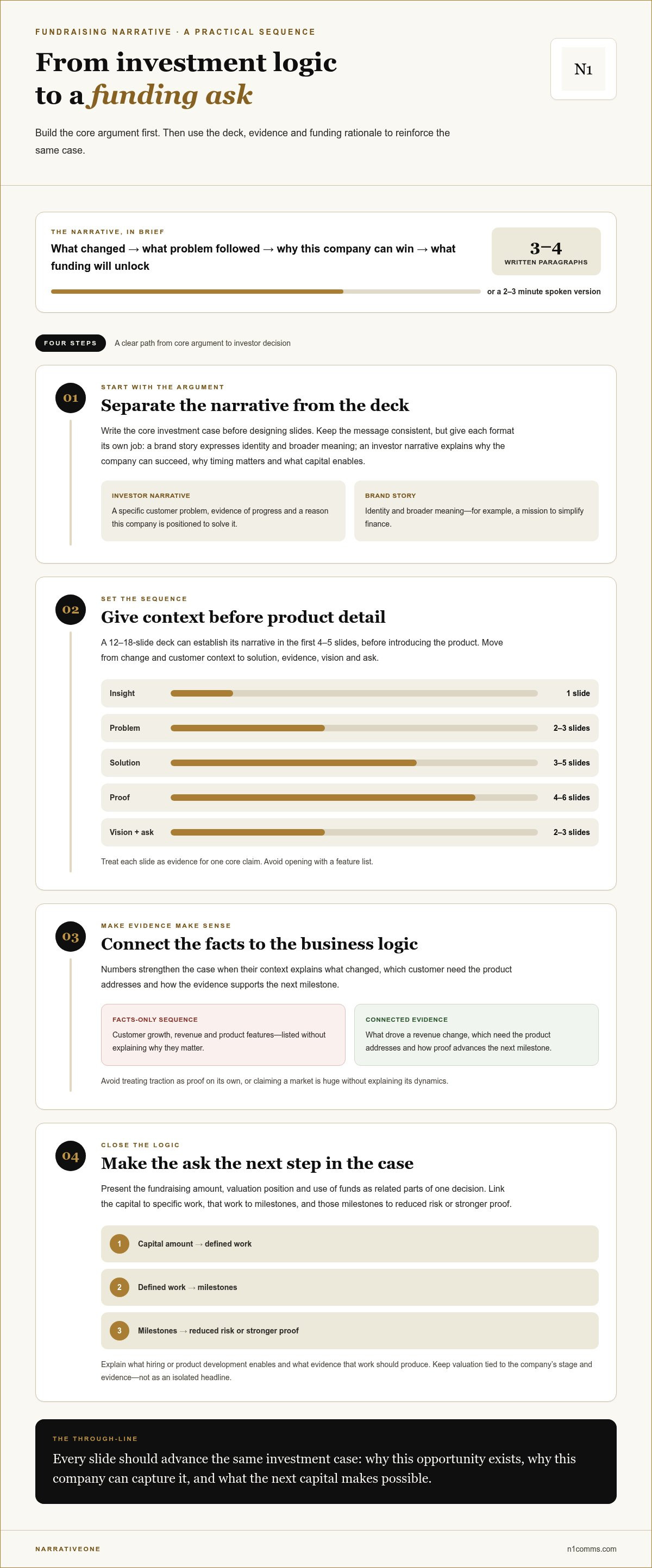
A fundraising narrative for fundraising rounds should fit into 3-4 tight written paragraphs or a 2-3 minute spoken explanation. A supporting deck can run 12-18 slides, but its length matters less than whether each slide advances the case. Investors need more than a polished story. They need to see why the opportunity exists now, why this company can win, and what new capital will make possible.
A clear narrative can still fall short when its timing is vague. “The market is growing” doesn’t explain what changed, why the opportunity exists now, or why the company is positioned to act. The “why now” argument should connect a market or technology shift to a real customer problem and evidence that the business can capture the opportunity.
This guide explains how to build that argument, choose the right level of detail, and adapt the emphasis for different investors without changing the underlying story. You’ll learn how to make the timing concrete, align the narrative with your deck and other fundraising materials, and test whether the logic holds when the slides are put aside. The goal isn’t a more dramatic pitch. It’s a more coherent investment case.
Key Takeaways
Separate the investment logic from the deck and brand story, then make each support the same central case.
Anchor “why now” in a specific market or technology shift and show how it changes the customer problem or opportunity.
Adapt the emphasis to each investor’s priorities without changing the company’s core claims or evidence.
Align your deck, spoken pitch, and supporting materials so each reinforces the same milestones, risks, and funding rationale.
Use investor questions to diagnose whether your case is clear and compelling, then refine the story without overstating the evidence.
Table of Contents
How long should my fundraising narrative be?
A strong investor narrative for fundraising rounds answers four questions: what changed, what problem followed, why this company can win, and what funding will unlock. It connects customer evidence, the solution, traction, team, and vision. The pitch deck presents that argument; it doesn’t replace it.
Build the story in 3-4 tight written paragraphs or a 2-3 minute spoken version. Use a specific customer problem, evidence of progress, and a clear reason the company is positioned to solve it. Each detail should advance investor conviction.
Explain the amount sought by linking the capital to defined work and milestones. Set out the valuation rationale in relation to the company’s stage and evidence, then show how each use of funds supports the next proof point. Keep the ask connected to the investment case.
Separate the narrative from the deck and brand story. Write the core argument in 3-4 paragraphs before designing slides. A brand story expresses identity and broader meaning; an investor narrative for fundraising rounds makes an investment case. It explains why the company can succeed, why timing matters, and what capital enables. For example, a brand story may emphasize a mission to simplify finance, while the investor case shows how a specific customer problem connects to a viable business opportunity. Keep the message consistent, but give each format its own job.
Sequence slides so context comes before product detail. A 12-18-slide deck can present its narrative in the first 4-5 slides, before introducing the product. Allocate 1 slide to the insight, 2-3 to the problem, 3-5 to the solution, 4-6 to proof, and 2-3 to vision and ask. Start with the change and customer context; then show the solution, evidence, and funding rationale. Treat each slide as evidence for one core claim. Don’t overload the opening slides with product features.
Replace a facts-only sequence with connected evidence. A facts-only pitch might list customer growth, revenue, and product features without explaining why they matter. An investor narrative for fundraising rounds explains what drove a change in revenue, which customer need the product addresses, and how the evidence supports the next milestone. Avoid opening with a feature list, claiming a market is huge without explaining its dynamics, or treating traction as proof on its own. Numbers strengthen the case when their context makes the business logic clear.
Make the ask the logical next step in the argument. Present the fundraising amount, valuation position, and use of funds as related parts of one decision. Connect the amount to specific work, that work to milestones, and those milestones to reduced risk or stronger proof. For example, explain what hiring or product development will enable, then identify the evidence that work should produce. Don’t present a valuation as an isolated headline or a budget as an unconnected list. The closing slides should reinforce conviction, not introduce new claims.
The market or technology shift behind a company’s “why now”
Answer “why now” by linking a market change to customer pain and a timely opening. Investors expect market-size and traction metrics suited to the business model and stage, with context showing what the numbers demonstrate.
Identify the Market or Technology Shift
Start by naming the change that makes the customer problem more urgent or newly solvable. Trace it to an observable shift within the past 3-5 years, such as a new technology, changed customer behavior, or altered market conditions. Then show how that shift affects purchasing, operations, or incumbent solutions.
For example, Series B FinTech CFOs may spend 40 hours per close reconciling three systems. Explain what has changed around those workflows, and why existing tools now leave a meaningful gap. Avoid presenting a broad trend as proof by itself; connect it directly to a customer’s decision or operating constraint.
Frame the Market Opportunity and Insight
State which customers face the problem, how often it occurs, and what prompts them to seek a different solution. Then explain the insight that changes your company’s position: perhaps an established workflow can now be automated, or a previously fragmented market can now be served through one system.
Define the opportunity in terms of reachable customers and how you’ll serve them. A huge market claim without specific market dynamics adds little. Show what drives demand, how the company can capture value, and what evidence supports that path. Distinguish the current opening from a general prediction about future growth.
Make timing causal, not decorative. Put the change, its consequence for customers, and the company’s response in sequence. For instance, a technology shift changes what customers can adopt; that shift exposes a costly process; the company offers a practical alternative. This lets investors assess why the opportunity exists now, rather than treating “now” as a slogan.
Then explain why the window matters. If competitors that fail to act could be disadvantaged within 18 months, identify the mechanism creating that pressure. Investors also want to know why the opportunity may not be obvious to everyone else in two years. Explain what has changed and what makes your team positioned to act.
Connect market claims to traction. Choose metrics that test the assumptions behind your opportunity case. Customer adoption, repeat usage, revenue movement, or progress in research and development may matter, depending on the business. Explain what caused a change in the numbers and what it establishes. A metric without context is a data point, not a market insight.
Finally, separate observed evidence from the next milestone. Show what customers already do, what the company has learned, and what further proof would strengthen the case. If your thesis depends on market adoption, make adoption visible. If it depends on technical feasibility, show progress toward proof of concept. This distinction makes the timing argument testable.
Should I change my narrative for different investors?
Keep the core case fixed, but adapt the emphasis to each investor’s interests. Present the business model, competitive advantage, and growth strategy as connected evidence, not separate claims.
Adjust Narrative Emphasis for Different Investors
Before each meeting, identify which part of the investment case matters most to that investor. If they focus on technical differentiation, foreground the mechanism behind your solution and the evidence for it. If they prioritize commercial progress, lead with customer adoption and how the business model captures value.
Change the order and depth, not the facts. Keep the market, traction, team, and funding rationale consistent across every pitch deck. Avoid presenting different versions of the company’s strategy to create artificial alignment. Tailoring should make the same case more relevant, not turn it into a new case.
Adapt Communication as the Startup Grows
Match the narrative to the company’s current stage and evidence. A pre-seed case addresses whether the team and thesis are viable. A seed narrative tests the product and early market validation. At Series A, explain the business model and whether growth is repeatable.
Series B and later rounds focus on scalability and capital efficiency. Show what becomes possible as the company scales, with evidence to support the case. Don’t claim a scale-up story before achieving product-market fit. An advanced growth narrative without operating evidence creates a credibility gap.
Translate the business model into investor logic. Explain who pays, what value they receive, and how delivery creates a durable business. Then connect the model to customer behavior and growth. For example, if a product serves a recurring operational need, show how customer use supports repeatable revenue rather than simply asserting that the model scales.
Define competitive advantage through a specific mechanism. It may rest on proprietary insight, customer access, execution, or another defensible edge. Explain why that advantage matters to the target customer and how it supports the company’s position. Avoid vague claims such as “better technology” without showing what changes for buyers.
Frame growth as a sequence of proof. Explain the next stage of expansion, the capabilities it requires, and the evidence that will show progress. For a Series A company, that may mean demonstrating a repeatable business model. For a later-stage company, it may mean showing how operations can scale while using capital efficiently.
Link the growth plan to the funding request. Investors should see how capital supports the plan, not encounter a broad ambition detached from execution. The pitch deck can shift emphasis for each meeting, but its milestones and claims must match the underlying strategy.
Use investor feedback to refine emphasis, not truth. Record which points prompt deeper questions and which cause confusion. If several investors ask how customer demand translates into revenue, clarify that connection in the next meeting. If questions move from understanding the model to assessing its risks, the explanation is advancing.
Review the narrative after each investor conversation. Update explanations when evidence or the company’s stage changes, and keep the core claims aligned. This discipline lets founders adapt their pitch deck without letting investor-specific edits fragment the company’s story.
Consistency across fundraising materials
Consistency means every investor-facing document supports the same operating case. Use one source of truth for claims, metrics, milestones, and the reason for raising.
Create a controlled narrative record. Keep the current thesis, approved metrics, milestone definitions, and funding rationale together. Record the date and owner for each update. For example, if the deck reports revenue for a particular period, the FAQ and founder talking points must use the same period and definition.
Separate verified results from management projections. Label each clearly in investor updates and presentation materials. If revenue increased, record the reason, such as a new customer segment or a change in pricing. That context prevents one slide from presenting a result as recurring while another describes it as a one-off.
Standardize answers to recurring investor questions. Build an FAQ bank with each question, its approved answer, supporting evidence, and any relevant caveat. Include topics such as customer concentration, sales efficiency, market assumptions, and use of funds. A founder and finance lead should be able to explain the same metric using the same definition.
Record questions after each meeting, then classify them as requests for clarification, risk questions, or requests for new evidence. If several investors misunderstand the revenue model, revise the explanation in the deck and FAQ together. Don’t change the underlying claim for each conversation.
Set a deliberate update cadence. Refresh materials when a material event changes the evidence, such as a new milestone, a revised forecast, or a change in customer behavior. Keep older versions accessible so the team can trace when a figure or claim changed. A dated version history helps prevent an outdated slide from resurfacing in a later meeting.
For ongoing investor communications, distinguish completed milestones from planned work. State what happened, what it means, and what comes next. If a forecast changes, explain the reason and update every document that relies on it. A silent edit creates conflicting records; a documented revision preserves the narrative’s logic.
Check the full materials stack before circulation. Compare the pitch deck, written narrative, financial model, FAQ, and investor update side by side. Confirm that customer definitions, reporting periods, milestones, and use-of-funds language align. For example, if the model assigns hiring costs to a growth milestone, the deck should explain that same connection.
Assign one owner to approve changes and notify everyone using the materials. Keep talking points in the same repository as the current deck, not in separate personal files. Consistency is an operating control: it lets founders adapt the emphasis without creating competing versions of the company’s case.
Why a fundraising narrative matters to investors
Investors assess more than numbers. A clear narrative helps them understand how the evidence, risks, and opportunity fit together. A well-built investor narrative for fundraising rounds makes those connections easier to assess and discuss.
Make the case easy to retain. Most fund partners hear dozens of company pitches but discuss only a handful. Your narrative helps an investor identify what makes this venture distinct and explain that distinction to colleagues. A list of features or metrics can be accurate yet forgettable. Connect each fact to a specific reason the company can win.
Use a simple test: can someone retell the case in three sentences without the slides? Those sentences should capture the customer problem, the company’s advantage, and the next value-creating milestone. If a listener remembers only the product category, the argument hasn’t established a distinct position.
Show how the elements support one another. Tie the problem, solution, market opportunity, traction, team, and vision into one investment case. For example, a customer pain point should lead naturally to the solution, while traction should show whether customers value it. Each connection lets investors judge the reasoning, not just the individual claims.
Make the founder’s choices clear, too. Investors want to understand why the team chose this problem, why it is suited to solve it, and why the timing works. A clear narrative explains those decisions with evidence and specific examples. It doesn’t ask conviction to substitute for proof.
Give traction its proper role. Metrics validate investor belief; they don’t make the entire case. Explain what drove a change in revenue, which customers contributed, and what the movement demonstrates about demand. If usage rises but revenue doesn’t, state what that difference means for the business model. Context turns numbers into evidence investors can evaluate.
Pair each important metric with its implication and limitation. For instance, customer growth may support a case for demand, while repeat purchases may provide evidence of retention. Investors can then assess how far the company has progressed and which risks remain. Precision builds credibility; unsupported certainty weakens it.
Use questions to diagnose clarity. Track whether investor questions move deeper into risk and execution or return to basic explanations. Repeated questions about the same business-model detail may signal that the narrative isn’t clear. Questions about customer concentration or repeatable sales show investors are examining the underlying case.
After each meeting, record the question, your answer, and the evidence used. If investors ask what caused a change in revenue, make that driver explicit in the next conversation. Preserve the underlying facts. Improve the explanation, not the claim.
Build conviction without hiding uncertainty. Investors can detect both overconfidence and excessive caution. Name the material weakness, explain its implications, and show how the company plans to address it. For example, if sales repeatability remains unproven, connect the funding plan to the work that will test the sales motion. Acknowledging the risk gives investors a basis for assessing the plan.
A strong narrative does not eliminate risk; it makes the decision logic visible. A disciplined investor narrative for fundraising rounds lays out the evidence, risks, and milestones without overstating the case. For teams aligning that logic across investor conversations, strengthen your fundraising narrative with a clear account of what the business can substantiate.
NarrativeOne: Fund Positioning
NarrativeOne helps investment firms clarify how their funds are positioned and communicated. When the fundraising case needs sharper structure, Fund Positioning and Fundraise Communications & Investor Narrative can align the fund’s central argument with investor conversations.
That work can continue beyond the raise. LP Communications supports clear communication with existing investors, while Partner Thought Leadership helps partners articulate their perspectives. The priority is coherence: each message should reinforce the fund’s position without obscuring the evidence behind it.
When your fund narrative needs clearer positioning or more consistent investor communications, contact NarrativeOne to discuss the next step.
Make the fundraising narrative an operating discipline
The next step is to keep the investment case useful beyond the pitch. Treat an investor narrative for fundraising rounds as a working framework: revisit it when company priorities change, and use it to keep leadership aligned on what the business is building and why. That discipline helps the story evolve with the company without losing its strategic center.
NarrativeOne’s Fund Positioning, Portfolio Announcements, and LP Communications support clear communication across fund and portfolio updates. If your fundraising story needs sharper structure or a stronger connection to ongoing investor communications, contact NarrativeOne to discuss your fundraising story.
A coherent case comes from deliberate decisions, not a sharper slogan. Keep refining the logic, align the people communicating it, and approach your next investor conversation with confidence.
Frequently Asked Questions
How Can Founders Build Long-Term Investor Relationships?
Build trust through relevant updates and reliable follow-through. After a meeting, send the materials or answer you promised, then record the investor’s stated interests and open questions. Future communication should connect company progress to those interests, not simply repeat a generic update. If an investor offers an introduction or advice, report what happened afterward. That closes the loop and makes the relationship useful beyond the immediate fundraising process.
How Can Founders Turn Investors into Active Supporters?
Give investors a specific, bounded way to help. Ask for an introduction to a clearly defined customer, a perspective on a hiring profile, or feedback on a market assumption. Explain why that contribution matters and what context the investor needs to act. Afterward, share the outcome and next step. A broad request to “help however you can” gives no clear action; a focused request makes support easier to provide.
How can founders communicate a missed target without creating unnecessary concern?
State the missed target plainly, explain the cause, and distinguish completed results from projections. Then describe the operational response, including which assumptions changed and how the team will monitor progress. For example, if customer conversion fell below plan, specify where the funnel weakened and what the team is adjusting. Don’t bury the variance in optimistic language or present a revised forecast as an achieved result.
How do I know if my narrative is working?
Look for progress in the quality of investor engagement, not just positive reactions. Track whether meetings lead to specific diligence requests, discussion of risks, or a defined next step. Note which parts of the explanation prompt follow-up and where investors ask for clarification. Compare those patterns across conversations. If interest stalls at the same point, investigate whether the evidence, framing, or fit with that investor’s mandate is limiting progress.
What Are the Biggest Investor Communication Mistakes?
Common mistakes include overstating certainty, using unexplained jargon, and avoiding direct answers about risk. Founders also weaken trust when they announce a milestone without clarifying what changed for customers or the business. Before sending an update, remove claims that cannot be supported and define unfamiliar terms in plain language. If a key assumption has shifted, explain the change and its implications instead of letting investors discover the discrepancy later.
How should the investor narrative differ by funding stage: pre-seed, seed, Series A, and later rounds?
Match the emphasis to the risk the round is designed to address. Pre-seed communication should make the team’s thesis and choice of problem credible; seed should center on product and early-market evidence. Series A should show whether the business model can support repeatable growth. Later rounds should explain scalability, capital efficiency, and what additional funding enables, using evidence appropriate to the company’s actual maturity.
Examples of effective investor narratives and fundraising pitch decks
An effective narrative links a market or technology shift to a specific customer problem, explains why the company can solve it, and shows what funding will unlock. For example, a company could explain how changing conditions expose a costly reconciliation problem for Series B FinTech CFOs, then present its solution, customer evidence, and milestones in a deck that builds from context to proof and the ask.
Frequently Asked Questions
How Can Founders Build Long-Term Investor Relationships?
Build trust through relevant updates and reliable follow-through. After a meeting, send the materials or answer you promised, then record the investor’s stated interests and open questions. Future communication should connect company progress to those interests, not simply repeat a generic update. If an investor offers an introduction or advice, report what happened afterward. That closes the loop and makes the relationship useful beyond the immediate fundraising process.
How Can Founders Turn Investors into Active Supporters?
Give investors a specific, bounded way to help. Ask for an introduction to a clearly defined customer, a perspective on a hiring profile, or feedback on a market assumption. Explain why that contribution matters and what context the investor needs to act. Afterward, share the outcome and next step. A broad request to “help however you can” gives no clear action; a focused request makes support easier to provide.
How can founders communicate a missed target without creating unnecessary concern?
State the missed target plainly, explain the cause, and distinguish completed results from projections. Then describe the operational response, including which assumptions changed and how the team will monitor progress. For example, if customer conversion fell below plan, specify where the funnel weakened and what the team is adjusting. Don’t bury the variance in optimistic language or present a revised forecast as an achieved result.
How do I know if my narrative is working?
Look for progress in the quality of investor engagement, not just positive reactions. Track whether meetings lead to specific diligence requests, discussion of risks, or a defined next step. Note which parts of the explanation prompt follow-up and where investors ask for clarification. Compare those patterns across conversations. If interest stalls at the same point, investigate whether the evidence, framing, or fit with that investor’s mandate is limiting progress.
What Are the Biggest Investor Communication Mistakes?
Common mistakes include overstating certainty, using unexplained jargon, and avoiding direct answers about risk. Founders also weaken trust when they announce a milestone without clarifying what changed for customers or the business. Before sending an update, remove claims that cannot be supported and define unfamiliar terms in plain language. If a key assumption has shifted, explain the change and its implications instead of letting investors discover the discrepancy later.
How should the investor narrative differ by funding stage: pre-seed, seed, Series A, and later rounds?
Match the emphasis to the risk the round is designed to address. Pre-seed communication should make the team’s thesis and choice of problem credible; seed should center on product and early-market evidence. Series A should show whether the business model can support repeatable growth. Later rounds should explain scalability, capital efficiency, and what additional funding enables, using evidence appropriate to the company’s actual maturity.