A press release is not a media relations programme. For a technology founder, tech founder media relations must turn a complex product into a clear, credible story and put that story in front of journalists who cover the subject. Broad distribution can create activity without useful coverage. Uncoordinated founder visibility can create a different problem: inconsistent messaging and avoidable reputational risk.
It’s reasonable to expect a partner to make your company easier to understand and your expertise easier to assess. The harder question is whether that partner has the seniority, discipline and controls to represent the business consistently, beyond a single announcement.
This guide sets out a practical framework for assessing strategy, seniority, execution and governance before you commit. You’ll see what a continuing programme should cover, how founder messaging can stay aligned across releases, interviews and thought leadership, and what a controlled process for journalist targeting, approvals and reporting looks like.
At NarrativeOne, the model is a twelve-month communications programme led by one senior operator. It includes native English and Arabic drafting and mandatory legal sign-off before releases reach journalists. The standard is not more noise. It’s a communications system built for clarity, relevance and control.
Key Takeaways
Anchor founder visibility to a defined business priority, such as credibility, recruiting, partnerships or investor interest.
Assess tech founder media relations by how well it connects narrative, journalist selection, approvals and performance reporting.
Look for tailored pitches built around a journalist’s focus, not identical releases sent to broad contact lists.
Prepare by clarifying the objective, assembling supporting evidence, selecting a spokesperson and establishing internal approval readiness.
Distinguish a clear, accountable operating model from one where ownership and handoffs are difficult to see.
Table of Contents
Why tech founder media relations must serve a business objective
What a disciplined tech founder media relations programme includes
Why tech founder media relations must serve a business objective
Founder media relations is planned communication with relevant journalists to explain a company, its market and its leadership. It can create opportunities for credible coverage, but it cannot guarantee publication or produce a business outcome on its own. As Understanding Media Relations makes clear, media relations is a distinct communications discipline, not a synonym for every public-facing activity.
That distinction matters. A story may earn attention; credibility, recruiting, partnerships and investor interest depend on how audiences interpret it and what the company does next. Tech founder media relations should therefore be designed around an intended change in understanding or confidence, not a promise of coverage.
Start with the business objective, not the headline
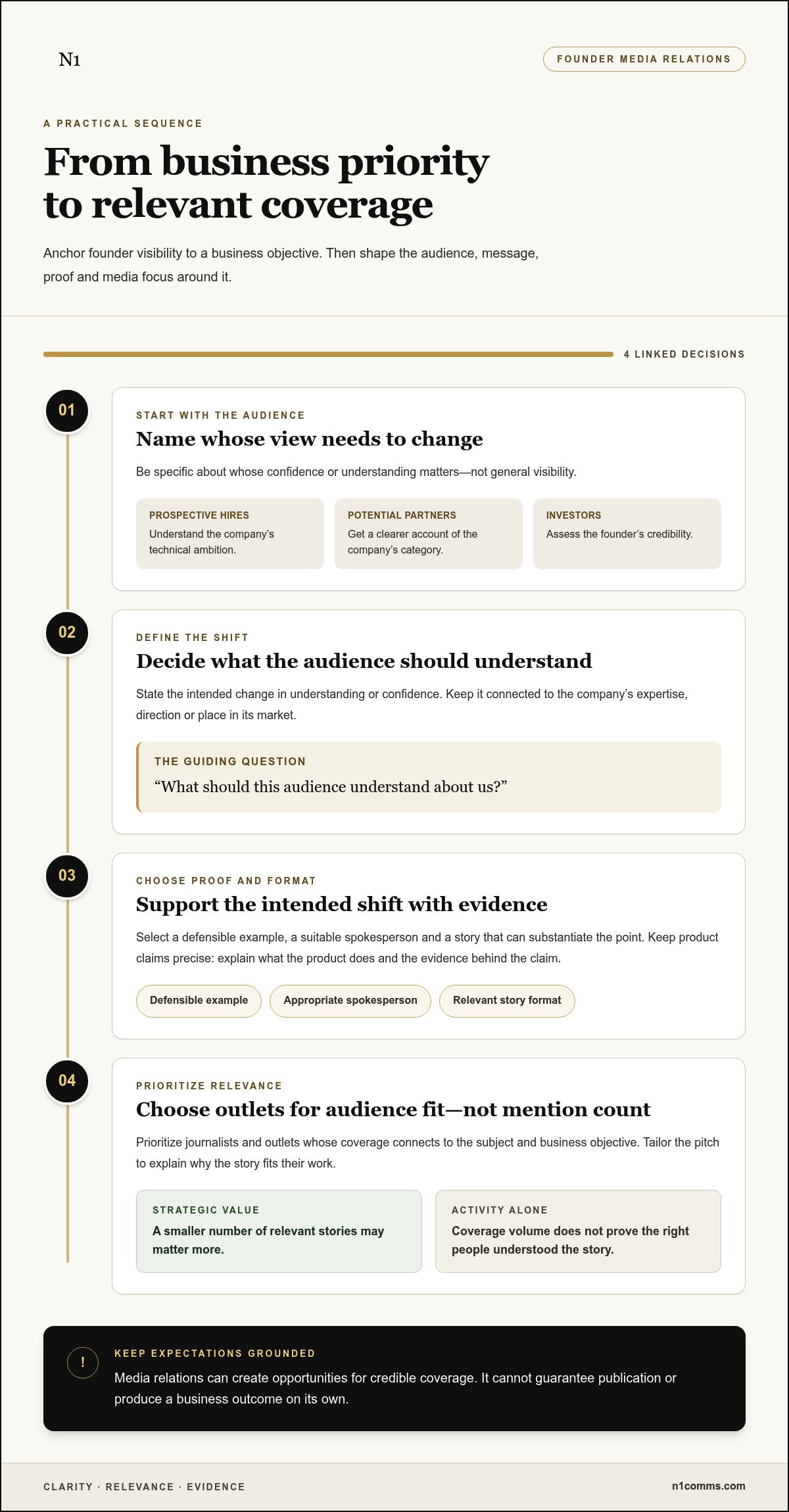
Before shaping a pitch, identify whose view needs to change. Is the priority helping prospective hires understand the company’s technical ambition? Giving potential partners a clearer account of its category? Establishing the founder’s credibility with investors? Each objective points to a different audience, proof point and editorial angle.
Use this sequence to keep the work anchored:
Name the audience. Specify whose confidence or understanding matters, rather than aiming for general visibility.
Define the shift. State what that audience should understand about the company, its expertise or its direction.
Choose evidence and format. Select a defensible example, spokesperson and story that can support the intended shift.
Set relevance before reach. Prioritise outlets whose audiences connect to the objective, not a high count of mentions.
This discipline changes how success is assessed. Coverage volume is an activity measure, not proof that the right people understood the story or acted on it. A smaller number of relevant stories may have more strategic value than broad exposure with no clear connection to the business priority.
Identify when founder visibility is strategically useful
Founder visibility is useful when the founder can explain something the company account cannot: why a category matters, what expertise informs a product decision, or how the company’s direction responds to a real market need. It can support credibility or recruiting when the founder’s perspective provides evidence and context, rather than simply repeating a corporate announcement.
Separate two kinds of opportunity. Sustained authority-building develops a consistent point of view across interviews and thought leadership. Milestone-led news ties a specific development to a timely, verifiable story. A fundraising announcement may provide a news moment; it does not, by itself, establish a durable founder narrative.
To build authority over time, keep the founder’s core ideas consistent while applying them to new, relevant questions. The thought leadership framework for VC partners explores how a focused point of view can compound through continued use. The principle applies to founders too: each appearance should reinforce a coherent account of the company, not reset it.
Set the objective first. Then decide whether media attention is the right instrument. That is the difference between a headline-driven push and a communications strategy with a business purpose.
What a disciplined tech founder media relations programme includes
A media relations programme is a repeatable workflow that turns a clear company narrative into relevant journalist engagement, reviewed communications and evidence-led reporting. It creates structure around the work. It does not guarantee coverage.
For tech founder media relations, that workflow should connect each stage rather than treat outreach as a standalone task. Narrative definition informs journalist selection. Selection shapes the pitch and supporting evidence. Drafting moves through approval before distribution. Monitoring then shows what happened and helps determine what to adjust next.
Build the narrative and the evidence before outreach
Start with the founder’s central argument: what should the audience understand about the company, its category or its direction? Support that argument with specific, defensible proof. A technical product claim, for example, should explain what the product does and the evidence behind the claim, without implying capabilities it doesn’t have.
Keep three layers distinct: the company’s enduring narrative, the founder’s perspective and the facts of a particular announcement. A product launch can provide a timely reason to approach journalists; it shouldn’t be forced to carry every part of the company story. This separation keeps a release precise while giving interviews and thought leadership a consistent foundation.
Journalist selection follows the story, not the other way around. Identify reporters whose coverage connects to the subject and intended audience, then tailor the pitch to explain why the story is relevant to their work. An identical release sent to a large contact list may generate distribution activity, but it doesn’t demonstrate that the story fits each recipient.
Make language and approval part of the workflow
Bilingual communications require more than converting an approved draft from one language to another. English and Arabic materials should be drafted natively for their respective audiences, with each pitch shaped around its audience and editorial context. The core facts remain aligned. The framing can differ where clarity and relevance require it.
Governance sits before distribution. A compliance-officer workflow should include mandatory legal sign-off before a release reaches journalists. The approval process should identify who reviews the draft and what evidence supports its claims. The control is clear: review first, distribute only after sign-off.
After distribution, monitoring should record meaningful activity: which journalists engaged, what coverage appeared, whether key messages were represented accurately and what follow-up is warranted. Reporting turns those observations into decisions about future angles, timing and targeting. It should distinguish completed activity from outcomes the programme cannot control.
A continuing programme needs this full operating chain, not just a release and a send list. Founders assessing how that work fits into a broader communications structure can review Narrative One’s communications approach.
How to evaluate a tech founder media relations partner
A credible partner should make ownership visible. You need to know who shapes the narrative, decides which journalists matter, controls approvals and interprets results. In tech founder media relations, seniority is not a title on a proposal. It is the person making consequential decisions and remaining accountable for execution.
Use the comparison below to assess how an operating model works in practice, not just what services it names.
Evaluation areaDisciplined operating standardOwnership and seniorityA named senior operator leads strategy, makes editorial judgements and remains accountable through execution. Handoffs and junior layers are explicit, not hidden.Journalist targetingOutreach is shaped around each journalist’s coverage and the story’s relevance, rather than relying on an undifferentiated contact list.Bilingual executionEnglish and Arabic content is drafted natively for each audience, with consistent facts and audience-specific framing.GovernanceApproval responsibilities are defined, with mandatory legal sign-off before a release reaches journalists.ReportingReports connect planned activity, journalist response and coverage to learning that can inform future decisions.
Assess seniority, targeting and accountability
Establish who makes the judgement calls. Who decides whether a founder’s perspective is stronger than a company announcement? Who assesses timing and journalist relevance? A clear operating model gives those decisions an owner. A model with unclear handoffs can separate strategy from delivery, leaving the founder unsure who is accountable when priorities change.
Look for a reporting chain that distinguishes inputs from outcomes: what was pitched, which journalists responded, what coverage appeared and what the team learned. A mention count alone is not a performance system. Useful reporting explains whether the intended message landed and what should change in the next cycle. Claims about coverage or business impact are evidence to examine, not guarantees of future results.
Test for bilingual and compliance capability
Bilingual execution should reflect editorial judgement in both languages, not a translated version of one master draft. Governance should be equally concrete. Legal review belongs before distribution, not after a concern surfaces. The workflow must also preserve the founder’s credibility by grounding claims in supportable facts and avoiding language that overstates product capabilities.
Leadership alignment matters because media statements must hold across the founder, company and other spokespeople. The executive communications strategy framework connects that alignment to a broader communications structure. Narrative One’s model places one senior operator across its twelve-month programme, with no junior layers. The test is simple: can the person accountable for the strategy explain how each decision will be made, governed and assessed?
How founders can prepare for effective media relations
Preparation starts inside the company, before a narrative is drafted or a journalist is approached. For tech founder media relations, the founder’s job is to establish what the business can say with confidence, who can say it and what the communications effort should help the company achieve. A concise readiness sequence makes that work concrete.
Prepare the founder narrative and supporting evidence
Begin with the company’s central claim and why it matters to the intended audience. Then assemble the evidence behind it: milestone records, product documentation and relevant founder experience. Separate substantiated facts from interpretation. Flag any statement that could affect legal, compliance or reputational risk for review before external use. Precision strengthens the story; unsupported certainty weakens it.
Set the business objective. Identify what the company needs communications to support, then name the audience whose understanding or confidence matters.
Write the central claim. In a few sentences, explain what the company does, what problem it addresses and why its approach is relevant. Avoid internal shorthand.
Gather proof. Collect evidence for milestones, product statements and founder expertise. Note the source and context for each claim so it can be checked before use.
Mark sensitive statements. Flag claims involving performance, financial matters, customers or other areas that need legal or compliance review. Don’t treat a draft as approved simply because the facts seem familiar.
Choose the spokesperson. Decide who can speak to the company’s direction, technical detail and public commitments. Make sure each person understands the boundaries of their role.
Agree what to learn. Identify the audiences, themes and media activity worth monitoring. Set expectations around what can be measured, while distinguishing activity and coverage from business results.
Set decision rights and measurement expectations
Before outreach begins, establish who approves statements and who is authorised to speak for the company. Decide how questions outside an agreed spokesperson’s remit will be handled. This prevents conflicting answers when an interview moves beyond prepared points. Founders should also clarify which themes need ongoing attention, such as how the company’s category is understood or how its expertise is represented.
Use this final readiness check: Is the core claim clear? Can the team support each factual statement? Are sensitive claims flagged? Are spokespersons and approvers identified? Does the company know which audiences and themes it wants to monitor? Resolve gaps before communications move into drafting or journalist engagement.
With those inputs in place, narrative development can proceed from evidence rather than assumption. Explore Narrative One’s communications approach to see how founder communications can be structured as a continuing programme.
Narrative One’s approach to tech founder media relations
Narrative One treats tech founder media relations as a continuing communications programme, not a one-off project built around the next announcement. The twelve-month programme connects narrative development, founder positioning, media relations, bilingual content, monitoring and reporting. Each component supports the same operating objective: a clear, credible account of the company that can be carried consistently into relevant media conversations.
From narrative foundation to media execution
The programme begins with narrative definition. The stated timeframe is 6-8 weeks to define the narrative, giving the work a foundation before it moves into external execution. Founder positioning and company messaging are developed as connected parts of that foundation, so an announcement, interview or thought leadership opportunity reinforces the same core account rather than introducing a new one.
Drafting, review and distribution follow in a stated three-week period. English and Arabic releases are drafted simultaneously for their respective audiences, not translated from one finished version. The facts remain aligned while the language and pitch are shaped for each audience. Journalists are selected and pitched individually according to their coverage, rather than treating distribution as a volume exercise.
Governance is built into the sequence. A compliance-officer workflow includes mandatory legal sign-off before a release reaches journalists. That is a pre-distribution control, not a corrective step after a concern has surfaced. It helps keep external claims aligned with approved facts and protects the consistency of the founder’s public messaging.
A senior-led programme with measurable operating discipline
One senior operator leads the programme, with no junior layers between strategic decisions and execution. That model gives the founder a clear point of accountability across narrative work, journalist engagement and communications output. It also draws on the founder’s 17 years of experience building companies, running accelerators and leading communications, experience that informs the operating perspective behind the programme.
Monitoring and reporting are part of the ongoing work, supported through the Narrative One platform. They provide a structured view of communications activity and journalist response, helping inform future decisions. Reporting does not turn media coverage into a promise of business impact. It makes the work visible, supports learning over time and distinguishes execution from outcomes that no communications programme can guarantee.
The track record includes 200+ startup milestones announced and placed and $1 B+ total valuation impact. These figures describe past work; they are not a forecast or guarantee for a new company. They offer context for assessing experience, while the programme’s structure explains how that experience is applied: narrative first, audience-specific execution, approval before distribution and continued monitoring.
For founders seeking a structured approach to positioning and media engagement, discuss a Narrative One programme.
Build a communications system that can grow with the company
The next step is not to manufacture a headline. It is to decide what your company needs audiences to understand, then build a communications discipline that can carry that understanding forward as the business evolves. That calls for a narrative grounded in evidence, clear decision rights and a programme measured by relevant learning, not promises of coverage.
Narrative One’s track record includes startup milestones announced and placed and valuation impact. Forbes Middle East named Tarek Fouad among the Middle East’s Most Influential CMOs in 2026. These are credentials, not a forecast of what another company will achieve. The operating question remains whether the approach fits your priorities and supports consistent founder communication.
Make the next decision deliberately. If your company is ready to develop a sustained approach to tech founder media relations, discuss a Narrative One communications programme. A clear starting point can help turn founder visibility into a disciplined asset for the company’s next stage.
Frequently Asked Questions
What does tech founder media relations include?
Tech founder media relations includes the strategic work that helps journalists understand a company and its founder. That can involve shaping the founder’s public narrative, identifying timely story opportunities, preparing spokespeople, developing media materials, coordinating approvals and reviewing journalist response. For example, a founder explaining a technical category may need a different set of proof points than one announcing a company milestone. The right mix depends on the company’s objective and audience.
How is founder media relations different from a press release?
A press release is one communication asset; founder media relations is the broader effort that determines whether and how it should be used. A release may announce a product milestone, while the surrounding work prepares the founder to explain its relevance, respond to questions and maintain a consistent position afterward. This distinction matters when journalists need context beyond the announcement. A document can state facts, but it cannot substitute for spokesperson judgement.
When should a tech founder hire media relations support?
Bring in support when the company has a meaningful story to explain and needs a deliberate way to reach the people who matter. A funding announcement, a shift in company direction, entry into a new category or a complex product launch can all create communications demands. Support is also useful when the founder’s public comments need greater consistency. Start before a high-stakes moment, so messaging and evidence aren’t assembled under deadline pressure.
How can founders assess whether media relations is working?
Assess it against the purpose established at the outset, not a raw tally of mentions. Track what was communicated, which journalists engaged, what coverage appeared and whether the central point was represented accurately. Then record what the response suggests about audience understanding and future story angles. For example, repeated questions about the same product concept may signal that the explanation needs refinement. Coverage and commercial results are related possibilities, not guaranteed outcomes.
Should a tech startup use bilingual media relations?
Use bilingual media relations when the company needs to communicate with audiences who work in both English and Arabic. The decision should follow audience relevance, not a desire to duplicate every item in two languages. Consider where customers, investors, partners or journalists need information, and whether each audience requires a distinct framing. Native drafting helps avoid treating one language as an afterthought and allows each version to communicate clearly in its own context.
How long does it take to develop a founder media relations programme?
For Narrative One’s programme, the stated planning sequence is 6-8 weeks to define the narrative, followed by 3 weeks to draft, review and distribute. Those are the setup stages, not the full duration of the engagement: the communications programme runs for twelve months. The sequence allows narrative work to precede external materials and outreach. Timing for a particular announcement should be planned around its facts, approvals and relevant media opportunity.
Frequently Asked Questions
What does tech founder media relations include?
Tech founder media relations includes the strategic work that helps journalists understand a company and its founder. That can involve shaping the founder’s public narrative, identifying timely story opportunities, preparing spokespeople, developing media materials, coordinating approvals and reviewing journalist response. For example, a founder explaining a technical category may need a different set of proof points than one announcing a company milestone. The right mix depends on the company’s objective and audience.
How is founder media relations different from a press release?
A press release is one communication asset; founder media relations is the broader effort that determines whether and how it should be used. A release may announce a product milestone, while the surrounding work prepares the founder to explain its relevance, respond to questions and maintain a consistent position afterward. This distinction matters when journalists need context beyond the announcement. A document can state facts, but it cannot substitute for spokesperson judgement.
When should a tech founder hire media relations support?
Bring in support when the company has a meaningful story to explain and needs a deliberate way to reach the people who matter. A funding announcement, a shift in company direction, entry into a new category or a complex product launch can all create communications demands. Support is also useful when the founder’s public comments need greater consistency. Start before a high-stakes moment, so messaging and evidence aren’t assembled under deadline pressure.
How can founders assess whether media relations is working?
Assess it against the purpose established at the outset, not a raw tally of mentions. Track what was communicated, which journalists engaged, what coverage appeared and whether the central point was represented accurately. Then record what the response suggests about audience understanding and future story angles. For example, repeated questions about the same product concept may signal that the explanation needs refinement. Coverage and commercial results are related possibilities, not guaranteed outcomes.
Should a tech startup use bilingual media relations?
Use bilingual media relations when the company needs to communicate with audiences who work in both English and Arabic. The decision should follow audience relevance, not a desire to duplicate every item in two languages. Consider where customers, investors, partners or journalists need information, and whether each audience requires a distinct framing. Native drafting helps avoid treating one language as an afterthought and allows each version to communicate clearly in its own context.
How long does it take to develop a founder media relations programme?
For Narrative One’s programme, the stated planning sequence is 6–8 weeks to define the narrative, followed by 3 weeks to draft, review and distribute. Those are the setup stages, not the full duration of the engagement: the communications programme runs for twelve months. The sequence allows narrative work to precede external materials and outreach. Timing for a particular announcement should be planned around its facts, approvals and relevant media opportunity.